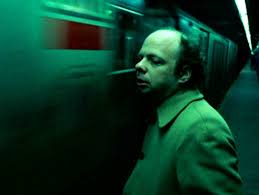
On the Film “My Dinner with Andre” Part I: Wally in New York

Note: Opening a multi-part early series from my first blog Classical Sympathies back in 2009, this piece takes up the beginning of Wallace Shawn’s walk through New York en route to his meeting with André Gregory in My Dinner with Andre, using Wally’s voice-over as a lens on artistic precarity, everyday survival, and the comic disproportion between existential weight and mundane errands. The note situates the film’s opening movement as both narrative setup and philosophical framing: a winter city of post offices, xerox shops, and unanswered calls becomes the psychological prelude to a conversation that will later expand into memory, performance, and self-mythology. This installment follows Wally up to his arrival at the restaurant for the pre-dinner drink, where the film’s central encounter is still suspended in anticipation, and meaning is generated less by action than by the act of getting there.

My Dinner with Andre is the famous, or infamous, 1981 film of a dinner conversation between Wallace Shawn, the actor and playwright, and Andre Gregory, the theater director. If I were to make a twofold claim for the film: i) that it is one of the most action packed films ever made, and ii) that it effectively encapsulates the thematics of the entire 20th century, I do not think this would be overstatement. My intent here, however, is not to establish either of these postulates, but rather to simply “blog” the script in the hopes that what needs to be said works its way to the surface. Fair warning: the undertaking will require several posts.

Money crops up on two of the first three pages of the script, and because money, and the lack of it, is a theme that runs beneath the entire script: Andre has money, has the freedom to travel and to spend several years trying to “find himself”; Wally does not. Still, “having money” is, as ever, a relative concept. At the opening of the film, Wally is seen walking through the streets of New York, heading for the restaurant where he is to meet Andre. It appears to be winter, maybe February. In the opening voice-over, Wally ruminates on the life of the artist: The life of a playwright is tough. It’s not easy, as some people seem to think. You work hard writing plays, and nobody puts them on. You take up other lines of work to try to make a living–acting, in my case–and people don’t hire you. So you spend your days crossing the city back and forth doing the errands of your trade. Today wasn’t any easier than any other day. I’d had to be up by ten to make some important phone calls, then I’d gone to the stationary store to buy envelopes, and then to the xerox shop. There were dozens of things to do. By five o’clock I’d finally made it to the post office and mailed off several copies of my plays, meanwhile checking constantly with my answering service to see if my agent had called with any acting work. In the morning, the mailbox had been stuffed with bills. What was I supposed to do? How was I supposed to pay them? After all, I was doing my best (17).

One of the marvelous things about the film is the tongue-in-cheek humor that is rarely, if ever, directly alluded to. A deeply serious film, Andre is also a comedy, a fact which we can recognize because we see that the writers are having fun with the characters who are in turn themselves. That is, Wally and Andre are playing versions of themselves–we assume that most of the experiences that Andre recounts in the film are based on real experiences, and that Wally’s account of his home life is more or less true to life–but exaggerated versions. As Shawn says in the preface to the script, “I knew immediately that {…} I’d have to distort us both slightly–our conflicts would have to become sharpened–we’d have to become–well–characters {…} It would be an enormously elaborate piece of construction” (14). In this initial passage, the humor lies in Wally’s conception of a difficult life: “I’d had to be up by ten to make some important phone calls.”

Wally’s sense of pressure is, from the outset, deliberately out of proportion to the scale of his circumstances. The tone is one of genuine complaint, but the complaint itself is almost comically domestic: the architecture of a “hard day” is built out of errands, envelopes, xerox shops, and an answering service that may or may not contain salvation in the form of an acting job. What Shawn achieves here, and what the film quietly sustains, is a recalibration of seriousness—where existential weight is not attached to grand events but to the texture of administrative survival. Wally’s New York is not a place of romance or revelation, but of circulation: between post office, mailbox, and telephone, as though modern artistic life has been reduced to a loop of deferred contact with recognition.

At the same time, the humor is never fully separable from sincerity. Wally is not merely being mocked; he is also articulating a recognisable condition of artistic precarity, one that the film refuses to glamorize. The genius of the opening monologue lies in this double register: we are invited to laugh at the disproportion between emotional tone and material fact, but we are also made to recognise how easily that disproportion becomes a lived reality. The “dozens of things to do” are not nothing; they are just insufficiently legible as crisis, which is precisely what makes them feel like crisis.

By the time Wally finally moves through the city toward the restaurant, the structure of the film has already been quietly established: this is a world in which meaning is not delivered through events but through the way events are narrated to oneself while walking between obligations. New York, in this sense, is not a backdrop but a medium of self-composition—an environment in which thought is constantly being assembled under mild pressure, as though consciousness itself were an errand.

He checks the time again, as he has been doing throughout the afternoon, and adjusts his route slightly, not out of urgency so much as orientation. The meeting with André already exists in his mind as something slightly unreal, a fixed appointment that has not yet been granted substance by arrival. He crosses another block, passes into the thinning evening light, and begins to approach the restaurant where, for the first time that day, the structure of waiting will shift from solitary to shared.

to be continued…

On Subcultures and Scenes in Craig Finn’s “It’s Never Been a Fair Fight”

New Note: It has been a little while since I last posted this piece, and I’m glad to bring it back into view. It remains my very favorite essay on the Kyoto Kibbitzer, and has continued to circulate far beyond what I ever expected, with many hundreds of reads over time. In an entirely unscientific but pleasingly persistent corner of the internet, it still seems to rank #2 in search results for the term “Katie Park Bad Moves,” just behind Wikipedia, which is pretty cool. I have no idea what to make of that, but I’m not complaining.

The piece itself—on Craig Finn’s “It’s Never Been a Fair Fight”—has always felt to me like one of the most complete things I’ve written about music, scenes, and subcultures, and I’m grateful for the continued readership and responses it has received. Reposting here in full for anyone who missed it the first time around, or wants to revisit it.

Original Note: This piece is about an absolutely amazing song by Craig Finn called “It’s Never Been a Fair Fight” released in 2020 on All These Perfect Crosses from Partisan Records. We will also expand on the song’s theme, which is how subcultures (and “scenes”) operate. Finn is, in my opinion, the greatest lyricist working today (not the greatest living lyricist, that’s still Dylan). I’ve written about about Finn before here, and here.

Craig Finn himself has commented on this song and says that “It’s Never Been A Fair Fight”:

“Is about the extreme difficulty of staying true to the rigid rules of a subculture as you get older. The character in the song revisits an old peer and finds struggle and disappointment in the place he left behind.”

In this case, the narrator had been part of the punk/hardcore scene in the 1980’s and 1990’s, has left the scene, and reflects on his time there and what it meant as he meets his old friend—and we suppose former lover—Vanessa. I’m not sure I understand the entire chronology of the song, as it engages in some apparent time jumps that can be a little hard to follow. Overall however, it is pretty clear what the song is about.

The opening verse sees the narrator (let’s call him C., because while we will grant Finn the understanding as an artist that his characters are characters, in this case the song feels pretty autobiographical) checking in with Vanessa. The song opens in the present day.

Finn has C. meet her “right in front of her building,” Vanessa “vague in taste and drowning,” telling him she’s “got a new man…in a new band,” and “they’ve got a new sound.”

We get the impression that C. has been out of the scene for a while, while Vanessa is very much still in it: new man, new band, new sound, same old place. Vanessa’s man, we assume, is in a hardcore band, and I believe it is the case that Finn came up through the hardcore scene before forming his first band Lifter Puller. Lifter Puller is not a hardcore band, and I don’t know if Finn was actually in a hardcore band or just in the scene.

Then comes one of Finn’s perfect little deadpan truths. C. shrugs that “hardcore’s in the eye of the beholder,” a funny line for a number of reasons (it also reminds me of the classic David Berman line: “punk rock died when the first kid said / punk’s not dead.”) The humor hits because it’s both self-aware and scene-aware.

After C. recalls his “broken heart from 1989,” Finn pivots the timeline. The song shifts back—back to when C. was attending hardcore shows, hot and sweaty, elbows in his eyes. The chronology bends, but the emotional logic stays firm.

Vanessa says there are “threads that connect us,” and “flags and wars we should never accept.” Angelo’s off seeing “snakes in the smoke” from someone’s cigarette. And Ivan? He isn’t concerned at all — for him it’s mostly just about “what you wear to the show.” C. admits he “heard a song…on the radio” that he liked, which we can assume violates at least one of Vanessa’s unwritten rules.

Finn is an absolute master of sketching characters in just a line or two. Here, he uses a sort of pointillistic approach to introduce us to two additional members of the scene, Angelo and Ivan. With just a few short verses we already understand a great deal about “the scene.” Here is what we can deduce:

i) All four members of the scene have very differently valenced loyalties. Put another way, they want different things from it. Vanessa is a purist; for her being part of the scene is like being part of an tribe, an army, and we take her to be a fierce protector of the in-group/ out-group aspects that tend to arise in subcultures. Angelo, it seems, is a little out there; he’s seeing snakes in the cigarette smoke and probably not all that interested in the ultimate nature or meaning of the scene. Ivan likes the t-shirts and jeans, likes the look. He’s not a purist either. And C., well he likes a little pop music, an inclination we assume is strictly verboten for folks like Vanessa.

ii) Probably because of the differences in ideas and ideologies between the scene members, C. sees things coming to an end, both with the scene and between he and Vanessa. Here we are reminded of the difficulty of keeping any kind of group together, whether a scene, a band, or just a group of friends. Everyone knows the feeling of having a group of friends who tell each other they will be tight forever, however life doesn’t usually work that way. The best film about this dynamic is Whit Stillman’s Metropolitan, which depicts a young group of friends in Manhattan who come together and then slowly, but inevitably, come apart over the course of a winter. There is a great moment in Metropolitan where the main character, Tom, looks around and realizes the scene is dead. Where did it go? It was here one day, gone the next. Scenes are like that, and this is what Finn is writing about.

iii) The inherent differences between people which make keeping the scene together are also something that Finn celebrates to a certain extent I think. One of the most salient features of Finn’s writing is his compassion. Finn has compassion for Angelo and his snakes, Ivan and his jeans, and for Vanessa, in all of her rigidity. As of the time of the song we know for sure that Vanessa is still in the scene and C. is not. I guess that neither Angelo nor Ivan is still around, however if only one of them is my money’s on Angelo, if he’s still alive.

Through the course of my own life, I have been involved, for a shorter or longer time, with a variety of subcultures. One category of subculture that I have frequented is what we could broadly call “new age.” My explorations of this category have been reasonably extensive. Back in my early 20s, I was involved for about 4–5 months with a Tibetan Buddhist group back in Washington State. I would get up at 4 AM, drive an hour across town to a beautiful old house on the hill, and meditate with the folks there. This group also organized some outings, such as mountain hiking.

I enjoyed the group and the meditation. The group leader, a slightly older woman who was lovely, asked me to pay like 6 dollars for a little book with chants in it, which I did. There was a total cross-section of people in the group of different ages and backgrounds, and all in all I liked it there. However, I peeled off from the group after a time for reasons very similar to those discussed by Finn. There were two specific things that led to me leaving. The second I’ll discuss a little later. The first was one day I was chatting with one of the members on the street outside after meditation. He was telling me how his daughter used to play chess, however he would no longer allow her to do so because it was interfering with her studies of Tibetan Buddhism. “There’s just not enough time,” he told me.

I had talked with this guy before and he was a perfectly nice guy, but I didn’t agree with his approach. I felt, in fact, that it was bad action. Now, I understood that people joined the group for different reasons and had different levels of investment. I was not looking to become a Tibetan Buddhist or anything—I was just “checking it out.” To circle back to Finn, the valence gap between this fellow’s take on the subculture and my own was vast, and his entire approach turned me off. This was the first step in my deciding to leave.

The next three verses of “It’s Never Been a Fair Fight” see C. trying to keep the door open to Vanessa even as he edges out of the scene. He wants to meet her and if she agrees he will know that she like him feels that “punk is not a fair fight.” Finn doesn’t say, but I’m guessing Vanessa doesn’t show.

If things change quickly/ just remember I still love you/ and I’ll circle ’round the block tonight/ between 9 and 10 o’clock tonight

If you’re still standing here, I’ll take that as a sign/ that you agree it was a sucker punch/ punk is not a fair fight/ it’s never been a fair fight

We said there weren’t any rules/ but there were so many goddamn rules/ we said that they’d be cool/ but then there were so many goddamn rules

Verse VII is the hinge-point of the song and basically its thesis. Finn’s point is straightforward: the appeal of the scene is the potential for freedom, exploration, rebellion, however once inside the subculture C. finds himself increasingly hemmed in by the strictures of that culture and the requirements necessary to remain within it. The very thing that drew C. to the subculture (flight from an over-determined social reality) is that thing that ultimately drives him away. “It’s Never Been a Fair Fight,” appears in two versions on All These Perfect Crosses; the main version is horn driven and upbeat, and there is also an acoustic version. On the main version, Finn, realizing perhaps that the repeated line is a bit poetically unorthodox, spits out a laugh on the “then” in “but then there were so many goddamn rules,” and in the process underlines the centrality of the sentiment to the song as a whole. It’s a great verse, and one which tells us something fundamental about C.’s nature: he likes the action, and as such needs to be free to pursue it wherever it may be. Action is not limited to the Minneapolis hardcore scene, after all.

Read more

The Adventures of the Thin Man and Andrea Available Now!

Well everyone, today is the day. My first novel, The Adventures of the Thin Man and Andrea is now available on Amazon and wherever books are sold.

This one took a while—written in fits and starts, in bars and hotel lobbies here in Kyoto—but it finally found its shape. More than anything, today I just want to thank all the readers of The Kyoto Kibbitzer, wherever you hail from; I’ve always thought of this as an ongoing conversation, and a lot of this book grew out of that exchange.

If you do pick it up, I hope you enjoy the ride—and if it lands for you, a quick review on Amazon would mean a great deal. Thank you, as always, for reading.

Matt

On Four Adventures of Tintin

Note: This essay takes up my personal four favorite books from the marvelous Adventures of Tintin series. I make no claim for these to be the best, and the list omits the very popular Moon books, however this is the list as it stands. I hope you enjoy Tintin as much as I do, and as always, thank you for reading.

Epigraph:

First Encounter

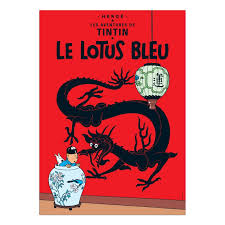
I first encountered Tintin in Grade 5, checking two slim volumes out of my elementary school library: The Blue Lotus and Tintin in America. I remember the physicality of them—the glossy covers, the bright blocks of color, the uncanny clarity of the drawings. They felt different from the other books on the shelf. Most children’s adventure stories required you to imagine the action. Tintin showed it to you panel by panel, with a confidence that made the whole world feel precise and alive.

Even before I fully understood the stories, I had the sense that I had stumbled onto something like treasure. The pages moved quickly. Cars skidded across city streets, gangsters hid in back rooms, deserts stretched into the distance. Tintin himself was fearless and tireless, a boy reporter who seemed capable of appearing anywhere in the world with little more than a notebook, a trench coat, and his small white dog.

But even at ten years old it was clear that the two books belonged to the same universe but not quite the same stage of its development. Tintin in America was energetic and funny but also loose and episodic, closer to a cartoon chase story than a carefully constructed narrative. The Blue Lotus, by contrast, felt deeper. The stakes seemed real. The world seemed larger and more dangerous. The book hinted at forces—politics, empire, war—that I could not yet name but could somehow feel moving behind the story.

Before going further, it’s worth acknowledging briefly the long-running controversy surrounding the politics of Tintin’s creator, Hergé. Some of the early Tintin stories reflect the colonial assumptions and stereotypes common in Europe during the interwar period, and Hergé himself worked for a newspaper in German-occupied Belgium during World War II. These facts have generated decades of debate. They are real and worth knowing. But they are also only one part of a much larger story. Over time Hergé’s work grew more humane, more attentive to other cultures, and more morally complex. For the purposes of this essay, it is enough to acknowledge the controversy and then move on to the books themselves, which remain among the most remarkable achievements in modern popular storytelling.


Mr Dreyer’s Class, 7th Grade:

Even before I took his class, I was aware that Mr. Dreyer was, let’s say, a different sort of fellow. He liked to tell a story about his brother who lived on a massive contour map of the San Francisco Bay area. The map was located in an enclosed structure that hung under a bridge in Oakland or something. And his brother just chilled there full time, so the story went. So Mr. Dreyer, apparently, was the normal one in his family.

(I remember Mr. Dreyer talking to me about John Lennon one day as well. This was maybe when I was taking his class, but I think it might have been before that. “John Lennon’s assassination was really sad,” he said, “he was just starting to put his life back together.” I had heard of John Lennon but at that time knew nothing of the circumstances of his death. And I certainly didn’t know about his ups and downs in the 1970s. Mr. Dreyer must have been a Lennon fan though, and wanted to tell me about it.)

In any case, when I got to middle school I was assigned Mr. Dreyer, as mentioned. Mr. Dreyer wore a mustache that looked pretty Frenchy to me—maybe that’s why I kind of thought he was a French native. There were also a number of the Tintin books in French on a shelf in the back of the room. I had read most of the Tintin books in English by then, so it was fun to browse the French versions and take in some of the action from a new lens.


The Blue Lotus

If the early Tintin books were clever adventure cartoons, The Blue Lotus was the moment the series entered history.

The story takes place in Shanghai during the turbulent 1930s, amid Japanese expansion and international intrigue. What distinguishes the book is not simply the exotic setting but the sudden moral seriousness that runs through it. Tintin is no longer merely chasing criminals. He is navigating a world shaped by imperial ambition, propaganda, and cultural misunderstanding.

Central to this shift is the introduction of Chang Chong-Chen. Chang’s friendship with Tintin humanizes the story in a way earlier books never attempted. Through Chang, the reader glimpses the everyday life of Chinese citizens caught between foreign powers and internal turmoil. The relationship is warm, sincere, and quietly revolutionary for its time.

One sequence has stayed with me since childhood: Tintin being smuggled into an opium den hidden inside barrels. As a child I read the scene simply as a thrilling act of infiltration. As an adult it evokes something darker—the lingering shadow of the opium trade and the colonial exploitation that shaped China’s nineteenth and early twentieth centuries. Even if young readers do not consciously grasp the historical weight behind it, they feel that something serious is at stake.

With The Blue Lotus, Tintin steps out of the cartoon world of early adventure stories and into a recognizably historical landscape. The hero is still brave and resourceful, but the world around him has grown more complicated.


The Crab with the Golden Claws

If The Blue Lotus deepened Tintin’s world morally, The Crab with the Golden Claws transformed it emotionally. The reason can be summed up in a single name: Captain Haddock.

Before Haddock appears, Tintin himself is almost too perfect. He is brave, clever, and incorruptible. Admirable, yes—but also somewhat distant. Haddock brings chaos into this orderly universe. When we first meet him he is a drunken wreck aboard a cargo ship, bullied by the crew and prone to bursts of confused outrage. In his introduction scene he is literally knocked around by events, bonked on the head and stumbling through the narrative like a man who has wandered into the wrong story.

Yet Haddock quickly becomes indispensable. His flaws—his temper, his drinking, his explosive vocabulary—make him recognizably human. Over the course of the series he evolves into the lord of Marlinspike Hall, a man readers root for not because he is flawless but because he struggles, blunders, and ultimately proves loyal beyond measure.

The mystery at the heart of the story—those curious tins of crab that conceal a narcotics smuggling ring—is classic Hergé plotting. An ordinary object becomes the gateway to a hidden criminal network. But what readers remember most is Haddock: the lovable rogue who changes the emotional chemistry of Tintin forever.


Land of the Black Gold

Land of Black Gold is one of the most unusual Tintin stories, blending geopolitical intrigue with comic delirium.

The plot centers on sabotage of the world’s gasoline supply, drawing Tintin into a web of international conspiracies in the Middle East. Yet what makes the book memorable is its sense of narrative labyrinth. The trader and raconteur Oliveira da Figueira talks endlessly, spinning stories within stories, improvising explanations that seem to circle back on themselves. His rambling style mirrors the complicated, byzantine nature of the intrigue unfolding around Tintin.

At the same time, chaos erupts in the form of the child Abdullah, whose relentless practical jokes push everyone toward exasperation.

And then there is the unforgettable desert sequence in which Thomson and Thompson pursue mirages while unknowingly driving in circles along their own tire tracks. The scene borders on hallucination. Heat, confusion, and comic misunderstanding combine to create one of the series’ most surreal episodes.

Where The Blue Lotus introduced moral depth and Crab introduced emotional warmth, Black Gold revels in controlled absurdity—the sense that the modern world is a maze of conspiracies, misunderstandings, and comic misadventures.


The Calculus Affair

By the time we reach The Calculus Affair, Tintin has entered an entirely new landscape: the Cold War.

The story begins with the kidnapping of Professor Calculus, whose research has attracted the interest of rival governments. Tintin and Haddock pursue him across borders, into secret fortresses and heavily guarded territories.

What makes this adventure distinctive is the absence of a clear moral center. Earlier Tintin stories often feature obvious villains. Here the lines blur. Rival states compete for technological advantage, intelligence services manipulate events, and even the heroes seem slightly overwhelmed by the scale of the intrigue surrounding them.

Tintin and Haddock are no longer simply solving a mystery. They are wandering into the murky machinery of international espionage.

Yet Hergé never abandons humor. The action sequences—helicopter pursuits, roadblocks, sticky-tape tricks, and frantic car chases—are thrilling while remaining faintly absurd. The tension builds like a spy thriller, but the comic timing prevents the story from becoming grim.

The result is perhaps the most sophisticated Tintin adventure: a tale in which suspense, humor, and geopolitical intrigue coexist in perfect balance.


Why Tintin Endures

Across these four books we can see the remarkable evolution of Tintin.

The Blue Lotus brings the series into history.
The Crab with the Golden Claws introduces human imperfection through Haddock.
Land of the Black Gold revels in the comic chaos of modern intrigue.
The Calculus Affair confronts the morally ambiguous world of Cold War espionage.

Through it all, Hergé’s storytelling remains astonishingly clear. Each panel advances the narrative. Each scene unfolds with the precision of a well-designed machine.

Tintin may begin as a boy adventurer, but over time he becomes something else: a traveler moving through the complicated landscape of the twentieth century. History deepens, friendships form, conspiracies multiply, and the world grows ever more ambiguous.

Yet the clarity of the storytelling never falters. That combination—simplicity of form paired with depth of experience—is the secret of Tintin’s endurance.

For many readers, the journey begins exactly as it did for me: a small book taken from a library shelf, opened with curiosity, and discovered to contain an entire world.

Dedication:

For Grade School libraries everywhere.

On Touts and Micro-Touts: Japan Observations

Note: This piece collects observations gathered across decades of nights out in Japan — moments that, taken individually, felt minor but over time revealed a coherent social pattern. The essay is not intended as a warning against nightlife, nor as an indictment of any particular place or person. Rather, it is an attempt to understand the subtle choreography that unfolds in urban night economies, where invitation, performance, and commerce intersect in ways that are rarely dramatic but often instructive.

The distinction between macro-touts and micro-touts emerged gradually. It reflects less a rigid taxonomy than a traveler’s growing sensitivity to atmosphere, tone, and the shifting boundaries between hospitality and transaction. Most encounters described here were neither dangerous nor traumatic; they were moments of mild disorientation that ultimately sharpened perception and deepened appreciation for the social intelligence required to navigate unfamiliar environments.

Japan remains one of the safest and most generous countries in the world to explore at night. The experiences recounted here are offered not as cautionary tales but as small pieces of ethnography — reminders that every city contains micro-economies of possibility, and that learning to read their signals is part of the quiet education that travel provides.

If there is a broader lesson, it is simply this: nightlife is built on invitations, and the skill of the traveler lies not in accepting or rejecting them categorically, but in recognizing the scripts they carry and choosing, with awareness, when to participate.

Part I — Kumamoto, Japan, Summer 1997

「どこの社長ですか?」

I was twenty-three and new to Japan — not just geographically new, but existentially new, the kind of new that leaves you unable to distinguish between hospitality and performance, sincerity and choreography. At that age you carry a quiet belief that experience will organize itself around you, that invitations are destiny, and that uncertainty is merely the prelude to belonging.

Kumamoto summer did nothing to challenge this illusion. The humidity hung in the air like a second shirt, streets shimmering with heat that seemed less meteorological than emotional. I met a couple of guys at a bar — friendly in that easy, late-night way where language fragments are enough and tone carries meaning. Half English, half Japanese, and entirely good-natured, they asked if I wanted to join their baseball team. I said yes immediately, not because I had any intention of playing, but because at twenty-three you rarely decline the promise of future identity.

The baseball team never materialized. But the invitation served its purpose. It opened the bridge.

They told me they wanted to show me real Japan. A phrase that should always raise questions but rarely does when you’re young and curious. “We know a place,” they said, the universal preface to experiences that exist somewhere between revelation and mild financial education.

That is how I entered my first hostess club.

It was not the neon spectacle I might have imagined. No polished decadence, no velvet rope theatrics. Instead: low lighting, carpet that seemed older than the Heisei era, and furniture whose best days had passed quietly without ceremony. Yet the room possessed its own gravitational pull, created not by décor but by orbit — women rotating from table to table with practiced ease, their presence transforming a modest environment into something that felt improbably expensive.

Mama-san presided with the quiet authority of someone who understood both mathematics and psychology. Her hair lacquered into permanence, her gaze sharp as accounting software, she functioned as conductor of a carefully orchestrated social economy. The women, each moving with subtle intentionality, carried scripts composed of compliments, curiosity, and gentle physical proximity.

Whisky mizuwari arrived with ritual precision, poured slowly as if time itself were being measured in diluted amber. The drink tasted ordinary. The price did not.

I was not uncomfortable — only aware of my own lack of schema. A foreigner equipped with politeness but not context, seated inside a room where intimacy operated as currency and identity functioned as flexible fiction. The women laughed easily, touched my arm, leaned close enough to suggest familiarity without commitment.

I did not interpret this as romance. I interpreted it as welcome.

Then came the line — delivered with effortless certainty and a smile that contained neither irony nor doubt:

「どこの社長ですか?」
Which company are you president of?

Not if.
Which.

Because the hostess club does not deal in biography. It deals in possibility. Within its walls, the boundaries of self dissolve gently. You arrive as yourself but are encouraged to inhabit a more generous narrative: company president, successful entrepreneur, patron of refined pleasures, bearer of an inexhaustible wallet. Identity becomes costume, worn lightly for the duration of the evening.

I understood that markup existed. What I did not yet understand was the degree to which markup could inhabit fantasy.

The bill arrived — perhaps thirty thousand yen. Not ruinous, not outrageous, but enough to sting the uninitiated and sharpen awareness. Before embarrassment could surface or negotiation begin, the friends who had invited me paid without ceremony. A wink, a casual next time, and the implicit understanding that this particular version of me — baseball player, future regular, provisional shachō — would remain confined to that evening.

I left lighter, though not poorer.

Not scammed.
Initiated.

The lesson did not arrive as resentment but as clarity:

Flattery has a price.
Fantasy carries a tab.
Sometimes you do not pay it directly — but you still learn the cost.


Part II — Kyoto: Rub-a-Dub and Bar Colors

Rub-a-Dub felt like oxygen.

A basement reggae bar where the air seemed shared rather than owned, bodies pressed into temporary community, music operating less as entertainment than as connective tissue. Tommy, as always, orbiting the jukebox with missionary zeal, attempting to convert the room to his playlist while flirting with the bar girl in ways that were equal parts hopeful and theatrical.

I stood with a Red Stripe, jacket discarded somewhere behind me, already drifting toward the kind of night where White Russians become plausible and conversation loosens into anecdote. Sweat, laughter, strangers whose names evaporate but whose presence remains — the familiar ingredients of third-place belonging.

Two men approached. One Jamaican, ponytail, voice thick with authority that seemed rooted in lived reggae culture rather than performance. The other younger, bilingual, improvising rap verses that moved seamlessly between Japanese and English with real talent. Not novelty talent — actual fluency. Conversation flowed easily. Fifteen, twenty minutes of exchange that lowered the drawbridge of suspicion.

Then the invitation:

“Let’s go to Bar Colors.”

I had seen the sign before. A reggae logo, unobtrusive, upstairs somewhere near Kiyamachi. Nothing alarming, nothing clandestine. Just another bar in a district defined by possibility.

We followed.

Three floors up — a vertical ascent that subtly altered the power geometry. Rub-a-Dub’s crowded warmth replaced by a smaller room with thinner oxygen. No dance floor, just music and seating. I chose the seat nearest the door, an instinctive habit that rarely announces itself consciously but persists nonetheless. Tommy relaxed into the environment with characteristic ease, while the rapper transitioned seamlessly into microphone performance, his skill functioning as social anesthesia.

We ordered beers — two each. Six hundred yen apiece. Simple arithmetic, comforting in its predictability. Safety often disguises itself as math.

Then came the disruption.

The Jamaican leaned in, tone shifting just enough to register as discordant:

“Who will pay the bill?”

The question felt misplaced. The wrong person asking, the wrong moment, the wrong authority. I responded with obvious clarity: we would pay for our drinks. He shook his head dramatically and launched into a loud, performative argument with the bartender — defending us against an unseen injustice, positioning himself as ally.

The performance was transparent once recognized. Theater designed to manufacture gratitude. Gratitude designed to justify inflated cost.

This is how micro-predation operates in Kyoto: not through threat but choreography.

When the bill arrived, it totaled five thousand yen. Double expectation. Not devastating, merely disorienting. Enough to create tension between principle and convenience.

I stood — full height, voice calm:

“I know what you’re doing. It’s bullshit. We came here in good faith.”

No escalation. No anger. Just refusal to participate in the narrative assigned.

We paid — not capitulation but calculation. Peace sometimes costs less than confrontation. Exit achieved without drama, wallets lighter but awareness sharpened.

Not victims.
Not victors.
Just awake.

The deeper lesson was not financial but perceptual: danger rarely announces itself loudly in Kyoto. It appears as suggestion, invitation, relational choreography. You do not need to be taken to understand the mechanics of being taken.

Rub-a-Dub had offered warmth.
Bar Colors offered clarity.

Some nights you dance.
Some nights you pay to leave.


Part III — The Kiyamachi Ecology of Micro-Touts

If Kumamoto introduced fantasy and Bar Colors revealed choreography, Kiyamachi provided taxonomy.

Kyoto’s nightlife economy operates differently from more overt red-light districts. There is little aggressive solicitation, no carnival barking, no theatrical insistence. Instead, micro-signals populate liminal spaces: a man standing slightly too still near a stairwell, a laminated menu with vague promises, a bilingual conversation that begins casually and ends directionally.

The micro-tout does not sell forcefully. He offers possibility.

And possibility is harder to refuse.

Micro-touting thrives in moments of uncertainty — the pause between bars, the lull between conversations, the question of where the night continues. The invitation arrives not as proposition but as continuity.

“Just one drink.”
“I know a place.”
“Special price.”
“Members bar but I can get you in.”

The language is intentionally thin. Curiosity performs the heavy lifting.

Unlike macro-touting, where spectacle clarifies the transaction, micro-touting relies on relational ambiguity. Trust precedes the offer. Conversation establishes provisional safety. Only then does the invitation appear.

You are not pressured.
You are positioned.

And positioning is the mechanism.


Part IV — Macro-Touts and Micro-Touts: A Taxonomy

Macro-touts belong to visible red-light economies. Their pitches are explicit, directional, and theatrical. Customers understand the transactional nature immediately. Kabukicho hosts calling from sidewalks, Osaka promoters guiding tourists toward neon staircases — these figures operate through spectacle.

Micro-touts function differently.

They blend into ordinary social environments: musicians, patrons, casual acquaintances, language exchange partners. Their authority derives from relational proximity rather than territorial control. They do not sell a product but offer narrative continuation.

Macro-touting relies on volume.
Micro-touting relies on timing.

Macro-touting demands attention.
Micro-touting waits for uncertainty.

Japan’s cultural emphasis on politeness and conflict avoidance creates fertile ground for micro-touting. The customer hesitates to confront, the operator anticipates this, and civility becomes economic leverage.

The genius of micro-touting lies in its invisibility. It rarely crosses legal boundaries and seldom escalates into overt harm. Instead, it extracts modest margins through social choreography.

Not robbery.
Repositioning.


Part V — The Ethics of Almost

What remains from these encounters is not resentment but recognition.

Both Kumamoto and Kyoto experiences share structural similarities: voluntary participation in constructed realities. The hostess club invites fantasy; the micro-tout offers narrative continuation. In each case, the individual is not coerced but positioned within an unfolding script.

The moment of realization rarely arrives as crisis. It appears as subtle awareness — a bill exceeding expectation, a tonal shift, a fragment of choreography revealing itself as performance.

Travel rarely educates through catastrophe. More often, it educates through near-misses — the ethics of almost.

You almost believed.
You almost overpaid.
You almost escalated.
You almost became the character the room was preparing.

Micro-touts teach attention rather than fear.


Part VI — Return to the Street

Kiyamachi after midnight remains a pedestrian theater of extraordinary subtlety. Music spills from doorways, cigarettes glow like punctuation, laughter dissolves into river air. Within this ordinary magic, micro-touts continue their quiet labor — neither villains nor heroes, simply participants in the nocturnal economy of possibility.

Nightlife is built on invitations.

Some lead to connection.
Some to illusion.
Some to modest financial education.

But all reveal the architecture of the city that issues them.

Kumamoto taught me fantasy has a tab.
Kyoto taught me ambiguity has a margin.

Neither felt like loss.
Both felt like tuition.

Because travel, like nightlife, is rarely about destinations. It is about learning to read the scripts unfolding around you — and recognizing that sometimes the most instructive figures in any city are the ones whose invitations you decline with gratitude.

Part I — Kumamoto, Japan, Summer 1997

「どこの社長ですか?」

I was twenty-three and new to Japan — not just geographically new, but existentially new, the kind of new that leaves you unable to distinguish between hospitality and performance, sincerity and choreography. At that age you carry a quiet belief that experience will organize itself around you, that invitations are destiny, and that uncertainty is merely the prelude to belonging.

Kumamoto summer did nothing to challenge this illusion. The humidity hung in the air like a second shirt, streets shimmering with heat that seemed less meteorological than emotional. I met a couple of guys at a bar — friendly in that easy, late-night way where language fragments are enough and tone carries meaning. Half English, half Japanese, and entirely good-natured, they asked if I wanted to join their baseball team. I said yes immediately, not because I had any intention of playing, but because at twenty-three you rarely decline the promise of future identity.

The baseball team never materialized. But the invitation served its purpose. It opened the bridge.

They told me they wanted to show me real Japan. A phrase that should always raise questions but rarely does when you’re young and curious. “We know a place,” they said, the universal preface to experiences that exist somewhere between revelation and mild financial education.

That is how I entered my first hostess club.

It was not the neon spectacle I might have imagined. No polished decadence, no velvet rope theatrics. Instead: low lighting, carpet that seemed older than the Heisei era, and furniture whose best days had passed quietly without ceremony. Yet the room possessed its own gravitational pull, created not by décor but by orbit — women rotating from table to table with practiced ease, their presence transforming a modest environment into something that felt improbably expensive.

Mama-san presided with the quiet authority of someone who understood both mathematics and psychology. Her hair lacquered into permanence, her gaze sharp as accounting software, she functioned as conductor of a carefully orchestrated social economy. The women, each moving with subtle intentionality, carried scripts composed of compliments, curiosity, and gentle physical proximity.

Whisky mizuwari arrived with ritual precision, poured slowly as if time itself were being measured in diluted amber. The drink tasted ordinary. The price did not.

I was not uncomfortable — only aware of my own lack of schema. A foreigner equipped with politeness but not context, seated inside a room where intimacy operated as currency and identity functioned as flexible fiction. The women laughed easily, touched my arm, leaned close enough to suggest familiarity without commitment.

I did not interpret this as romance. I interpreted it as welcome.

Then came the line — delivered with effortless certainty and a smile that contained neither irony nor doubt:

「どこの社長ですか?」
Which company are you president of?

Not if.
Which.

Because the hostess club does not deal in biography. It deals in possibility. Within its walls, the boundaries of self dissolve gently. You arrive as yourself but are encouraged to inhabit a more generous narrative: company president, successful entrepreneur, patron of refined pleasures, bearer of an inexhaustible wallet. Identity becomes costume, worn lightly for the duration of the evening.

I understood that markup existed. What I did not yet understand was the degree to which markup could inhabit fantasy.

The bill arrived — perhaps thirty thousand yen. Not ruinous, not outrageous, but enough to sting the uninitiated and sharpen awareness. Before embarrassment could surface or negotiation begin, the friends who had invited me paid without ceremony. A wink, a casual next time, and the implicit understanding that this particular version of me — baseball player, future regular, provisional shachō — would remain confined to that evening.

I left lighter, though not poorer.

Not scammed.
Initiated.

The lesson did not arrive as resentment but as clarity:

Flattery has a price.
Fantasy carries a tab.
Sometimes you do not pay it directly — but you still learn the cost.


Part II — Kyoto: Rub-a-Dub and Bar Colors

Rub-a-Dub felt like oxygen.

A basement reggae bar where the air seemed shared rather than owned, bodies pressed into temporary community, music operating less as entertainment than as connective tissue. Tommy, as always, orbiting the jukebox with missionary zeal, attempting to convert the room to his playlist while flirting with the bar girl in ways that were equal parts hopeful and theatrical.

I stood with a Red Stripe, jacket discarded somewhere behind me, already drifting toward the kind of night where White Russians become plausible and conversation loosens into anecdote. Sweat, laughter, strangers whose names evaporate but whose presence remains — the familiar ingredients of third-place belonging.

Two men approached. One Jamaican, ponytail, voice thick with authority that seemed rooted in lived reggae culture rather than performance. The other younger, bilingual, improvising rap verses that moved seamlessly between Japanese and English with real talent. Not novelty talent — actual fluency. Conversation flowed easily. Fifteen, twenty minutes of exchange that lowered the drawbridge of suspicion.

Then the invitation:

“Let’s go to Bar Colors.”

I had seen the sign before. A reggae logo, unobtrusive, upstairs somewhere near Kiyamachi. Nothing alarming, nothing clandestine. Just another bar in a district defined by possibility.

We followed.

Three floors up — a vertical ascent that subtly altered the power geometry. Rub-a-Dub’s crowded warmth replaced by a smaller room with thinner oxygen. No dance floor, just music and seating. I chose the seat nearest the door, an instinctive habit that rarely announces itself consciously but persists nonetheless. Tommy relaxed into the environment with characteristic ease, while the rapper transitioned seamlessly into microphone performance, his skill functioning as social anesthesia.

We ordered beers — two each. Six hundred yen apiece. Simple arithmetic, comforting in its predictability. Safety often disguises itself as math.

Then came the disruption.

The Jamaican leaned in, tone shifting just enough to register as discordant:

“Who will pay the bill?”

The question felt misplaced. The wrong person asking, the wrong moment, the wrong authority. I responded with obvious clarity: we would pay for our drinks. He shook his head dramatically and launched into a loud, performative argument with the bartender — defending us against an unseen injustice, positioning himself as ally.

The performance was transparent once recognized. Theater designed to manufacture gratitude. Gratitude designed to justify inflated cost.

This is how micro-predation operates in Kyoto: not through threat but choreography.

When the bill arrived, it totaled five thousand yen. Double expectation. Not devastating, merely disorienting. Enough to create tension between principle and convenience.

I stood — full height, voice calm:

“I know what you’re doing. It’s bullshit. We came here in good faith.”

No escalation. No anger. Just refusal to participate in the narrative assigned.

We paid — not capitulation but calculation. Peace sometimes costs less than confrontation. Exit achieved without drama, wallets lighter but awareness sharpened.

Not victims.
Not victors.
Just awake.

The deeper lesson was not financial but perceptual: danger rarely announces itself loudly in Kyoto. It appears as suggestion, invitation, relational choreography. You do not need to be taken to understand the mechanics of being taken.

Rub-a-Dub had offered warmth.
Bar Colors offered clarity.

Some nights you dance.
Some nights you pay to leave.


Part III — The Kiyamachi Ecology of Micro-Touts

If Kumamoto introduced fantasy and Bar Colors revealed choreography, Kiyamachi provided taxonomy.

Kyoto’s nightlife economy operates differently from more overt red-light districts. There is little aggressive solicitation, no carnival barking, no theatrical insistence. Instead, micro-signals populate liminal spaces: a man standing slightly too still near a stairwell, a laminated menu with vague promises, a bilingual conversation that begins casually and ends directionally.

The micro-tout does not sell forcefully. He offers possibility.

And possibility is harder to refuse.

Micro-touting thrives in moments of uncertainty — the pause between bars, the lull between conversations, the question of where the night continues. The invitation arrives not as proposition but as continuity.

“Just one drink.”
“I know a place.”
“Special price.”
“Members bar but I can get you in.”

The language is intentionally thin. Curiosity performs the heavy lifting.

Unlike macro-touting, where spectacle clarifies the transaction, micro-touting relies on relational ambiguity. Trust precedes the offer. Conversation establishes provisional safety. Only then does the invitation appear.

You are not pressured.
You are positioned.

And positioning is the mechanism.


Part IV — Macro-Touts and Micro-Touts: A Taxonomy

Macro-touts belong to visible red-light economies. Their pitches are explicit, directional, and theatrical. Customers understand the transactional nature immediately. Kabukicho hosts calling from sidewalks, Osaka promoters guiding tourists toward neon staircases — these figures operate through spectacle.

Micro-touts function differently.

They blend into ordinary social environments: musicians, patrons, casual acquaintances, language exchange partners. Their authority derives from relational proximity rather than territorial control. They do not sell a product but offer narrative continuation.

Macro-touting relies on volume.
Micro-touting relies on timing.

Macro-touting demands attention.
Micro-touting waits for uncertainty.

Japan’s cultural emphasis on politeness and conflict avoidance creates fertile ground for micro-touting. The customer hesitates to confront, the operator anticipates this, and civility becomes economic leverage.

The genius of micro-touting lies in its invisibility. It rarely crosses legal boundaries and seldom escalates into overt harm. Instead, it extracts modest margins through social choreography.

Not robbery.
Repositioning.


Part V — The Ethics of Almost

What remains from these encounters is not resentment but recognition.

Both Kumamoto and Kyoto experiences share structural similarities: voluntary participation in constructed realities. The hostess club invites fantasy; the micro-tout offers narrative continuation. In each case, the individual is not coerced but positioned within an unfolding script.

The moment of realization rarely arrives as crisis. It appears as subtle awareness — a bill exceeding expectation, a tonal shift, a fragment of choreography revealing itself as performance.

Travel rarely educates through catastrophe. More often, it educates through near-misses — the ethics of almost.

You almost believed.
You almost overpaid.
You almost escalated.
You almost became the character the room was preparing.

Micro-touts teach attention rather than fear.


Part VI — Return to the Street

Kiyamachi after midnight remains a pedestrian theater of extraordinary subtlety. Music spills from doorways, cigarettes glow like punctuation, laughter dissolves into river air. Within this ordinary magic, micro-touts continue their quiet labor — neither villains nor heroes, simply participants in the nocturnal economy of possibility.

Nightlife is built on invitations.

Some lead to connection.
Some to illusion.
Some to modest financial education.

But all reveal the architecture of the city that issues them.

Kumamoto taught me fantasy has a tab.
Kyoto taught me ambiguity has a margin.

Neither felt like loss.
Both felt like tuition.

Because travel, like nightlife, is rarely about destinations. It is about learning to read the scripts unfolding around you — and recognizing that sometimes the most instructive figures in any city are the ones whose invitations you decline with gratitude.

Note: If you like this essay, you may like “Tuesday Kyoto Bar Crawl.” You can find it here.

Tuesday Kyoto Bar Crawl

Note: A Tuesday crawl in Kyoto carries a different texture from the weekend version: looser expectations, smaller crowds, conversations that wander rather than perform. The city feels slightly off-schedule, which is exactly what makes it fertile ground for observation, connection, and the quiet serendipity that defines third-place culture.

These midweek circuits are less about excess and more about continuity — checking in with familiar rooms, familiar faces, and the evolving micro-narratives that accumulate across bars, balconies, and late-night sidewalks. The crawl becomes a moving vantage point on the city’s emotional topography: moments of laughter, fragments of confession, the soft choreography of strangers becoming temporary companions.

In that sense, the Tuesday crawl isn’t a deviation from routine but a ritual of perspective. It reminds the wanderer that urban nightlife is not only spectacle but ecology — a network of spaces where stories intersect briefly before dissolving back into the Kyoto night.

For the crawler, the goal is simple: move lightly, notice everything, and leave each room exactly as it was found, carrying only the residue of atmosphere and the promise of return.

Epigraph
“Is there room enough for two / if I don’t have a point of view?”
— Tommy Stinson

Dedication
For the people who made a night by simply being themselves.


I. Umineko

Early evening began without urgency, the way a proper crawl should. Umineko held the kind of atmosphere that makes arrival feel less like an event and more like a gradual settling — low light, gentle conversation, bodies occupying space without demanding attention. Nothing theatrical, nothing curated for spectacle. Just people existing alongside one another, sharing a small pocket of warmth before the night found its pace.

I took a seat and allowed the room to reveal itself slowly. Watching first, speaking later. Listening without the pressure to respond. The posture was closer to observation than participation, not out of distance but out of respect for rhythm. A crawl does not begin with energy; it begins with calibration. I was not collecting stories yet, not assigning meaning or searching for narrative threads. I was tuning my frequency, aligning with the environment until the subtle shift in atmosphere signaled readiness.

When the bar moved from fullness toward thinning, the message was clear without needing articulation. Crawls are not forced forward by intention; they move according to instinct and current. I stepped back into the night air, carrying nothing but presence, following momentum without destination.


II. ING

ING felt like stepping into a room anchored by a still point. Haku stood behind the bar wearing a Rolling Stones shirt, perfectly unconcerned with audience or approval. His presence created an equilibrium that defined the space more than any décor or playlist could. I took the center seat — ideal angle, clear sound, good conversational acoustics — and ordered a Negroni, marking the transition from arrival into engagement.

A White Russian followed, not out of necessity but out of curiosity. Choice itself becomes part of the method on nights like these. Drinks are less about intoxication and more about pacing, punctuation marks in a narrative unfolding in real time.

Haku mentioned, almost casually, that Jimmy Cliff was not Rasta. The comment carried no agenda, only observation. I responded in kind. He played Cliff anyway, and the neutrality of the exchange underscored something important: truth in these spaces does not require resolution. Dead or alive, category or contradiction, the music persists independent of classification.

Later, Haku slipped into what could only be described as algorithm mode. The Grateful Dead followed Joy Division, which then dissolved into Blink-182. The sequence was unpredictable yet internally coherent, a playlist guided by instinct rather than performance. Bars like ING do not curate for approval; they curate for honesty. The expectation is not participation but presence.

Some bars ask for energy.
ING asks only that one remain authentic within its walls.

After a time, movement arrived not through boredom but through instinct. I finished my drink, nodded to Haku, and stepped back into the night once more.


III. Mafia Bar

The entrance to Mafia Bar announced itself through indifference: narrow doorway, plastic sheeting, a quiet DGAF energy that discouraged pretense. Inside, the dynamic was already established — Master, sub-bartender, and Satsuki forming a triangle of familiarity that neither required nor excluded me.

I ordered a gin and tonic, lit a clove cigarette, and allowed proximity to substitute for conversation. Master smoked and drank with the ease of long habit, while Satsuki vaped and scrolled through photos on his phone, their heads occasionally leaning close in shared amusement. The intimacy belonged to them; my role was to witness without intrusion.

A brief choreography unfolded when the sub-bartender excused himself for the bathroom. Another stepped in seamlessly, maintaining rhythm until the first returned moments later, laughing about his inability to hold it and wiping his hand absentmindedly on Satsuki’s jacket. Her gentle scolding carried affection rather than irritation. The moment passed as ordinary within their ecosystem, a reminder that interpretation is often unnecessary.

Three London men arrived — Dan, Joe, and another Joe — consultants and a commercial artist navigating unfamiliar territory. I recommended Concrete, a suggestion offered lightly but accepted gratefully. Participation, not intervention. Guidance without ownership.

I remained roughly thirty-five minutes, absorbing both atmosphere and lore. The story circulated quietly: the owner had once taken the fall for a crime he did not commit, serving twenty years in silence before emerging to receive this bar as recompense from the underworld that owed him. Whether factual or mythic mattered little. Stories gain legitimacy through repetition, and truth is often secondary to resonance.

I left on foot, crossing the river with the sense that each stop was less a destination than a waypoint.


IV. Stinboat

Arrival at 9:02 p.m., two minutes after opening, placed me inside a room still forming its identity for the night. Rickey stood behind the bar alongside the evening’s performer, both moving through preparatory gestures that transform an empty space into a living environment.

I asked about glasses I had left behind on Saturday. Rickey produced a pair, though not mine. The exchange felt inconsequential yet oddly grounding, a reminder that memory and objects rarely align perfectly.

A Negroni in hand, I settled into observation as the room awakened. A visitor from Kuwait approached with curiosity, asking whether a bunny show would occur. He mistook me for staff, and I redirected him gently toward Rickey. Ambiguity satisfied him enough to remain.

At 9:20, the room shifted from potential to presence. Nine guests entered — among them an older man with a younger girlfriend and a cluster of Japanese patrons whose arrival created density without chaos. I took the microphone early, choosing Common People as an opening statement. The performance landed not as a home run but as a solid triple, establishing footing without overreach. I became part of the environment rather than an observer at its edge.

The performer navigated the bar through a series of micro-interactions, brief pockets of attention resembling miniature dates, popcorn intimacy distributed evenly across the room. I followed with Honky Tonk Women, drawing visible delight from the older man and his partner.

Preparation for Tiny Dancer involved a brief retreat with headphones — aligning tempo, breath, and emotional landing. As I sang, activity continued around me, including a staged whipping performance in the back that unfolded without disrupting the song’s internal narrative. Presence required maintaining focus amid spectacle, allowing parallel realities to coexist without competition.

The evening progressed through pole performance, enthusiastic audience participation, and ritualized tipping. I followed established protocol, understanding that the moment belonged to the performer’s choreography rather than personal interpretation.

Later, I Fought the Law brought collaborative energy: the older man on drums, eye contact establishing tempo and trust, his girlfriend filming with increasing engagement. Rickey eventually joined on drums, a younger guitarist delivered a brief but intense solo, and a spontaneous vocalist in his mid-fifties erupted into a single song before departing. Applause and hoots carried communal warmth rather than performance judgment.

As the crowd thinned, what remained was intimacy without spectacle: Rickey, the performer, the older man and girlfriend, Sari, a couple, and myself. Fairytale of New York unfolded with Sari joining briefly before drifting into her own narrative with the older man. I continued singing, neutral observer and participant simultaneously.

The set concluded with Miley Cyrus, We Will Rock You, and finally Take It Easy — a closing song chosen less for nostalgia than for resolution. Afterward, physical exhaustion arrived cleanly, the kind that follows completion rather than depletion. Brief hugs, a playful belly rub offered as pure joy, and a ¥4500 bill that felt symbolically insufficient to measure the night’s experiential value.

Stinboat held the evening’s center of gravity, and I left without loose emotional threads.


V. Concrete Bar

The walk back across the river lasted roughly eight minutes, a transitional corridor between intensity and closure. Concrete greeted me with understated calm, a space designed less for spectacle and more for lingering conversation.

Leon from Wales occupied a stool, unfamiliar with the phrase “detox and retox.” I bought him a Cocalero anyway, and we spoke in the gentle cadence of end-of-night strangers — exchanging warmth rather than biography, presence rather than personal history. These conversations carry their own authenticity precisely because they resist permanence.

I sensed no need for additional experiences. The crawl had delivered what it intended.


VI. Taxi → Home

At 1:30 a.m., a taxi waited at the stand as if anticipating completion. There was no negotiation, no wandering, no hesitation. Just entry, transit, and the quiet satisfaction of closure.

Back home, I read half of Zach’s new piece in bed and texted immediate feedback. He prefers responses unfiltered and alive, preserving the energy of first impression before reflection cools interpretation.

Sleep followed naturally.

A crawl complete — not dramatic, not moralized, not engineered for narrative payoff. Simply observed, recorded, and experienced through presence. I did not judge the night, and the night did not demand judgment. I entered it, and in its quiet generosity, it allowed me to belong within it for a few hours before releasing me back into ordinary time.

Note: If you like this essay, you may also like “On Touts and Micro-Touts: Japan Observations.” You can find it here.

On My Week with Isobel (aka London Girl) Part III: Aftermath

Note: This is the third of a three part series. Part I is here and Part II is here.

Epigraph I:

Oh my sentimental fool

Lloyd Cole

Epigraph II:

Was the risk I sent to you received?

Metric

Leaving Oxford / Returning to Japan

I walked the five minutes back to the hotel after the bus pulled away. My wife was going on to visit friends in Germany and I would have about five days alone in Kyoto after I got back to Japan. At the hotel I couldn’t get back to sleep, so I said a small prayer to the angels asking for grace to get through the day, showered, packed my things, and waited for the 8 AM car pickup.

I did not rush. Packing became a deliberate act, almost ritualistic in its pacing. I folded shirts one at a time, placed my notebook carefully into my bag, slipped the Tintin postcard between pages so it would not bend. Sue Tompkins went in next, followed by the charger, the toothbrush, the small practical objects that restore a sense of order after emotional disturbance. The room itself was modest — functional, forgettable in most respects — yet it felt oddly expanded, as if some invisible event had occurred there despite the absence of anything outwardly dramatic. Something had shifted in me, and the room seemed to hold the echo of that shift.

At the desk, I laid everything out for a moment, not to organize but simply to gather myself. The Mendoza Line was no longer playing, but the music had already done its work. The emotional charge it helped ignite remained present, circulating quietly beneath the surface. There was nothing to heighten or prolong; the effect was already internalized.

Around eight, the hire car arrived. The driver was polite, efficient, the kind of professional whose calm competence creates a reassuring neutrality. He helped with my bag, and we exchanged small talk as we pulled into traffic — London housing costs, wages, the persistent difficulty young people face in trying to establish themselves. On the radio, a news segment discussed the rising number of homeless families and children across the UK. Normally, such stories register as troubling but abstract statistics. That morning, however, the report landed differently. I found myself thinking about untethered lives, about how fragile the structures that hold people together can be, and how sometimes the tether itself is the only thing preventing a deeper psychological unraveling.

Traffic was light, and we arrived at the airport mid-morning. Inside, I purchased a simple breakfast — fruit, yogurt, coffee — and found a seat removed from the main flow of travelers. Airports are environments of constant movement, but solitude can still be carved out within them if one chooses carefully. I opened my Kindle and downloaded volumes four through six of Anthony Powell’s A Dance to the Music of Time. It was not an act of escapism so much as orientation. I wanted narrative continuity, a long arc where identity unfolds gradually rather than collapsing under sudden pressure. Powell’s world offered lineage, structure, and a reassuring sense of temporal patience.

I texted Isobel. She responded almost immediately, and what followed was a long, bright thread of conversation carried across airport Wi-Fi. There was no sense of emotional comedown, no awkward reentry into ordinary distance — only continuation. The connection felt intact, natural, as if the meeting had established a channel that did not require reinforcement to remain open.

When boarding was called, the transition felt procedural rather than dramatic. The flight passed in a quiet blur of clouds, Molina songs, Powell’s prose, and intermittent thought. Beneath it all was a subtle ache under the ribs — not pain, not longing in any acute sense, but effect. A residual emotional state that did not demand resolution, only acknowledgment.

On the plane I read some Powell and listened to music. I remember playing “Two Suns in the Sunset” by Pink Floyd and being unexpectedly moved by it. I was in an emotional state — not overwhelmed, but open and exposed — and the flight passed quietly. I landed at Kansai Airport in the afternoon.

I landed in Japan first. My wife continued on to Germany to visit friends, and my son was in Australia on a school trip. I took the Haruka train back toward Kyoto. The wide seats and generous legroom made me feel welcomed back into my country of choice. Much as I had enjoyed England, I felt real relief in returning. There is a particular comfort in Japanese transit — the order, the space, the quiet efficiency — and my body recognized it immediately.

The house, when I entered it, was silent in a way that felt tangible. I carried that silence with unusual care, as if it were made of glass and might shatter if handled abruptly. Solitude is often restorative, but this solitude had an amplifying quality, heightening rather than settling internal experience.

That evening, I went to Takumiya, a pub in north central Kyoto. I ordered food and three craft beers and spoke casually with whoever happened to be nearby. Conversations were light, unstructured, yet I sensed an unusual responsiveness from people around me — as though I possessed a slightly elevated emotional voltage that others could detect without understanding its source. Even animals seemed to register it. Cats approached me with a familiarity that felt less coincidental than intuitive, as if some form of static had gathered on the soul.

I had no sense of impending crisis. No awareness that within three days I would walk into my principal’s office and offer my resignation

First Days Back

On my first full day back I did laundry and in the late afternoon went to Takumiya, a pub in north central Kyoto near Karasuma Oike. I don’t remember whether I texted or called Isobel that day, but I almost certainly did. At Takumiya I ordered sashimi and had a few craft beers from their rotating selection. I stayed longer than planned, talking lightly with whoever happened to be sitting nearby.

The next day was Tuesday and I went to work as scheduled. I checked the heat index readings as part of my summer administrative duties. Dr. Fox was on campus. Seeing him immediately shifted the emotional temperature of the day.

I have written elsewhere about my problems with Dr. Fox and I won’t revisit them in detail here. What matters for this story is that by that point I felt he had betrayed me and failed to show up when I most needed institutional support. Trust had already been damaged. Seeing him again after Oxford brought all of that to the surface at once.

We spoke briefly. Before I left, he asked me to come in the following day to help prepare a presentation he was scheduled to give to an alumni group. I had ghostwritten material for him many times before. Under normal circumstances I would have said yes without hesitation. This time I agreed anyway, even though I was already internally unstable and emotionally saturated.

It would not turn out well.

I returned to Takumiya each night that week. There was comfort in being present in public spaces while remaining largely anonymous. The balance allowed me to exist among others without the demands of deeper recognition. Meanwhile, at five in the evening Japan time — nine in the morning in London — Isobel and I spoke daily. The calls were not brief check-ins but sustained conversations lasting anywhere from thirty minutes to an hour and a half. Often she walked through a park while we spoke, and I imagined her surroundings as she described them, the geographical distance softened by conversational continuity.

During one of these calls, I told her that I wanted to write a book. Not about her specifically, but about the chain of experiences that led to meeting her and the clarity that encounter unexpectedly revealed. She understood immediately. More than that, she expressed a quiet appreciation for being part of that moment of ignition — not as subject matter but as catalyst.

At the same time, unresolved resentment toward Dr. Fox did not dissipate with distance. Instead, it sharpened. The baseball heatstroke issue lingered at the margins of thought, alongside a broader accumulation of professional frustrations: moments of perceived disrespect, ambiguous expectations, and a decade of service that increasingly felt like professionalism without true partnership. None of these tensions were new, but the emotional openness of the week amplified their weight. Background noise began to feel like pressure.

By Friday, when I walked into school, I was not consciously planning a decisive action, yet I sensed a degree of internal instability that made ordinary interactions feel precarious. When Dr. Fox called me into his office to request assistance with a presentation — a familiar pattern, a non-work day expectation framed as routine — the moment crystallized something that had been building long before Oxford. I resigned. The decision belonged to a larger narrative, but this story carries its immediate emotional context.

As the reality of resignation settled into my body, a quiet clarity followed. I knew I needed to speak with my wife. The conversation would not revolve around specifics — call durations, text counts, or the mechanics of connection — but around truth in its broader emotional sense.

She returned home Saturday night. With her presence, the house regained its weight: history, shared furniture, a past that possessed shape and gravity. We sat together without wine or any conversational buffer. The moment did not invite performance or gradual disclosure; it required directness.

“I quit,” I said. “And I met someone.”

She asked only one question.

“Did you sleep with her?”

“No.”

She nodded, her response quiet and measured.

“Okay. Have fun on the phone.”

Nothing fractured dramatically in that moment. There was no raised voice, no immediate emotional rupture. Yet something subtle shifted — an alteration not of structure but of atmosphere. The past remained intact, but the future carried a slightly different texture. Nothing broke, but nothing stayed exactly the same.

Saturday and Sunday

Saturday and Sunday arrived with a quietness that felt disproportionate to the events of the preceding week. For the first time in months, there was no alarm set for early administrative duties, no email requiring immediate response, no expectation of presence within the institutional rhythms that had long structured my days. I was off work — not merely for the weekend, but in a more consequential sense that I could not yet fully absorb. I would not return until 2022. The long-term ramifications of what had unfolded were already in motion, though at that moment they existed more as a distant horizon than as a lived reality whose contours could be clearly seen.

The weekend therefore carried a strange dual quality. On the surface, it resembled any other stretch of unstructured time: coffee in the morning, small household tasks, the slow pacing of hours unburdened by schedules. Beneath that surface, however, ran a persistent awareness that something fundamental had shifted. The scaffolding of daily life — work expectations, professional identity, habitual responsibilities — had loosened, and with its absence came both relief and a faint, almost disorienting spaciousness.

At five o’clock sharp Japan time, which was nine in the morning in the UK, I called Isobel. The timing became instinctive, a daily point of orientation that anchored the day before it fully began. She answered as she was waking, her voice carrying that soft mixture of sleep and recognition that collapses distance instantly. We picked up exactly where we had left off, as if conversation were a continuous thread rather than a sequence of separate exchanges. We talked and laughed easily, moving between subjects without effort — music, muses, love, the nature of intimacy, and the broader textures of life that surface when two people feel unexpectedly understood.

The calls possessed a quality that felt, at the time, almost transcendent. I experienced a heightened emotional state that bordered on euphoria, a sense of expansion difficult to articulate without risking exaggeration. There was an unmistakable feeling of being lifted beyond ordinary emotional gravity, as if the connection existed in a space slightly removed from daily constraint. For brief stretches, I felt powerful in a way that had little to do with control and everything to do with aliveness — the psychological equivalent of standing in clear light after months of muted color.

Yet even within that intensity, I carried a quiet awareness that such states are rarely sustainable. The experience felt too vivid, too precise in its timing, to belong to permanence. I understood, somewhere beneath the exhilaration, that what we were inhabiting was a moment granted rather than guaranteed. For the time being, however, there was a mutual permission to exist within that space without prematurely interrogating its future. We allowed the conversations to unfold fully, accepting their immediacy without insisting on outcome.

The rest of the weekend unfolded around those calls like a soft frame. I moved through ordinary activities — brief walks, small household routines, moments of shared quiet with my wife — with an undercurrent of emotional intensity that did not demand expression but remained unmistakably present. Silence felt less empty than suspended, as though the days themselves were pausing before the arrival of consequences not yet visible.

What remained most striking about that weekend was not any single event but the emotional totality it carried. The combination of resignation, solitude, reconnection, and emerging uncertainty produced a state that was both exhilarating and fragile. I was aware, even then, of the paradox inherent in the experience: the joy of discovery intertwined with the inevitability of complication, the brightness of connection shadowed by the knowledge of its precariousness.

That was the weekend. In its quiet span, I found myself inhabiting an emotional condition that was at once expansive and difficult, sustaining and destabilizing. I was, deeply and undeniably, in love — not in a settled or declarative sense, but in the raw, immediate way that accompanies sudden recognition. The feeling carried power and tenderness in equal measure, along with a subtle ache that suggested awareness of its limits even as it unfolded.

The Rest of September

The rest of September passed with a quality that is difficult to reconstruct in precise sequence. Days did not feel discrete or individually memorable; instead, they merged into a continuous emotional field in which time moved forward without the usual markers of routine. The absence of work removed one of the primary structures that normally segments experience, and without that scaffolding the month acquired a dreamlike texture. Moments were vivid while they occurred, yet quickly dissolved into the broader atmosphere of the period.

Isobel and I remained in frequent contact. We spoke most days and exchanged messages with a familiarity that no longer required initiation or explanation. The connection persisted, but the intensity that had defined the immediate aftermath of Oxford began, subtly, to dim. This was not a collapse or a dramatic withdrawal — rather, a gentle tapering, the natural adjustment that follows emotional peaks once they settle into the rhythm of distance and everyday life. The calls remained warm, often intimate, and still carried laughter and shared curiosity, but the sense of suspended transcendence that characterized the earlier weeks softened into something more ordinary.

My days were largely unstructured. Without professional obligations, I devoted time to my blog, experimenting with longer reflections and shorter fragments that attempted to capture the evolving emotional landscape. I also began broadcasting on Periscope, drawn to the immediacy of speaking into a space where audience and solitude coexist in curious balance. These activities did not replace work so much as fill the temporal vacuum it left behind, offering forms of expression that required presence without imposing rigid expectation.

Later in the month, I briefly reentered the professional sphere when I accompanied my senior students to a university fair at Canadian Academy. The experience felt almost surreal in its normalcy — a reminder of institutional rhythms that continued independently of my altered position within them. It was the only direct work engagement I undertook during that period, and its brevity reinforced the sense that September existed outside the usual professional narrative.

Toward the end of the month, I traveled for a significant assignment: serving as lead evaluator for the Diploma Programme at Western Academy of Beijing. The responsibility was substantial, and I approached it with an intention to perform at the level expected despite the internal shifts that characterized the preceding weeks. The visit, however, was complicated by dynamics within the evaluation team. The MYP leader’s preference for extended, often unfocused meetings created an atmosphere of fatigue, and Ashish, the Head from IB Singapore, lacked either the authority or inclination to redirect those discussions effectively. Evenings stretched late into the night. We ordered Indian food, reviewed documentation, and navigated the procedural demands of the evaluation with a professionalism that felt increasingly mechanical.

During one of those evenings, after the meetings had ended and the day’s formal responsibilities were complete, I called Isobel. We spoke at length, as had become our habit, but the conversation carried a different quality. She told me about a dream — one involving a fire and a cabin in the forest. In the dream, I was present. She mentioned that she had shared the dream with her therapist, a detail that suggested the experience held significance beyond casual narrative. Yet when I asked about it, she hesitated. She did not want to recount the dream in full. The partial disclosure introduced an ambiguity that I could not immediately interpret but nonetheless felt.

The moment did not register as conflict or withdrawal. There was no overt tension, no articulated concern. Yet something subtle shifted in the emotional atmosphere between us. The change was nearly imperceptible, detectable less through words than through absence — a slight alteration in tone, a new reticence where openness had previously been instinctive. It was not dramatic enough to prompt confrontation, but it carried the unmistakable sensation of movement beneath the surface.

As September drew to a close and October approached, our communication began to thin. Calls became less frequent, messages shorter, pauses between exchanges longer. The transition unfolded gradually, without a definitive turning point, but its trajectory felt clear. What had once been continuous conversation now required renewed initiation, and the ease that had defined our early exchanges gave way to a quieter, more tentative rhythm.

In retrospect, September stands as an interlude — a period suspended between ignition and resolution. The connection with Isobel remained meaningful and emotionally resonant, yet the conditions that had sustained its earlier intensity were shifting. October would bring both culmination and conclusion, the apex of the relationship’s emotional arc and, simultaneously, its quiet dissolution.

October

October arrived without ceremony, yet the emotional atmosphere surrounding it was markedly different from the suspended haze of September. I was not working at all during that month, and the absence of professional structure began to feel less like pause and more like rupture. Relations with my Principal, Dr. Fox, had deteriorated to an all-time low, and what had once been a strained but functional working relationship now carried open hostility.

We had two phone calls that month about university counseling, both of them angry and vitriolic. The topic itself — university advising — should have been procedural, collaborative, even routine. Instead, it became a flashpoint that exposed a deeper accumulation of mistrust and frustration. From my perspective, he was mishandling critical processes and creating unnecessary stress for students and staff alike, and I felt a growing sense of professional indignation that was difficult to contain. I shouted at him on the phone twice: once while walking along the river, my voice carrying across the water in a way that felt disproportionate to the setting, and once from a hotel bar in Osaka, where the contained intimacy of the space made the confrontation feel even more exposed. The bartenders glanced at me with a mixture of curiosity and quiet concern, clearly aware that they were witnessing a private eruption in a public place. Still, they allowed the moment to pass without interference, serving drinks and processing the bill with the practiced discretion that characterizes hospitality in Japan.

In mid-October, I traveled to Singapore for another IB training. This assignment positioned me as lead trainer for the Diploma Programme, with Duan Yorke serving as my deputy. Duan was excellent — steady, competent, and easy to work alongside — providing a professional counterbalance to the internal instability I carried with me. Yet despite the outward success of the training’s first day, something felt off internally. The emotional residue of the previous weeks, combined with the unresolved professional tensions, manifested as a quiet but unmistakable dissonance. On the second day, I found myself unable to maintain the expected level of engagement and withdrew temporarily to visit an esoteric healer. The visit itself belongs to another narrative thread, one that requires its own context, but its occurrence reflected the broader sense that I was searching for equilibrium in unconventional ways.

I returned and completed the training successfully, fulfilling my responsibilities with the professionalism the role demanded. Afterward, I remained in Singapore for an additional three days, using the time to decompress in a city that had long felt both familiar and emotionally neutral. The extended stay provided space for quiet reflection, casual wandering, and the gradual release of accumulated tension. Professionally, my obligations were minimal. I completed a handful of recommendation letters for early decision applicants — necessary work, given that our new counselor was struggling with the process — but beyond that, my professional identity remained largely suspended.

During this period, Isobel and I spoke only once. The call carried an unmistakable clarity: whatever had sustained the connection through September was no longer present. Whether the shift stemmed from the dream she had mentioned earlier, the simple realities of distance, or the natural fading that accompanies emotionally intense encounters, the result was the same. The spark had dissipated. What struck me most was the absence of dramatic heartbreak. I did not feel shattered or undone. Instead, I experienced a dull void — a quiet ache occupying the space where my love for her had briefly lived. It was less a wound than an absence, the emotional equivalent of a room that had been furnished and then emptied.

Singapore became the final location in which we spoke. After that call, the connection ended without formal closure, dissolving into silence rather than conflict.

When I returned to Japan, I settled back into writing and Periscoping with a renewed sense of creative urgency. Singapore itself had already played a role in that shift. In a billiards bar there, I drafted the first installment of The Thin Man, capturing fragments of narrative that would later expand into a larger project. The act of writing felt less like discipline and more like necessity — a way of metabolizing the preceding months and translating emotional experience into narrative form. Back in Japan, I continued this process through a series of essays that month, each exploring different facets of the transitional period.

October also introduced another unexpected connection. That month I met Mela, a woman from New York City in her thirties who was on medical leave from her work as a props assistant in film production. She was housesitting at the time and occupied her days in ways that mirrored my own state of suspended routine: scrolling Tinder, investigating potential matches with a mixture of curiosity and humor, and broadcasting extensively on Periscope. We connected easily, moving from initial interaction to Instagram texts and eventually long phone calls. Neither of us had pressing daily commitments, and the absence of structure created space for conversations that extended for hours — sometimes entire afternoons — ranging across music, film, personal history, and the broader philosophical questions that surface when time is abundant and emotional stakes feel low.

Months later, in December, I would meet her in person during a museum visit in Queens. The day unfolded quietly: exploring exhibits, browsing the bookstore, and sharing soup in the café. At one point, descending a staircase, she leaned into me in a way that felt intentional — a brief physical gesture that carried a hint of performative vulnerability. She said, “you saved me,” a remark delivered with ambiguity that allowed interpretation without demanding it. The moment marked the closest we came to flirtation, and even that remained understated, more symbolic than consequential.

Yet the defining emotional endpoint of October remained tied to Isobel. Singapore had been the final setting of our conversation, and with its conclusion, that chapter closed without spectacle. The month that began with professional conflict and emotional residue ended in creative ignition, quiet acceptance, and the emergence of new but less charged connections. October stood as both apex and dissolution — the culmination of an emotional arc that had begun in Oxford and the gentle fading that followed its brief, luminous peak.

Conclusion

Looking back on it now, the question that naturally arises is what, if anything, can be concluded from the experience. Memory has a way of smoothing edges while preserving emotional truths, and the passage of time introduces perspective without necessarily dissolving ambiguity. What remains is not a tidy narrative with a clear moral, but a series of impressions that continue to carry meaning long after the events themselves have receded.

Was I in love with Isobel? The answer, for me, is uncomplicated. Yes — absolutely. The feeling was immediate, powerful, and unmistakable in its emotional clarity. It was not rooted in fantasy or projection so much as in recognition: the sudden awareness that another person had seen and engaged parts of me that often remain peripheral or unarticulated. The connection possessed both intellectual and emotional intimacy, creating a sense of alignment that felt rare and therefore significant.

Whether she was in love with me is less certain. That question remains open, and perhaps necessarily so. Love does not always manifest symmetrically, nor does it require identical emotional timelines. What I do believe is that she was deeply drawn to me — enamored with qualities she named explicitly: my maturity, my openness, my willingness to explore symbolic and esoteric frameworks such as astrology, and what she described as my confirmed oddness. These were not superficial points of attraction but aspects of identity that shape how one moves through the world and forms connection. In response, she opened herself in ways that felt unprecedented in my experience with other women. The openness was emotional, conversational, and psychological, revealing vulnerabilities and reflections that suggested a level of trust both genuine and meaningful.

Yet that openness stopped short of the one dimension that often defines romantic relationships in conventional terms. Physical consummation never occurred. And still, I remain convinced that it might have — that the night of the red dress, that Wednesday evening suspended in quiet possibility, carried the potential for that final step had I not withdrawn. The decision to pull back was not rooted in lack of desire but in an instinctive recognition of complexity and consequence, a moment where restraint felt simultaneously protective and destabilizing.

At the beginning of this narrative, I wrote the line: “I did not sleep with her, so I had to quit my job.” On its surface, the statement reads as paradoxical or even absurd. Yet in a literal and emotional sense, it reflects the truth as I experienced it. Something that transpired between us disrupted my internal equilibrium in a way that extended far beyond the boundaries of romantic encounter. The experience did not create professional dissatisfaction where none existed; rather, it crystallized tensions that had long been present but insufficiently confronted. In the altered emotional state that followed Oxford, I could no longer compartmentalize or tolerate dynamics that had gradually eroded trust and professional fulfillment. The decision to resign emerged not as a reaction to Isobel but as a response made possible by the clarity her presence inadvertently catalyzed.

What, then, did Isobel have to do with that decision? It is a question without a definitive answer, and perhaps one that resists definitive resolution. Objectively, professional circumstances and romantic encounter belong to separate domains, each governed by distinct motivations and consequences. Yet subjective experience does not always honor such boundaries. In my mind and in my heart, the two remain inextricably linked. The emotional awakening precipitated by our connection illuminated aspects of my life that had grown untenable, accelerating a reckoning that might otherwise have unfolded more gradually.

In this sense, Isobel did not cause the decision but revealed the conditions that made it inevitable. The encounter functioned as catalyst rather than origin, exposing fractures already present and clarifying the need for change. The love I felt for her, whether reciprocated in equal measure or not, became intertwined with a broader transformation — one that encompassed identity, professional alignment, and creative direction.

Ultimately, the experience resists reduction to a singular meaning. It was neither tragedy nor triumph, neither mistake nor destiny. It was an encounter marked by intensity, ambiguity, and consequence, leaving behind a residue of insight rather than closure. If anything can be said with certainty, it is that the connection altered the trajectory of my life in subtle but enduring ways. The emotional truth of that alteration persists, even as the specifics of the relationship have receded into memory.

And perhaps that is the most accurate conclusion available: that some relationships are defined not by duration or outcome but by the clarity they introduce, the decisions they precipitate, and the self-recognition they make possible. In that sense, Isobel remains both part of my past and part of the internal landscape through which I continue to move — a presence whose significance lies less in what occurred than in what it revealed.

Coda

What remains, after the noise has faded and the chronology has settled into memory, is not regret but recognition. Isobel was never meant to be a permanent figure in my life; she was a moment of ignition, a flare that illuminated terrain I had been walking blindly for years. Loving her did not undo me — it clarified me. It revealed fault lines in my professional life, deepened my awareness of emotional possibility, and reminded me that connection can arrive without warning and depart without resolution while still altering everything that follows. Some encounters are not chapters but catalysts, and their power lies precisely in their brevity. I did not leave Oxford with a lover, but I left with a truth that could no longer be ignored, and that truth reshaped the decisions that defined the months and years ahead.

So the story does not end with loss but with transformation. The quiet house in Kyoto, the late-night calls across time zones, the resignation spoken into an office heavy with history, the essays written in the wake of confusion and clarity — all of it forms a single arc whose meaning resides not in permanence but in awakening. Isobel remains a presence not because of what we became, but because of what her existence made visible: that love, even when fleeting, carries the capacity to reorder a life. And in that sense, the experience stands complete. Not a tragedy, not a triumph, but a moment of rare and incandescent alignment — a brief crossing of paths that left behind warmth, ache, and an enduring knowledge that sometimes the most consequential relationships are the ones that arrive, burn bright, and quietly pass into memory while continuing to shape the person who remembers them.

Note: If you linked this piece, you may also like my short story Simona below.

Why It Is So Hard to Get Breakfast in Japan (with a dream cameo from the Gemini Donald Trump)

New Note (2025): Since this piece was first published, Japanese Breakfast the band has gotten even bigger, Michelle Zauner wrote another book, and the cultural universe has shifted enough times that some aspects of this essay may be outdated. I’ve kept the original text intact because the dream-logic and breakfast-logic still stand.

I live in Kyoto, Japan, and after many years here I’ve traveled pretty widely—especially in the greater Tokyo area. Traveling in Japan is pretty easy as long as you can manage a little spoken Japanese and read a train map. The trains are famously efficient and connect most of the country, including every major city.

I haven’t driven a car here in more than fifteen years and don’t miss it at all. Trains and taxis get the job done just fine. Overall, I love traveling in Japan and I love exploring Tokyo, a city that contains worlds within worlds. I have almost no complaints about Japanese travel.

Except for one.

It is nearly impossible to get a good breakfast—or really any breakfast—when you’re on the road.

Now, it’s not that Japanese people don’t eat breakfast. They do. The archetypal morning meal—rice, miso soup, maybe a little fish—is as recognizable in its way as the “full English” of sausages and beans. But the Japanese breakfast is overwhelmingly a home operation. Once you’re traveling, the options narrow to two—two and a half, if we’re being generous.

I. The Hotel Breakfast

Mid-price and nicer hotels usually offer a breakfast buffet with “Japanese” (rice, miso, maybe grilled fish) and “Western” (toast, jam, and some ambivalent eggs) selections. Except at the truly top-tier hotels, these buffets manage to be both overpriced and bad. A traveler is lucky to escape for ¥1,500–¥1,800 (about fifteen dollars before the yen weakened), and more commonly pays north of ¥2,000 for a pretty uninspired spread.

Budget hotels often don’t offer breakfast at all.

In my experience, Japanese hotel breakfasts are among the weakest anywhere in the world. I take this as symptomatic of a broader truth: Japanese people simply don’t care about breakfast when they’re on the road—and maybe not all that much at home either.

II. The Convenience Store (“Combini”) Breakfast

When I have raised the issue of the lack of decent breakfast in Japan, Japanese people usually point me to the convenience store. And it’s true: you can purchase food and coffee at any of the ubiquitous combinis—Family Mart, 7/11, Daily, Lawson, and the rest. They’re open 24 hours, and they stock a range of items that theoretically qualify as breakfast. Hard-boiled eggs, yogurt, rice balls, steamed buns, fried chicken, sometimes bananas, and of course hot and cold coffee.

I’ve certainly been in situations where I had no choice but to fall back on the combini for breakfast while traveling. And this is…fine, to an extent. But most combinis have nowhere to actually sit and eat, and in any case you can’t really call a combini breakfast nice.

Most Japanese folks seem to regard a combini breakfast as perfectly acceptable—desirable even. And while one can admire the low expectations, or the cultural pragmatism behind them, it’s possible to admire those qualities and still wish for more.

III. Starbucks or a Local Coffee Shop

Starbucks are fairly common in major cities and usually open at 7 a.m. (if you’re lucky) or, more commonly, 8 a.m. They should really open at 6. The food offerings are overpriced, and Starbucks has never truly figured out its food—which remains baffling. Still, one can grab a few combini items and smuggle them in, or settle for a four-dollar fragment of quiche with your Americano. I would not classify Starbucks as having breakfast, per se, but they are pleasant enough to sit in, and one can create a simulacrum of breakfast there.

Then there are the local coffee shops. These, fortunately, often open at 7 a.m. or even earlier, and serve strong coffee—often brewed by hand at the counter with a drip filter—and a breakfast that nearly always consists of a single piece of white toast and an egg. White toast, egg, and handmade coffee with old guys reading the paper around you is, I admit, at least an approximation of breakfast, and I have certainly relied on this setup while on the road.

But it’s still not quite what we are looking for if we want a hearty, balanced breakfast. There is no French toast, no fruit bowl, no omelette, and only very occasionally a strip of bacon. None of the staples one might reasonably expect from a decent, full breakfast.

And that’s more or less the list. You can also find 24-hour beef-bowl restaurants, but they are cheap as and not exactly the sort of thing you look forward to when greeting the day. Beyond that, most restaurants simply don’t open until 11:00 or 11:30 for lunch. The concept of brunch—dicey even under ideal circumstances—barely exists outside the swankiest of upmarket hotels.

It is, put bluntly, really hard to find a proper breakfast in Japan unless you make it yourself. And that fact continues to puzzle me. I understand that most people here eat rice and miso at home, or grab something at the convenience store. Fine. But metropolitan Tokyo has roughly 30 million people. None of these 30 million want a real breakfast at 7:00 or 7:30 a.m.? Not even a few hundred thousand?

It seems incomprehensible. And yet, incomprehensible or not, this is simply the reality. There is no broad Japanese market for breakfast. I mean, I’m in the market—but apparently one man does not a demographic make.

Go figure.

Now, I’ve covered the issue of Japanese breakfast—its scarcity, its odd cultural positioning—to the best of my ability. But before we move on, I want to add a few details that may seem unrelated. Let’s see if we can get them to connect.

Because the truth is, I dream about getting breakfast in Japan. And in a surprising number of these dreams, the Trumpster shows up.

More precisely: the dreams focus on the fact that the Trumpster and I share a birthday (June 14th), which makes us both late Geminis. Late Geminis, I have good reason to believe, are uniquely dangerous and slippery. But in my dreams the Trumpster isn’t dangerous at all. He shows up as basically an empty suit.

Trump/ Breakfast Dream I:

I am at a breakfast buffet in Japan. This is at a hotel that I am not staying at, and I may indeed be attempting to crash the buffet while masquerading as a hotel guest. Trump is there with an entourage, and he sees me staking out the buffet. I make a comment to him that we are both late Gemini, and he nods, curtly but with some minimal consideration. He sees me trying to steal the breakfast, does not care, and would probably provide cover if it came to that. He and I are not aligned, but nor are we enemies.

Trump/ Breakfast Dream II:

I am outside in the morning, standing on a dock or something of that nature. I am looking for breakfast, and not finding it. There is a commotion above me to the east, and I realize that Trump is being rolled out, literally on like coaster wheels, for a speech. He is on some kind of sliding seat and when this seat hits the balcony he stands up and postures about like Mussolini. I am watching and he sees me watching, but continues with his Mussolini act. I realize quickly that this is a total act and that he doesn’t even want to be there. He is not dangerous in this moment or in this speech, just faintly ridiculous. Still, no breakfast.

=====

What do Trump and breakfast have to do with one another? I’m not sure yet. But I do know that Trump, although maligned by nearly everyone I know (I know a bunch of liberals), and apart from being an egotistical, mafia-adjacent, easily flattered, shape-shifting sociopath, is also pretty funny. Before I lose half of my readership, I’ll just nod to the comedian Shane Gillis, who made this point several months after Trump left office.

Has enough time passed that we can admit Trump was funny? Can we finally admit that he was funny? (…) He was funny (…) I saw it. I’d show my friends I’d say look at that. They’d be like “what?”

“It’s funny.”

“There’s nothing funny about Donald Trump.”

I don’t know, during Hurricane Dorian he was like “maybe we should nuke it” (…) Like that was a real suggestion from the President (…) “Hey we got a big storm coming, you want me to blow it up?”

They were like “no, what the fuck are you talking about?”

“I don’t know, I fuck around dude. It’s what I do.”

“I fuck around, it’s what I do,” is a great summary of Trump’s whole approach to governing. Now, is there anything funny about his terrible immigration policies, his attempted pressure of the Georgia secretary of state to “find” 1800 votes, his total disregard of democratic norms? No, not really. But is there anything funny about his speculation that maybe a little light and a little bleach could cure COVID? Why yes, there is. Is there anything funny about his noting that Frederick Douglas is getting bigger and bigger these days? Yes indeed. Is the way he pronounces “huge” funny? It’s funny to me anyway. And in my dreams, the two above being part of a series of about four or five total Trump breakfast dreams, he always shows up as semi-defanged, basically neutered, and non-dangerous. I think this is because, as a fellow late Gemini, I kind of have Trump’s number. It takes a late Gemini to know one, and I know this guy. In fact, I see right through him, to the extent that I know he’s not even there.

One other salient piece of data, there is an indie rock band called Japanese Breakfast that is getting bigger and bigger these days (they tell me “sir, this Japanese Breakfast is getting bigger and bigger these days, and I say look at that, wow, this Japanese Breakfast is really getting huge”). I don’t know them that well, but they sound like the kind of band I would like. I do wonder though if their name is not an ironic nod to the fact that Japanese breakfast is not a thing. Is the band name self-effacing, or even self-erasing? Does Japanese Breakfast the band exist at all? Does Trump? There is a way in which the Trump presidential term has come to feel like a fever dream or collective delusion, a set of events that cannot really have occurred as we recall them. In this sense, the Trump presidency may in the future be subject to Phantom Time Hypothesis speculation. And he and his handlers have already played right into this speculation what with their first lady doubles, the totally unhinged press conferences with the ubiquitous helicopter waiting in the wings, and the classic Trumpism, “we’ll see what happens.”

Here is what I think. Japanese Breakfast as a band exists. The Trumpster exists, but his wife spent most of her time in the White House being doubled. Trump and I are dream doubles, and I have his number. Japanese people don’t care about breakfast. And I am always starving at around 9 AM when on the road in Japan. Someone should look into the matter. I hear the Trumpster is free these days, maybe he’s the guy for the job.

Note: If you enjoyed this piece, you may also like the pieces below which also deal with American politics, albeit from a slightly different angle.

https://thekyotokibbitzer.wordpress.com/2025/11/25/on-the-federal-age-of-consent-a-reply-to-alan-dershowitz/

Introducing The Kyoto Kibbitzer

“Half hours on earth/ What are they worth/ I don’t know

In 27 years/ I’ve drunk fifty thousand beers/ And they just wash against me/like the sea into a pier…”

David Berman (Silver Jews), from Trains Across the Sea.

Welcome to thekyotokibbitzer.com. On this site you will experience posts uploaded whenever I write one. I write mostly about people, music, language, things that happened to me, and things I have observed. I also write some fiction.

Basically, I like to “check things out,” so some of the posts will just be sort of check-ins–that is briefish looks at a topic. Other pieces will be a little fuller, a little more polished.

The kibbitzer, classically, seeks neither fame nor fortune and is seen only by those in the audience, if at all.  If you feel like an audience member, drop a line or leave a polite and interesting comment. Also, if you’d like to write for the site send me a guest post and I’ll see if it’s a good fit.

Peace out.