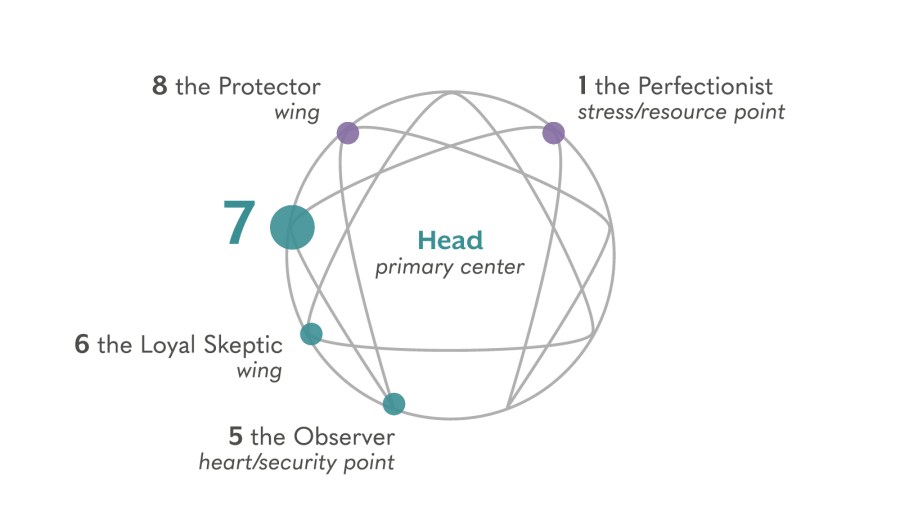
Note: The disintegration model in Enneagram theory is often presented as a stable directional map—types “move” under stress into predictable neighboring patterns. But in lived experience, this model can become overly schematic and psychologically flattening.
What it risks missing is that what looks like “disintegration” is often not a movement into another type, but a loss of functional integration across multiple systems at once: attention, affect regulation, impulse control, social adaptation, and narrative coherence do not shift in a single vector. They fragment unevenly.
In practice, what gets labeled as disintegration may include: regression into earlier learned coping strategies rather than type-specific movement; situational adaptation under constraint (not structural change); nervous system overload presenting as behavioral inconsistency; or simply fatigue states misread as typological drift.
The model also assumes a kind of psychological symmetry between integration and disintegration paths that is not always empirically supported. Integration often feels like increased flexibility and coherence, but “disintegration” can be indistinguishable from stress, grief, substance effects, sleep deprivation, or environmental pressure.
The core critique is therefore structural: The disintegration pathway is better understood as a metaphor for destabilization under load, not a reliable map of personality transformation.
Which means its value is poetic and heuristic, but limited as a diagnostic or predictive framework for actual human behavior over time.
Epigraph
These days I feel immune
To all the sadness and the gloom
If things fall into place
Get onto the right side of grace
— The Jesus and Mary Chain
Introduction and Thesis
This paper takes a direct and critical look at the Enneagram concept of the “direction of disintegration,” more recently reframed as the “stress point.” While various authors and teachers—including Don Richard Riso and Russ Hudson—have attempted to soften or reinterpret this terminology, the underlying assumption remains largely intact: that movement in one direction represents growth, while movement in the other reflects regression under stress.
This paper challenges that assumption directly. I argue that if one of the central aims of Enneagram work is to evolve through the full set of connecting points (for example, 5–8–2–4–1–7), then the so-called “direction of disintegration” cannot coherently be understood as purely regressive. On the contrary, it may represent a necessary and even ultimate phase of development—one that completes the circuit rather than deviating from it.
More specifically, I propose that what is commonly termed “disintegration” is better understood as the destabilizing emergence of previously repressed or underdeveloped capacities. Movement along these lines—particularly under conditions of stress—may therefore appear chaotic or maladaptive in the short term, while in fact reflecting the early stages of a deeper and more comprehensive integration. In this sense, the concept of “disintegration” does not merely mislabel the process; it obscures its developmental significance.
This perspective may be further illuminated by comparison with cyclical models of development, including certain strands of Buddhist thought, in which the movement from undifferentiated being through structured identity and back toward a more integrated state is understood as a continuous process. From this vantage point, the so-called “direction of disintegration” may be interpreted not as a fall from development, but as a return toward a more foundational mode of experience—one that has been obscured, rather than lost, in the formation of personality.
Personal and Theoretical Grounding
My interest in this question is not purely theoretical. From the outset, I found the concept of “disintegration” difficult to reconcile with lived experience—particularly in relation to my own type, Type 5. In the standard model, the Five is said to disintegrate toward Type 7, exhibiting scattered, excessive, or escapist tendencies under stress. While I recognize the descriptive accuracy of this account at certain levels of functioning, it does not fully capture the experiential reality of the movement.
In my own case, the movement toward 7 has not been merely regressive. On the contrary, it has often represented access to states that feel more expansive, embodied, and alive than the constrained intellectualism of the core Five structure. This raises a fundamental question: if the experiential quality of this movement can be described as more “whole” rather than less, in what sense can it be understood as disintegration?
One possible answer lies in the developmental origins of type itself. If personality structure is understood, as Don Richard Riso and Russ Hudson suggest, as a provisional adaptation formed in early childhood, then it is reasonable to ask what precedes that adaptation. It is at least conceivable that what emerges in the movement toward the so-called disintegration point is not simply dysfunction, but the reactivation of capacities that were present prior to the consolidation of type—capacities that were subsequently repressed in the service of psychological survival.
In this light, the apparent instability of “disintegration” may reflect not breakdown, but overload: the sudden return of domains of experience—such as sensation, spontaneity, or emotional intensity—that the personality has not yet learned to integrate. What appears as regression is, in this sense, the difficulty of expansion. The task is not to avoid this movement, but to engage it consciously, such that what begins as turbulence may ultimately become integration.
Literature Review: The Problem of Directionality in Enneagram Theory
The question of directional movement along the Enneagram’s lines of connection remains one of the least resolved and most inconsistently articulated aspects of the system. While widely taught using the language of “integration” and “disintegration,” there is no clear consensus in the literature regarding the precise meaning, function, or developmental significance of these movements. A review of major contributors to the field reveals a pattern of partial reformulation without full theoretical resolution.
The most influential articulation of directional movement appears in the work of Don Richard Riso and Russ Hudson, particularly in Personality Types (1987/1996) and The Wisdom of the Enneagram(1999). In this model, each type is understood to move along two lines: one toward “integration” (growth) and one toward “disintegration” (stress). Movement in the direction of integration is said to require conscious effort and corresponds to psychological health, while movement toward disintegration is described as automatic, reactive, and associated with declining levels of functioning.
However, this model contains an important and often overlooked tension. Riso and Hudson also suggest that the broader aim of Enneagram development is to move “around the circle,” integrating the positive capacities of all types over time. This implies that the points reached via the so-called direction of disintegration are not inherently pathological, but form part of a larger developmental sequence. The result is a structural ambiguity: movement toward a given point may be framed as regressive in one context and developmental in another, depending on whether it is understood locally (single-step movement) or globally (full-cycle integration). This inconsistency has not been fully resolved within their framework.
Subsequent authors have attempted to refine or reframe this model, often by softening the negative connotations of “disintegration” without fundamentally altering the underlying directional asymmetry. Sandra Maitri, for example, rejects the terminology of stress and disintegration and instead proposes an “inner flow” governed by what she describes as a “logic of the soul.” In her model, forward movement along the lines is driven by a search for fulfillment that ultimately proves unsatisfying, while backward movement leads toward what she terms the “heart point,” associated with a deeper layer of the self or “soul child.” While this approach usefully destabilizes the purely negative interpretation of one directional line, it replaces it with a different asymmetry, privileging backward movement as more essential to growth. Moreover, the conceptual basis of this model remains insufficiently specified, particularly in its account of how and why one direction should be considered developmentally primary.
Beatrice Chestnut builds on and systematizes aspects of Maitri’s approach, offering a more structured reinterpretation of the lines of connection. In her model, movement along both lines can be either constructive or maladaptive, depending on the level of awareness and integration involved. Terms such as “growth through stress” and “security point” attempt to capture the complexity of these dynamics, acknowledging that development may occur through challenge as well as stability. While this represents a significant advance in clarifying the bidirectional potential of the lines, it nevertheless retains an implicit directional logic and does not fully resolve the question of whether one direction should be considered primary, or whether the distinction itself is theoretically necessary.
Other contributors, including Tom Condon, have explicitly questioned the stability of unified directional models. Condon argues that individuals routinely access both connecting points under a range of conditions and that attempts to impose a single, consistent directional pathway oversimplify what is, in practice, a complex and dynamic psychological process. From this perspective, the notion of a fixed “direction of disintegration” becomes increasingly difficult to sustain, as both lines appear capable of expressing high and low functioning depending on context.
Across successive editions and public teachings, Russ Hudson has made a clear and commendable effort to soften the language surrounding the Enneagram’s directional model. Terms such as “disintegration” have increasingly been reframed as “stress,” and there is greater emphasis on the idea that no movement within the system is wholly negative. This shift toward more “warm” and less judgmental language reflects a broader maturation within the field and has undoubtedly made the system more accessible and psychologically usable.
At the same time, this evolution in terminology has not been matched by a corresponding clarification of the underlying theory. The central asymmetry—where one direction is implicitly associated with growth and the other with regression—remains largely intact, even as the language used to describe it has become more neutral. As a result, the model continues to carry an unresolved tension: it acknowledges that all points contain both higher and lower expressions, yet continues to treat movement toward certain points as fundamentally stress-based rather than developmentally necessary.
As other contributors have begun to explore more symmetrical and developmentally integrated interpretations of the lines, the persistence of the traditional asymmetry begins to feel less like a settled conclusion and more like an inherited assumption that has yet to be fully re-examined.
In this respect, the field appears to have reached a transitional stage. The vocabulary has evolved, the teaching has broadened, and important correctives have been introduced. Yet the underlying structure of the model—particularly with respect to directional movement—remains theoretically underdeveloped. For a system that places such emphasis on precision of language and clarity of inner dynamics, this gap is not insignificant. It suggests that what has often been treated as a foundational principle of the Enneagram may, in fact, remain an open question—one that calls for more direct and systematic reconsideration.
Applications: Reconsidering the Nine Directional Movements
If the preceding analysis is correct, then the implications must be demonstrated concretely across the system itself. What follows is a re-examination of each of the nine directional movements traditionally described as “disintegration.” In each case, I argue that what has been labeled regression can be more accurately understood as the activation of a higher function—a necessary but often turbulent phase of integration.
Type 1 → Type 4: Emotional Depth as Higher Function
In the conventional model, Type 1 “disintegrates” to Type 4, becoming moody, self-absorbed, and emotionally volatile. The principled, rule-oriented One—committed to order and correctness—appears to lose stability and fall into irrational feeling states.
However, this interpretation overlooks the rigidity inherent in the One’s structure. Ones tend to operate within strict internal frameworks, often fearing deviation from what is “right.” This can produce clarity and integrity, but also emotional constriction and black-and-white thinking.
Movement toward Type 4 introduces a necessary counterbalance: emotional depth, nuance, and subjectivity. The Four’s capacity for feeling, imagination, and romantic engagement allows the One to move beyond mere correctness into lived experience. What appears as instability may, in fact, be the early and uneven integration of emotional life. A One who cannot access this domain risks becoming brittle and overly moralistic. The 1 → 4 movement, properly integrated, expands the One’s humanity.
Type 2 → Type 8: Assertion as Higher Function
Type 2 is traditionally understood to “disintegrate” to Type 8, becoming aggressive, domineering, and self-centered. The caring, other-oriented Two is seen to abandon empathy in favor of force.
Yet the Two’s structure often involves excessive attunement to others at the expense of the self. Twos may defer, accommodate, and seek approval, losing touch with their own needs and convictions.
Movement toward Type 8 activates the capacity for directness, strength, and self-assertion. The Eight’s willingness to say “this is what I think” or “this is what I need” is precisely what the Two lacks when overextended. While this shift may initially appear abrupt or even confrontational, it represents a critical step toward autonomy. The 2 → 8 movement allows the Two to embody their own authority rather than living exclusively through others.
Type 3 → Type 9: Grounded Presence as Higher Function
In the standard model, Type 3 “disintegrates” to Type 9, becoming disengaged, complacent, and apathetic. The driven, success-oriented Three is seen to lose momentum and fall into inertia.
However, the Three’s relentless focus on achievement can lead to over-identification with external validation and performance. The constant pursuit of success may obscure deeper questions of meaning, connection, and being.
Movement toward Type 9 introduces stillness, acceptance, and presence. The Nine’s capacity to step out of striving and into being offers a necessary counterweight to the Three’s forward drive. This shift can soften the ego’s edge, allowing the individual to reconnect with others and with themselves beyond performance. What appears as loss of ambition may, at a higher level, represent the integration of humility and peace—qualities often observed in mature leaders who transition from personal success to collective contribution.
Type 4 → Type 2: Relational Engagement as Higher Function
Type 4 is said to “disintegrate” to Type 2, becoming needy, dependent, and overly focused on others for validation. The introspective, emotionally rich Four appears to lose depth and become externally fixated.
Yet the Four’s structure can incline toward solipsism—an intense inward focus on personal identity, feeling, and uniqueness. This can limit engagement with others and reinforce a sense of separation.
Movement toward Type 2 opens the Four to relational connection. The Two’s outward orientation—its attentiveness to the needs and feelings of others—provides a pathway out of self-absorption. While this may initially manifest as dependency, it also represents the development of empathy, generosity, and shared experience. The 4 → 2 movement enables the Four to participate in relationship rather than merely reflect upon it.
Type 5 → Type 7: Embodiment and Expansion as Higher Function
Type 5 “disintegrates” to Type 7 in the traditional model, becoming scattered, impulsive, and escapist. The focused, analytical Five is seen to lose coherence and retreat into distraction.
In practice, however, the Five’s core challenge lies in over-withdrawal into the mind. The Five often privileges thought over experience, constructing elaborate internal systems while remaining detached from immediate reality.
Movement toward Type 7 activates sensation, spontaneity, and engagement with life. The Seven’s openness to experience allows the Five to step out of abstraction and into embodied presence. In my own experience, this movement has not been merely destabilizing but profoundly enlivening—an entry into states of being that feel more whole and integrated than the Five’s default stance. The initial excesses of this shift reflect the difficulty of integrating long-repressed domains, not their inherent dysfunction.
Type 6 → Type 3: Self-Confidence and Agency as Higher Function
Type 6 is said to “disintegrate” to Type 3, becoming competitive, image-conscious, and arrogant. The loyal, cautious Six appears to abandon its grounded nature in favor of performance.
However, the Six’s strengths—commitment, vigilance, and reliability—can become limiting when accompanied by self-doubt and over-reliance on external validation. Sixes may hesitate to act decisively, seeking reassurance rather than asserting direction.
Movement toward Type 3 introduces confidence, initiative, and forward momentum. The Three’s capacity to act, to lead, and to project capability is precisely what the Six requires to move beyond hesitation. While this may initially appear as overcompensation, it represents the development of self-trust. The 6 → 3 movement allows the Six to step into authority rather than continually deferring it.
Type 7 → Type 1: Structure and Discipline as Higher Function
Type 7 “disintegrates” to Type 1, becoming critical, rigid, and constrained. The free-spirited, pleasure-seeking Seven is seen to lose joy and become moralistic.
Yet the Seven’s pursuit of experience can lead to fragmentation—constant movement without depth or completion. Avoidance of discomfort may prevent sustained engagement with reality.
Movement toward Type 1 provides structure, discipline, and ethical grounding. The One’s capacity for focus and follow-through allows the Seven to channel its energy into meaningful action. While this shift may feel restrictive at first, it enables coherence and purpose. Real-life trajectories often reflect this movement, as individuals transition from restless seeking to grounded commitment, finding stability where previously there was only motion.
Type 8 → Type 5: Reflection and Restraint as Higher Function
Type 8 is said to “disintegrate” to Type 5, becoming withdrawn, secretive, and overly cerebral. The powerful, action-oriented Eight appears to retreat into isolation.
However, the Eight’s strength can become overextended, leading to dominance and a lack of reflection. Constant outward force may limit the ability to process experience or consider alternative perspectives.
Movement toward Type 5 introduces introspection, analysis, and restraint. The Five’s capacity to step back allows the Eight to refine its actions with insight. This shift does not diminish strength but deepens it, transforming immediate power into considered leadership. The 8 → 5 movement enables the Eight to lead with both force and understanding.
Type 9 → Type 6: Engagement and Commitment as Higher Function
Type 9 “disintegrates” to Type 6, becoming anxious, reactive, and worried. The calm, accommodating Nine appears to lose peace and stability.
Yet the Nine’s desire for harmony can lead to passivity and avoidance. By minimizing conflict, the Nine may disengage from necessary challenges and from their own priorities.
Movement toward Type 6 activates engagement, vigilance, and commitment. The Six’s attentiveness to potential problems encourages the Nine to confront rather than avoid difficulty. While this may introduce anxiety, it also fosters responsibility and active participation. The 9 → 6 movement transforms passive peace into engaged stability, grounded in awareness rather than avoidance.
Conclusion
This paper does not claim to offer a final or definitive resolution to the question of directional movement within the Enneagram. The system itself remains, by the admission of its most influential contributors, a work in progress. What has been offered here is a more limited but, I would argue, necessary intervention: a direct challenge to the prevailing assumption that one line of connection represents “integration” while the other represents “disintegration” or regression under stress.
The analysis presented suggests that this distinction, while historically influential, is conceptually unstable and developmentally incomplete.At a broader level, the persistence of this framework points to a certain hesitation within the field. There remains, at times, a noticeable deference to the foundational formulations of Don Richard Riso and Russ Hudson—a deference that is understandable given their substantial contributions, but which may also inhibit more direct re-examination of their assumptions.
Foundational work deserves respect; it does not require preservation in its original form. In a living field, even the most influential models must remain open to revision where they no longer adequately account for observed experience.The evidence considered here—both theoretical and experiential—suggests that movement along the so-called “direction of disintegration” is not inherently regressive, but often represents the activation of underdeveloped capacities essential for full psychological integration. While this movement may initially appear chaotic or destabilizing, it is better understood as the early phase of expansion rather than contraction. To continue to frame it primarily in terms of breakdown risks obscuring one of the Enneagram’s most valuable insights: that growth frequently occurs through precisely those domains the personality has learned to avoid.If this paper has a broader aim, it is simply to encourage a more direct and less deferential conversation about this aspect of Enneagram theory.
The language of “integration” and “disintegration” has had a long and influential run, but its limitations are increasingly apparent. All theoretical systems, if they are to remain vital, must be willing to outgrow their earlier formulations. It is in that spirit that this argument is offered—not as a final word, but as a contribution toward moving the discussion forward.
Dedication.:
For Tom Condon, the GOAT. And for Lynn.
Note: If you enjoyed this piece you may also like the piece below which also takes up the topic of the Enneagram.