On the Film “My Dinner with Andre” Part I: Wally in New York

Note: Opening a multi-part early series from my first blog Classical Sympathies back in 2009, this piece takes up the beginning of Wallace Shawn’s walk through New York en route to his meeting with André Gregory in My Dinner with Andre, using Wally’s voice-over as a lens on artistic precarity, everyday survival, and the comic disproportion between existential weight and mundane errands. The note situates the film’s opening movement as both narrative setup and philosophical framing: a winter city of post offices, xerox shops, and unanswered calls becomes the psychological prelude to a conversation that will later expand into memory, performance, and self-mythology. This installment follows Wally up to his arrival at the restaurant for the pre-dinner drink, where the film’s central encounter is still suspended in anticipation, and meaning is generated less by action than by the act of getting there.

My Dinner with Andre is the famous, or infamous, 1981 film of a dinner conversation between Wallace Shawn, the actor and playwright, and Andre Gregory, the theater director. If I were to make a twofold claim for the film: i) that it is one of the most action packed films ever made, and ii) that it effectively encapsulates the thematics of the entire 20th century, I do not think this would be overstatement. My intent here, however, is not to establish either of these postulates, but rather to simply “blog” the script in the hopes that what needs to be said works its way to the surface. Fair warning: the undertaking will require several posts.

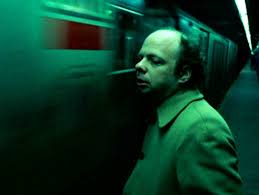
Money crops up on two of the first three pages of the script, and because money, and the lack of it, is a theme that runs beneath the entire script: Andre has money, has the freedom to travel and to spend several years trying to “find himself”; Wally does not. Still, “having money” is, as ever, a relative concept. At the opening of the film, Wally is seen walking through the streets of New York, heading for the restaurant where he is to meet Andre. It appears to be winter, maybe February. In the opening voice-over, Wally ruminates on the life of the artist: The life of a playwright is tough. It’s not easy, as some people seem to think. You work hard writing plays, and nobody puts them on. You take up other lines of work to try to make a living–acting, in my case–and people don’t hire you. So you spend your days crossing the city back and forth doing the errands of your trade. Today wasn’t any easier than any other day. I’d had to be up by ten to make some important phone calls, then I’d gone to the stationary store to buy envelopes, and then to the xerox shop. There were dozens of things to do. By five o’clock I’d finally made it to the post office and mailed off several copies of my plays, meanwhile checking constantly with my answering service to see if my agent had called with any acting work. In the morning, the mailbox had been stuffed with bills. What was I supposed to do? How was I supposed to pay them? After all, I was doing my best (17).

One of the marvelous things about the film is the tongue-in-cheek humor that is rarely, if ever, directly alluded to. A deeply serious film, Andre is also a comedy, a fact which we can recognize because we see that the writers are having fun with the characters who are in turn themselves. That is, Wally and Andre are playing versions of themselves–we assume that most of the experiences that Andre recounts in the film are based on real experiences, and that Wally’s account of his home life is more or less true to life–but exaggerated versions. As Shawn says in the preface to the script, “I knew immediately that {…} I’d have to distort us both slightly–our conflicts would have to become sharpened–we’d have to become–well–characters {…} It would be an enormously elaborate piece of construction” (14). In this initial passage, the humor lies in Wally’s conception of a difficult life: “I’d had to be up by ten to make some important phone calls.”

Wally’s sense of pressure is, from the outset, deliberately out of proportion to the scale of his circumstances. The tone is one of genuine complaint, but the complaint itself is almost comically domestic: the architecture of a “hard day” is built out of errands, envelopes, xerox shops, and an answering service that may or may not contain salvation in the form of an acting job. What Shawn achieves here, and what the film quietly sustains, is a recalibration of seriousness—where existential weight is not attached to grand events but to the texture of administrative survival. Wally’s New York is not a place of romance or revelation, but of circulation: between post office, mailbox, and telephone, as though modern artistic life has been reduced to a loop of deferred contact with recognition.

At the same time, the humor is never fully separable from sincerity. Wally is not merely being mocked; he is also articulating a recognisable condition of artistic precarity, one that the film refuses to glamorize. The genius of the opening monologue lies in this double register: we are invited to laugh at the disproportion between emotional tone and material fact, but we are also made to recognise how easily that disproportion becomes a lived reality. The “dozens of things to do” are not nothing; they are just insufficiently legible as crisis, which is precisely what makes them feel like crisis.

By the time Wally finally moves through the city toward the restaurant, the structure of the film has already been quietly established: this is a world in which meaning is not delivered through events but through the way events are narrated to oneself while walking between obligations. New York, in this sense, is not a backdrop but a medium of self-composition—an environment in which thought is constantly being assembled under mild pressure, as though consciousness itself were an errand.

He checks the time again, as he has been doing throughout the afternoon, and adjusts his route slightly, not out of urgency so much as orientation. The meeting with André already exists in his mind as something slightly unreal, a fixed appointment that has not yet been granted substance by arrival. He crosses another block, passes into the thinning evening light, and begins to approach the restaurant where, for the first time that day, the structure of waiting will shift from solitary to shared.

to be continued…

The Most Insane People of All Time (aka You’re Outta Control!): #2 John McAfee

Note: This second installment in The Most Insane People of All Time (aka You’re Outta Control) looks at John McAfee, tracing his evolution from software pioneer to global fugitive, crypto evangelist, and online cult figure. The piece emphasizes the improvisational chaos of his later life and contrasts it with more conventional tech figures like Elon Musk and Bill Gates, arguing that McAfee’s volatility places him in a category of his own. The tone is impressionistic, comparative, and intentionally informal.

Epigraph: 

“I fought the law and the law won…”

— I Fought the Law, The Clash

John McAfee starts in relatively conventional fashion: brilliant programmer, eccentric personality, builds the first widely adopted consumer antivirus software in the late 1980s, and becomes extremely wealthy when McAfee Associates takes off. But even in the early years there’s instability, and a foreshadowing of things to come — drug use, paranoia, erratic business decisions, and a growing anti-authority streak. He sells his stake, drifts through various ventures, and by the late 2000s relocates to Central America, eventually settling in Belize. There he buys beachfront property, hires armed guards, collects dogs, experiments with quasi-scientific projects, and begins acting like a semi-autonomous local strongman. It’s the first fully “outta control” phase: money, isolation, guns, and a man already well inclined toward paranoia.

Then comes the neighbor incident. In 2012, McAfee’s American neighbor, Gregory Faull, is found murdered. McAfee is named a person of interest — never charged — and instead of lying low, he goes fully theatrical. He claims the authorities are targeting him, allegedly evades police by hiding, disguising himself, and moving between safe houses, all while giving interviews and live-tweeting the saga. With girlfriend (later wife) Janice McAfee and various associates in tow, he flees Belize, surfaces in Guatemala, is detained, then ultimately allowed back to the United States. The whole episode is surreal: a tech millionaire allegedly on the run for murder, narrating the chase in real time on social media. It’s not just outta control — it’s performance art.

Back in the U.S., McAfee briefly lands in Florida but quickly re-enters chaos. He promotes cryptocurrencies, launches bizarre tokens, courts publicity, and cultivates a global cult following. He posts paranoid threads about surveillance, claims he lives inside Faraday cages, talks about government plots, and offers wild schemes — including promises to evade arrest by sea, air, or even paragliding into New Mexico to meet with fans! He pops up in unexpected places, from Caribbean boats to European cities, always accompanied by Janice and a rotating cast of loyalists. At one point he tattoos crypto branding onto himself, predicts conspiracies, and positions himself as both fugitive and prophet. The line between performance and belief dissolves completely.

Eventually, legal trouble catches up. U.S. authorities charge him with tax evasion and crypto-related fraud, and he’s arrested in Spain in 2020. From prison he continues tweeting through intermediaries, hinting at conspiracies and insisting he’ll never kill himself. In June 2021, shortly after a Spanish court approves extradition to the United States, McAfee is found dead in his cell — ruled a suicide. His supporters, including Janice, immediately dispute the finding, pointing to earlier posts and tattoos as supposed foreshadowing. The ending is as chaotic as the life: software pioneer turned fugitive, Twitter antihero, crypto evangelist, paranoid showman, and finally a death that only deepened the mythology. Outta control doesn’t even begin to cover it.

Compared to John McAfee, figures like Elon Musk and Bill Gates still look almost conventional — even when they drift into odd territory. Musk’s public persona is chaotic in a very modern way: late-night posting, impulsive announcements, awkward humor, and personal-life theatrics. The relationship with Grimes, the bizarre naming of children, and the infamous weekend when Azealia Banks claimed she was stranded at Musk’s house amid talk of LSD and general weirdness all add to the sense of volatility. Then there are the dad-joke moments — hauling a sink into Twitter headquarters and posting “let that sink in,” which is either performance art or just terrible humor. It’s eccentric, sometimes cringe, occasionally outta control — but the companies still run, rockets still launch, and the chaos never fully escapes the bounds of reality.

Gates, by contrast, is a more old-school eccentric. Bill Gates has the reputation of a hyper-competitive young executive who mellowed into a philanthropic technocrat, but the quirks linger. The awkward dancing, the slightly rumpled appearance, the perennial jokes about dandruff — he has always projected a kind of brilliant-but-uncool energy. The later-life turbulence — divorce from Melinda after decades, scrutiny over his contacts with Jeffrey Epstein, and the general aura of a private billionaire navigating public controversy — adds complexity but not chaos. Gates remains structured, Musk volatile, but both operate within functioning systems. McAfee, meanwhile, is something else entirely: not just eccentric but improvisationally unstable, a man who turned paranoia, fugitivity, and spectacle into a lifestyle. Musk may be chaotic, Gates may be awkward, but McAfee is outta control in a different register altogether.

In the end, John McAfee feels more outta control than Keith Raniere, Elon Musk, or Bill Gates — and that’s saying something. Raniere was creepy and manipulative but small; Musk is chaotic but still tethered to real-world outcomes; Gates is eccentric but fundamentally structured. McAfee, by contrast, seemed to live entirely outside normal constraints. Guns, boats, dogs, girlfriends, crypto tokens, Faraday cages, live-tweeting alleged manhunts, promising wild escapes, drifting between countries — the whole thing reads less like a biography and more like a fever dream. He wasn’t just eccentric; he appeared to improvise his life day by day, escalating the spectacle each time. That kind of volatility is rare. It’s also why he became a cult hero: he embodied a fantasy of total freedom, however reckless, however unsustainable.

Years after his death, the mythology hasn’t faded. Supporters still debate the circumstances, quote his tweets, and treat him as a kind of outlaw technologist who refused to play by the rules. Whether you see him as mad genius, performance artist, or cautionary tale, the scale of the chaos is undeniable. There may have been more dangerous figures, more powerful figures, even more tragic figures — but few as consistently, flamboyantly outta control. That’s what makes McAfee a legend. Not admirable, not necessarily likable, but unforgettable. And like all true originals, there probably won’t be another. So RIP, prayers up, and pour one out for a real one, John Motherfucking McAfee.

Note: If you liked this piece, you may also like the other ones in out “You’re Outta Control” series.