Don’t Pump Me Man!

Note: Spokane, early 1983: minor league baseball, cheap seats, and kids living in the gaps between innings. This piece recalls Spokane Indians games, chasing balls during batting practice, and a strange collision of childhood mischief and adult volatility at the edge of the outfield fence. Sandy Alomar Jr.—then a local catcher on his way to a long MLB career—signs a baseball in handwriting so precise it feels like a signature on a future already underway, while a moment of chaos involving thrown persimmons and a furious adult named Mike Trowbridge becomes the kind of story that sticks far longer than the season itself.


Epigraph:

Do you know who you’re fucking with?/ You’re fucking with a stallion mange.

Ween

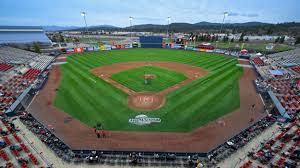
It was 1983 in Spokane, the kind of summer that felt permanently suspended in late light and dry heat, where the air at night still carried the dust of the day like it had nowhere else to go. We played Little League baseball in uniforms that never quite fit right, and then on weekends we graduated to something bigger and looser and more important: Spokane Indians games at the old stadium, Single A ball, where the dreams were real and still close enough to touch.

The Spokane Indians were a kind of civic promise back then. It was a small town, and in the early 1980s there wasn’t always a lot going on. The Indians were not quite big league, but not quite nothing. Just enough baseball to make you believe that something important was always one bus ride away. The seats were cheap, the beer cheaper, and the fences closer than they should have been. The whole place had that slightly improvised feel—like the city had built it thinking, this will do for now.

We didn’t go to games like spectators. We went like we belonged.

Behind the outfield wall during batting practice, kids gathered like scavengers. We chased homers, argued over balls, sprinted through patches of grass worn down by repetition. Sometimes we were the only ones back there. Sometimes there were older kids, or dads, or random locals who knew the angles better than we did. It was a loose territory. Not quite policed. Not quite ours. Something in between.

That summer, the Indians had a catcher everyone knew. Local kid. Quiet confidence. Clean mechanics. The kind of player adults already talked about like he had a future attached to him.

Sandy Alomar Jr. was that guy even then—before the long MLB career, before the All-Star years, before anyone outside Spokane would know the name properly. He was already different. You could see it in the way he stood when he wasn’t moving, like he was always half a second ahead of the next pitch.

I got his autograph once. It wasn’t dramatic. Just a moment after BP, when he signed a ball for a cluster of kids leaning too far over a rail. His handwriting was unexpectedly beautiful—controlled, deliberate, almost elegant in a way that didn’t match the dirt and sweat of the field. I remember thinking even then: this is what someone looks like when they’re going somewhere.

I kept that ball for years.

Because baseball wasn’t just baseball. It was a hierarchy you could see. You had the guys who were going to make it, the guys who might make it, and the rest of us orbiting the idea that proximity alone might transfer something.

Most of them wouldn’t go anywhere. That was obvious even then, though nobody said it out loud. But that day, none of that mattered yet. What mattered was the fence.

Our party was up high in the stands on the first base side, just beyond where the stadium fence met a thin strip of wild space. A tree had grown there—some kind of fruit tree, nobody was ever fully sure what it was. Persimmons, maybe. Something orange-red and heavy-looking, the kind of fruit that doesn’t look like it should be thrown but absolutely is.

Some kids started throwing them. Just kids, just fucking around. But they didn’t know who they were fucking with. Fuck with me and I’ll fuck with you.

The fruit flew. Not carefully. Not aimlessly either. More like experimentation. Testing distance. Testing reactions. Some of them were aiming at fans, others just launching them over the fence because it felt like something you could do if no one stopped you.

It was mildly funny at first. Then mildly annoying. Then mildly dangerous in a way that nobody fully acknowledged.

Because persimmons, if that’s what they were, aren’t soft. They hit like small decisions.

I remember one bouncing near a row of seats and rolling under a foot. Someone laughed. Someone else shouted. But nobody moved with urgency yet. It was still in the category of “kids being kids.”

Until Mike Trowbridge noticed.

Mike T was there with his kids—David Trowbridge and his sister Dawn. David had been a teammate of mine in Little League, a few years younger, outfield guy, quiet in the way younger kids sometimes are when they’re still deciding how loud they’re allowed to be. Dawn was just there in the background of everything, observing.

Their dad, Mike, was not background.

He was one of those adults you noticed before you understood why. Volatile energy. Tight posture. Goatee, black tank top, gold chains around his neck. A bit of a greaser; drove a Harley. Always slightly too close to losing his temper. He wasn’t a bad guy exactly—he could laugh, he could talk—but you always felt like there was a second version of him sitting just under the surface.

He saw the fruit being thrown. And something in him snapped into motion. He walked straight to the fence line, fast enough that it changed the temperature of the moment.

“Knock that shit off right now,” he yelled.

The kids paused. Not because they were scared exactly, but because the voice had weight.

Then one of them—small kid, maybe ten, sunburned confidence, the kind of kid who doesn’t fully understand consequences yet—looked up and said:

“Don’t pump me, man.”

It was such a strange sentence. Too casual for the situation. Too confident for the speaker. Like he had borrowed it from somewhere older and wasn’t sure how it fit yet.

There was a beat of silence where the entire stadium noise seemed to pull back slightly.

Mike T looked at him.

“Don’t pump me?” he said.

Then his voice shifted.

“You want me to pump you? I’ll pump you.”

And in that moment—this is the part that still feels unreal even now—he climbed the fence. Not slowly. Not theatrically. Just decisively. Like the boundary wasn’t a boundary at all.

Everything changed at once.

Me, David, Dawn—everyone nearby—we all froze in that wide-eyed way kids do when they realize the rules might not hold. It wasn’t comedy anymore. It wasn’t baseball anymore.

It was just: Mikey baby don’t kill that kid.

That’s what it felt like in my head. Not words were spoken, just panic translated into something almost verbal.

The kids scattered instantly. Full sprint. No hesitation. The fruit stopped mid-air and dropped forgotten. The stadium behind us suddenly felt far away, like it belonged to a different scene entirely.

Mike T took a step forward, still inside the fenced edge of this improvised battlefield, breathing hard, still locked in that strange overlap between anger and disbelief.

And then—somehow—it was over. No actual violence. No contact. Just the threat of it, large enough to erase the mischief that had caused it.

The kids were gone. The fruit stopped flying. The tree stood there like nothing had happened. Afterwards, the stadium noise came back slowly, like a system rebooting.

My dad, Ross, had seen the whole thing. He was laughing, hard. Not the kind of polite laugh adults do when they think they’re supposed to. This was involuntary. Almost helpless. The kind of laugh that tries to stay respectful but can’t quite hold the line.

Because it was funny. In that terrible, chaotic way childhood sometimes is when it brushes up against adult intensity and survives without breaking.

Ross would tell that story for years after. The kid. The fence. The persimmons. The line: don’t pump me man. He never stopped laughing at that part.

Neither did I.

But at the time, I just stood there thinking about Sandy Alomar Jr. somewhere on that field, already on his way to something else entirely, signing baseballs in beautiful handwriting, while right behind the stadium wall the rest of us were learning the difference between games and consequences in real time.

Most of us wouldn’t make it to the Bigs. But for one afternoon in 1983, it all felt like it might matter just the same.was 1983 in Spokane, the kind of summer that felt permanently suspended in late light and dry heat, where the air at night still carried the dust of the day like it had nowhere else to go.

But for one afternoon in 1983, it all felt like it might matter just the same.

Dedication:

For Mike T. And for the kid. You got balls young man, I’ll say that.

Scenes from Hamilton College VI: Junior Year in New Zealand

Note: This is Part VI of the Hamilton series. Part I, Part II, Part III, and Part IV and Part V are available.

Epigraph:

They all come and peep through a hole in the wall
Keep the bastards guessing
He likes to take the long way home,
It’s another fine decision

Peter Jefferies

I spent a full academic year, the second semester of my junior year and the first of my senior year, at The University of Otago in Dunedin, New Zealand. Otago is a pretty good university, but Dunedin is pretty small and kind of country. Overall, it was a good experience, but I was flat broke and not on a meal plan due to an oversight by I guess myself and my parents. More on that later.

After I landed, I spent one night at a hotel and bought a bottle of wine, for the first time in my life. I was of legal drinking age in New Zealand. I drank about three-quarters of it and was a little hungover the next day. At Hamilton people did not drink wine.

The first few days I was on a homestay in the country with a sheep farming family. The father spent the day watching cricket, and then would rouse and take the sheep out and move them around, with sheepdogs and all. I remember going to a local pub with two of his sons and their friends and we had five or six beers and they drove home. On the drive home they tried to run over rabbits on the road, and roared with delight when they got close. That was a scene.

Then, I went back to Dunedin, and met my roommates who were all in graduate school studying to be teachers. These were Tim, Ho (who was of Maori descent), Sharlene, and Donna. Tim was a musician and there was a large piano in his room. The roommates were good folks, however I think I disappointed them a little because they asked for an American roommate and were apparently expecting someone really flamboyant and loud. I was not that, and kept to myself much of the year. One time though that I lived up to their expectations was when Tim once again said “you’re from Washington D.C.” and I said “I’m not from fucking Washington D.C., I told you before I’m from Washington State!” Tim said to the roommates, “I told you rooming with an American would be fun.”

There were a number of other exchange students from the U.S. there and I got to know some of them a bit at first, but for some reason I was a little standoffish, and we didn’t hang out much after the first week or so. I was back into running, not smoking and barely drinking, although I did go out once with Ho and his Maori friends and got blasted. I would run 8-10 miles a day, sometimes more, and was in training for a marathon.

As I mentioned, my food situation was bad. We had neglected to put me on a meal plan, and I think my parents didn’t even know this, and at first I chipped in what I could to the communal roommate shopping. However, they ate very poor quality mutton all the time and I just couldn’t hack it. Mutton is pretty bad at the best of times, and cheap mutton is awful. So I went off the roommate plan and ate mostly trail mix for dinner. Trail mix, it turns out, is among the best value for money food around. I would buy raisins, peanuts, and carob chips and that’s what I ate at the flat. For lunch I would eat one apricot yoghurt bar and a cup of coffee, costing around $3.50 NZD. I would eat super slowly, taking about 45 minutes to finish the apricot bar and somehow this made me feel like I’d had a meal. I was living on about $7 NZD a day and was hungry all the time. With this and the running, I was also super thin.

At Otago I studied some more literature, and also a lot of Indian History, with a focus on Ghandi. I learned a great deal about Gandhi this year, and found him interesting. One incident I recall was in one class on Buddhism the professor assigned a paper on Zen. I had the bright idea to turn in an empty paper, which I thought would be symbolic, but the professor was a step ahead of me. “Don’t try and turn in an empty paper for this,” he said, “I’ve seen that move before.”

One more interesting thing that happened was when I was invited to the faculty club for drinks by my Australian literature professor. He was in his 60’s and was an Otago lifer. At first I was kind of flattered to be invited, however on arrival it was clear he had other motives. He started hitting on me in a most egregious manner, and it was obvious he had done this many, many times. I had two drinks and politely removed myself. To his credit this had no impact on how he treated me in class, and things went on as normal. I guess it was all par for the course.

The Otago campus was on the north side of town, and the south side was said to be pretty rough. “Don’t go down there,” I was told more than once, “it’s dangerous.” But I thought it couldn’t be that dangerous, so one day I walked down there by myself to check it out. There were a lot of industrial areas and such, and it was a little run-down, but I got home safe just fine. I suspected that “dangerous” in a New Zealand context might mean something a little different than in a U.S. context.

My roommate Sharlene had a friend who just had a breakup and Sharlene wanted us to get together. She invited us both to a party, and sure enough we started making out, under a table as I recall. It just lasted that one night, but Sharlene thought it was hilarious. “They were pashing,” she cried, “pashing away.” Pashing is apparently Kiwi slang for kissing, or maybe it was a Sharlene original.

Sharlene had a stepfather and I visited his house once. He had a nice car and complained on and on about how many tickets he would get from traffic cameras. Traffic cameras were on the scene in 1995. This appeared to be his only topic. He should have driven more carefully.

After the pashing incident, there was another girl who was interested in me. I forget her name, but it started with an M. M. was really into me, maybe because I read a lot and so did she. There was a kind of club place for students with TVs (I remember watching the O.J. Simpson car chase there), and I would hang out there. M. would come in and lob a snickers bar from over my shoulder for me and buy me a coke. This was really nice and super helpful because I needed all the calories I could get. M. wanted to get together, but I wasn’t into it. We did spend a fair amount of time together, at the club and going to the bookstore with another friend of hers.

As I mentioned, I was in good running shape this year and actually went out for a marathon. I was doing great through the first half, but started to fade really bad around the 20 mile mark. I had terrible blisters and pulled my groin and couldn’t imagine doing another 6 miles, so I pulled up. I asked a couple with a car for a ride to the finish line where there were buses, and they gave it to me but made it clear they were not impressed with me packing it in. I wasn’t impressed with myself either, but marathons hurt like hell.

In addition to running, and starving, I also went out for Aikido. Aikido is a Japanese martial art, and I was already well on my way to my Asian Studies minor and was getting into all things Asian. Aikido was taught by a white couple, and this was their life. They were ok teachers, but the atmosphere was just a little culty. Despite my father’s fears, I have never been amenable to cults-like scenes. I stuck with it for a number of months however, and managed to get my first belt.

I don’t remember listening to a lot of music that year because I don’t think I had a stereo in my room, however, one day on the radio I did hear a song I immediately fell in love with. This was “The Fate of the Human Carbine,” by a Dunedin artist called Peter Jefferies. It was spooky and weird and totally captivating. Cat Power would later cover it, and lines from this song serve as the epigraph for this piece.

One more thing that happened this year was that Jenny from Hamilton visited. I don’t think she came specifically to see me, but I’m not sure. I was traveling, with god knows what money, in the New Zealand Alps which are on the South Island there and are really lovely. Jenny and I stayed at a hostel, and hung out which was really cool. That’s the same trip when I went for a walk in deep snow and almost died when the snow suddenly came up to my neck. Deep snow is almost as dangerous as the ocean, it turns out.

Those are my memories of New Zealand. Despite being so broke I had to eat a 45 minute apricot bar, it was a good year and I got really good grades. My academic focus would fall off, however, when I got back to Hamilton, but that’s a story for the next post.

Dedication:

For apricot bars and trail mix. You literally saved my life.