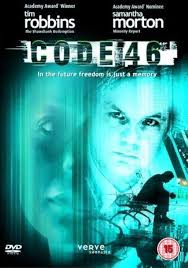
Review of the Film Code 46

Note: We don’t do a lot of film reviews here, but Code 46 earns the exception—partly because Michael Winterbottom is one of my very favorite directors, and still wildly underrated, and partly because this film quietly seeps into you in a way that feels unshakable; set in a world that is clearly not ours but just similar enough to be discomforting—real Shanghai that isn’t quite real, deserts that feel earned, a system of “cover” and genetic law that replaces freedom without ever announcing itself—the film follows William, a kind of intuitive investigator who lives more than feels, and Maria, who works in a bureaucratic “fate factory” and senses, before she knows, that something is already off; their connection unfolds in fragments—interrogation as flirtation, impulse as rebellion, intimacy as violation—until the central truth emerges: in a world where memory can be edited and biology legislated, even love itself can be illegal; the genius of the film is its restraint.

Tim Robbins and Samantha Morton don’t overwhelm you with chemistry, which actually makes the relationship feel more provisional, more real, more doomed—and by the time the system reasserts itself (memory erased, lives restored, Maria exiled with the burden of remembering), you realize the film hasn’t been building to a climax so much as a quiet erasure; it’s less than 90 minutes, barely announces its futurism beyond small details (languages blending, empathy viruses, low-fi surveillance), and yet it lingers in a way much louder films don’t; it also clearly fed into the DNA of the Thin Man—this idea of movement through controlled spaces, of intuition over evidence, of relationships that feel both fated and structurally impossible—and in that sense it’s not just a film I admire, it’s one that got under the skin and stayed there.

Michael Winterbottom’s Code 46 is less a conventional sci-fi film than a drifting, half-lucid meditation on love, control, and memory. It runs under 90 minutes, but it feels strangely elongated—like a dream you keep slipping back into.

The hero, William (Tim Robbins), isn’t exactly living—he’s existing. A kind of insurance investigator, a “driver” moving through a world defined by pollution, restriction, and bureaucratic control. This isn’t the neon overload of something like Blade Runner—Shanghai here feels real, but off. The deserts outside the cities are harsh and empty; if people can’t get “cover” to move, there’s a reason. The world is closed, stratified, quietly oppressive.

William is established early as compassionate—at a checkpoint, he shows a kind of human softness that marks him apart. But he’s also slippery. He bluffs and charms his way through situations, his “cunning” explicitly noted as one of his professional tools. He doesn’t rely on evidence so much as intuition: “It’s intuition you’re paying for.”

Maria (Samantha Morton) narrates parts of the film, grounding it in something more intimate and unstable. Her sense of time is fractured—lucid dreaming, recurring visions, a sense that something is about to happen. “Every year I have this dream… is this the night I wake?” There’s a constant feeling that fate is closing in. She works in what is essentially a “fate factory,” issuing the cover documents that determine where people can go and what they can do. In this world, fate substitutes for freedom.

When William meets Maria, there’s an immediate sense of déjà vu—she feels she’s met him before. Their early interactions blend interrogation and flirtation. The dynamic is unusual: older man, younger woman, but the aesthetic—her shaved head, the stripped-down environments—blunts the cliché. Their connection feels tentative, exploratory. She tests him; he reads her. There’s attraction, but it’s not fully trusted on either side.

Their relationship develops in fragments: subway encounters, shared meals, small rule-breaking gestures. William knows she’s impulsive—she admits it. The film introduces the idea of engineered “viruses” that alter human ability—perfect pitch, empathy. It’s a strange, understated sci-fi touch that reinforces how mediated everything is, even emotion.

There’s a looseness to their chemistry. Robbins and Morton don’t generate overwhelming heat, but that actually works. The relationship feels uncertain, provisional—two people circling something they don’t fully understand. Their intimacy is uneven, sometimes tentative, sometimes urgent. Maria seems to need William more than he needs her, or at least she feels the stakes more sharply.

The world around them continues to intrude. There are hints of smuggling, of bureaucratic corruption, of quiet desperation. Maria has lived “outside” for ten years—without cover, presumably—which raises questions the film never fully answers. William’s moral stance, when it emerges, feels weak, almost performative.

When he returns home, he tries to reassert control—rejecting Maria, then calling her back. But the narrative destabilizes. A colleague dies; William is sent back to investigate. The technology—video links, surveillance—feels oddly low-fi, as if the future never quite fully arrived.

As William digs deeper, the film’s central taboo emerges. Maria has violated Code 46—a genetic restriction law. Through fragments of dialogue and investigation, William pieces together the truth: they are biologically too similar. A “50% match.” Worse, her mother was a clone—one of many. The implications are quietly devastating.

Maria’s past is altered—an illegal pregnancy erased, along with the associated “memory cluster.” Identity itself becomes unstable. Memory, love, and experience can all be edited, removed, rewritten.

Their attempts to escape—to flee together, to build something outside the system—feel almost doomed from the start. The idea of Jebel Ali, drawn from her father’s stories, becomes a kind of imagined refuge. But the system closes in. A car crash. Memory erasure. Reintegration.

In the end, William is returned home, restored to his life, his wife, his routine. Covered for. Maria, by contrast, is exiled—sent out into the desert with her memories intact. She becomes the one who remembers, who carries the weight of what happened.

The final note is pure loss. Lost love, stripped of even the possibility of reunion. Maria staring out into the distance, holding onto something the world has decided should not exist.

Code 46 is not a perfect film. It’s uneven, sometimes opaque, and emotionally muted in ways that can frustrate. But its ideas linger. It captures something rare: a future where control is soft but absolute, where love is possible but prohibited, and where memory itself becomes the final battleground.

It doesn’t hit you all at once. It seeps in.

On Four Adventures of Tintin

Note: This essay takes up my personal four favorite books from the marvelous Adventures of Tintin series. I make no claim for these to be the best, and the list omits the very popular Moon books, however this is the list as it stands. I hope you enjoy Tintin as much as I do, and as always, thank you for reading.

Epigraph:

First Encounter

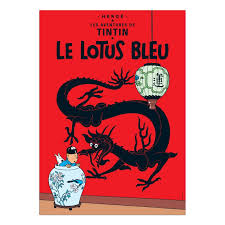
I first encountered Tintin in Grade 5, checking two slim volumes out of my elementary school library: The Blue Lotus and Tintin in America. I remember the physicality of them—the glossy covers, the bright blocks of color, the uncanny clarity of the drawings. They felt different from the other books on the shelf. Most children’s adventure stories required you to imagine the action. Tintin showed it to you panel by panel, with a confidence that made the whole world feel precise and alive.

Even before I fully understood the stories, I had the sense that I had stumbled onto something like treasure. The pages moved quickly. Cars skidded across city streets, gangsters hid in back rooms, deserts stretched into the distance. Tintin himself was fearless and tireless, a boy reporter who seemed capable of appearing anywhere in the world with little more than a notebook, a trench coat, and his small white dog.

But even at ten years old it was clear that the two books belonged to the same universe but not quite the same stage of its development. Tintin in America was energetic and funny but also loose and episodic, closer to a cartoon chase story than a carefully constructed narrative. The Blue Lotus, by contrast, felt deeper. The stakes seemed real. The world seemed larger and more dangerous. The book hinted at forces—politics, empire, war—that I could not yet name but could somehow feel moving behind the story.

Before going further, it’s worth acknowledging briefly the long-running controversy surrounding the politics of Tintin’s creator, Hergé. Some of the early Tintin stories reflect the colonial assumptions and stereotypes common in Europe during the interwar period, and Hergé himself worked for a newspaper in German-occupied Belgium during World War II. These facts have generated decades of debate. They are real and worth knowing. But they are also only one part of a much larger story. Over time Hergé’s work grew more humane, more attentive to other cultures, and more morally complex. For the purposes of this essay, it is enough to acknowledge the controversy and then move on to the books themselves, which remain among the most remarkable achievements in modern popular storytelling.


Mr Dreyer’s Class, 7th Grade:

Even before I took his class, I was aware that Mr. Dreyer was, let’s say, a different sort of fellow. He liked to tell a story about his brother who lived on a massive contour map of the San Francisco Bay area. The map was located in an enclosed structure that hung under a bridge in Oakland or something. And his brother just chilled there full time, so the story went. So Mr. Dreyer, apparently, was the normal one in his family.

(I remember Mr. Dreyer talking to me about John Lennon one day as well. This was maybe when I was taking his class, but I think it might have been before that. “John Lennon’s assassination was really sad,” he said, “he was just starting to put his life back together.” I had heard of John Lennon but at that time knew nothing of the circumstances of his death. And I certainly didn’t know about his ups and downs in the 1970s. Mr. Dreyer must have been a Lennon fan though, and wanted to tell me about it.)

In any case, when I got to middle school I was assigned Mr. Dreyer, as mentioned. Mr. Dreyer wore a mustache that looked pretty Frenchy to me—maybe that’s why I kind of thought he was a French native. There were also a number of the Tintin books in French on a shelf in the back of the room. I had read most of the Tintin books in English by then, so it was fun to browse the French versions and take in some of the action from a new lens.


The Blue Lotus

If the early Tintin books were clever adventure cartoons, The Blue Lotus was the moment the series entered history.

The story takes place in Shanghai during the turbulent 1930s, amid Japanese expansion and international intrigue. What distinguishes the book is not simply the exotic setting but the sudden moral seriousness that runs through it. Tintin is no longer merely chasing criminals. He is navigating a world shaped by imperial ambition, propaganda, and cultural misunderstanding.

Central to this shift is the introduction of Chang Chong-Chen. Chang’s friendship with Tintin humanizes the story in a way earlier books never attempted. Through Chang, the reader glimpses the everyday life of Chinese citizens caught between foreign powers and internal turmoil. The relationship is warm, sincere, and quietly revolutionary for its time.

One sequence has stayed with me since childhood: Tintin being smuggled into an opium den hidden inside barrels. As a child I read the scene simply as a thrilling act of infiltration. As an adult it evokes something darker—the lingering shadow of the opium trade and the colonial exploitation that shaped China’s nineteenth and early twentieth centuries. Even if young readers do not consciously grasp the historical weight behind it, they feel that something serious is at stake.

With The Blue Lotus, Tintin steps out of the cartoon world of early adventure stories and into a recognizably historical landscape. The hero is still brave and resourceful, but the world around him has grown more complicated.


The Crab with the Golden Claws

If The Blue Lotus deepened Tintin’s world morally, The Crab with the Golden Claws transformed it emotionally. The reason can be summed up in a single name: Captain Haddock.

Before Haddock appears, Tintin himself is almost too perfect. He is brave, clever, and incorruptible. Admirable, yes—but also somewhat distant. Haddock brings chaos into this orderly universe. When we first meet him he is a drunken wreck aboard a cargo ship, bullied by the crew and prone to bursts of confused outrage. In his introduction scene he is literally knocked around by events, bonked on the head and stumbling through the narrative like a man who has wandered into the wrong story.

Yet Haddock quickly becomes indispensable. His flaws—his temper, his drinking, his explosive vocabulary—make him recognizably human. Over the course of the series he evolves into the lord of Marlinspike Hall, a man readers root for not because he is flawless but because he struggles, blunders, and ultimately proves loyal beyond measure.

The mystery at the heart of the story—those curious tins of crab that conceal a narcotics smuggling ring—is classic Hergé plotting. An ordinary object becomes the gateway to a hidden criminal network. But what readers remember most is Haddock: the lovable rogue who changes the emotional chemistry of Tintin forever.


Land of the Black Gold

Land of Black Gold is one of the most unusual Tintin stories, blending geopolitical intrigue with comic delirium.

The plot centers on sabotage of the world’s gasoline supply, drawing Tintin into a web of international conspiracies in the Middle East. Yet what makes the book memorable is its sense of narrative labyrinth. The trader and raconteur Oliveira da Figueira talks endlessly, spinning stories within stories, improvising explanations that seem to circle back on themselves. His rambling style mirrors the complicated, byzantine nature of the intrigue unfolding around Tintin.

At the same time, chaos erupts in the form of the child Abdullah, whose relentless practical jokes push everyone toward exasperation.

And then there is the unforgettable desert sequence in which Thomson and Thompson pursue mirages while unknowingly driving in circles along their own tire tracks. The scene borders on hallucination. Heat, confusion, and comic misunderstanding combine to create one of the series’ most surreal episodes.

Where The Blue Lotus introduced moral depth and Crab introduced emotional warmth, Black Gold revels in controlled absurdity—the sense that the modern world is a maze of conspiracies, misunderstandings, and comic misadventures.


The Calculus Affair

By the time we reach The Calculus Affair, Tintin has entered an entirely new landscape: the Cold War.

The story begins with the kidnapping of Professor Calculus, whose research has attracted the interest of rival governments. Tintin and Haddock pursue him across borders, into secret fortresses and heavily guarded territories.

What makes this adventure distinctive is the absence of a clear moral center. Earlier Tintin stories often feature obvious villains. Here the lines blur. Rival states compete for technological advantage, intelligence services manipulate events, and even the heroes seem slightly overwhelmed by the scale of the intrigue surrounding them.

Tintin and Haddock are no longer simply solving a mystery. They are wandering into the murky machinery of international espionage.

Yet Hergé never abandons humor. The action sequences—helicopter pursuits, roadblocks, sticky-tape tricks, and frantic car chases—are thrilling while remaining faintly absurd. The tension builds like a spy thriller, but the comic timing prevents the story from becoming grim.

The result is perhaps the most sophisticated Tintin adventure: a tale in which suspense, humor, and geopolitical intrigue coexist in perfect balance.


Why Tintin Endures

Across these four books we can see the remarkable evolution of Tintin.

The Blue Lotus brings the series into history.
The Crab with the Golden Claws introduces human imperfection through Haddock.
Land of the Black Gold revels in the comic chaos of modern intrigue.
The Calculus Affair confronts the morally ambiguous world of Cold War espionage.

Through it all, Hergé’s storytelling remains astonishingly clear. Each panel advances the narrative. Each scene unfolds with the precision of a well-designed machine.

Tintin may begin as a boy adventurer, but over time he becomes something else: a traveler moving through the complicated landscape of the twentieth century. History deepens, friendships form, conspiracies multiply, and the world grows ever more ambiguous.

Yet the clarity of the storytelling never falters. That combination—simplicity of form paired with depth of experience—is the secret of Tintin’s endurance.

For many readers, the journey begins exactly as it did for me: a small book taken from a library shelf, opened with curiosity, and discovered to contain an entire world.

Dedication:

For Grade School libraries everywhere.

On the Eventfulness of Pre-Eventified Incidents

Note: Today I’m revisiting a travel vignette about hierarchy, ritual, and the strange ways institutions manufacture “events.” It features a Big Man, a flawless flunky, Jung on surrealist art, and a ceremonial poster board signing that may or may not have meant anything at all. A quiet question lingered long after the ceremony ended. As always, judge for yourself.

If you enjoy this piece, you may enjoy my analysis of the underground rapper and crypto-hacker, Razzlekhan. You can find it here.

Yeah, I met Lou Reed and Patty Smith

It didn’t make me feel different

Conor Oberst

I visited China a number of years ago with a highly ranked member of my university structure and a flunky. My own participation was last-minute as I was filling in for someone else. I guess in a way I was a flunky too. Certainly it was the big man’s show from start to finish.

We visited a number of schools and also met with a business guy who was working very hard to transact with our group something so complex that I never even began to grasp the shape of it despite sitting in multiple meetings around the matter.

The trip was interesting for a number of reasons. The big man barely spoke to me for the first few days despite spending all day together. The schedule was brutal. I was reading Jung On Art on my phone as I was enrolled in on online course I never finished. Jung On Art is great and spends a lot of time on the surrealist painter Yves Tanguy. Finally the big man took a long look at me and said (in Japanese) “you read a lot, don’t you?” I confirmed this, and after that he spoke to me a little more.

The flunky was an archetype of the species. He handled the schedule, made the trains run on time. He did nothing else and deferred to the big man on absolutely every non-schedule related matter. My own strongest contribution to the proceedings was occupying the attention of a friend of the business man during an excruciatingly protracted whisky drinking session so that the business guy and the big man could talk turkey. I am not a great whisky drinker for some reason and making sensible small talk for three or four hours over whisky took a truly heroic effort.

The business guy had a kind of a house in a kind of a hotel, it was hard to say. A full staff was on hand to serve us a full course Chinese meal with white and red wine. This was before the whisky. It was a scene, all the way.

Anyway, all of that is context. I want to write about a specific incident that occurred when we visited one school. The principal who received us knew the big man and we were received by a group of about eight people. We got the school tour. Now, school tours are an occupational hazard in my line of work, and I have trained myself to be a durable recipient. But I don’t really like them. We went through the formalities, which predictably took forever. I daydreamed about Yves Tanguy and bed.

Toward the end of the tour we reached a wall with the school name or emblem on it. Here, the principal paused and asked the big man to write some Chinese characters on some poster board. This was to mark his visit, to consecrate it in a sense. The whole group fanned out into a kind of semi-circle and the big man went through a series of highly performative grimaces to index his deep thought. Or maybe he just didn’t know what to write. I certainly wouldn’t have. Finally he took the pen and with the pomposity of a South American dictator wrote a few characters. The message, to my recollection, was underwhelmingly anodyne. Basic. Or maybe it was gnomic and brilliant. In either case the audience made appropriately awed sounds. I murmured my own supposed appreciation–the role of the acolyte was there to be filled after all. The poster board was then displayed with a flourish on the wall.

At first blush I found the entire episode both deeply interesting and deeply narcissistic. However, the big man was invited to contribute some characters and he did so, so in that sense fair enough. Let’s zoom out a little before rushing to judgment.

You know how some restaurants and bars will have signed pictures of famous people that visited on their walls? Mickey Mantle, Bob Hope, Stallone, whatever. In these cases the visit of the celebrity was an event in the life of the establishment. It merited consecration across time. I understand this. But the big man was not a celebrity in any real sense. He was a university bureaucrat with a taste for acting like a big shot.

But maybe I’m seeing this all wrong. Because there was actually a hint of the classical in the occasion. A host had received an honored guest. The honored guest was asked to bestow words of wisdom and afforded space to do so. The whole performance was approached with apparent complete sincerity by all involved. I was probably the only one not acting in good faith. My feelings at the time were the same as they are now; on the one hand the whole thing was super pompous, on the other hand it had an old-world ceremony that I am not exactly against. An event should be eventful–my little motto–may at times create an unrealistically high bar for situations to rise to. Still, I have a nagging feeling that this visit was not of a sufficiently high caliber or general import to require consecration in kanji.

You know how in the old days a person would take a letter of introduction with them when visiting a new country and would receive an audience on the basis of this kind of letter? That’s probably an almost entirely lost art. When you presented someone with a letter of introduction, as I imagine it, you were then received. Your visit was authorized and elevated into a thing, an event. The eventification of aspects of life is important, even vital, however maybe we are going about the equation backwards. I go to see a lot of live music and at the end of the show the band will often gather at a table to sign merchandise and such. The opportunity to meet the band, if offered, is cool–I’m all behind it. However I myself often skip these lines, even if I love the band. This is because the chance to meet the band and have an experience of doing so is a built-in aspect of the entire evening and therefore pre-eventified so to speak. It’s still cool, but I’m not sure pre-eventified events are best positioned to be eventful. The true event takes place without being pre-planned. The true event emerges and cannot be structured. Most of the time when I see a supposed event transpire, an opening ceremony of some event for example that has been obviously rehearsed, I can barely suppress a yawn. In the immortal words of The Replacements, “color me impressed.”

The epigraph for this piece is from Conor Obrest’s 2016 song “Next of Kin.” It’s a jaded coda to a meeting that we might have supposed would have been eventful, and also a wry recognition that whatever happens to us we are always left with ourselves again. I saw a man sign a poster board. It didn’t make me feel different.

Note: If you enjoyed this piece, you may also enjoy “On the Centrality of the No Helmet Law.” Available below.

On the Centrality of the No Helmet Law

Scenes from St. George’s, Part VI: Teacher Quality/ Senior Year I

Don’t get sued.

My Readers

Note: This is Part VI of Scenes From St. George’s. You can find the earlier parts here: Part I, Part II, Part III, Part IV, Part V. I want to make just a few comments here about the direction of this series. I had originally planned to do only five of these pieces, and this is already number six. This is mostly because of the positive reception the pieces have gotten, which has been great, and I have been prompted by the many pieces of feedback I have gotten from readers to expand the scope of the series slightly. Nonetheless, the narrative arc of this series is nearing a close, and I don’t expect to write more than one or two more of these.

High School Chinese History Class, High School Computer Class

In this series I have already talked a bit about teacher quality at St. George’s, as well as suggesting that student quality, for lack of a better term, is also related to the perception of teacher effectiveness. For example, I wrote that E.T. was a “mediocre” science teacher, however he was in fact a good science teacher for students who wanted to learn Physics. He just wasn’t the best at controlling a large science lab where only 20% or so of the class had an interest in learning on a given day. In contrast, I wrote that C.F. was a good teacher for 5th graders despite being somewhat lazy. I’m not sure the lazy part of this is fair or not actually–all in all he managed to control what I’m sure was a pretty unruly classroom and left me with some memorable learning points, so maybe he was actually a good teacher until he peaced out. In any case, teacher quality is often pretty subjective. However I think I can state unequivocally that Betty Barber was a good teacher, and that this guy called J.G. was a bad one. Both Betty and J.G. taught me in high school; Betty taught Chinese History as a senior elective and J.G. taught English mainly I think, but I had him for computer class. Overall, Betty’s Chinese History class was the most important I ever took and was central to establishing my life course, and J.G.’s computer class was an unmitigated disaster.

Let’s start with the bad. J.G. was a pretty young guy, bearded, who had a serious hippie vibe. He came to school as part of a “teaching couple” with a woman called V., however I don’t believe that arrangement lasted very long. A lot of schools like to hire teaching couples; my own experience leads me to suggest giving them a miss, by and large. J.G. told us he had walked through Japan on foot with next to no money staying with people he met all along the way, and overall he seemed like an alright dude. However, his computer class was terrible.

What I recall was, we had basically one assignment all term which was to make a white ball that was sitting at the bottom of the screen move and bounce off the other sides of the screen. It was like we were re-making the game Pong or something. In order to make the ball move, we were supposed to do some coding, I guess. And this might have been possible, however J.G. gave us no instructions, no hints, no information or data of any kind about how to move the freaking ball. This was around 1990, so it wasn’t like we could cruise over to You Tube and figure it out. So we would ask J.G. “hey there J.G. dude, could you give us some pointers on where to start with this here ball movement?” And J.G. would answer “no. That’s the whole idea of learning something. You have to figure it out for yourself.”

Now I don’t know a lot about learning theory, but I know a little bit, and I don’t think this is really right. The learning theory that makes the most general sense to me is called “The Zone of Proximal Development.” If you are in education, or even if you are not, you might be familiar with the Zone of Proximal Development, or ZPD for short. In this theory, there is stuff the learner can already do, stuff they can do with help (that’s the zone of proximal development itself), and stuff they currently are not going to be able to do (stuff that is developmentally non-proximal so to speak). So in computer class in 1990 stuff we students could already do might include: turn on the computer and open an application, or whatever passed for an application in 1990; play a video game; and probably compose an essay or report on a writing program. For me, in any case, stuff I could handle most certainly did not include coding a white ball to bounce around. I had literally no idea where to start, not even the hint of a “coding language” or anything from J.G. there.

So, if a student such as myself is bouncing-white-ball-challenged, ZPD theory says they need to be shown the way toward acquiring the new skill through scaffolding. Scaffolding is just what it sounds like; it is giving the student sufficient steps to be able to get to a point where they can expand their ZPD like a balloon and incorporate the new skill in their repertoire. For the bouncing white ball, in my estimation, this would at an absolute minimum have required showing us how to access the coding section of the computer or program or whatever we were supposed to be doing, giving us some information about what kind of code we needed to write, and giving us some of the elements of the coding language. At a minimum. I mean as a freshman in university I took Latin, and my first semester Latin teacher had us reading Cicero by October, which was ambitious, but at least he gave us six weeks of verbs first. I can’t speak for others, but I needed six weeks, or at least six days, of coding language to begin to move the ball. But we didn’t get it, so after about 30 minutes of messing around with the computer the boys started to do other things such as compose dirty limericks and make jokes about other people’s mothers. The girls, I am sure, were more productive. I mean, what else were we supposed to do in the face of such incompetent instruction? Here is one little ditty I composed at the time–I apologize in advance, but it does contain some American History knowledge:

A pious reformer named Mather

Was frequently known to blather

About the great judgement hour

But the word from the shower

Was that Mather knew his way around lather

This should not be in print. In any case, eventually, some student figured out how to move the ball and told everyone else, and J.G. just sat there and watched, and we all passed the assignment. Was this the point? Was this all some elaborate exercise in collaboration? Here are the possibilities as I see them, from most generous to least generous to J.G.:

i) J.G. was giving us a lesson in working together when faced with a hard problem and the class went just like he intended.

ii) J.G. actually gave us a little more information than I am recalling, and it was enough for the better computer students to work things out and we all learned by osmosis. Sort of a ib) actually.

iii) J.G. believed in the learning method he stated–namely that the point of learning is to do everything yourself. Although I believe this to be an ineffective learning theory most of the time, it is at least a theory.

iv) J.G. had no idea how to code the ball to move either and was just hoping a student could solve it. In the meantime, he knew the challenge would take a while, and was killing class time so he didn’t have to teach any more computer.

v) J.G. resented having to teach computer class, which, as a penniless hippie, he knew nothing about, and intentionally sabotaged the class.

All and all I’m guessing a combination of iii) and iv) that was in play here, with maybe just a bit of ii). But I legit do not remember him teaching us a single thing or me learning a single thing in a whole term of class. So I’d have to say, he was a pretty bad teacher.

Betty Barber, on the other hand, was a great Chinese History teacher. Prior to taking this as a senior elective as I mentioned, I had taken World History from Betty as a sophomore or junior. I did pretty well in this class, but my maturity level was still only slightly higher than that of Mason Anderson, so Mason and I would take turns trying to steal each other’s wallets from the pocket of our letter jackets for much of the class. Pick-pocketing, I am sure, is one of the world’s oldest professions, and I’m sure my skills in this arena exceeded my computer skills, but still I didn’t exactly distinguish myself. In Chinese History, things were different. Betty had taken student groups to China in the very early 1980’s, just after the country opened up for tourists after the death of Mao and the Gang of Four era, and had a deep knowledge of the topic. Most of our high school teachers, I would say, were competent enough in their subject, with the notable exception of J.G., however Betty was really an expert in Chinese History, and I don’t use that term lightly.

Part of what made her a good Chinese History teacher for me and the class a good class was undoubtedly that it was an elective. In other words, I was there by choice. The second thing was, she knew the subject in great detail and relished sharing it with us. And third, as I mentioned above, she had been to China at an absolutely critical time in history in the early Deng Xiaoping era and had a view of events informed by real life knowledge and experience. She told us that she expected us to take the class seriously. We read a range of challenging texts, delved deeply into pre and post-WWII Chinese politics, and I personally was finally mature enough by this time to grasp and respect the depth of Betty’s knowledge and passion. As a result, and for the first time in my life, I worked my ass off. I wrote a super long, properly researched, if rose-colored glasses influenced, paper on The Long March, and developed a desire to visit China and Tibet (I eventually made it to China, though have yet to get to Tibet, which is just a little more challenging even though I have ample Yeti theory all ready to go). When it came time to chose classes at university, although I was an English Literature major, I gravitated to classes in Asian Art, Asian History, and Asian Politics, and ended up with the much coveted (or at least somewhat unusual) Asian Studies minor. And within ten months of graduating university I was living in Asia. There is no way any of this would have happened if it hadn’t been for senior year Chinese History.

So Betty was a good teacher because she just was, but also because I was a good student. Was J.G. a good teacher to someone who just happened to crush the Pong reboot? If you dear reader are that student, please do get in touch. But I seriously doubt it. I think J.G. sucked. (Don’t get sued Matty baby.) One way to look at the matter is, how would the respective teaching strategies hold up today? Well, the white ball issue would be solved in 10 minutes on someone’s phone, while Betty could teach the exact same class and it would still be excellent.

I could say a lot more about teachers, good bad and in-between, however I have probably commented more than enough on the professional skills, or lack thereof, of people who may be in my extended Facebook audience, so I will desist. And Betty if you happen to see this, thank you dude. You rock.

The School Credit System and My Senior Year Part I:

One odd feature of SGS in the early 90’s was its very generous credit system. Private schools generally have less oversight on their credit system, less oversight in general much of the time, and either no administrator there chose to focus on the credit system or something had just slipped through the cracks, because my senior year classes, in their totality, included: English Class, Chinese History, Knowledge Bowl. That was it. I also took statistics at night a few times a week with K.R. and J.S. at a local college for college credit.

(K.R. and J.S. and I had been in the advanced Math class since 7th grade with one other student, and we had had John Nord as our teacher from 8th grade through junior year of high school. How I was placed into advanced math, I have no idea because although I could hack the algebra alright, I was a poor geometry student and an even worse calculus student. I passed junior year calculus only because K.R. gave me her, beautiful, notes (thanks K.R.), and I just faked it on the basis of these notes. Anyway, I got a 1 on the Calculus A.P.–the worst score–yet this was still good enough for Mr. Nord to vote for me for student of the year, based on the fact that I read Catch 22 in my spare time. As much as I appreciated the confidence, Joseph Heller didn’t help me a whit with derivatives.)

The odd thing is, I think my senior year class load was only slightly lighter than my classmates, as some of them still had in-school math to complete. As a result, we had tons of time to mess around, play street hockey, skip school because of trick knees, regional basketball games, or any other excuse, etc. The credit system was really bizarre, and I wonder why.

I’ll tell one story here that probably happened senior year because my friends all had drivers’ licenses already, and which I incorporated in my essay on good and great talkers. When I was in high school my friend Kelly Rudd and I were both big fans of Larry King’s radio show. For those who don’t remember, King had a late night radio show for years before, and briefly concurrent with, his TV show on CNN. I liked Larry’s CNN show, however the radio show was way better. There were a couple of features of the show that I especially liked. The first was that King famously did no preparation for his guests. He knew a huge amount about the world of course, however he never read the guests’ book ahead of time or anything like that.

Now, this might sound lazy, but King explained that it was because he wanted to come in totally open. He’d say “if my guest is a firefighter, my first question will be ‘so what’s it like to be a firefighter?’” This was his style—open-ended and non-directive. King was perhaps a “lazy” interviewer, but in the best possible sense. By making the guest do almost all the work, King got himself out of the way, and as a result guests might go in any direction and the show became “eventful.” Another thing I loved was, after the main guest left King would take questions on absolutely anything. Most of the time he would give full, generous answers to his listeners, however sometimes a caller would be really weird or inappropriate. In these cases, King would fall back on a singular phrase. He’d cut off the conversation by saying “cold compress ma’am” or “cold compress sir.” Basically, he was telling them to lie down and ice their head. Which is hysterical.

Anyway, Kelly and I loved Larry, and Kelly even lent me Larry’s books, which were, predictably, about talking. King’s show was broadcast in Spokane from around 9 PM Pacific time and then re-run immediately after, and I would listen to him before falling asleep only to wake up in the middle of the night with the re-run playing. (Like many male teenagers, I had trouble sleeping, and still do). And then, all of the sudden, King’s show was dropped from the AM radio station in town. Now, you might think this was something we had no ability to do anything about, however Kelly didn’t see it that way. He proposed we drive down to the radio station and stage a protest. This seemed to me just bizarre enough to be exciting, so I said sure, let’s go. So Kelly and me and another friend piled into Kelly’s car, skipping out of school mid-morning, and drove the 45 minutes or so to the station. We had no appointment, and were just three high school kids with no leverage of any kind. When we got to the front door it was locked and there was a kind of intercom. Kelly, naturally, nominated himself to do the talking, and started to explain over the intercom why we had come.

“Do you have an appointment?” they asked?

“No.”

“Who are you?”

“We are high school students and we are Larry King fans. We think it’s outrageous that your station recently cancelled his show and we want to talk to someone about it.”

Kelly’s approach was pretty brazen, and at first it didn’t get the job done. We remained shut out of the station. However he kept going, and going, and sooner or later the person on the other end caved. “OK,” she said, “we’ll send someone down.” Sure enough, the station manager himself came down and let us into the hallway. Kelly pleaded his case, and I backed him up to the best of my ability. The station manager, to his great credit, heard us out. “I understand you guys were big fans, and I’m sorry about the cancellation. We love Larry too, and we’d like to bring him back.” And so on. The station manager was BSing us, of course, and we knew it, however it was nice to get a hearing. We left after a while, knowing we hadn’t changed policy but that we had, at least, given it our best shot. Then we drove back to school.

By the time we got back to school it was after lunch and we were late for English class. The teacher eyed us as we walked and said something like “there’d better be a story.” And Kelly said, “why yes there is,” and proceeded to recount the whole incident in his patented comic manner. This was obviously more than enough for the teacher who laughed and folded us into the class. King never came back on the Spokane airwaves, and his radio show gave way to TV pretty soon after in any case, however I learned from Kelly that day. What I learned was, social “rules” are often pretty fungible with the right amount of conversational lubricant. As I understood it, Kelly was essentially creating his own reality by “re-framing” the Larry King situation. We kids had no standing to protest the show’s cancellation, however his insistence that we were passionate fans and therefore deserved a hearing carried the day. Likewise, although we were late for class, Kelly delivered a funny story that won over the teacher and gave us a little grace.

The Larry King incident was just one in a senior year full of off-the-clock shenanigans and foolishness. I would drive out with friends to the dog tracks in Idaho, possibly during school time, with the idea that I could use my hard-won statistics knowledge to “beat the track.” Yeah right. Dog track odds are stacked against you, just in case you hadn’t guessed. But I never would have figured that out if the school hadn’t given me so much time to undertake an independent study in dog racing, so I guess I owe SGS a thank you there. Thanks dude. You rock. Ish.

to be continued…