WAYFARER: A PLAY

Note: This piece is a five-act play based loosely on a week I spent in Oxford in 2018. Unlike my previous narrative essays on the same material, (here, here, and here), this is written as a staged work, with dialogue, silence, and structure doing the heavy lifting. At its core, the play explores the tension between experience and narration—what happens when a person tries to turn a living moment into a story too quickly, and what is gained (and lost) in that process. While grounded in real events, it is not strictly autobiographical; it is a shaped and curated version of those experiences. As with all my work, the hope is that it resonates beyond its immediate context. Thank you for reading.

A Five-Act Play


EPIGRAPH

I can’t believe all the good things that you do for me
Sat back in a chair
Like a princess from a faraway place
Nobody’s nice
When you’re older your heart turns to ice

Mark Kozelek Have You Forgotten

ACT I — THE WAYFARER


Scene 1 — Registration Desk (Threshold)

Lights: institutional white. Gradual warm shift beneath it, as if memory is already leaking into the space.

Sound: distant conference murmur. A faint, unresolved piano note.

A desk. A GATEKEEPER. A lanyard laid out like an object of passage.

MATT enters. Slightly lost. He has clearly been walking longer than intended.

GATEKEEPER
Name?

MATT hesitates. Reaches for something that is not yet ready.

MATT
Here. I think.

He presents credentials.

Stamp sound. Too loud for the space.

The badge is handed back.

CHORUS (from off, soft, not fully placed in space)
Arrival.
Conference.
Inn.
Story begins again.

NARRATOR-MATT (aside, not heard by others)
I thought I came to learn.

The badge feels heavier than it should.

Lights soften.


Scene 2 — Inn Common Room

Warm, slightly unreal hospitality lighting.

Tables. Cups. A space that feels both public and private but refuses to decide which.

ELODIE is present as if she has always been there.

MATT notices her immediately.

NARRATOR-MATT
Voltage.

ELODIE
Tea?

MATT
Yes. Thank you.

Beat. Nothing rushed.

CHORUS (slightly brighter, almost encouraging)
House lady.
Innkeeper.
Muse—

(a correction, quieter)
No. Person.

ELODIE does not acknowledge the Chorus.


Scene 3 — “Sing for Your Supper”

Sound: faint guitar motif. The room subtly shifts into performance space without fully becoming one.

CHORUS subtly rearranges space like memory editing.

MATT sings quietly:

MATT (singing fragment — The Clientele, “The Violet Hour”)
so that summer came and went
and I became cold
yeah I became cold

ELODIE listens. No visible transformation.

NARRATOR-MATT
Hospitality is not destiny.

The room remains unchanged.

Blackout.


ACT II — THE HOT ZONE


Scene 1 — The Casino

Green felt lighting. Rotating overhead spot.

CROUPIER replaces Gatekeeper.

CROUPIER
Place your bet.

MATT
Meaning.

CHORUS
Luck.
Chance.
Myth begins when odds are misread.

MATT places chip.

Sound: chip hits felt—final, sharp.


Scene 2 — Triptych (Three Trips)

Lighting pulses three times. Distinct beats.

MATT (low, repeating)
Three trips.
No more trips.

CHORUS fractures into three figures: GENIE / GHOST / MESSENGER.

NARRATOR-MATT
Inspiration gone.

GENIE (brief, playful)
First.

GHOST (slow, distant)
Memory.

MESSENGER (clear, neutral)
Transmission.

All fade.


Scene 3 — Jungle Confrontation

Green light. Reduced set. No realism.

MATT
Her.
Leave everything.
Frontman.
Practice.

ELODIE
No.

MATT
What is this?

ELODIE
Not your exorcism.

CHORUS
Brink.

Blackout.


ACT III — NAMING THE PATTERN


Scene 1 — Needy Boys

Two chairs. Neutral white light.

ELODIE
Don’t narrate me.

MATT pauses. This lands fully.

NARRATOR-MATT
I was writing her.

Silence.


Scene 2 — Chapel

Stillness. Breath-level sound only.

CHORUS (barely present)
Meaning.
Destiny.
Story.

NARRATOR-MATT
Room, not revelation.

Silence holds.


Scene 3 — Pattern Recognition

Lighting: subtle timeline shifts—memory flickers, not time travel.

NARRATOR-MATT
Senior year.
Again.

ELODIE
Your pattern is yours.

MATT
I see it.

CHORUS
First choice.

Blackout.


ACT IV — RELEASE


Scene 1 — The Offer

Dusk light.

MATT
Part-time.
Scout.
Not jungle.

ELODIE
Boundaries are kindness.


Scene 2 — The Pivot

Warm domestic light replaces earlier symbolic tones.

MATT
Family.
Music.
Life.

CHORUS
Myth.
Escape.
Hero.

MATT
No.

Silence holds. No response from Chorus.


Scene 3 — Chorus Dissolves

Lighting: references dim one by one.

CHORUS removes masks.

NARRATOR-MATT
The story stayed.
The spell lifted.

Blackout.


ACT V — OXFORD CODE


Scene 1 — Gesture

Morning Oxford grey. Minimal space.

ELODIE
Take care.

MATT
You too.

Beat.

No escalation. No closure ritual.


Scene 2 — Benediction (Chapel Revisited)

Same chapel. Quieter now.

Sound: Arvo Pärt piano. Sparse. Non-declarative.

NARRATOR-MATT
Gratitude.

Silence. Breath.

MATT listens without narrating.


Scene 3 — Train

Sound: distant platform announcement. Train readiness.

Gatekeeper becomes CONDUCTOR.

CONDUCTOR
All aboard.

CHORUS
Run back.
Declare.
Confess.

MATT
No.

MATT boards train.

NARRATOR-MATT
The jungle is real.
The girl is real.
The story remains.

Beat.

NARRATOR-MATT (softer)
You think you’ve finished it. Then it comes back different.

NARRATOR-MATT (aside)
She knew more than I could say.

Train departs.

Lights fade with motion, not blackout.


FIN

Levels of Lucidity in Dreams: A Close Reading

Illustrations presented with thanks by Riko Kusahara

Note: This piece was written for the Psiber Dreaming Conference offered by IASD in September 2018, under a strict word limit that forced a level of compression I don’t always allow myself. It draws on a series of lucid dreaming experiences to explore how we determine whether we are dreaming or awake, and why those determinations so often fail under pressure. Looking back, I’m less interested in the specific techniques of lucidity than in the broader question the paper circles: what happens when our usual markers of reality—stability, plausibility, even self-awareness—prove unreliable? The result is less a theory of dreaming than a compact record of trying to think clearly inside a system that continually revises its own ground.

Epigraph I:

The difference between most people and myself is that for me the “dividing walls” are transparent.  That is my peculiarity.

—Carl Jung

Epigraph II:

The conventional scientific sentiment has become that—while we don’t totally understand why dreaming happens—the dreams themselves are meaningless. They’re images and sounds we unconsciously collect, almost at random {…} Which seems like a potentially massive misjudgement.

—Chuck Klosterman

Dream I: I awake in a warehouse.  The bed is against one wall–on the other is a thirty-foot mountain of cantaloupes.  I realize I am dreaming.  I get up and run my hands over the cantaloupes.  They feel absolutely real—as tangible as in life.  I remember that tangibility is not a viable reality test—I’ve made that mistake before.  Now fully lucid, I decide to levitate.  The room dissolves, and I float suspended somewhere in dense, colourless space.  Eventually, I feel the need to come back to earth but cannot locate it.  I feel something beneath me.  This is my bed, and I awake back in the warehouse, relieved yet exhilarated.  The cantaloupes are still there, however I don’t question them.  I just happen to live in a room full of fruit.  Moments later I awake again, this time in diurnal “reality.”

The most common dream experience is of waking from a dream we take to be real, only to understand that it was “just a dream.”  However, a subset of dreamers, probably more than we generally imagine, have experienced lucid dreams, dreams in which, to some degree, they are aware they are dreaming.  Lucid dreamers may also experience “false awakenings”[1]— the sensation of waking progressively through dream “levels.”  False awakenings can be disorienting (Robert Waggoner writes that after seven successive false awakenings he “would accept {…} any reality {…} as long as it stayed put[2]), or sought after (Daniel Love and Keith Hearne have independently developed techniques to induce false awakenings[3]).  Regardless of the desirability of the experience, the existence of dream levels, far from a simple oddity, provides a potential window into massive metaphysical questions.   

First, we need to understand how dreamers use evidence to establish whether they are dreaming or awake.  

II: I am in a dreaming contest with another dreamer.  The contest begins and slimy amphibians begin to appear.  Some resemble frogs; others are in shapes that dont exist in nature.  Their size varies from that of a pinky to that of a fist and they are very colourful.  I am not trying to dream them, rather they are spilling everywhere around my feet.  I sense this is a dream and check on the other dreamer.  He is standing to my right in empty space.  He looks just like me and hasnt begun his dream. 

This dream is non-lucid at first and becomes lucid because of the bright color and absurd number of the amphibians.  An awareness beyond the dream senses a non-natural situation.  

III: I am picking out fruit at a fruit stand.  There are some huge avocados, almost too good looking.  I wonder if I am in a dream, and touch an avocado to check.  The one I choose is ripe and soft—I squeeze it a little.  There is no doubt that I am having a tactile experience, and I conclude I am not dreaming.  Of course, I am. 

Two dreams, two types of evidence.  In Dream II, I correctly identify the amphibians as anomalous, and become lucid.  In Dream III, my attempt to test the lifelikeness of the avocado as an indicator fails.  Simply put, realistic sensation is not sufficiently indicative of reality.  Love agrees: “we are not looking for a qualitative difference in how realistic the experience feels {…} we are {…} on the lookout for issues with stability and plausibility.”[4]  In Dream I, at first the huge pile of melons in my bedroom appears implausible and triggers lucidity; after moving up a dream level, my mind overrides the implausibility by “justifying”[5] the anomaly.  

Because we awake from sleep and dreams every morning, we are very familiar with the experience of awakening.  It is therefore unsurprising that when we wake inside a dream we accept the new reality as the waking world, even if it contains anomalous elements.  

IV: I am in a huge house where a large group of families on motorcycles arrive.  The families are making noise all night.  I realize I am dreaming and levitate over to the families.  Later I decide to wake up.  I ease myself out of bed, bumping my nose into an ironing board.  The room looks and feels exactly like my room.  I dont recall the ironing board being there, but whatever.  Moments later I awake again—the situation is identical, only, the ironing board is gone.  I feel a pit in my stomach, wondering what is ultimately real.

Dream IV is a good example of how dream levels can become increasingly realistic as we move through them.  An ironing board in front of the bed is (for me) more plausible than a house full of bikers.  Dreams such as this beg the question of how we can ever be sure we are awake.  I have dreamt of getting up, walking to the front door, opening it, and emerging into the sunshine in my neighbourhood.  At every point, this dream felt entirely realistic with no anomalies.  After experiences like this, is it wholly unrealistic that we could dream an entire morning?  An entire day?

There are different ways to approach this kind of question.  The first is to use rigorous reality tests.[6]  Using reality tests after each fresh awakening can help us filter anomalies in what may be an increasingly realistic dream state. The second is to open ourselves to a wider set of questions.  Although space limitations make full exploration of these questions impossible, modern dreamers would do well to recall that throughout recorded history people have speculated on the meaning of the dream state and what it can tell us about space, time, life after death, and the nature of reality. 

As dreamers, we know that dreamtime behaves very differently than waking time.  Robert Moss distinguishes between Chronos (“linear time”) and Kairos (the “spacious now.”)  He writes that when Kairos operates in waking life, “ordinary time is {…} suspended or elastic,” and that the world can “quiver or shimmer.”[7]  Moss’ Kairos time sounds a great deal like dreamtime.  Jung in his memoir writes “our concepts of space and time have only approximate validity,”[8]  and “there are indications that at least a part of the psyche is not subject to the laws of space and time.”[9]  Jung makes multiple connections between dreams and life after death, suggesting that our waking world,

in which we are “conscious,” may in fact be a projection of a more “real” and permanent, even timeless, unconscious.[10] 

In the Tibetan tradition of dream yoga, the yogi prepares for death through dreams and meditation, entering death consciously by releasing the bodily energy in such a way that the body partially or entirely dissolves into pure light.  This “rainbow body” is well-documented in Tibet and China, and cases of this phenomenon have been reported across multiple religious traditions.[11]  Finally, Moss connects dreams with the much discussed Many Worlds theory, as does, in popular culture, Richard Linklater. [12]

V:  I am among a large group of people on the top floor of a building.  We lie down on our backs and form bundles.  The molecular structure of these bundles begins to dissolve, we become lighter, then totally empty.  This process is dictated by a power outside of us which doesnt speak.  Once empty, we have the choice to become anything we want.  I choose to become white light.  Suddenly I am transported through space in a burst of pure white light, my old body left entirely behind.  This is the most peaceful and thrilling feeling in the world.  Then, I am back into a new bundle, trying again to become empty.  I make progress, but it is hard and I am over-concentrating.  Progress ceases; I wake up. 

Although I have thought at length about dreams, I am a normal person with a normal job, dreaming anonymously night after night.  I don’t belong to a spiritual tradition, am not a yogi or a meditating hermit.  As a lucid dreamer, like many of us, I am self-taught.  While we anonymous dreamers are wise to suspend judgement about the particularities of a theory as mind-boggling as dreams as an interface to infinite parallel universes, it is perhaps not by chance that my dreams of ascending to a state of pure white light bear close resemblance to innumerable near-death experiences or the reported manifestations of a lifetime of dream yoga.  Although admittedly outside of our normal rational mode of apprehension, the experience of journeying through multiple dream levels, and the energy and amazement which often accompany these experiences, may point the way toward worlds far above, below, or beyond our own.  

Who are we in our trek through life?  Are we the maker, or the made?  The writer, or the page?  The actor, or the stage?  The happening, or the happened to?  Perhaps, our ability to exercise agency in the vastness of forever depends in part on learning to navigate levels of “reality,” however we encounter them.  Or, perhaps, journeying to the far side of the dream can bring us face to face with that which is actually dreaming us.

Bibliography

Jung, Carl. Memories, Dreams, Reflections. Vintage Books, 1989.

Linklater, Richard, director. Slacker. Orion Classics, 1990.

Love, Daniel. Are you Dreaming? Enchanted Loom Publishing, 2013.

Moss, Robert. Sidewalk Oracles. New World Library, 2015.

Rinpoche, Gyalwai Nyugu.  “About Rainbow Body.” http://www.gyalwai-nyugu.com/about-rainbow-body/.  Accessed 24 July 2018.

Rinpoche, Tenzin Wangyal. The Tibetan Yogas of Dream and Sleep. Snow Lion Publications, 1998.

Thomas, Matthew.  “On Coming Through”: A New Meditation on Intention. https://craftfollowsconcept.com/2013/05/13/on-coming-through-statement-of-intent-on-the-approach-of-my-39th-birthday/#more-11. Accessed 24 July 2018.

Waggoner, Robert. Lucid Dreaming. Moment Point Press, 2009.


[1] Waggoner, 61

[2] ibid., 63

[3] Love, 131

[4] Love, 71

[5] Love cites “poor reasoning skills” as one common reason for failing to recognize dream signs and achieve lucidity.  Love, 73.

[6] Love, 78-79; Waggoner, 259.  (Wagonner uses the term “reality check” instead of “reality test.”)

[7] Moss, 49

[8] Jung, 300

[9] ibid., 304

[10] ibid., 324

[11] Tenzin Wangyal Rinpoche, 314; Gyalwai Nyugu Rinpoche

[12] Moss, 74-74; Linklater

On Coming Through

New Note: This essay sits roughly in the middle of my writing life online. By the time it was written I had already spent several years experimenting with ideas and forms in earlier blogs—first Classical Sympathies, which was more academic and literary in tone, and later Jungian Intimations, which tried to bring Jungian psychology, symbolism, and dream material into a more personal register. Both projects were attempts to understand the terrain of the mind and the pressures placed on a thinking person trying to live inside modern institutions.

“On Coming Through” belongs to that same line of inquiry, but it also marks a turning point. At the time I felt strongly that one phase of life—what might loosely be called early adulthood—was coming to a close. The essay reflects an effort to make sense of that closing: the roles I had played, the ambitions that had driven me, and the ways in which those ambitions both clarified and constrained the direction of my life.

The language of Jung, Hollis, and Rudhyar appears throughout the piece because those writers were the tools I was using at the time to think about cycles of development, identity, and what Jung famously called individuation. Looking back now, some of the terminology feels a little grand, but the underlying questions remain ones I still care about: how a person develops a provisional identity in youth, how that identity eventually exhausts itself, and how one finds the courage to begin again.

In hindsight this essay also foreshadows something that had not yet fully taken shape for me: the idea that writing itself might become the primary vehicle through which I would explore those questions. The project I mention near the end—“Where I’m Coming From: A Straight Answer to the Smart Kids”—was never completed in the form imagined here. But in another sense it never really went away either. Many of the later essays I would write over the following decade, including those that eventually appeared on The Kyoto Kibbitzer, are variations on that same impulse: to record honestly what it feels like to move through the world as a reflective person trying to make sense of culture, relationships, and the shifting terrain of the self.

For that reason I have left the essay largely as it was originally written. It captures a particular moment in the middle of the journey—after the early experiments of Classical Sympathies and Jungian Intimations, but before the more narrative, outward-facing voice that would later emerge. Seen from that vantage point, it reads less like a conclusion and more like a bridge between phases of thought and writing.

Original Note: This little piece is a lightly structured meditation on aspects of the past and clarification of intentions concerning the future.  It appends my previous statement of intent from four years ago (posted below).  Although there is some continuity of concern, specifically around the nature of the demands that playing a role or roles in society places on the individual actor, and some continuity of theory through the continued influence of Peter Berger and Thomas Luckmann, hopefully there is some new material and new thinking as well.  I should acknowledge a debt to several writers whom I have read intensively over the past four years: most especially this piece bears the fingerprints of Carl Jung, James Hollis, and Dane Rudhyar, and many of the ideas here would not exist, or at least not be as fully articulated, without their assistance.  I should also acknowledge that I have been experimenting with different means of writing, different approaches to producing a text, and to the extent that anything herein bears traces of the spirit I can claim no credit.

Epigraph:

“I wanna dedicate this to someone out there watching tonight, I know she knows who she is.”

Bob Dylan, spoken introduction to “Oh Sister.”  From the bootleg record “Songs for Patty Valentine.”

Today I feel as if I stand at the edge of a new world.  The journey through early adulthood has drawn itself to a close, in stages, over the past several years, and I am alive to the fact that a new journey must now be set out upon.  In order to face any new journey properly, with intelligence and intention, we are called upon first to recognize the altered nature of the landscape we will make our way across in the new phase.

The longer I live, the more I understand the words of Ecclesiastes, “to every thing there is a season, and a time to every purpose under the heavens.”  Each era of our lives, each season, sometime even each week or set of weeks, seems to take on a certain coloring and certain characteristics that differentiate it from what came before, just as each zone of time seems to require different things of us.  The strength of our intention and will, as well as the quality and effectiveness of our reactions and decision making, are forever put to the test in small ways, and large ones, and we are forced to define, if only to ourselves, the nature of our relationship to our surroundings, our community, our dharma, our fate.

When we are young, time seems to stretch on almost indefinitely.  The summer of my eighth year, for example, was experienced as a vast expanse of almost undifferentiated time; two or three weeks would pass in a barely conscious haze of biking around my parent’s property, hiking and collecting stones from quarries in the area, or sitting on the roof in the sun, a child in the flow of nature, without “problems” of his own.  Looking back on such a period today, it indeed has a coloring of a kind, and this coloring is so loaded with low-grade nostalgia and barely remembered circumstances that my memories exist not so much in the form of events, rather in the form of a “feel.”  I have a sense of what it felt like to be eight, a sense of the patterns into which life energy fell or was collected, pooled, also a sense of my budding interests, which would in time round into what we are pleased to call “personality.”  There was nothing specific that I was “up to,” and I never had the need to think more than a day or so in advance.  The expression of my energy was essentially aligned with the desires of my heart as much as at that age we can know these at all–or perhaps that is just the point, in a state of primitive unknowingness we are naturally and effortlessly aligned with the desires of our heart, and only when we begin to have to analyze or ask after these do we begin to lose connection with them.

As we grow, the process of socialization begins to crowd in on us, and no person, no personality, is wholly free from the pressures of socialization, of collective expectation, of the reactive categorizations and projections of the always slightly behind-the-curve zeitgeist.  Depending on our own type and manner of apprehending the world as it appears to us, we react and position ourselves in some relation to, at some angle toward, the categories and projections that surround us.  Indeed, both the conformist and the rebel define themselves in relation to and reaction to “the system,” and in many ways their respective positioning is far more similar than otherwise.  Dane Rudyhar makes this point clearly, as do, in more elliptical and elaborated terms, Berger and Luckmann.  Even those (myself for example) who purport or imagine to be able to live outside of collective expectations, to create their own life and write their own script, yet define themselves primarily through the categories that the zeitgeist makes available–it takes work, huge, lasting work, to even begin to transcend one’s era and circumstance in even the smallest part.

The first part of life is necessarily a struggle to find one’s footing in the swim of society, to demonstrate value, usefulness, and the ability to check whichever boxes one is asked to check.  Occasionally, we meet someone who in significant ways seems to have wrenched herself free of some of this static at an earlier age, but even such persons habitually define themselves in terms of existing categories and remain to some extent still a prisoner of them.  For most of us, the child turned young adult, buffeted by external events and demands, adjusts herself over a period of years by applying her core characteristics, tendencies, and abilities to the game as it seems to present itself, and in the process slowly relinquishes immediate touch with that inner voice that provided direction to the child of nature who knew instinctively what was and wasn’t good for her, what was and wasn’t desirable.

At the same time, the goals that one identifies for oneself in youth are not to be lightly dismissed.  They do often provide a symbol sufficient, to borrow Jung’s phrase, to drive libido up a gradient steeper than nature; one learns to accomplish “work,” and to appreciate both the material and ego-related satisfactions that comes from this accomplishment.  Jung says as much when he tells us that it is essentially heathy and necessary when a young person becomes “entangled with fate” which “(involves) him in life’s necessities and the consequent sacrifices and efforts through which his character is developed and his experience matured.”  This dance with fate leads us into a variety of positions and stances, some of which we may carry out with grace and ease, others of which require contortions which we preform without a clear sense of the relationship between the presented or required form and our ability to functionally engage with that form.

Under the pressure to make something of ourselves, to build a career, a business, an image, a body of work, to make more of time by trying to subdue it, we may come to feel that we have found the game, we are on the fast track, we are properly situated under the stage lights, playing the part as it is supposed to be played.  A little light, a little attention, these things classically and nearly inevitably lead to a degree of what Jung calls “inflation,” the expansion of ego-consciousness and the over-identification with the product of one’s work in the world as the summum bonum.  The small still voice of the spirit recedes, or expresses itself through fantasy and other forms of idle ideational free association–fantasies of setting out to sea, of starting over with a new name in an unknown land, of being orphaned and having to fend for oneself, intriguing as these dreams may be they most often serve to cement through counterpoint the existence we actually live out and the style, or lack thereof, in which we do so.

My favorite singer, Matthew Houck from Phosphorescent has a song called Los Angeles where he describes the deeply ambivalent relationship one can have toward one’s accomplishments in the world.  He sings:

The road is alive/ And everybody’s all here/ I’m closing my eyes/ Till the colours appear/ Oh me oh my/ Ain’t it funny up here/ To stand in the light/ Said I ain’t come to Los Angeles just to die

They told me my eyes/ Would never be clearer/ To hold on to mine/ Make good money out here/ They told me those lies/ Just a grinning from ear to ear/ They said ‘here is our offer, ain’t it fine’

Are you getting a lot of attention now/ Are you bleeding in every direction now/ Are they covering you up with affection now/ Are they giving you a lot of attention now…Said I ain’t came here to Los Angeles, baby, just to die

I know, in exquisite and painful detail, exactly what Houck means (or I know exactly what he means to me, which is all the audience can ever really claim to know).  He means that when you bring your interior goods, your art, your vision, your beauty and light, out into the public eye and when some part of that is seen as having value or serving the purposes of established interests, an offer is made whereby your specific value, your original genius and spark, is rewarded at the same time as it is strangled, rewarded through exposure and compensation, and strangled as established interests nearly always (but perhaps not absolutely always) want and need to tie you to a set of projections and definitions that have already taken external form and are recognized as valid, and therefore commodifiable, categories.

At the same time, the singer in this equation is not without culpability in the narrowing of his own genius.  He knows that the kind of attention he is getting is dangerous for him, that it threatens to bring out his worst tendencies, his tendency toward excess, and to distance him from the source of his own art, but he is getting a little addicted to the attention, to the light.  The paradox, or trap, turns out to be that it is very, very difficult for a younger person in the first flush of ego-development to stand in the stage lights for too long without beginning to mistake this external light for the light inside.  Although the singer is trapped, he recognizes the trap, recognizes that he is dying out there, and the song remains hopeful, hopeful that the singer will be able to relocate the reasons for coming to Los Angeles in the first place.  After all, if he didn’t come all the way to Los Angles just to die, he came for some other purpose.

However, what the singer maybe does not recognize is that sometimes a death is necessary in order for life to begin anew.  Most ancient cultures, perhaps all, practiced sacrifice, and the idea at the heart of sacrifice is precisely this–new life follows inexorably from the exhaustion of the old.  The ancients, being literal minded and without the ability to metaphorize as fully as humanity has since learned to, could only see this sacrifice as taking physical form–thus human and animal sacrifice entailed actual bloodletting.  The story of Issac in the Bible, as well as the story of Job, are in fact kind of metaphors for a psychological hinge point in the development of consciousness among the people of the ancient Eastern Mediterranean, a development which eventually led, among other things, to the dwindling of the use of such literal forms of religious sacrifice, but the core idea remains in our present culture in all sorts of places.  (Indeed, much of the Old Testament deals with the development of what we call “consciousness” and the alterations in the character of the Old Testament god mirror alterations in the fundamental psychological character and mentality of the swim of generations over a period of several hundred or a thousand years leading up to to the birth of Christ.)  That is kind of another story, so let us just say that all nature seems to be structured around cyclicality, not so much linearity.  From the ashes of the old comes the living spark of the new.  

The above outline of the first flush of adulthood and its inevitable compromises is not original to me, and those who have looked honestly and hard at the development of the human life have set out this process much more precisely.  James Hollis puts it this way: “What I have called the middle passage arises from the collision of the provisional personality–that group of behaviors, attitudes toward self and other, and reflexive responses which the child is obliged to assemble and manage its relationship with an all powerful environment–with the insurgency of the natural, instinctual Self (…) The passage is experienced as an enervation of the former way of seeing oneself or of one’s functioning in the world (…) The exhaustion of the old is the occasion for the advent of the new, though we are seldom pleased to suffer that death which is necessary for older values to be supplanted.  In fact, one may wander, alone and afraid, for a very long time in the great In-Between before a new psychic image will arise to direct libido into the required development channel.”  Enervation means weakening, loss of vigor, and what Hollis points to in his description of mid-life is a kind of inflection point that I think actually occurs periodically through life, a juncture where one is obliged to examine that agglomeration of the “provisional personality” and the diminishing returns it may be receiving.  Once again, constructing an effective set of behaviors and approaches to the work of life turns out not to be a fully linear process, rather it seems to be cyclical and to necessitate periods of emptiness and exhaustion as well as periods of zenith and culmination.

The last three years of my own life have been but stages toward the exhaustion of this provisional personality.  A character from the television show “The Wire,” explaining to another character that when he says he is ready he means it, says something to the effect of: “you have no idea what I had to do to get to where I am today.”  To the extent that I have embodied and carried out my statement of intent from 2010, I can with some justification say the same.  Being in a position to say this is not necessarily the most pleasant place to be, and I cannot really recommend my process and progress through the proverbial belly of the whale to anyone, certainly not to anyone with a faint heart.  However, along the way I have been blessed, there is no better word, to have met extraordinary people who have given me essential clues as to from where and in which direction my second journey would launch.  I have also been fortunate beyond all measure and worthiness to have received several “big dreams,” and if this indeed characteristic of the stellium in my astrological ninth house (Rudhyar writes that a ninth house person will be drawn to “whatever expands a person’s field of activity or the scope of his mind–long journeys, close contacts with other cultures and with foreigners in general, and (…) ‘great dreams'”) I will take it.  Finally, through periods of intense work and strain which have combined, sometimes combustibly and unpredictably with both great people and great dreams, my consciousness has pulsed or rippled open a fraction, in the process integrating to some extent my inferior functions, first feeling, and then, more challengingly, sensing.

Coming to terms with one’s inferior functions is an essential part of coming to terms with one’s limitations, as these are much the same thing.  However, in some mysterious way that I can barely begin to name, I feel as if I am carrying, and trying to pay off, a larger karmic debt of some kind.  To be honest, I don’t even know how to begin to write about this.  Two years ago, in the autumn, I consulted a humanistic astrologer based in the United Kingdom.  Very well known in her field, she turned out, over Skype, to be deeply learned as well as deeply open and generous.  Her reading was strong, interesting in every respect, but still it was a reading–she has a professional method which she applied with ease and confidence.  Except in one respect–twice during the reading she stumbled, paused, lot her train of thought and said that she couldn’t put her finger on something.  The first time was when she said that I was on the verge of leaving behind an ancestral inheritance 500 years in the making.  She didn’t know what this was, but said it was in my bloodline.  Thirty minutes later or so she cycled back to it, saying she couldn’t make it out but that I was poised to see something or break out of a way of reacting or thinking that had held back my ancestors for generations.  Her reading took place a few months after my inheritance dream, which occurred in the summer of 2011.  Here is the dream:

My father is due to receive an inheritance, and his acceptance of it somehow enables others (his extended family) to also share in the inheritance.  My mother is telling me this in a darkened bedroom with my father outside the door.  She doesn’t want him to hear that she is telling me this, and keeps lowering her voice.  I get the impression that my father’s portion of the inheritance is relatively small, but somehow his taking of it is key to everyone’s access.  While at first I think that it is only a medium sized inheritance, suddenly the television comes on and begins to give more backstory.  It turns out, according to the program, that my father is attached, in a roundabout way, to one of the largest fortunes in the world, and one that is intimately connected to shadowy political power in some unnamed European countries (perhaps Germany, Austria, but spilling westward as well).  The program is a fairly typical expose of networks and hidden hands behind the throne, but nonetheless absolutely riveting.  There is a single male figure at the center of this network, shown briefly in the dream standing behind a spokesman who is speaking into a microphone.  This takes place on a lawn in front of a large and well-to-do house, but both the male figure and the house appear relatively normal and not obviously terrifying or malevolent.  My father’s reluctance to take up his inheritance thus represents a reluctance to involve himself in the political power networks, but the program makes clear through implication that failure to take up the inheritance poses a danger both to himself, and perhaps to my mother and myself.  Much or all of the action in the dream takes place indirectly–through implication or (literally) through a screen.

Humankind being a pattern seeking animal, of course I immediately connected the two data points with a third, the moment in which Ruth Van Reken, the author of “Third Culture Kids” and basically co-founder of this field of study, told me in a hotel lounge in Singapore in March of that same year that god had a mission for me, and a fourth, a quiet but persistent inner voice telling me I had a gift that was not being fully given to others, a gift I was holding inside, that I had another gear, that perhaps I hadn’t come to Los Angeles just to die.

What, in hindsight, I was dealing with and trying to make sense of was in fact Hollis’ insurgent self, a self which was seeking a new psychic image, a new core myth around which a fresh tapestry of charged energy could be woven.  I was living Jung’s individuation, or it was living through me.  This quest was apparent as the subtext to the inheritance dream, and many others of that period.  After writing down the inheritance dream I commented as follows:

There is a lot of context for the dream, best summarized as a fluid and somewhat wild/ chaotic/ noisy social night scene.  This kind of backdrop is quite common in my dreams, so much so I am inclined to refer to my ‘long night dreams’.  These usually take place over several ‘hours’ and spill late into the night or early morning.  They generally build through escalating events/ imagery and crystalize in a single memorable and stirring image.  The dream about an inheritance is in this larger category, but the specific incident in question feels broken out of its immediate context and stands alone in the dreamspace.

Another memorable long night dream from a slightly earlier period culminated in a scene where I came upon a group of revelers around a bonfire, deep in the forest, swinging in hammocks or dancing unrestrainedly some hours after midnight–maybe two in the morning.  Although I was not, knew I was not, of them, I longed to join in their joyous communal frenzy.  This image of a revelry around a bonfire possessed an energetic charge that animated all that came into contact with it, in other words this image, the image of the inheritance, and other images buried late in these long night dreams, were presenting themselves as possible material for my personal myth.  I can imagine a life founded on the idea of an enormous inheritance or a communal dance just as the grail image has, as Robert Johnson convincingly argues, served as the founding myth for western masculinity for a thousand years.

Standing back a little, and thinking about how it is that I have the courage to face a new journey, certain steps, some fairly conventional, others rather more esoteric and specific, have been necessary for me to face the future with confidence and with nerve, to lay the past to rest, to open a new channel to life.  Life, sounds, smells, textures, colors, spill into me and swirl around as never before, and a multi-year process has certainly reached exhaustion, and cleared the way for a realized rebirth.  Rudhyar writes revealingly about the ending of a cycle: “Any person who has had to improvise a speech after a dinner party knows how difficult it is to bring his talk to a convincing and significant end.  When coming to the close of their speech many speakers fumble, repeat themselves, go from climax to anticlimax, and perhaps let their words die out wearily and inconclusively (…) The composer of music, the dramatist, and the novelist often find the same difficulty when confronted with the obvious necessity of bringing their works to a conclusion.”  He goes on: “the natural end of everything is exhaustion–one gets exhausted and so do the people around you.  The speech or the individual himself, dies rather meaninglessly of old age.  Unless the self, the spiritual being, takes control and, binding up all the loose strings of the great lifelong effort, gathers the most essential elements into an impressive and revealing conclusion, there is danger that the great moment will become obscured by the settling dust of the struggle.”

Here, Rudhyar seems to be talking about the end of life, but a little later it becomes clear that he is actually talking about all acts, all events: “The art of bringing every experience to a creative end is the greatest of all arts (…) What this art demands first of all is the courage to repudiate the ‘ghosts’ of the past.  It is this repudiation that is also called severance (…) One must have the courage to dismiss the things unsaid, the gestures unloved, the love unexperienced, and to make a compelling end on the basis of what has been done.”  In other words, a graceful ending acknowledges that there is a great deal more that could have been done, and nonetheless strives to encapsulate and put into perspective that which was done.

With exhaustion of the old comes, as we have seen, the first breath of the new.  In what areas, to what purpose, and up which gradient ought I to apply my newfound energies and intent?  I suspect that the paying off of whatever karmic debt I am holding is a necessary feature of taking up whatever inheritance is to be assumed.  Once again, Rudhyar gives us a hint when he writes of crossing the threshold of rebirth: if the individual “has absorbed and assimilated the darkness represented by the ‘Guardian of the Threshold’–the memories and complexes of the personal and collective Unconscious–then the Tone of the new cycle can ring out clearly.  The individual, conscious of his true Identity, is able to use for his purpose of destiny whatever conditions have been inherited from his past and the past of his race, from his parents and from humanity” (italics in the original).

I love this phrase, “the Tone of the new cycle,” capitalized Tone, (by which we could also understand to mean “style”).  If indeed I am saddled with some sort of baggage from centuries past, an idea which I do not advance lightly in the least, then clearly it is my duty as a future directed individual who simultaneously “believes” in cyclicality as a basic principle of human and natural operations, to transform the elements of this baggage, this ragged tune, into a new tone which can ring clear to anyone who might benefit in some way from hearing it.  My listeners, my audience, are those smart kids who, blessed and cursed with preciosity, struggle to make sense of the terrain of their own mind which, in the immortal words of Gerard Manly Hopkins has mountains, O the mind, mind has mountains.

In order to reach authentically another I need then to perform in my own style.  Arriving at an original style is the first great challenge for any artist; in the arts formally this generally entails assimilating the style of others with one’s own insurgent urge toward expression such that the resulting product is recognizably your own and resonates with your inner sense of what you are about.  The effort to live one’s life with style, to make of one’s life a work of art, is harder still, for instead of working toward a finished product, a song, a novel, poem, or canvas, we are instead seeking to infuse each moment, each encounter, each event pocket, with creative intent and energy.  This effort requires attention as well as imagination, and here attention and imagination exist in a delicate and precise balance. Without attention the mind quickly loses itself in projection, in maya, the mist of illusion and fantasy.  However, without imagination attention may be overly focussed in the immediately apparent and explicable.  Hollis quotes Gaston Bachelard: “Psychically, we are created by our reverie–created and limited by our reverie–for it is the reverie which delineates the furthest limits of our mind.”  The courage to imagine, to wander, and to bring back to and integrate into diurnal consciousness the imprints and impressions of our furthest wanderings, this is the courage we may need in order to live at the highest levels of creativity.

This essay is beginning to feel the pressure to make a compelling end.  The other evening, I ran into an acquaintance from an earlier incarnation and we started talking event theory.  He summarized his own view of events in five words: “an event should be eventful.”  The eventfulness of an event depends on both the arrangement and combination of space, time and energy to create an event arc with pockets of luminosity and on the willingness of the participant to experience eventfulness, to happen.  Oddly, happenings are neither entirely willed and created nor entirely received.  Instead, happenings and events transpire in the liminal band between will and fate, writer and muse, figure and ground.  Phosphorescent again: “See I was the wounded master/ oh then I was the slave/ my hands and my mouth, aw honey/ they would not behave/ See, I was the holy writer/ then I was the page/ I was the bleeding actor/ then I was the stage.”  Who are we in our journey through life, around, and back again?  Are we the maker, or the made?  The master, or the slave?  The writer, or the page?  The actor, or the stage?  The happening, or the happened to?  Are we in charge of our own destiny or awash and afloat in a current so much stronger than we are?  Are we all of these things simultaneously?  What is my mission on this new journey I am called to alight upon?  What is the mission of my young friends, a generation younger than I, who face the difficult transition to adulthood in the keening wind of the 21st century?

My deepest wish is simply this, that today’s smart kids may navigate the delicate relationship between their mind and their life during the first half of life in a more graceful and integrated manner than have I, that they receive, if only from a handful of people, compassionate help and understanding to this end, and that the experiences visited upon me may in some small way assist this integration, if necessary as a sort of sacrifice.  Perhaps in the end this makes me too an “established interest.”  However, I hope I have no specific requirements any more than I have specific requirements for myself, no program, no method, no dogma other than the welling hope that when they reach their own Los Angeles they are able to negotiate their own terms upon being asked to stand for a while in the light.

On the last page of Italo Calvino’s masterpiece Invisible Cities, the Great Khan and Marco Polo are concluding their conversation about Polo’s travels across the globe.

Already the Great Khan was leafing through his atlas, over the maps of the cities that menace in nightmares and maledictions: Enoch, Babylon, Yahooland, Butua, Brave New World.

He said: “It is all useless, if the last landing place can only be the infernal city, and it is there that, in ever-narrowing circles, the current is drawing us.”

And Polo said: “The inferno of the living is not something that will be; if there is one, it is what is already here, the inferno where we live every day, that we form by being together.  There are two ways to escape suffering it.  The first is easy for many: accept the inferno and become such a part of it that you can no longer see it.  The second is risky and demands constant vigilance and apprehension: seek and learn to recognize who and what, in the midst of the inferno, are not inferno, then make them endure, give them space.”

The philosopher Ludwig Wittgenstein, who worked at Cambridge, once advised a colleague to leave the university as there was “no oxygen” for him there.  Upon being asked why then he, Wittgenstein, stayed, the philosopher is said to have replied: “It doesn’t matter…I manufacture my own oxygen.”  While I am deeply grateful to those handful of people who have gone out of their way to give me space, in some ways I feel as if I have to too great a degree, had to manufacture my own oxygen.  Perhaps the atmosphere of the coming journey will consist of some other arrangement of elements such that oxygen, or whatever allows one to breath there, is made more freely available.  In the meantime, I intend to give the only gift that I have to whichever smart kids might take something away from it.  This gift is simply the truthful and open record of what it has been like for one relatively smart kid to navigate life, relationships, and his own psychology and mentality–a primer on the basic aspects of living the first half of life as a semi-ambitious introverted intuitive living between centuries and shuttling between east and west.

Before any new journey can be set out upon, passage must be secured–I know this because I have dreamt it.  Possessing no riches of my own, the price of the new journey will have to be paid by the brokering of an inscription, a text, of the old one.  This text will necessarily be partial, incomplete, subject to criticism for what it redacts, a map that barely begins to reflect the territory as was the dream text itself, as are all dream texts.  This has to be accepted at the outset; after all even the holy writer is perpetually bound by the constraints of form.  And even as we are writing the record of our coming through that earlier landscape, the greater work of embodying the living word such that the opulent and decorative higher floors of our co-constructed mansion are made manifest through our participation in reverie and revelry, of ascending the far-flung mountains of a new Aeon, will already have begun.

Dedication:

For all the smart kids.

Works Cited/ Referenced:

Peter Berger and Thomas Luckmann, The Social Construction of Reality.

Italo Calvino, Invisible Cities.

Ecclesiastes.

Gerard Manly Hopkins, “Mind Has Mountains (No Worst, There is None).”

James Hollis, Creating a Life: Finding Your Individual Path.

Julian Jaynes, The Origins of Consciousness in the Bicameral Mind.

Robert Johnson, He.

Carl Jung, On the Nature of the Psyche.

Van Morrison, “No Guru No Method, No Teacher.”

Phosphorescent, “Los Angeles,” from Here’s to Taking it Easy.

Phosphorescent, “Terror in the Canyons,” from Muchacho.

Dane Rudhyar, The Astrological Houses.

Andrei Tarkovsky, Stalker.

On Julian Jaynes and the Origins of Consciousness: A Modern Look

Note: This essay is a reflection on the ideas of Julian Jaynes and his remarkable 1976 book The Origin of Consciousness in the Breakdown of the Bicameral Mind. Jaynes’ theory—that human beings once experienced divine voices guiding their actions before the emergence of modern introspective consciousness—remains controversial and widely debated. The purpose of this essay is not to prove or disprove Jaynes’ neurological model but to explore the enduring power of the questions he raised.

In particular, I am interested in two aspects of Jaynes’ work that remain deeply suggestive: his interpretation of early literature such as the Iliad, where modern psychological interiority appears strangely absent, and his observations about how mobility—travelers, shepherds, merchants, and wanderers moving between cultures—may have destabilized older systems of divine authority. These figures, operating in uncertain cultural terrain, may have been among the first people forced into the improvisational reasoning that resembles modern consciousness.

The essay also touches on institutions like the Oracle of Delphi and on the persistence of voice phenomena in modern contexts, ranging from hypnagogic states and exhaustion to more troubling historical cases such as the assassination of Robert F. Kennedy by Sirhan Sirhan. These examples are not presented as proof of Jaynes’ theory but as reminders that the boundary between internal thought and perceived external command may be more complex than we sometimes assume.

Finally, the brief personal anecdote involving an MRI scan is included not as evidence but as illustration: a small modern echo of the ambiguous mental territory Jaynes explored. Moments in which voices seem to arise from somewhere between the inner and outer mind remain part of human experience.

Whether Jaynes was ultimately correct in his sweeping historical claims is still an open question. But his work continues to provoke a fascinating possibility: that consciousness itself has a history, and that the modern reflective self emerged gradually out of older forms of human experience.

If nothing else, Jaynes reminds us that the human mind is not a finished structure. It is something still unfolding—shaped by culture, language, movement, and time.

“She keeps coming closer saying I can feel it in my bones
Schizophrenia is taking me home.”
— Sonic Youth


There are certain books that never quite disappear. They do not settle comfortably into the academic canon, nor are they fully dismissed. They linger. They circulate quietly among curious readers, occasionally resurfacing in conversation decades after publication, as if waiting for another generation to discover them.

One such book is The Origin of Consciousness in the Breakdown of the Bicameral Mind.

Its author, Julian Jaynes, was a psychologist who spent much of his career outside the central institutions of modern neuroscience. When the book appeared in 1976 it created an immediate sensation. Reviewers alternately described it as brilliant, bizarre, visionary, or simply impossible. The theory it proposed was breathtaking in scope. Jaynes suggested that the subjective, introspective consciousness modern people take for granted—the inner sense of “I,” the reflective voice narrating our own thoughts—was not an ancient human constant. It had emerged, he argued, only a few thousand years ago.

According to Jaynes, the minds of early civilizations functioned differently. People did not experience themselves as the authors of their own decisions. Instead they heard the voices of gods.

Not metaphorically. Literally.

Commands issued in auditory form—voices that appeared to come from outside the self—guided action. These voices, Jaynes argued, were generated by one hemisphere of the brain and experienced by the other as divine instruction. He called this earlier mentality the bicameral mind.

The theory has never been accepted in its full neurological form. Archaeologists, classicists, and neuroscientists have raised serious objections. And yet the book continues to circulate, discussed by philosophers, psychologists, historians of religion, and the occasional curious reader who stumbles across it in a used bookstore or late-night internet search.

Why?

Part of the answer is simple: Jaynes was asking a question that remains deeply unsettling.

What if human consciousness has a history?

What if the inner voice we experience as our own—our private mental narrator—was not always there?

I first encountered Jaynes sometime around 2012 or 2013, during a period when I was reading deeply in the work of Carl Jung and writing a small series of reflections that I called Jungian Intimations. Like many readers drawn to Jung, I was interested in symbolism, archetypes, and the strange persistence of mythic imagery in the modern psyche. I briefly considered enrolling in an online course with the Jungian analyst Michael Conforti, though in the end I took a class from his wife, Nancy Qualls-Corbett, on Jung and visual art. Around that time I read the slim but remarkable volume Jung on Art, which argues that artistic creation often emerges when archetypal material pushes through the individual psyche into symbolic form.

Jaynes appeared in my reading not long afterward. At first glance he seemed to be asking a related but far more radical question. Jung had treated mythic figures as symbolic expressions of the psyche. Jaynes suggested that the gods of ancient literature might once have been experienced as genuine voices—psychological events interpreted as divine command.

Whether or not one ultimately accepts his neurological model, Jaynes assembled a body of evidence that continues to provoke thought. In particular, he pointed to a striking feature of early literature. Characters in ancient texts often act without the kind of introspective self-reflection modern readers expect. Decisions appear suddenly, attributed not to inner deliberation but to divine intervention.

Nowhere is this more visible than in the world of the Iliad. When Achilles restrains himself from killing Agamemnon, it is not because he pauses to analyze his emotions. Athena appears beside him and tells him what to do. The boundary between divine command and human action is porous.

Jaynes argued that such passages were not merely literary conventions but traces of an earlier mentality.

Yet perhaps the most fascinating part of his theory lies elsewhere—in the margins of ancient societies, among the people least anchored to a single cultural world.

The wanderers.


Ancient civilizations were more mobile than we sometimes imagine. Even in the Bronze Age there were shepherds drifting across borderlands, merchants following caravan routes between cities, sailors moving from port to port across the Mediterranean and Near East. These figures lived at the edges of cultural systems that otherwise depended on stability and hierarchy.

For Jaynes, such wanderers may have played an unexpected role in the transformation of the human mind.

The bicameral system, as he described it, functioned best within tightly structured societies. Authority flowed downward through clear hierarchies: gods to kings, kings to priests, priests to ordinary people. Ritual, language, and shared myth reinforced the system. The divine voices guiding behavior were embedded within a familiar cultural environment.

But travelers moved beyond those environments.

A shepherd leaving his village might cross into territory where different gods were worshipped. A merchant arriving in a foreign city encountered unfamiliar laws, languages, and customs. A sailor might spend months among people whose rituals and social expectations bore little resemblance to those of home.

In such situations the guiding voices of one’s own culture could become unreliable.

If a divine command urged action in a place where the surrounding society operated under entirely different assumptions, the voice might cease to function as a stable guide. The traveler found himself in a new psychological situation—cut loose from the authority structures that had previously organized experience.

This was not a comfortable position.

To survive, wanderers had to develop different skills. They had to negotiate, observe, and interpret. They had to learn foreign languages and read unfamiliar social signals. They had to improvise.

In other words, they had to think.

Jaynes speculated that these mobile figures—shepherds, traders, sailors—may have been among the first people forced into something like modern reflective consciousness. The birthplaces of that consciousness may not have been temples or palaces but the messy contact zones of ancient trade: caravan routes crossing deserts, harbor towns where languages mingled, frontier markets where strangers bargained with one another under uncertain rules.

If the bicameral system required cultural enclosure to function, then mobility threatened its stability.

And the ancient world was becoming increasingly mobile.


Even as this transformation unfolded, remnants of the earlier mentality persisted in institutional form.

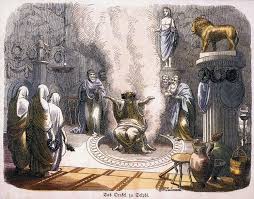
One of the most famous examples was the Oracle of Delphi. For centuries Greek leaders traveled to Delphi seeking divine guidance on matters of war, colonization, and political decision-making. The oracle’s pronouncements—often delivered in trance-like states by the Pythia—were treated as authoritative messages from the god Apollo.

From a Jaynesian perspective, institutions like Delphi may represent cultural technologies designed to preserve the authority of divine voices even as the underlying psychological system weakened. Kings and city-states continued to seek guidance from gods because the tradition of divine command remained embedded in social life.

Gradually, however, new forms of decision-making emerged.

Written law codes appeared. Philosophical reflection developed. Greek drama explored the tensions between divine authority and human responsibility. The shift was not sudden or uniform, but over time a new psychological landscape became visible—one in which individuals increasingly experienced themselves as authors of their own thoughts.

This transition was not simply intellectual. It may have been neurological, cultural, linguistic, and historical all at once.

Jaynes placed the decisive phase of the transformation during the turmoil of the late Bronze Age collapse, roughly between 1200 and 800 BCE—a period when many ancient societies experienced widespread disruption. Cities were destroyed, trade networks collapsed, and populations migrated. In the midst of this upheaval, older forms of authority may have faltered, forcing new modes of self-organization to emerge.

Whether or not Jaynes correctly identified the precise mechanism, he was surely right about one thing: consciousness as we experience it today may not be a timeless given.

It may be an achievement—fragile, historically contingent, and still evolving.


Yet if the bicameral mind truly vanished, one might expect the phenomenon of hearing commanding voices to disappear entirely from modern experience.

It has not.

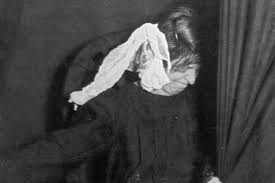
Under certain conditions, people still report experiences remarkably similar to those Jaynes described. In states of extreme exhaustion, during moments of sensory deprivation, or in the liminal territory between waking and sleep, voices sometimes appear that are difficult to classify as either internal or external.

I had an experience of this kind several years ago while undergoing an MRI scan in a hospital.

Anyone who has had an MRI knows the strange psychological environment it creates. You lie alone inside a narrow tube, immobilized, while the machine produces a sequence of loud mechanical pulses and vibrations. The noise is rhythmic and relentless. There is little sensory input beyond the sound and the awareness of one’s own breathing.

Somewhere in the midst of that experience, a voice appeared.

It was not loud or dramatic. It was simply there—a calm male voice with the unmistakable tone of a father speaking to a child. The message itself was simple, almost reassuring. But what struck me most was the ambiguity of the experience. The voice did not feel exactly like a thought, yet it did not feel entirely external either. It occupied a strange borderland between inner and outer perception.

The moment passed quickly, but the memory lingered.

Experiences of this sort are not uncommon. Psychologists studying hypnagogic states—the transitional zone between waking and sleep—have documented similar phenomena. Auditory hallucinations appear in certain psychiatric conditions, most famously schizophrenia. Hypnotic suggestion can also produce experiences in which subjects perceive commands or messages that seem to originate outside their conscious control.

Jaynes believed such phenomena represented vestiges of the older bicameral mentality.

The voices of the gods, in his view, had not entirely vanished. They had simply retreated to the margins of modern consciousness.


Occasionally these phenomena intersect with darker episodes of modern history.

The assassination of Robert F. Kennedy by Sirhan Sirhan remains one of the most disturbing cases often discussed in connection with hypnosis and altered states of consciousness. Some researchers have argued that Sirhan may have been unusually susceptible to hypnotic suggestion, raising unsettling questions about the relationship between external influence and voluntary action.

It would be irresponsible to claim that Jaynes’ theory explains such events. Human behavior is far too complex for any single model to capture fully. Yet cases like Sirhan’s remind us that the boundary between autonomous decision and externally shaped impulse is not always as clear as modern assumptions suggest.

The mind remains a mysterious territory.


Half a century after its publication, The Origin of Consciousness in the Breakdown of the Bicameral Mind continues to provoke debate not because it solved the problem of consciousness but because it reframed it. Jaynes forced readers to confront the possibility that the human mind has undergone profound historical transformations.

Even if the details of his neurological model prove incorrect, the broader insight may endure. Literature, religion, and psychology all suggest that the experience of selfhood has changed over time. The ancient world did not necessarily perceive the mind in the same way we do.

Something was gained in the transition to modern consciousness.

We gained introspection, philosophical reflection, and the capacity to examine our own motives. We gained the intellectual freedom that made science, democracy, and modern literature possible.

But something may also have been lost.

In the world Jaynes described, human beings lived in a landscape animated by voices of divine authority. Decisions arrived not through anxious deliberation but through commands experienced as sacred guidance. That world may have been more constrained, but it may also have felt more certain.

Modern consciousness offers freedom, but it also brings doubt and solitude. The voices of the gods have largely fallen silent, replaced by the quieter and often less confident voice we call our own.

Perhaps the most we can say is that consciousness, like culture itself, continues to evolve. The wanderers of ancient caravan routes helped shape the first emergence of reflective thought. Today we inhabit a global world of constant movement, translation, and negotiation—a world not entirely unlike those early contact zones where cultures once collided.

We are all wanderers now.

And somewhere, perhaps, the faint echoes of older voices still remain.


Dedication:

For dreamers and wanderers everywhere.

Note: If you enjoyed this piece, you might also like the pieces below, which take up somewhat similar themes.

On Transference in Artistic Collaboration

I will lay laid open…
I do it ’cause I’m a family man…
With the beat in now…
And your chest came out
’Cause you weren’t too scared.

Big Red Machine — “Deep Green / Deep Dream”

There is transference.
There just is.

Matthew Thomas

I. — The Pull That Isn’t Personal

It’s real because it’s grounded.
It’s real because the adult self is the one in the room.

That sentence might sound simple, but it marks a fault line between two entirely different ways of collaborating. The younger version of me would have blurred this difference almost immediately — not out of desire in any straightforward sense, but out of hunger. Out of the impulse to turn recognition into destiny, resonance into narrative inevitability, voltage into myth.

In earlier years, artistic encounters carried an undertow of idealization. When someone appeared whose sensibility aligned, whose aesthetic instincts felt familiar yet surprising, whose presence produced that unmistakable flicker of creative electricity, the experience was difficult to contain inside ordinary frames. Recognition felt like revelation. Shared language felt like intimacy. Creative energy felt like evidence of something larger than collaboration — something fated, symbolic, charged with meaning beyond the work itself.

But time has taught me that this interpretive inflation is not depth. It is transference — not as pathology, but as architecture. A current running through collaboration that invites projection, narrative layering, and emotional over-interpretation. A dynamic that can produce beautiful work, but also confusion, distortion, and boundary collapse when left unexamined.

What has changed is not the presence of that current but my relationship to it.

The boundary is no longer defensive; it is intelligent.
It is not erected to keep the other person out but to keep the work alive.
It is the condition that allows collaboration to breathe without suffocating inside symbolic noise.

And the boundary itself is deceptively simple:

We stand side by side, not on top of each other’s meaning.

We remain in our own psyches.
We allow resonance without fusion.
We allow voltage without blur.
We allow openness without myth-making.

This distinction may appear subtle, but it carries enormous implications. It is the difference between collaboration as encounter and collaboration as reenactment. The difference between creative exchange and symbolic entanglement. The difference between working together and unconsciously attempting to resolve unfinished narratives through one another.

In this sense, transference is neither villain nor obstacle. It is part of the terrain — inevitable wherever humans meet in creative space. The danger lies not in its presence but in its invisibility.

History offers cautionary examples. Jung’s relationship with Sabina Spielrein, initially framed as therapeutic, evolved into a complex emotional and intellectual entanglement in which transference blurred professional boundaries and personal identities. Toni Wolff later entered Jung’s life as collaborator and intellectual partner, yet the triangular dynamic that formed illustrates how symbolic roles can quickly overtake relational clarity. None of these figures lacked insight or integrity; what they lacked was a boundary capable of containing the symbolic intensity generated by their shared work.

That boundary — the one Jung struggled to hold, the one Sabina never had the power to define, the one Toni inhabited with both strength and vulnerability — is precisely the boundary that matters in artistic collaboration. Not a line of separation but a line of differentiation, one that preserves psychological sovereignty while allowing creative permeability.

The collaboration that underlies this piece has tested that boundary in productive ways. The work carries voltage. The exchange of ideas, images, and aesthetic intuition generates moments of recognition that could easily be misinterpreted as evidence of deeper narrative convergence. The temptation toward symbolic overreach is real, as it always is when creative chemistry emerges unexpectedly.

But the boundary holds.

Not through suppression or distance, but through integration. Through the adult self’s capacity to remain present without narrativizing the encounter into something it is not. Through a commitment to form — not as rigidity, but as container. Through an understanding that artistic collaboration thrives when the symbolic field remains clear enough for the work to speak in its own voice.

Openness with form.
Exposure with spine.
Laid open, but not laid bare.

This is not restraint for its own sake. It is creative hygiene. It is the discipline that keeps collaboration from dissolving into projection, keeps admiration from mutating into idealization, keeps creative voltage from being mistaken for emotional destiny.

The boundary is not what limits the collaboration; it is what makes it possible.

And in that sense, the boundary is not a line between collaborators at all. It is a line that keeps the field clear so the work can keep happening.

This is how adults collaborate: with clarity, with shape, with mutual sovereignty intact, with symbolic noise turned down, with the quiet confidence that resonance need not imply fusion. The trio remains intact — internal voices aligned rather than fragmented — allowing openness without collapse and connection without reenactment.

Music has offered a parallel language for this dynamic. The Big Red Machine ethos — stepping forward without fear while remaining rooted in personal identity — models a form of creative openness that resists mythic inflation. The lines echo not as romantic declaration but as psychological instruction:

I will lay laid open…
I do it ’cause I’m a family man…
And your chest came out ’cause you weren’t too scared…

Openness is not the danger.
Losing oneself inside openness is.

This brings the piece to its quieter question, one that underlies all collaboration, all transference, all creative exchange:

Can I remain open without giving myself away?
Can I step into voltage without mistaking it for destiny?
Can I meet clarity without dissolving into it?
Can I collaborate without collapsing?
Can I inhabit a resonant field and still leave it as myself?

The answer, tentatively but firmly, is yes.

Not because discipline has replaced feeling, not because detachment has replaced intimacy, not because protection has replaced vulnerability, but because integration has replaced fragmentation. Because the internal architecture is stable enough to allow openness without fear. Because the dream that once blurred boundaries now functions as threshold rather than invitation. Because the symbolic layer — what I sometimes describe as the Draco grounding — operates not as mystical escape but as orientation, a reminder that identity persists across shifting relational fields.

Transference remains part of the architecture. It always will. A subtle undercurrent running beneath creative interaction, capable of enriching perception when acknowledged and distorting reality when ignored. The adult task is not to eliminate it but to refuse its authority as narrative director.

The adult self leads.
The trio leads.
The work leads.

And so the closing question emerges, less dramatic than the fears that once accompanied it, but more meaningful:

What does it mean to stay laid open and still stay mine?

That is the adult version of transference — not avoidance, not collapse, but clarity held with a steady hand.


Dedication

For the collaborators:
the drifters,
the drop-ins,
the ones who catch the tune mid-air and don’t flinch.

You keep the corners loose
and the truth a little crooked.
My kind of people.

Note: If you like this piece, you may also like “Elodie and Matt: A Modern Fairy Tale.” You can read it below.

Carl Jung’s Collected Works: I

Volume I of Jung’s Collected Works is titled Psychiatric Studies, and begins with his dissertation, “On the Psychology and Pathology of the So-Called Occult Phenomena.” The editor’s preface to Volume I characterizes the dissertation as reflecting “simple descriptive research,” while acknowledging that many of Jung’s later concerns are foreshadowed herein (vi). In our posts on Volume I we shall attempt to draw out some of these foreshadowings, while also taking seriously this most “scientific” of the phases of Jung’s career and work.

It is of course highly significant that occult phenomena signify in Jung’s first major published work, as Jung’s reputation, for better or worse, is to this day closely linked with the occult, mysticism, astrology, post-material synchronicity, and the unconscious archetype. That Jung refers to “the so-called occult phenomena” here is suggestive, on its face, of at least some measure of empirical leaning in the young Jung.

As we shall see in later posts, Jung waged a decades-long internal battle to preserve his belief in himself as a man of science, rather than an artist, and the question of whether he was primarily a scientist or an artist would play a significant role in his mid-life crisis which set in during the decade of the 1910s. It is interesting to note here that Freud also held fast to the label of “scientist,” even as critics such as Roger Brown have suggested that he surrendered all claims to the title as early as 1896 (Storr, 24).

It is well known that Jung’s early years were suffused with religion and spiritualism, with several members on both sides of his extended family being parsons (MDR 42). From his earliest writings, however much he clung to the idea of himself as an empiricist (understood in its more typically narrow sense), Jung’s interest in the faint intimations of the “other world,” in the liminal zone between normal experience and those experiences or states which stray over the borderline of normal consciousness and everyday apprehension and into the dark underbelly of the unconscious, betrays the awestruck and bemused metaphysical wanderer who at seven would sit on a stone and wonder, “Am I the one who is sitting on the stone, or am I the stone on which he is sitting?” (MDR, 20).

“Liminality” is defined nicely by Wikipedia as “a psychological, neurological, or metaphysical subjective state, conscious or unconscious, of being on the ‘threshold’ of or between two different existential planes” (Wikipedia, “Liminality,”) and from the first paragraph of “On the Psychology and Pathology of the So-Called Occult Phenomena,” we can see Jung’s interest in liminality at play:

In that wide domain of psychopathic inferiority from which science has marked off the clinical pictures of epilepsy, hysteria, and neurasthenia, we find scattered observations on certain rare states of consciousness as to whose meaning the authors are not yet agreed. These observations crop us sporadically in the literature on narcolepsy, lethargy, automatisme ambulatoire, periodic amnesia, double consciousness, somnambulism, pathological dreaminess, pathological lying, etc. (Collected Works Vol. I, 3).

The author makes no claims to being a psychologist or to having any detailed empirical knowledge of the difference between automatisme and somnambulism, but briefly, for the sake of clarity, epilepsy refers to an overly active electrical circuit in the brain which causes seizures; neurasthenia is an outdated term that referred to deep exhaustion; what Jung and Freud referred to as hysteria we would more probably call neurosis; narcolepsy is a threshold state between sleep and waking which may include hallucinations; automatisme ambulatoire and somnambulism, as far as I can make out, both refer to sleepwalking or other actions taken while one is technically asleep.

Pathological dreaminess appears to be a coinage of Jung’s own, and pathological lying is best understood to be a state where one lies repeatedly with no motive force, no hope for, or anticipation of, gain.

What all these mental states have in common is a significant lack of control which those so afflicted have over their symptoms. Indeed, in all of the above cases it can fruitfully be asked, “who or what is in control of our psychological processes?” This is precisely the question that certain childhood experiences forced Jung to ask himself.

As recounted in Memories, Dreams, Reflections, at a very early age Jung had experienced the force of unbidden subterranean psychic contents which pushed their way to the surface of his consciousness. At the age of three, Jung dreamed of an “ithyphallically enthroned” ritual phallus entombed underground behind a thick green curtain. The ritual phallus “was made of skin and naked flesh, and on top there was something like a rounded head with no face and no hair. On the very top of the head was a single eye, gazing motionlessly upward” (MDR, 11–12).

The young Jung equated this ritual phallus with “a subterranean God ‘not to be named'” as well as with the Jesuits, whom at that point he believed feasted on human flesh (MDR, 12). Looking back from late middle age, Jung writes that the symbolically freighted symbolism of such a dream is far beyond what any child’s psyche would be able to produce without some kind of blueprint. His conclusion was that someone or something was already speaking with or through his mind:

It {became} clear to me how exceedingly unchildlike, how sophisticated, and oversophisticated was the thought that had begun to break through into consciousness {…} Who was it speaking in me? Whose mind had devised them? What kind of superior intelligence was at work? {…} Who talked of problems far beyond my knowledge? Who brought the Above and Below together and laid the foundation for everything that was to fill the second half of my life with stormiest passion? Who but that great alien guest who came both from above and from below? (MDR, 14–15).

Although these ruminations are retrospective, it is fairly clear that the inner autobiographical events that Jung highlights in MDR lay the groundwork for the young scientist’s interest in psychic liminality in all its manifestations. While the early studies mostly center upon the symptomatology of young, hysterical women, Jung’s early efforts to exteriorize his investigations would eventually give way to a deeper probing of his own levels of consciousness.

Indeed, the bulk of Jung’s mature, original work draws directly from his own borderline experiences, half-induced and half-received, during and after the outbreak of the First World War.

Therefore, while the early writings of Jung may with some justice be described as “simple descriptive research,” his choice of subjects and range of interests immediately plunge us into deep metaphysical waters, as Jung wrestles with questions such as where conscious control over the psyche ends, what exists or pertains beyond this control, and who or what is exerting itself when the formerly and apparently autonomous psyche cracks and the great unknown — the serpent in the garden, the siren on the farther shore, the vast propulsive other, or the slime of the deep — makes manifest its eternal will to power.