On Why Sicario Is the Greatest Film of the 2010s

Note: This essay reflects on the film Sicario and its place within the cinema of the 2010s. It is written in the spirit of cultural criticism rather than formal film scholarship. My aim is not to produce a definitive ranking of the decade’s films, but to articulate why Sicario stands out as a particularly revealing work about power, violence, and the uneasy moral landscape of contemporary geopolitics.

The film’s depiction of the U.S.–Mexico borderlands and the covert war against drug cartels resonated strongly with me because it refuses many of the narrative comforts typical of American action cinema. Instead of heroic triumphs or clear moral resolutions, Sicario presents a world in which institutional power often operates through ambiguous methods and morally troubling compromises.

In that sense the film belongs to a small tradition of American cinema willing to look directly at the realities of U.S. involvement in Latin America. An earlier example is Salvador, which similarly attempted to depict American policy in the region without the usual patriotic framing.

Readers who disagree with the claim that Sicario is the greatest film of the 2010s are very much invited to do so. Film arguments are part of the pleasure of cinephile culture. The claim here is intentionally bold because bold claims tend to produce interesting conversations.

At the very least, the border extraction sequence alone earns Sicario a place among the most unforgettable cinematic moments of the past decade.

I first watched Sicario on Netflix.

Which is not the way great films are supposed to enter one’s life. Great films are meant to arrive in dark theaters, on enormous screens, in the company of strangers who feel the tension at the same moment you do. Netflix, by contrast, offers films casually, like items on a digital buffet.

But sometimes a movie survives even that.

Sicario does.

Within half an hour it becomes clear that the film is operating at a different frequency from most thrillers. The dialogue is spare. The pacing is deliberate. The camera lingers on landscapes and silences. Something about the atmosphere suggests that the story is heading somewhere morally uncomfortable.

Then comes the border crossing.


The Extraction

The convoy moves slowly toward the border crossing at Juárez.

The mission seems straightforward: extract a prisoner from Mexico and return him to the United States. The vehicles move through traffic in tight formation. Nothing dramatic is happening yet.

And yet everything feels wrong.

Cars begin to surround the convoy. Drivers stare from their windshields. Traffic slows to a crawl. The camera—guided by the extraordinary eye of Roger Deakins—cuts between glances, mirrors, steering wheels, hands resting near weapons.

The tension builds with almost mathematical precision.

What makes the scene so powerful is not the violence itself but the certainty of its arrival. Everyone in the vehicles understands what is about to happen. The operators watch the surrounding cars with an eerie calm, as if they are simply waiting for a timer to run out.

Disaster is not possible.

It is inevitable.

When the gunfire finally erupts it is sudden, efficient, and disturbingly professional. The scene ends almost as quickly as it began.

By the time the convoy crosses back into the United States, the viewer understands that the film is not interested in the usual heroics of the crime thriller. It is interested in something darker.


The Line Between Law and Power

Part of what makes Sicario extraordinary is the way it gradually dissolves the moral categories the audience expects.

Emily Blunt’s character, FBI agent Kate Macer, begins the film believing she is participating in a legitimate law enforcement operation.

Kate Macer

But as the mission unfolds, she begins to realize that the institutions she represents are operating according to rules that have very little to do with the law.

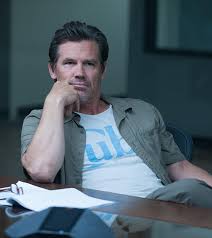
The key figure in this realization is the relaxed, almost cheerful CIA operative played by Josh Brolin.

Matt Graver

Graver is one of the film’s most fascinating characters because he openly blurs the lines between legality and strategy. He treats the war against the cartels not as a legal battle but as a geopolitical game in which certain rules simply no longer apply.

He jokes. He smiles. He reassures Kate that everything is under control.

And yet the deeper the operation goes, the clearer it becomes that the “control” he represents has very little to do with justice.


Alejandro

If Matt Graver represents the pragmatic face of American power, Alejandro represents something older and more elemental.

Alejandro Gillick

Alejandro is not a police officer or a soldier in any conventional sense. He is a weapon deployed inside the machinery of the state.

His presence reveals the film’s central truth: the war on drugs, as depicted here, is not really about drugs. It is about power, revenge, and the maintenance of geopolitical equilibrium through violence.

The final dinner-table scene—quiet, controlled, almost polite—delivers one of the most chilling moments in modern cinema.

Alejandro does not rage.

He simply completes the task.


A Film Without Illusions

The reason Sicario stands above most films of the 2010s is that it refuses to decorate its subject with comforting illusions.

American cinema has often struggled to portray U.S. foreign policy in Latin America with any degree of honesty. Films frequently soften the narrative with patriotic framing or moral reassurance.

Sicario does the opposite.

In that sense it belongs to a small tradition of films willing to examine American power without the usual gloss. One earlier example is
Salvador.

Like SalvadorSicario presents U.S. involvement in the politics and violence of the region not as a heroic intervention but as a complicated and morally ambiguous system of influence.

The film does not sermonize about this reality.

It simply shows it.


The Craft

What elevates the film from strong political thriller to masterpiece is its extraordinary craftsmanship.

Director Denis Villeneuve constructs the story with remarkable restraint. Exposition is minimal. Dialogue is sparse. Much of the narrative unfolds through mood and implication rather than explanation.

Roger Deakins’ cinematography turns the borderlands into a stark visual landscape of highways, deserts, and shadowy tunnels.

And the score by Jóhann Jóhannsson provides the film’s subterranean heartbeat—deep, rumbling tones that feel less like music than like distant artillery beneath the earth.

Together these elements create an atmosphere that is almost hypnotic.


The Film of the Decade

Every decade produces films that entertain, and a smaller number that capture the psychological mood of their time.

Sicario belongs to the second category.

The 2010s were a decade in which institutions increasingly appeared opaque, power operated through indirect mechanisms, and the line between legality and strategy often seemed disturbingly thin.

Sicario does not attempt to solve these problems.

It simply looks at them without flinching.

And that honesty may be precisely why it stands as the greatest film of its decade.

In Partial Defense of Reddit: An Essay

Note: This essay is not intended as a blanket endorsement of Reddit. The platform has many well-documented flaws: trolling, pile-ons, misinformation, and a general tendency toward chaos. Much of its reputation as one of the rougher corners of the internet is entirely deserved.

The point here is narrower.

Despite its disorder, Reddit also preserves something that has become rarer elsewhere on the modern web: large, open conversations among people who possess small but real pockets of knowledge about highly specific subjects. When these fragments accumulate—through correction, argument, memory, and curiosity—they can occasionally produce surprisingly informative results.

The examples in this essay range from the internal royalty disputes of Jane’s Addiction to a map of alleged sightings compiled by the Bigfoot Field Researchers Organization. In both cases the same phenomenon appears: individuals contributing small pieces of cultural memory that gradually assemble into something resembling a collective understanding.

This is the limited claim of the essay. Reddit is frequently messy and unreliable, but it also functions as a peculiar kind of public knowledge commons—one where curiosity, enthusiasm, and the occasional obsessive hobbyist can still combine to produce insights that might otherwise remain scattered or forgotten.

Everyone knows that Reddit is terrible.

It is chaotic. It is full of profanity, bad jokes, half-informed opinions, and the occasional theory that appears to have been typed at three in the morning by someone who has not slept since the Clinton administration. Entire careers have been built explaining why Reddit represents the worst tendencies of the modern internet.

And yet.

The other day I was reading a thread about the latest implosion of Jane’s Addiction, the once-great Los Angeles group whose internal tensions have been simmering since roughly the Reagan administration. The immediate subject was the collapse of a reunion tour following an onstage altercation involving frontman Perry Farrell. The comments were exactly what one would expect from Reddit: profanity, gallows humor, and several variations of “this band has been breaking up since 1991.”

But as the thread continued something interesting happened.

Between the jokes and one-line reactions, the users began reconstructing the band’s internal history. Someone noted that Jane’s had already declared itself finished several times across the decades. Someone else pointed out that the early sound of the band had been shaped heavily by bassist Eric Avery. Another commenter raised the eternal rock-band problem: royalties.

And this, as it turns out, is where the story becomes interesting.

Money has a way of dissolving even the most inspired musical partnerships. Bands begin as small utopian experiments—four or five people creating something new together—and then the checks begin to arrive. Once that happens, questions emerge that are almost impossible to resolve cleanly. Who wrote the song? Who contributed the riff? Who deserves the lion’s share of the publishing?

Rock history is essentially a graveyard of groups destroyed by arguments over fractions of ownership.

In the thread I was reading, one user mentioned a detail I had not known: a claim that Avery at one point wore or promoted merchandise suggesting a 51 percent stake in the band’s identity. Whether literally true or not, the anecdote captured something fundamental about how these disputes unfold. Creative partnerships may begin democratically, but the distribution of credit rarely stays that way.

The remarkable part was that I had learned all of this not from a music journalist or a band biography, but from a chaotic conversation among strangers.

Which brings me to the modest defense of Reddit.

The platform’s reputation is built on its worst features: trolling, argument, and endless bad takes. All of those things exist, of course. But what critics often miss is that Reddit also contains something else: an enormous micro-density of cultural knowledge.

The process is messy. Someone posts a half-remembered fact. Someone else corrects it. Another person adds a detail from an interview they once read fifteen years ago. Gradually, through the collision of dozens of small contributions, something resembling a coherent picture emerges.

It is not elegant. It is rarely authoritative in the traditional sense. But it is often surprisingly informative.

What Reddit does, at its best, is something the modern media ecosystem sometimes struggles to replicate: it gathers together thousands of people who care obsessively about very specific things. Musicians. Gearheads. Amateur historians. Programmers. Aviation nerds. Movie buffs. Backyard astronomers.

And when those people start talking, knowledge begins to accumulate.

The phenomenon becomes even clearer when the subject matter becomes absurd.

Consider a thread from the cryptozoology corner of Reddit devoted to a map of Bigfoot sightings. At first glance the discussion appears to be pure nonsense. The premise itself—tracking sightings of a large unidentified forest creature—is hardly the sort of topic one expects to produce serious information.

And yet the map itself is strangely compelling.

People immediately begin checking their regions. Someone from Maine wonders why Bigfoot seems to avoid the state despite its endless forests. Another user proposes that two “alpha Bigfoots” are fighting for territorial dominance between Maine and Canada. Someone else links to the sightings database maintained by the Bigfoot Field Researchers Organization. A commenter from rural Illinois notices that two reported sightings occurred along the same river that runs behind his property and proceeds to describe the terrain—swampy woods surrounded by miles of farmland where, he notes, something large might plausibly remain hidden.

The subject is ridiculous.

The conversation, however, is oddly informative.

You learn about geography. You learn about folklore. You learn where people live, how they interpret the landscapes around them, and how stories circulate through local communities. What begins as a joke about Bigfoot gradually becomes something like amateur field anthropology.

This is the strange virtue of Reddit.

The platform functions as a kind of digital commons in which thousands of small fragments of knowledge collide in public. No single commenter possesses the full story. But collectively they often assemble something larger than any individual source might provide.

Which leads to the modest conclusion of this essay.

If you want perfectly verified information delivered in polished and authoritative form, Reddit is not the place to go. But if you want to watch curiosity, memory, obsession, and local knowledge combine in unpredictable ways, it can be surprisingly useful.

It turns out that when enough ordinary people gather in one place to talk about the things they care about—even Jane’s Addiction royalty disputes or the migratory patterns of an imaginary forest giant—they occasionally produce something that the official channels of culture struggle to replicate.

Not perfection.

But knowledge, nonetheless.

Scenes from St. George’s Part III: Mr. Dreyer, French Teacher Extraordinaire (with a cameo from Richard Marx)

When I was in middle school I took French from one Monsieur Dreyer. I had already been studying (the verb is used loosely) French for a couple of years, and had some of the basics. In Mr. Dreyer’s class I learned a little more, and could actually kind of hack it in French there for a bit. But any actual language learning that took place in Mr. Dreyer’s class was seriously secondary to the excellent action that took place around his class.

I wasn’t first introduced to Mr. Dreyer in middle school, however. In fact, I first met him when I was in elementary school around the time he began teaching at the school where my father taught, and I attended, in the early 1980s. I remember going to the apartment he shared with his wife, who is Japanese, when they had an exchange student called Atsushi from Japan staying with them. Atsushi was my age, and he showed us how to make onigiri (rice balls). Making rice balls is not all that tough, just rice, water, and salt. Still, I thought onigiri were pretty exotic and Atsushi pretty cool. Some time later Mr. Dreyer and his wife must have come up a bit short of ready cash, because they lived in a tent in my family’s front yard for a while. This seems a little strange looking back, but it wasn’t then. I have no idea what the bathroom or shower situation looked like, but something must have happened.

(My brother Mike also lived out in a tent in the front yard during the summer for a number of years. Maybe it was the same tent. Mike would run an extension cord out to the tent and play his boombox. This was a few years after the Dreyer clan was tenting it, and Mike was deep into the singer Richard Marx. I thought Richard Marx was alright, but he didn’t seem to have a lot of songs. This mattered not at all to Mike who played the same Richard Marx tunes over and over again.

Today Richard Marx is, strangely enough, bigger than ever. But not as a musician. He runs a popular Twitter account where he is a big liberal and also pretty funny. Marx is like Rex Chapman but less problematic. Rex Chapman is super-problematic. I’m not sure exactly how, I just know he is.)

Mr. Dreyer also played a little chess with my father, although my impression is that both of them were pretty bad. Certainly they were not pulling out a lot of “hard-to-find” moves. At that time, I knew Mr. Dreyer was a French teacher, but didn’t know if he was in fact French. Today I believe it to be the case that he is not French, is in fact from California, and just somehow became proficient in the language. Good for him.

Even before I took his class, I was aware that Mr. Dreyer was, let’s say, a different sort of fellow. He liked to tell a story about his brother who lived on a massive contour map of the San Francisco Bay area. The map was located in an enclosed structure that hung under a bridge in Oakland or something. And his brother just chilled there full time, so the story went. So Mr. Dreyer, apparently, was the normal one in his family.

(I remember Mr. Dreyer talking to me about John Lennon one day as well. This was maybe when I was taking his class, but I think it might have been before that. “John Lennon’s assassination was really sad,” he said, “he was just starting to put his life back together.” I had heard of John Lennon but at that time knew nothing of the circumstances of his death. And I certainly didn’t know about his ups and downs in the 1970s. Mr. Dreyer must have been a Lennon fan though, and wanted to tell me about it.)

In any case, when I got to middle school I was assigned Mr. Dreyer, as mentioned. Mr. Dreyer wore a mustache that looked pretty Frenchy to me—maybe that’s why I kind of thought he was a French native. There were also a number of the Tintin books in French on a shelf in the back of the room. I had read most of the Tintin books in English by then, so it was fun to browse the French versions and take in some of the action from a new lens.

In Mr. Dreyer’s class everyone got a “French name,” and I was called “Philippe.” I don’t really care for all these fake names in language class, although I recognize that some people do adopt them as a kind of alter ego. I mean, if a Japanese gal called “Sari” wants to go by “Sally” in English class that’s great. Makes sense. But my actual name sounds nothing like Philippe, so it just seemed kind of random. In any case, little Phillippe was not a bad French student, but he was a restless one. Mr. Dreyer’s classroom opened from the back door onto a kind of grassy area, and for reasons passing understating Philippe would leave class in the middle of the lesson and then try to crawl back in through the back door and up through the room, hoping to escape Mr. Dreyer’s attention. Mr. Dreyer did notice, of course, but he was pretty cool about it.

“What you doing there Philippe? Sneaking back into the room again? Welcome to French class si vous plait.” Something like that. I wasn’t trying to aggravate Mr. Dreyer or anything because I really liked him as a teacher, I was just doing what 12 year old boys do. However, Mr. Dreyer did not view every student as leniently as myself. One of my classmates was a guy we’ll call “E.P.” E.P. was a trouble-maker, and was known to pull the fire alarm in the middle school there on a regular basis. His parents were called, repeatedly, but he didn’t care. He loved pulling that fire alarm. E.P. would also prank call mothers of other students for whom he somehow had phone numbers from the school phone and talk dirty to them in a fake voice. So, yeah.

One week, E.P. and some other students had started throwing wadded up pieces of paper toward a metal garbage can located at the front right corner of Mr. Dreyer’s classroom. Mr. Dreyer let this roll for a few days, however one day before lunch he decided to crack down. “Mr. E.P.,” he said, “I’ll make you a deal.” “You can have one more throw of a paper at that trash can. If you make it, you can go to lunch. If you miss, you have lunch detention.”

Now this struck me as a pretty fair deal, because E.P. didn’t have to accept the challenge. He could have just passed and gone about his day. That, of course, is not what happened. Instead, E.P. wadded up yet another piece of paper and lobbed it at the trash can. He missed. This was the last straw for Mr. Dreyer who, instead of keeping him in detention as promised, took matters a step further. He grabbed the trash can (which was about three and a half feet high) and carried it over to where E.P. was sitting.

“You like garbage!” he shouted. “I’ll show you garbage.” And sure enough Mr. Dreyer, onigiri expert, former tent dweller, and French teacher extraordinaire, emptied the whole thing right on top of E.P.’s dome. Now you might think this was some bad action, and from today’s perspective sure, it probably was. But for us middle schoolers it was hysterical.

“Did you hear what Mr. Dreyer did?” we whispered for the rest of the week. “He dumped a full garbage can on E.P.’s head.” This was the biggest thing to happen all month, and we milked it, obviously. Again, if this happened today, Mr. Dreyer might have faced some kind of sanction, but the 1980’s were not like that. E.P. had been dumped on, and life moved on.

Mr. Dreyer eventually left that school and moved to Kyoto where he taught for a while at Kyoto International School before ultimately moving back to California where his brother lived on a map. Years later I reconnected with Mr. Dreyer on Facebook, where he regularly posts groaningly bad, yet still somehow funny, visual puns. “Cyrano wins by a nose” with a drawing of Cyrano crossing the finish line in a foot race, that sort of thing. Anyway, I wanted to get his perspective on the whole the garbage can situation so I sent him a message. What did he recall of the incident?

He didn’t remember it at first, but then he said “oh yes, that was with a student called “J.”

“No,” I replied, “it was with E.P.”

“No, no, no,” he replied, it was “J. JFK.”

Now I knew that Mr. Dreyer is prone to making some strange jokes, and at first I thought he was making some kind of oblique assassination reference. Was he suggesting that there must have been a second shooter?

“This was not JFK related,” I said. “It was some E.P. action. I‘m sure of it.”

Mr. Dreyer was not sold though, and it occurred to me that there may have been more than one dumping. This may, in fact, have been Dreyer’s go-to-move. After all, his treatment of E.P. was, in truth, pretty unfair—the deal was advertised as sink the shot or detention. Dumping was never mentioned. Was Dreyer moving about the globe and dumping full garbage cans on students left and right? It was a possibility. Maybe I was smart to stay low to the ground after all.

These days, Mr. Dreyer is living in California where he enjoys the warm climate. And he reads this blog. Hey there Mr. Dreyer baby, you’re a cool guy but that garbage can move could maybe use a little reflection. E.P. was a troublemaker, sure, but dumping just wasn’t part of the deal.

to be continued…