Epigraph:
Why not see a legend while it’s still being made?
The Silver Jews
Introduction:
This essay looks at the life and career of the greatest chess player of all time, Bobby Fischer.
This one is especially meaningful to me because my dad, Ross Thomas, taught me to play chess when I was a little kid. Neither of us has ever been a great player, but we both love the game. Ross still enjoys playing today as do I, and although I don’t follow competitive chess as closely as I once did, I’ve never lost my fascination with its history—or with the remarkable personalities who have shaped it.
Few personalities have ever been as brilliant, complicated, or tragic as Bobby Fischer.
In this essay I explore Fischer’s astonishing rise from Brooklyn prodigy to World Champion, the unforgettable 1972 Match of the Century against Boris Spassky, his extraordinary genius over the board, and the painful decline that followed. Like many towering figures, Fischer left behind a legacy that is impossible to separate from his contradictions.
Whether you’re a lifelong chess player or simply interested in remarkable lives, I hope you’ll enjoy the journey. As always, thank you for reading, commenting, sharing, and making these conversations possible.
I. Brooklyn
There are bogglers, and then there is Bobby Fischer.
History is littered with men who threw away fortunes, marriages, careers, and reputations. Every generation seems to produce a few gifted souls who wake up one morning, look at a perfectly good life, and decide to drive it into a ditch at seventy miles an hour. Howard Hughes belongs in that conversation. John McAfee as well. A handful of Roman emperors deserve honorable mention. But if I had to pick a patron saint of the truly bewildering decision, the gold medal still goes to Bobby Fischer.
Which makes the whole thing even stranger, because Bobby began as almost the opposite of a boggler. He was a skinny kid from Brooklyn who found a chessboard before he found the rest of the world and went on in short order to change the game forever.
I never saw Bobby Fischer play. By the time I was old enough to understand chess, he long gone. The World Championship in Reykjavík belonged to another era, and Bobby himself had already begun drifting into legend. I didn’t discover him through television or newspaper headlines. I discovered him through my father, who loved chess and spoke of Bobby the way baseball fans talk about Willie Mays or boxing fans talk about Muhammad Ali. Bobby wasn’t simply another grandmaster. Bobby was Bobby.
Even if you know almost nothing about chess, you’ve probably heard the name. That’s rare.
Most world champions become famous inside their sport. Bobby transcended the board entirely. For a brief moment in 1972, during the height of the Cold War, a chess player became one of the most recognizable people on the planet. He wasn’t just trying to beat Boris Spassky. Millions of people saw him as the lone American challenging decades of Soviet dominance in the game’s intellectual heartland.
He won.
And then… Well. This is where the boggling really begins.
II. Brooklyn & Chess
Every legend has to begin somewhere. Abraham Lincoln had the log cabin. Muhammad Ali had Louisville. Bob Dylan had Hibbing. Bobby Fischer had a small apartment in Brooklyn, a single mother, and a chessboard.
Not exactly the ingredients from which you would expect history to emerge.
Bobby wasn’t born into wealth or privilege. There was no grandmaster father waiting to pass down generations of chess wisdom. There was no Soviet state pouring unlimited resources into his development. There was just a skinny, bright kid who discovered a game that somehow made more sense to him than almost everything else around him.
The game never let him go.
Neither, apparently, did he ever let go of it.
I never saw Bobby Fischer play.
By the time I was old enough to understand what a chessboard even was, Bobby had already disappeared from competitive chess. I was born in 1974, just two years after Reykjavík, so I missed the whole thing. My Bobby wasn’t the Bobby of television broadcasts and newspaper headlines. My Bobby came secondhand through my father.
Dad loved chess.
He wasn’t a master by any stretch, but he loved the history, the personalities, and above all Bobby Fischer. Long before YouTube breakdowns, Twitch streams, and chess engines stronger than every human being who has ever lived, my father told me stories about this kid from Brooklyn who walked into a game the Soviet Union practically owned and somehow beat them anyway.
To a little kid, that sounded impossible.
And maybe that’s why Bobby has fascinated me ever since.
Not because I became a serious chess player—I didn’t. Not because I memorized openings or dreamed of becoming a grandmaster. I didn’t do that either. Bobby fascinated me because even before I knew the details, he already felt larger than life. Some people become famous. Others become myths. Bobby somehow managed to become both before he was thirty.
There’s another thing I like about Bobby. He wasn’t polished. He wasn’t exactly charming. He wasn’t selling anything.
He didn’t seem remotely interested in being a celebrity. If anything, fame looked like something that had happened to him against his will. He wanted to play chess. The rest of the world insisted on turning him into a symbol.
That’s a dangerous bargain. Especially for someone who already viewed the world with suspicion.
The irony, of course, is that the qualities that made Bobby great at chess were probably the same qualities that made ordinary life so difficult. Absolute concentration. Endless preparation. Refusing to accept conventional wisdom. Seeing threats and possibilities invisible to everyone else. Across sixty-four squares those qualities made him nearly unbeatable. Outside the chessboard, they often made life bewilderingly complicated.
The boy from Brooklyn had found the one place in the world where everything made perfect sense. The trouble began when he had to leave the board.
III. Bobby’s Rise
The funny thing about genius is that it rarely announces itself politely. It doesn’t knock on the door. It kicks the damn thing in.
By the time Bobby Fischer was in his early teens, the whispers had already begun. Chess players who had spent decades studying the game found themselves losing to a kid who wasn’t even old enough to drive. Adults who expected to teach him lessons instead received one themselves. Tournament after tournament, Bobby kept climbing until people slowly stopped asking whether he was unusually talented and began asking a much stranger question:
How good can one human being actually become?
That question haunted the chess world for the next decade.
Remember, this wasn’t today’s chess. There was no internet. No YouTube lectures. No databases containing millions of games. No engines instantly pointing out every mistake with the emotional warmth of a tax auditor. If you wanted to improve, you studied books until they fell apart. You replayed famous games by hand. You stared at positions for hours. Chess was slower, lonelier, and in many ways far more mysterious.
Bobby loved every minute of it.
Or perhaps “loved” isn’t the right word. He consumed it. The game became less a hobby than an ecosystem. Everything else seemed secondary. School. Friends. Ordinary teenage life. Those things existed somewhere off to the side while Bobby disappeared deeper into sixty-four squares.
That kind of obsession usually scares people. Sometimes it should. But every now and then history rewards it.
By the late 1960s Bobby wasn’t merely America’s best player. He had become the only serious obstacle standing between the Soviet Union and permanent ownership of the World Championship. For decades the Soviets had treated chess almost as a national project. They produced champion after champion with an efficiency that bordered on the industrial. To beat one Soviet grandmaster was impressive.
To beat all of them? That sounded ridiculous. Bobby apparently didn’t’ received the memo. What amazes me isn’t simply that he won. It’s how he won. He didn’t scrape through on lucky breaks. He didn’t sneak across the finish line. He flattened people.
Strong grandmasters—men who had dedicated their lives to becoming the best in the world—found themselves losing in ways that almost never happened at that level. His Candidates matches became the stuff of legend. The scores looked less like contests between equals than demonstrations of what happened when somebody operating on a different frequency sat down at the board.
There are athletes who win. There are athletes who dominate. Then there are the rare few who make everyone watching wonder whether the rules somehow stopped applying.
Babe Ruth. Wayne Gretzky. Michael Jordan. Michael Phelps. Usain Bolt. Bobby Fischer belongs in that conversation.
That’s the point people often miss. Bobby’s greatness wasn’t confined to chess enthusiasts. His rise had the unmistakable feeling of witnessing something unprecedented. You didn’t need to understand the Sicilian Defense or the King’s Indian to recognize that this skinny kid from Brooklyn was forcing an entire establishment to panic.
And somewhere along the way, Bobby stopped being just another chess player. He became a symbol. Americans wanted him to humble the Soviets. Journalists wanted a story. Television wanted a star. Sponsors wanted a celebrity. Everyone wanted a piece of Bobby Fischer. I’m not sure Bobby wanted any of them.
Looking back now, that’s the first place I can see the seeds of The Greatest Boggler beginning to sprout. Before the paranoia, before the disappearances, before the bizarre interviews and the years wandering from country to country, there was already a young man who seemed profoundly uncomfortable with everything that came attached to success except the game itself.
He wanted chess. The world insisted on giving him everything else. And history has a habit of charging interest on bargains like that.
IV. The Wooden Click
By the summer of 1972, Bobby Fischer had become something no chess player had ever really become before. A global celebrity. That sentence still sounds strange.
Golf has Tiger. Basketball has Jordan. Boxing has Ali. Baseball has Ruth. Tennis has Federer. Even if you’ve never watched them play, you know their names.
Chess? Chess wasn’t supposed to work that way.
Yet for a few extraordinary weeks in Reykjavík, Iceland, it did.
The Cold War had turned sixty-four squares into a battlefield. Bobby Fischer wasn’t simply challenging Boris Spassky for the World Championship. Fairly or unfairly, millions of people saw him as one American standing against an entire Soviet chess machine that had dominated the game for decades.
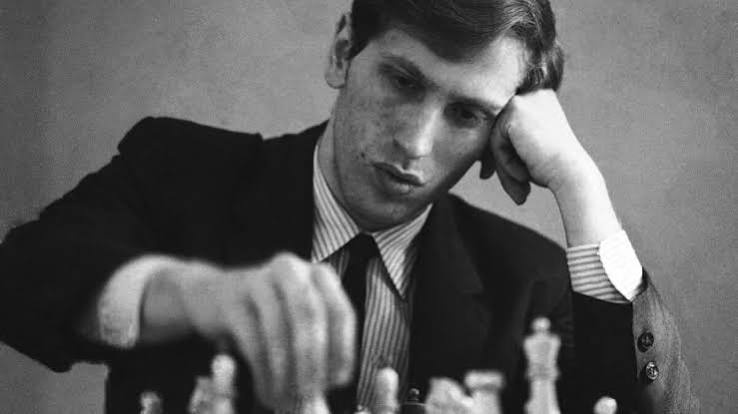
Every move became news. Every expression became news. Every delay became news. The entire world seemed to be watching a board covered in little carved pieces of wood. Most people would have loved every second of it. Bobby Fischer looked like he wanted to crawl under the table.
Here’s where “The Greatest Boggler” first begins to make sense. Most celebrities worry about bad reviews. Most athletes worry about losing.
Bobby worried about everything. The lights. The cameras. The spectators. The photographers. The chairs. The draft. The conditions. If there was a distraction available, Bobby could find it.
Reading about Reykjavík today, I can’t help but laugh at one recurring image. I picture Bobby sitting at the board convinced there were eyes in his soup. Not literally, of course, but psychologically. Somebody was always watching. Somebody was always listening. Somebody was always trying to gain an advantage.
The walls had ears. The soup had eyes. The room itself felt hostile. To the outside world, this looked ridiculous. To Bobby, I suspect, it felt completely real.
The most famous example has become almost comic. The noise. Specifically…
The little wooden click.
Imagine devoting your entire life to becoming the greatest chess player on Earth. You arrive for the biggest match in the history of the game. Billions of people—well, what feels like billions—are watching. Your opponent reaches for a knight. He places it on the board.
Click.
Bobby couldn’t stand it. Now, I admit, this is where my sympathy and my sense of humor collide. Part of me wants to put an arm around Bobby and say,
“Buddy… it’s a knight.”
“It’s made of wood.”
“It’s going to make a little wooden click.”
“It just is.”
“Have a cup of tea.”
“Take a breath.”
“Let’s play.”
Because the knight isn’t going to stop clicking. It just isn’t. The cameras aren’t going to disappear. The reporters aren’t going to go home. History has arrived. You’re Bobby Fischer. This is the price.
But another part of me wonders what that match must have felt like from inside Bobby’s own head.
Imagine carrying not only your own expectations but those of an entire country. Imagine believing every sound matters. Every movement matters. Every distraction matters. Imagine sitting across from the Soviet World Champion knowing that one lapse in concentration could cost you everything. Suddenly the little wooden click doesn’t seem quite so funny anymore.
It becomes symbolic. The click isn’t really about the knight. It’s about a mind that could never completely switch itself off. That’s Bobby.
The same obsessive concentration that allowed him to discover combinations invisible to everyone else also made ordinary imperfections almost unbearable. His gift and his burden may have been the very same thing. The remarkable thing is that none of it ultimately mattered.
Not the cameras. Not the click. Not the endless negotiations. Not the circus surrounding the match. Bobby won. Against all the noise, all the distractions, all the pressure, he became World Champion. For one shining moment, the kid from Brooklyn stood alone at the top of the chess world. It should have been the beginning of a long reign. Instead, astonishingly, it proved to be the beginning of something else entirely.
The greatest boggler had finally reached the summit. Now he was about to begin climbing back down.
V. The Walk Away
History loves a coronation. It has far less patience for an abdication.
If this were a Hollywood movie, Bobby Fischer wins the World Championship in Reykjavík, returns home a conquering hero, defends the title half a dozen times, writes a bestselling book, gives exhibitions around the world, settles into a comfortable house somewhere in California, and spends old age dispensing colorful stories to admiring grandchildren.
Instead… He walked away. Not immediately. Not dramatically. Just… steadily. Like a man fading into the California sun. That’s the image that stays with me. Not the young genius lifting the crown. The older Bobby, somewhere in Los Angeles, drifting farther and farther from the life everyone assumed he would lead.
People forget just how extraordinary this decision was. Imagine Michael Jordan retiring forever after his first NBA title. Imagine Tiger Woods winning the Masters once and never entering another major. Imagine Bob Dylan releasing Highway 61 Revisited and deciding he’d said everything he needed to say.
That’s the scale of Bobby’s disappearance. He simply stopped defending the thing he had spent his entire life trying to win.
Officially, there were disputes over match conditions, prize funds, and the rules proposed by FIDE. Bobby wanted changes. FIDE accepted some, rejected others, and when agreement couldn’t be reached, he refused to play. In 1975 the title passed to Anatoly Karpov by default.
No final game. No dramatic defeat. Just… Silence.
That, to me, is the first truly monumental boggle. Because Bobby had finally reached the summit. The hard part was over. History was his.
He could have defended the title once, twice, maybe five times. He could have become the elder statesman of American chess. He could have written books, taught children, appeared on television once a year, smiled for the cameras, and lived comfortably for the next forty years.
Instead he disappeared.
The farther Bobby drifted from chess, the farther he seemed to drift from almost everyone else. His relationship with his mother had always been complicated. She had encouraged his early interest in chess but also worried, understandably, that it was consuming his life.
As Bobby became more famous, the distance between them widened. Their relationship fractured, and by adulthood they were largely estranged. There is something deeply sad about that. The person who first helped place a chessboard in his life became someone increasingly absent from it.
Then came the paranoia. Now, I want to tread carefully here. It’s tempting to diagnose people after the fact. Every eccentric becomes “obviously” this or “clearly” that. Real life isn’t that tidy.
What we do know is that Bobby became increasingly distrustful of institutions, governments, journalists, organizers, and eventually whole groups of people. The suspicious streak that had surfaced during Reykjavík seemed to expand until almost nothing escaped it.
The cameras weren’t merely annoying. People weren’t merely mistaken. The soup still had eyes. Everywhere Bobby looked, somebody seemed to be watching. Somebody seemed to be cheating. Somebody seemed to be plotting.
And perhaps the saddest part is that the world kept giving him reasons to feel besieged. Fame invites attention. Attention attracts opportunists. The more Bobby withdrew, the more mysterious he became, and the more mysterious he became, the more people pursued him.
Round and round it went. By the 1980s, he had become almost a ghost.
There were periods when he was reportedly living with remarkably little money. Accounts differ on exactly how precarious his circumstances became, but there were stretches in Southern California when he moved from place to place, staying with acquaintances, in modest accommodations, sometimes even homeless, living a life almost unimaginable for the most famous chess player in the world.
That image boggles my mind. The undisputed World Champion. The man who had conquered the Soviet chess empire. A man without a stable home. How does that happen?
Then there is even a darker chapter. This is has to with Bobby’s antisemitic statements. There is no graceful way around them. They were ugly.
They became more frequent as he grew older, and they permanently damaged his reputation. The bitter irony, of course, is that Fischer had Jewish ancestry through his family background, making his rhetoric all the more bewildering. Whatever mixture of grievance, paranoia, anger, or ideology produced those statements, they caused real harm and deserve neither excuse nor romanticization.
This is where the essay stops being merely funny. Because up until now we’ve been laughing about wooden clicks. About photographers. About impossible demands. About eyes in his soup. Now we’re watching a genuine hero unravel in public. That’s different. It’s heartbreaking.
I keep coming back to the same question. What if Bobby had simply found peace?
Not perfection. Just peace. A little house. A morning walk. A cup of coffee. Chess club on Tuesdays. A few exhibitions every year. Maybe a family, maybe not. Just… enough.
Instead, the world champion kept walking. Farther from chess. Farther from home. Farther, it sometimes seemed, from himself.
And the California sun kept getting lower
VI. The Long Decline
There’s an old saying that every man dies twice. The first time is when his heart stops. The second is the last time someone says his name.
If that’s true, Bobby Fischer may never die.
Even people who couldn’t explain en passant or the Sicilian Defense know who Bobby Fischer was. The tragedy is that millions know him for the wrong reasons. The years after Reykjavík don’t unfold so much as scatter. He’s here. He’s there.
Budapest. The Philippines. Japan. Iceland. Anonymous apartments. Hotel rooms. Friends’ spare bedrooms. Long disappearances.
Then suddenly he’d surface again, as if he’d been underwater for years. The world would remember. Then he’d vanish once more. His life begins to feel almost impossible to narrate because it no longer has a center.
There’s no career. No family life to anchor the story. No steady work. No annual rhythm. Just movement. Always movement.
I’ve known people like that. Not world champions. Just drifters. Men who are always leaving. Always beginning again. Always convinced that the next city, the next apartment, the next job, the next relationship will finally outrun whatever has been chasing them.
It never does.
Because the thing following them is themselves. That’s Bobby’s sadness. No matter where he went, Bobby Fischer came too. There were occasional bursts of hope. Every few years somebody would announce that Bobby was coming back.
Maybe another match. Maybe another appearance. Maybe another interview. Maybe this time everything would settle down. It never quite happened.
Instead, Bobby became almost mythological. People told stories.
“I heard he’s living here…”
“I heard somebody saw him there…”
“I heard he’s working on this…”
Like Elvis or Howard Hughes, the man slowly disappeared while the legend continued multiplying.
The saddest thing about isolation is that eventually it becomes self-reinforcing. If you believe everyone is watching you you stop trusting people. When you stop trusting people you become lonely. Loneliness makes suspicion stronger. Suspicion creates more loneliness.
Round and round it goes. Eventually the circle becomes almost impossible to break. I don’t pretend to know exactly what was happening inside Bobby’s mind. None of us can. It’s easy—far too easy—to diagnose historical figures from the comfort of an armchair decades later.
Life isn’t a psychology textbook. Human beings rarely fit neatly into categories. What we can say is simpler.
Bobby became increasingly isolated. Increasingly angry. Increasingly suspicious. And increasingly difficult for the people who cared about him to reach.
Those are observations. They’re almost enough. The truly heartbreaking part is that flashes of the old Bobby never seemed to disappear. Whenever chess came up, the brilliance was still there. He could still see the board in ways almost nobody else could.
He advocated for Chess960, arguing that modern opening preparation had become too mechanical. Whether or not one agrees, it was another reminder that Bobby never stopped thinking deeply about the game itself. Even after decades away from the championship, his mind was still searching for new possibilities.
That fascinates me.
Because it suggests Bobby never really abandoned chess. He abandoned the world surrounding chess. Those are two very different things. People sometimes ask why geniuses so often end badly. I think that’s the wrong question.
Most geniuses don’t. Most extraordinarily gifted people build long, productive lives. The better question is why some geniuses seem unable to find a place to stand once the applause stops. For Bobby, victory solved the one problem he’d devoted his life to solving. After that…
What remains? You can spend twenty years climbing Everest. You can’t spend the next twenty standing on the summit. Eventually you have to come down. Most people descend into ordinary life. Bobby never really did.
He remained, psychologically, somewhere on that mountain. Still listening. Still watching. Still hearing the tiny wooden click. Still looking for eyes in his soup. And that’s why I keep resisting simple explanations. Was Bobby a hero?
Absolutely. Was he also capable of saying ugly, hateful, indefensible things? Absolutely. Both can be true. History isn’t obligated to give us clean characters. Some lives remain stubbornly contradictory. Perhaps that’s why Bobby still fascinates us more than fifty years after Reykjavík.
Not because he was perfect. Not because he was monstrous. Because he was profoundly, bewilderingly human. Gifted beyond measure. Flawed beyond measure. A man who could see twenty moves ahead on a chessboard and sometimes seemed unable to see the next move in his own life.
Then came one of my favorite Bobby stories.
For years, chess fans traded rumors that Bobby had quietly returned to the internet, anonymously playing blitz games against unsuspecting opponents. The greatest of those stories involved English grandmaster Nigel Short, who later said he believed he’d been playing Fischer himself.
Was it really Bobby? Nobody knows for certain. Maybe yes. Maybe no. That’s almost beside the point. The story sounds like Bobby, so I like to think that it is true.
The greatest chess player in history, hiding behind a screen name somewhere, refusing interviews, refusing publicity, refusing to tell anyone who he was, and simply playing chess because that was still the one language that made sense to him.
Whether it happened exactly that way almost doesn’t matter anymore. It has become mythology. And Bobby, by then, belonged as much to mythology as to history.
VII. Checkmate
Every story has to end somewhere. It’s fitting, I suppose, that Bobby Fischer’s ended in Iceland. Not New York. Not Brooklyn. Not Los Angeles. Not Moscow. Iceland.
The little island where, for one extraordinary summer in 1972, he became the most famous chess player who had ever lived. It was the only country that would still welcome him.
Life has a strange sense of symmetry. After years of drifting through countries and controversies, after the endless rumors, the disappearances, the interviews that shocked the world, the legal battles, the wandering, Iceland quietly opened its doors to him one last time.
In Iceland, at least, Bobby found something resembling peace. Not complete peace. I’m not sure Bobby Fischer was ever built for complete peace. But enough. Enough to walk. Enough to think. Enough to play a little chess. Enough, possibly, to grow old.
He did a couple of interviews just before his death and I have read one or two. In them he sounds, if not exactly becalmed, at least somewhere approaching peace. This is a good note to end on.
Bobby Fischer died in Reykjavik January 2008 at tixty-four years old. A chessboard has sixty-four squares. Just one of those funny coincidences I guess. It’s hard not to smile. The number somehow feels right. When Bobby died, the obituaries arrived almost immediately. Some celebrated the genius. Some dwelled on the paranoia. Some focused almost entirely on the antisemitism and the bitterness of his later years.
All of them were telling part of the truth. None of them were telling all of it.
That’s the difficulty with Bobby Fischer. He refuses to fit inside a headline. He wasn’t simply a genius. He wasn’t simply a crank. He wasn’t simply a hero. He wasn’t simply a tragic figure. He was all of those things. That’s what makes him so fascinating.
Earlier I called Bobby Fischer the greatest boggler who ever lived. I stand by it. Not because he was the strangest. History has produced stranger people.
Not because he was the cruelest. History has produced far crueler men.
But because no one ever stood so close to having everything and then walked away from so much of it.
That’s the boggle.
Not the wooden click. Not the cameras. Not the soup with eyes. Those were symptoms. The real mystery is simpler.
How does a boy from Brooklyn become the greatest chess player on Earth and never really find a place to live in the world outside the board?
I don’t know. I don’t think anyone does. Maybe that’s why we’re still talking about him. His chess itself is immortal. The combinations still sparkle. The games are still taught. The brilliancies are still breathtaking.
Young players who weren’t born until decades after Reykjavík still sit in quiet rooms and replay Bobby’s victories, shaking their heads at moves that seem impossible until suddenly they aren’t.
That’s one kind of immortality. The other is stranger. Some people leave behind answers. Bobby Fischer left behind questions.
Questions about genius. Questions about obsession. Questions about loneliness. Questions about the terrible price that brilliance sometimes demands.
Suppose Bobby Fischer were sitting across from us now. No cameras. No reporters. No photographers. No Soviet delegation. No championship. Just a quiet chess club on an ordinary Tuesday afternoon.
I’d like to think we’d set up the board. He’d reach for his knight. It would land with that tiny…
click.
I’d smile. He probably wouldn’t.
Then we’d play.
And for a little while at least, the world would make perfect sense again.
Dedication:
For Bobby. And for my dad, who taught me everything I know about chess. Dad you are my hero and I love you.