On Living Paycheck to Paycheck

Note: This essay gathers together several different periods of my life when money was tight and the margin for error was thin. Some of these moments go back many years, including a student exchange year in Dunedin, New Zealand, when a bureaucratic oversight left me without a meal plan for most of the academic year and forced me into a very basic daily routine of trail mix, apricot bars, and coffee. Others come from later phases of adulthood: early teaching years in Kumamoto, young family life in Kyoto’s Mukaijima district, the strange suspended months of COVID, and the present day.

I include these episodes not as a complaint but as a recognition of how common this experience actually is. Living paycheck to paycheck is often imagined as the result of bad choices or personal irresponsibility, yet in reality it is frequently the ordinary condition of people who are working hard, raising families, paying tuition bills, navigating institutional decisions, and simply trying to keep their lives moving forward.

The story of my friend Mandiola, included here with his blessing, illustrates another version of the same pattern. A long career in education, a series of institutional shifts, and one administrative decision were enough to push a once-stable life into years of financial improvisation before things slowly stabilized again.

What these experiences have taught me is less about money than about perspective. Hunger sharpens the mind, small kindnesses matter enormously, and the distance between stability and struggle is often much smaller than we imagine. For that reason, the real lesson of living paycheck to paycheck is not resentment but compassion.

Epigraph

Money won’t save your soul.
— Tim Burgess


A lot of people talk about living paycheck to paycheck as if it were a kind of personal failure. A budgeting problem. A lack of discipline. A mistake someone somewhere made.

In reality it is something far more ordinary than that. It is simply the condition in which millions of people live their lives. Often quietly, often competently, and often without anyone around them quite realizing how narrow the margin really is.

I first learned that margin in Dunedin.

I was on exchange at the University of Otago and through a small bureaucratic mix-up I was not on the meal plan. I had no work visa and no savings. My parents sent twenty dollars here and there, but it took months before anyone realized the full situation.

So for nearly the entire academic year I developed a system.

Breakfast and dinner came from a large white bucket in my room: trail mix, carob chips, raisins, peanuts. Lunch every day was the same: one yoghurt-covered apricot bar and one black coffee at the campus canteen. NZ $3.50.

Day after day after day.

My roommates didn’t know. They just thought I hated the mutton they cooked every night. And to be fair, I did hate the mutton.

Every once in a while a friend named Maren would buy me a Snickers and a Coke at the student club and we would sit there watching the O.J. Simpson chase and the trial coverage on television. Those snacks felt like luxury.

But even then I understood something important.

I wasn’t even the hungriest fellow.

After Dunedin, life improved but the margins never entirely disappeared.

In Kumamoto in 1997 I was earning about ¥250,000 a month teaching English at NOVA. It wasn’t a fortune but it was enough. I could go to the izakaya, drink Asahi, play pool, and date the woman who would later become my wife.

It wasn’t abundance, but it was livable.

A few years later, from 2002 to 2004, my wife and I were living in a subsidized apartment in Mukaijima on the Kintetsu Line outside Kyoto. I was working part-time as a social studies teacher and earning roughly the same ¥230,000–250,000 a month.

Our rent was only ¥40,000 thanks to her hospital job in Uji. The apartment had three large rooms, a kitchen, a genkan, and it was surprisingly well insulated.

Our son Hugh had just been born and wasn’t yet in daycare. My wife worked night shifts and often made more money than I did.

We weren’t rich, but we made it work. And we were happy.

Then years later came another version of the same story.

During COVID I took leave from work and drifted into a strange suspended routine. I spent most of my time in my room playing chess online, watching chess streamers, and talking on the phone.

My peak rating reached about 1200, which I was absurdly proud of.

My expenses were minimal because my life had contracted. I only went out drinking with a friend named Philip maybe three times a month, usually to places like Takimiya’s, Stones, or Rub-a-Dub.

Things were precarious, but manageable. Barely.

And then there is the present.

In January of 2024 I had roughly $60,000 in savings and no debt. My wife and I also had about $20,000 in gold and platinum and a couple of retirement plans. It looked, on paper at least, like stability.

But the final years of my son’s schooling at the University of Auckland slowly drained those savings.

As I write this in March of 2026, at age fifty-one going on fifty-two, I have about $3,000 in the bank and another $3,000 on a Kyoto Bank credit card. My ANA card covers most day-to-day expenses, but that line of credit has already been cut once and could disappear again at any time.

I am a professional educator with thirty-five years of experience. I am gainfully employed and reasonably skilled at what I do.

And yet the margin remains thin.

But my story is hardly unique.

My friend Mandiola is sixty-three years old and has spent most of his life in Los Angeles. He knows that city better than almost anyone I have ever met. His first job after high school was delivering maps for a map store, which meant driving all over the city and learning it street by street.

Later he earned a degree from a University of California campus and became a high school teacher in the Beverly Hills public school system.

For a while things were stable. Then life intervened.

Divorces, relocations, graduate school that never quite finished, and years of improvisation eventually brought him back to Los Angeles where he landed what he considered a dream job in an independent study program. He taught the children of show-business families and even got to know people like Larry King through the students he worked with.

He loved the work. He was his own boss and taught every subject except music. After school he played board games with the kids.

He was, in his words, in hog heaven.

Then a new administration arrived. He calls them the Chicago mafia.

They decided he was too expensive and too independent. He was replaced, after years of conflict and legal battles, by what he describes as three bureaucratic drones.

A $60,000 settlement kept him afloat for a while, but the money vanished quickly.

When I visited him in Los Angeles in March of 2024 he was essentially broke. He struggled to cover his mortgage, his association fees, his car insurance, and groceries at Trader Joe’s. He borrowed money from friends, from his mother, from anyone willing to help.

Eventually he pieced together work again through substitute teaching and tutoring. Today he earns about $4,100 a month and is just months away from retirement eligibility.

Even now he occasionally borrows money.

Not because he is irresponsible, but because life sometimes simply runs that way.

And that, in the end, is the point.

Living paycheck to paycheck is not a moral failure. It is a structural reality for a huge portion of the population. Careers falter. Administrators make decisions. Tuition bills arrive. Children grow up. Systems fail. Life shifts.

Hard times can strike almost anyone.

What those years taught me — from Dunedin to Kumamoto to Mukaijima to the strange suspended months of COVID and the present day — is how little we actually need to survive, how hunger sharpens the mind, and how enormously small acts of kindness can matter.

But most of all they taught me how close to the edge so many people really are.

Which is why compassion is not optional.

It is necessary. Now more than ever.

Dedication

For the middle and lower classes.
For now and eternity.
Note:

On Why Sicario Is the Greatest Film of the 2010s

Note: This essay reflects on the film Sicario and its place within the cinema of the 2010s. It is written in the spirit of cultural criticism rather than formal film scholarship. My aim is not to produce a definitive ranking of the decade’s films, but to articulate why Sicario stands out as a particularly revealing work about power, violence, and the uneasy moral landscape of contemporary geopolitics.

The film’s depiction of the U.S.–Mexico borderlands and the covert war against drug cartels resonated strongly with me because it refuses many of the narrative comforts typical of American action cinema. Instead of heroic triumphs or clear moral resolutions, Sicario presents a world in which institutional power often operates through ambiguous methods and morally troubling compromises.

In that sense the film belongs to a small tradition of American cinema willing to look directly at the realities of U.S. involvement in Latin America. An earlier example is Salvador, which similarly attempted to depict American policy in the region without the usual patriotic framing.

Readers who disagree with the claim that Sicario is the greatest film of the 2010s are very much invited to do so. Film arguments are part of the pleasure of cinephile culture. The claim here is intentionally bold because bold claims tend to produce interesting conversations.

At the very least, the border extraction sequence alone earns Sicario a place among the most unforgettable cinematic moments of the past decade.

I first watched Sicario on Netflix.

Which is not the way great films are supposed to enter one’s life. Great films are meant to arrive in dark theaters, on enormous screens, in the company of strangers who feel the tension at the same moment you do. Netflix, by contrast, offers films casually, like items on a digital buffet.

But sometimes a movie survives even that.

Sicario does.

Within half an hour it becomes clear that the film is operating at a different frequency from most thrillers. The dialogue is spare. The pacing is deliberate. The camera lingers on landscapes and silences. Something about the atmosphere suggests that the story is heading somewhere morally uncomfortable.

Then comes the border crossing.


The Extraction

The convoy moves slowly toward the border crossing at Juárez.

The mission seems straightforward: extract a prisoner from Mexico and return him to the United States. The vehicles move through traffic in tight formation. Nothing dramatic is happening yet.

And yet everything feels wrong.

Cars begin to surround the convoy. Drivers stare from their windshields. Traffic slows to a crawl. The camera—guided by the extraordinary eye of Roger Deakins—cuts between glances, mirrors, steering wheels, hands resting near weapons.

The tension builds with almost mathematical precision.

What makes the scene so powerful is not the violence itself but the certainty of its arrival. Everyone in the vehicles understands what is about to happen. The operators watch the surrounding cars with an eerie calm, as if they are simply waiting for a timer to run out.

Disaster is not possible.

It is inevitable.

When the gunfire finally erupts it is sudden, efficient, and disturbingly professional. The scene ends almost as quickly as it began.

By the time the convoy crosses back into the United States, the viewer understands that the film is not interested in the usual heroics of the crime thriller. It is interested in something darker.


The Line Between Law and Power

Part of what makes Sicario extraordinary is the way it gradually dissolves the moral categories the audience expects.

Emily Blunt’s character, FBI agent Kate Macer, begins the film believing she is participating in a legitimate law enforcement operation.

Kate Macer

But as the mission unfolds, she begins to realize that the institutions she represents are operating according to rules that have very little to do with the law.

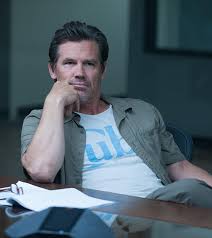
The key figure in this realization is the relaxed, almost cheerful CIA operative played by Josh Brolin.

Matt Graver

Graver is one of the film’s most fascinating characters because he openly blurs the lines between legality and strategy. He treats the war against the cartels not as a legal battle but as a geopolitical game in which certain rules simply no longer apply.

He jokes. He smiles. He reassures Kate that everything is under control.

And yet the deeper the operation goes, the clearer it becomes that the “control” he represents has very little to do with justice.


Alejandro

If Matt Graver represents the pragmatic face of American power, Alejandro represents something older and more elemental.

Alejandro Gillick

Alejandro is not a police officer or a soldier in any conventional sense. He is a weapon deployed inside the machinery of the state.

His presence reveals the film’s central truth: the war on drugs, as depicted here, is not really about drugs. It is about power, revenge, and the maintenance of geopolitical equilibrium through violence.

The final dinner-table scene—quiet, controlled, almost polite—delivers one of the most chilling moments in modern cinema.

Alejandro does not rage.

He simply completes the task.


A Film Without Illusions

The reason Sicario stands above most films of the 2010s is that it refuses to decorate its subject with comforting illusions.

American cinema has often struggled to portray U.S. foreign policy in Latin America with any degree of honesty. Films frequently soften the narrative with patriotic framing or moral reassurance.

Sicario does the opposite.

In that sense it belongs to a small tradition of films willing to examine American power without the usual gloss. One earlier example is
Salvador.

Like SalvadorSicario presents U.S. involvement in the politics and violence of the region not as a heroic intervention but as a complicated and morally ambiguous system of influence.

The film does not sermonize about this reality.

It simply shows it.


The Craft

What elevates the film from strong political thriller to masterpiece is its extraordinary craftsmanship.

Director Denis Villeneuve constructs the story with remarkable restraint. Exposition is minimal. Dialogue is sparse. Much of the narrative unfolds through mood and implication rather than explanation.

Roger Deakins’ cinematography turns the borderlands into a stark visual landscape of highways, deserts, and shadowy tunnels.

And the score by Jóhann Jóhannsson provides the film’s subterranean heartbeat—deep, rumbling tones that feel less like music than like distant artillery beneath the earth.

Together these elements create an atmosphere that is almost hypnotic.


The Film of the Decade

Every decade produces films that entertain, and a smaller number that capture the psychological mood of their time.

Sicario belongs to the second category.

The 2010s were a decade in which institutions increasingly appeared opaque, power operated through indirect mechanisms, and the line between legality and strategy often seemed disturbingly thin.

Sicario does not attempt to solve these problems.

It simply looks at them without flinching.

And that honesty may be precisely why it stands as the greatest film of its decade.

My Time At Northern Arizona University Interlude and Part V: Return to Japan and Year II Term I

Interlude — Return to Japan, Winter 1999

I flew back to Japan in early December ’99, eleven months after Flagstaff, twenty six years ago today.

My girlfriend — soon to be my wife — met me in Kumamoto and before we went anywhere near a city office we took a bus tour of Kyushu. One of those packaged trips where the landscape is real but the schedule isn’t — temples, viewpoints, souvenir shops engineered into the route because somebody is getting a cut. I’ve never liked bus tours. Too passive. Too commercial. A landscape you watch instead of inhabit.

The first night in the hotel we were intimate for the first time in a year. It was good enough — tentative, self-conscious on my part, like we were remembering choreography rather than improvising. It would all come back pretty quickly.

After the tour we stayed with her parents in Uto City — small house, tatami floors, her childhood bedroom upstairs. We shared a single futon where she had slept alone as a girl. I remember the narrowness of it, two adults lying in a past built for one. The walls thin, the air still, her parents downstairs, in their own world.

.We went to the city office the first week of December and signed the papers — no ceremony, no white dress, no crowd, just bureaucracy, and permanence I suppose. A moment small in appearance and enormous in consequence. One pen stroke and we weren’t dating across continents anymore — we were married.

I flew back to Arizona before the semester resumed. I was a married man. Small ring. Big life. My cold room waiting.

That was the hinge — Japan in winter, Flagstaff in spring, and me between two homes that I didn’t yet know they would trade places for good.

NAU Year Two — Term One

I flew back to Spokane that winter the same way I had the year before — no plan except back to NAU and see what I could do. The red Toyota pickup was waiting for me, still running, still mine, connecting Washington and Arizona. I drove south again — long highways, cheap motels, maps instead of GPS, how I knew what I was doing I have no idea.

Flagstaff was colder that winter, or maybe I had just forgotten what dry cold felt like. I didn’t keep the old room near campus, and I didn’t want to. I spent two nights in a budget hotel, stretching my graduate-tutor income across meals and rent in my head. Still — I was back, and that is what mattered.

A classmate pointed me toward a woman named Bev who had a room for rent. She lived twelve minutes from campus. She has a big house — divorce settlement money, and a shoo downtown that sold wood furniture she built by hand. The furniture was bad, and she told had sold exactly zero pieces. That alone told me she was operating on a different financial zone than the rest of us.

I moved in. My own room, my own bathroom, access to the kitchen, $700 a month. Not luxury, not struggle — just workable. I drove to campus every day, which meant less drinking, more structure. Only once did I drive home drunk, and it scared me enough to make sure it stayed a single incident. Mostly, I left the truck downtown and taxied home, or I didn’t drink at all.

Academically, the rhythm was set — Said, Ray Huang’s 1587, Braudel, Portelli, more Bourdieu when I could manage it. The hardest class was Bob Baron’s Marx seminar. Everything else felt manageable, maybe even easy when I had momentum. My friendship with Mandiola deepened that semester — sharper, closer, more real — the two outsiders orbiting the same department.

That was also when I noticed Sonia. First as a presence — around campus, then behind the counter at the organic market I could barely afford. The book van outside sold $1 paperbacks, and I bought more of those than groceries. We exchanged looks — recognition, curiosity — but nothing more. Later I realized she was an undergrad in the Post-War German History class I lectured in. That alone helped keep the boundary clean.

By late fall the loneliness was real. I was married, but alone. She missed me. I missed her. She was thriving at work — promoted to Head Nurse at 24 — and still, distance was beginning to feel like erosion rather than opportunity. So we made a plan:

So in the Fall of 2000 my wife would come to Flagstaff and take part-time English classes. We would be in the same place again.

Around that same time the last of my Hamilton debt — $17,000 — was paid off by her or by her mother. I’m still not certain which. Either way, relief arrived quietly. I would repay it not as a transaction but by building a life — covering everything from 2002 onward.

And that was the first term of year two. Cold roads, heavy reading, a quiet spark at the edge of ethics, and the decision that distance had served its purpose.

My wife would come next term.

My Time at Northern Arizona University Part II: The Other Graduate Students

Note: This is Part II of my series on my time at Northern Arizona University between 1999-2001. This post takes up the other graduate students in the History Department. Part I, Decision and Arrival, can be found here.

NAU — The Graduate Students

The History Building was located near the northeast of campus, and as I mentioned in Part I it was mere minutes for where I was staying in my first year of the program. There was one graduate office on the second floor — a narrow room with four aging computers, a stubborn printer, and more bodies than desks. Some students shared chairs. Some wrote standing up. You could hear arguments through the walls, even with the door closed. It wasn’t glamorous, but it was the whole ecosystem: every thesis, every grudge, every friendship, every theory, all pressed into what was a pretty small space.

Cindy

The center of the room was Cindy. Early thirties, beautiful, charming, half-brilliant and fully aware of her own gravity. She studied the Southwest like almost everyone else in the cohort, but she made scholarship look like a party you had to be invited to. Men tried. None succeeded. She never dated within the department, but she flirted like a form of cultural exchange — a compliment, a smirk, a dismissal, repeat.

A number of us would go bowling from time to time, and when I bowled a clean 200 one night (still my best score ever) she called me Zen — partly for Japan, partly for the way I moved through things without forcing them.

As mentioned, Cindy flirted lightly with all the single guys in the department, and she and Mandiola had a particular dynamic going on. More on that below.

Lance and Gretchen

Orbiting Cindy were Lance and Gretchen, a long-term unmarried couple renting a big place in the low hills behind campus. Lance was military reserve — rigid posture, some money behind him. Gretchen was smart and generous; they held Thanksgiving at their house and the whole department came. It was clear to me, however, that she lived in Cindy’s shadow a fair bit.

Their relationship read like a stable table with a crack underneath. They had been together for a while at that point, though I don’t believe it ultimately survived.

Dave Diamond, Patrick, and Gary

At the other end of the room sat three men who could fill a bar with argument, and did.

Dave Diamond — mid-fifties, blue-collar history etched into him. Fishing boats, oil platforms, mines. He smoked dope daily like other people drink coffee. His thesis was on one apple orchard. Not agriculture policy in general — one orchard. He traced labor, yield, frost, policy, immigration, machinery, exploitation and renewal through a single patch of earth. That was Diamond: narrow focus, infinite depth. He was grumpy in the best possible tradition, and as I’ll mention later hooked me up with a little green from time to time, and I liked him.

Patrick was about twenty-two, a conservative, and worshipped Ronald Reagan. He believed the free market solved more problems than it created. Diamond thought Reagan had gutted the working class and could give footnotes from memory. They shouted at each other constantly, sometimes in the office, more often over drinks— full volume, full conviction — then they would move on like nothing had happened. They weren’t enemies. They were the ongoing argument.

Gary stood between them philosophically but never took the middle. Libertarian, Western-minded, big on personal risk and responsibility. Motorcycle helmets should be optional, ICU bills be damned. A man should be free to crack his skull if he wants to. You couldn’t move him. His logic was dry and clean. I wrote about Gary and his helmet policy at length here, and here is an excerpt:

Later that year Gary’s brother, also a biker, died in a motorcycle accident on a New Mexico mountain. It was a sad day for the department and for Gary. His brother was a biker and a cop, and I happened to walk past the church where the funeral was being held. There were dudes in Hell’s Angels jackets and cops in dress uniform side by side. Gary came by the graduate student office a day or two later. Yeah, he said, a funeral like that is the only time you’ll see bikers and cops side by side. He talked about his brother and how much he loved his motorcycle. I offered my condolences, but then curiosity got the better of me, as per usual.

“Gary, I have to ask, was your brother wearing a helmet?”

“Of course not. He died like he lived, free.”

“Does the accident make you think any differently about helmet laws?”

“If anything, it makes me more opposed to them. The right to ride without a helmet is what makes a biker a biker. Without that, we have nothing. My brother would feel the same.”

The three of them — Diamond, Patrick, Gary — were a triangle of conflict that never quite resolved. I liked them all in different ways and they all added color to the department.

Scott Fritz

Then there was Scott Fritz — early thirties, soft-spoken, spaced-out, gentle. Loved Las Vegas with an almost devotional sincerity. Not for gambling. For cocktails at 3 a.m. in glass palaces of light. He was in line for a major scholarship until Mandiola took it out from under him. I’m not sure what Scott was studying, but probably the American Southwest as well.

Mandiola

Mandiola and I were the outsiders. Not Southwest scholars. He was studying semiotics. I was studying Asia, oral history, and collective memory.

He was born in Chile, raised in LA, carried two languages without ceremony. His mind was fast — too fast in many ways. He had been married, and at this time was seeing P., an English professor who was at NAU on sabbatical. I met her twice; once over pizza with other members of the department and once more. We didn’t like each other at all, which Mandiola found hysterical. That was him: always drawn to drama — either generating it or laughing at it.

He was the loudest voice in the room. His banter with Cindy dominated the grad office for weeks — compliments tangled with insults. It wasn’t romantic. It was force meeting force, and they both held their ground. I also wrote about becoming friends with Mandiola in my piece I Have a Crush on Katie Park of the Bad Moves; here is a little bit of that:

A good friendship, in my opinion, is one where no matter how long you and your friend have not hung out, if you see them it’s as if not a day has passed. With this sort of friend, I’ve found, there is between yourself and them something fundamental shared. It can be anything really. For example, I first met my good buddy when we were both in graduate school in Arizona, and at first I thought he was a total dick. He was loud, interrupted people constantly, and loved being the center of attention. One night we were drinking as a department and he started razzing me there on the street, just casually insulting me left and right. Suddenly I got where he was coming from. This was, in fact, his way of offering to be friends. Once I understood this, I began to give it right back to him. Called him every name in the book. And he ate it up. By the end of the night we were fast friends and have been ever since, because we share an understanding that our friendship is based, in part, on ripping on each other.

Me

I was twenty-four, newly returned from Japan, married but alone in Flagstaff. I ran most mornings, didn’t drink in my tiny freezing room, and wanted to get straight As. And I got them, with just one A- to keep me honest I guess.

Summary

  • Cindy had presence.
  • Lance and Gretchen had the house on the hill.
  • Fritz had Vegas dreams.
  • Patrick had Reagan.
  • Gary had principles made of stone.
  • Diamond had an orchard.

And Mandiola and I — for all our differences — were the sharpest minds in the room, and it is he that I would spend the most time with and remember the best.

My Time at Northern Arizona University Part I: Decision and Arrival

Dateline: Kumamoto, Japan. Fall of 1998.

I am living in a small apartment near downtown, tatami under my feet, a low loft overhead, the city moving quietly outside. I’d been teaching English conversation long enough to know I was going nowhere in that job. It wasn’t a crisis; it was a slow stalling-out. Good enough money, students I liked, but no real future. A life you could idle in forever.


Most nights I sat on the floor with a notebook, paging through information on American graduate programs. I wasn’t dreaming about tenure, an academic ladder, or a nameplate on some elite office door. I wasn’t trying to become a history professor at all. What I wanted was simpler and sharper: a way back to the U.S., a life I could actually live inside, and a path that might let the woman I loved come over later, maybe as a nurse, once her father’s condition — only after marriage — was met.

I emailed Tom Wilson, my old Asian History professor from Hamilton, and asked if he would write on my behalf. He agreed, and somewhere out in the system his recommendation went off to people who would never meet him. He also wrote back: don’t go to Northern Arizona; go to Chicago, my school. You can become a professor. It was kind and sincere and completely beside the point. He was thinking career. I was thinking oxygen.

The search itself was slow. I compared cities, programs, costs, climates. When I landed on Northern Arizona University and started looking at Flagstaff, it just felt right: high desert, pine trees, a small city you could walk, not a sprawl you endured. The history program was solid enough, and it wasn’t a teaching-credential track. It looked like a place where I could move forward, not just sideways.

When the offer came back, it was more than just admission. NAU gave me a scholarship and in-state tuition, even though I had never lived in Arizona. That got my attention. Schools don’t hand out cheaper rates to out-of-staters for fun. For whatever mix of reasons — Japan, Hamilton, Tom Wilson’s letter, my file on someone’s desk — they wanted me. That was enough.

I packed up my life in Kumamoto, said goodbye to Washington — my second English conversation school, not the state — and flew back to Spokane. From there I bought a red Toyota pickup for four thousand dollars from a teacher’s husband at St. George’s; he was a cop. It was almost all the money I had. I drove away with a truck, an acceptance, and not much else.


The road south was long and winter-empty. I followed a paper map through states I barely knew, slept in a couple of cheap motels under thin blankets, and kept going at first light. The truck held together. I did too.

Early January, I rolled into Flagstaff. Cold air, bright sky, nothing arranged. I had no housing lined up and almost no cash. I parked on campus, put on black trousers, a black turtleneck, and a black blazer, and walked straight into the History building like that was a normal thing to do.


Karen Powers, the chair, treated it as if it was. I told her I’d just arrived and had nowhere to stay. She didn’t flinch. A friend of hers, she said, had a room to rent a minute from campus, three minutes from the department. We walked over.


It was a small back bedroom, six hundred a month, a parking space in the yard, and a shared bathroom with the guy in the next room. No kitchen, no run of the house. Not ideal. But it was available, and it was there.

I took it on the spot. That same day, I moved in.