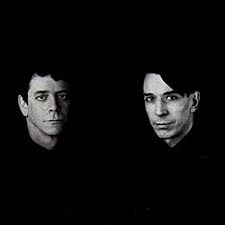
Note: This post takes up Songs for Drella (1990), Lou Reed and John Cale’s uneasy reunion album/biographical song-cycle about Andy Warhol, moving track by track through Warhol’s trajectory from Pittsburgh outsider to Factory-era icon to post-shooting isolation and mythic afterlife. Along the way it reads the record not just as tribute or elegy, but as a sustained meditation on work, style, and the thin boundary between populist gesture and aesthetic theory—especially in the pointed figure of “classicists” versus Warhol’s downtown anti-orthodoxy. What emerges is less a linear album review than a set of reflections on art, authorship, and cultural literacy, with Warhol as both subject and pretext for thinking about what it means to make anything count as art in the first place.

In 1990, Lou Reed and John Cale, formerly of the Velvet Underground, latterly famously not getting along, reunited to make Songs for Drella, a tribute/ musical biography of their first patron, Andy Warhol. Drella is a 15 song cycle which takes the listener through Andy’s life and career, from his early days in Pittsburgh, through success in New York, getting shot, latter-day isolation and and loneliness, and ending with an epitaph. The songs fit loosely together in chronological order. Here is the basic scheme: “Smalltown” sees Andy unhappy in Pittsburgh and dreaming of the big city; “Open House” describes the early days of the factory, when all and sundry stopped by and provided Andy with inspiration; “Style it Takes” gives an overview of some of Andy’s famous works and his working method; “Work” explains the considerable work ethic that underlay Warhol’s success; “Trouble with Classicists,” in what is presumably Andy’s voice, provides a series of opinions about “classicists”, “impressionists”, and “personalities”; “Starlight” appears to consider Andy’s flirtation with Hollywood, or Hollywood’s flirtation with him; “Faces and Names” kicks off the second section of the record and finds Andy in despair, something like a midlife crisis; “Images” details Andy’s philosophy of art and hits back at the critics of his method; “Slip Away,” “It Wasn’t Me,” and “I Believe” represent the nadir of the record in which Andy is warned about the people he associates with, confronts a junkie, and is shot by Valerie Solanis; “Nobody But You” sees Andy bereft of companionship hanging out and paying the price of dinner of a nobody; “A Dream” synthesizes all which has come before and puts Andy’s life into fuller perspective; “Forever Changed” sees Andy’s past slipping away; and “Hello It’s Me” represents Reed’s epitaph and apology to Warhol.
Some of the songs are better than others; specifically, I get comparatively little out of “Starlight,” “It Wasn’t Me” and “Forever Changed,” but every song has its place in the story of Warhol’s life and his influence on Reed and Cale, his circle, New York city, and the art world in general. This post will take up the first five songs as a bridge into a wider discussion of the meaning of “classicism” today. There may or may not be a part two to this post.
“Smalltown” is about leaving Pittsburgh, and introduces us to the fact that Andy was gay:
When you’re growing up in a small town
Bad skin, bad eyes – gay and fatty
People look at you funny
When you’re in a small town
New York is more to his liking, and provides a context for his art to flourish:
Where did Picasso come from
There’s no Michelangelo coming from Pittsburgh
I hate being odd in a small town
If they stare let them stare in New York City
The theme of small town boy (girl) made good in the big city is classic and well worn, of course, but Andy thrives in NYC, and soon “The Factory” is open to all comers (“Open House”):
Come over to 81st street I’m in the apartment above the bar
You know you can’t miss it, it’s across from the subway
and the tacky store with the Mylar scarves
Andy wants people around him, and this is one of the major themes of the record; his ability to work is dependent on company and inspiration from associates, peers, and even hangers-on:
It’s a Czechoslovakian custom my mother passed on to me
The way to make friends Andy is invite them up for tea
It’s a Czechoslovakian custom my mother passed on to me
Give people little presents so they remember me
Whereas “Smalltown” is loud and bracing, the music on “Open House” is soft, elegant, gentle even. But even in his halcyon early days in NYC Andy cannot entirely escape the demands of the market or of other people’s ideas of what he should be doing:
I think I got a job today they want me to draw shoes
The ones I drew were old and used
They told me — draw something new
Open house, open house
You scared yourself with music, I scared myself with paint
I drew five-hundred fifty different shoes today
It almost made me faint
Open house, open house
Andy’s career takes off, and he clearly has something that people want–he has “The Style It Takes.”
You’ve got connections and I’ve got the art
You like attention and I like your looks
and I have the style it takes and you know the people it takes
I’ve got a Brillo box and I say it’s art
It’s the same one you can buy at any supermarket
‘Cause I’ve got the style it takes
Here, Reed and Cale delve into the perennial question of the definition of art–what’s good, what’s bad, and how do we know the difference? The answer which “Style It Takes” seems to offer is: the status of something as “art” is dependent upon someone with “style” telling so. This observation is at once banal (we know art is art because it hangs in a museum and because of the reverent hush of the patrons), and somehow inspiring (a kid from Pittsburgh, “bad skin, bad eyes – gay and fatty,” can take the New York art world by storm simply be possessing some quicksilver attribute called “style,” something so powerful that a simple box of soap pads becomes accepted as art less on its own merit and more on the strength of its association with Warhol, who by 1964 was rapidly ascending to the status of an icon). This song also sees the first appearance on the record of a little group called The Velvet Underground, who Andy “shows movies on.”
“I’ve got a Brillo box and I say it’s art”–is this a populist claim or an elitist one? Is it classical? Certainly not classically classical, but is there not a way in which Warhol’s “pop art”–which is often read as representing the “emptiness” of modern popular culture, is perfectly sincere and actually uninflected with irony? Another major theme of the record is Andy’s work ethic–he was a working artist on whose sweat the whole Factory scene was dependent. Andy’s work ethic, according to Reed and Cale, even had a religious aspect. “Work” starts with Andy in prayer, and despite the neat twist on the phrase “Protestant ethic” here, we are left with the strong feeling that Andy was no self-ironizing dilettante, and that his blue-collar background stuck with him throughout his life:
Andy was a Catholic,
the ethic ran through his bones
He lived alone with his mother,
collecting gossip and toys
Every Sunday when he went to church
He’d kneel in his pew and he’d say,
“It’s work,
all that matters is work.”
He was a lot of things,
what I remember most
He’d say, “I’ve got to bring home the bacon,
someone’s got to bring home the roast.”
He’d get to the factory early
If you asked him he’d told you straight out
It’s work
In “Work,” Andy stresses quantity over quality; just as he had painted 550 different shoes in “Open House,” here he advises Reed to write like there is no tomorrow:
No matter what I did it never seemed enough
He said I was lazy, I said I was young
He said, “How many songs did you write?”
I’d written zero, I’d lied and said, “Ten.”
“You won’t be young forever
You should have written fifteen”
It’s work
But despite his working artist approach, Andy is not content to merely record the surface of what he sees. Neither, however, is he given to too much soul-searching or self-analysis about why he is who he is, or why he does what he does. “The Trouble with Classicists” is the central song on the record, the song where Reed and Cale get closest to defining Warhol’s attitude toward art. It is also here from which I was moved to take on the issue of classicism in our times:
The trouble with a classicist he looks at a tree
That’s all he sees, he paints a tree
The trouble with a classicist he looks at the sky
He doesn’t ask why, he just paints a sky
The trouble with an impressionist, he looks at a log
He doesn’t know who he is,
standing, staring, at this log {…}
That’s the trouble with impressionists
If neither classicism nor impressionism, than who or what is Warhol drawn to? The answer is graffiti artists, of all things:
I like the druggy downtown kids who spray paint walls and trains
I like their lack of training, their primitive technique
I think sometimes it hurts you when you stay too long in school
I think sometimes it hurts you when you’re afraid to be called a fool
That’s the trouble with classicists
Let’s dig a little deeper. Cale, who sings “Classicists,” is himself famously a “classically trained” musician, who has drunk heavily of modernism and dissonance without surrendering what I still see as a fundamentally classical musical and aesthetic sensibility. Moreover, writing a song called “The Trouble with Classicists” in this day and age is in itself a classical act. This I think is a key point; whereas once upon a time a Romantic poet could have defined himself or herself in violent opposition to Classicism and made it stick, today, and perhaps even in Warhol’s day, the ability to criticize classicism as a form or style is evidence of a degree of learning and cultural literacy which can only be described as classical, and, yes, a little elitist.
Is this right? It sounds right, at least, and I would add the following: a) the vagueness with which I am approaching the question of a modern definition for classicism in these paragraphs is symptomatic of the generally pitiable state of true learning on that part of what Edward Said calls “the general intellectual”; b) Said’s general intellectual today tends also to be as Dean Williams has said a “profound modernist”–which is a nice way of saying someone who knows, and cares, very little about Western culture’s classical roots, very little about the Bible, very little about the great religion (at least in any fine grained way), probably very little about Shakespeare for that matter; c) today’s general intellectual knows very little about music compared with his 18th or 19th century counterpart. This is a point which Said makes in his chapter on Glenn Gould in On Late Style: “Today’s literary or general intellectual has little practical knowledge of music as an art, has hardly any experience playing an instrument or studying solfege or theory, and except for buying records or collecting a few names like Karajan and Callas, does not as a matter of course have a sustained literacy–whether that concerns being able to relate performance, interpretation, and style to one another, or recognizing the difference between harmonic and rhythmical characteristics in Mozart, Berg, and Messiaen–in the actual practice of music” (115). Any of my general intellectual readership care to take this argument on? If so, please produce 100 words on solfege without reference to Wikipedia before wading in.
My point, which is, I fear, on the verge of getting lost, is less that Warhol or for that matter Reed and Cale are in any specific way “classical,” but that because what Said calls the lack of “sustained literacy” in music on the part of the general intellectual is not confined to music, but extends to art, classical and great literature (how many of us who name drop Aristotle have actually spent any time reading him? how many of us who attempt to evince first-hand knowledge of Marx have actually broached Capital?), and philosophy. That is to say that the general intellectual today is apt not only to be a profound modernist, but also to be a profound generalist, who knows a miniscule amount about a huge number of things, a little bit about a few things, and knows almost nothing is any truly extensive or impressive detail. In this context, not only is “The Trouble with Classicists” deeply classical, not only is Classical Sympathies, by very virtue of its being and intent, classical, but any attempt to engage in a serious way with issues of aesthetic definition marks one out as both a classicist, and at least a minor elitist. Certainly Said, for all his “oppositional” stances and leftist politics, was both–but the question of how leftism and classicism can co-exist is best left for a latter date; it is time to stop work on this post and risk being called a fool.