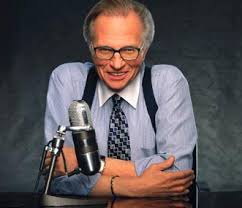
On Larry King, the Radio GOAT

Epigraph:

“I listened to the radio / I waited all night long…”
— Radio Radio, Elvis Costello

Note: This piece reflects my personal memories of listening to Larry King’s overnight radio show in the late 1980s and early 1990s, along with later impressions from television appearances, interviews, and conversations with people who knew him. It is written in the spirit of appreciation and nostalgia rather than media criticism, and emphasizes the uniquely loose, humane, and unpredictable quality of King’s radio work, which for me remains the defining core of his legacy.

I grew up listening to Larry King’s overnight radio show between roughly 1988 and 1992, and in my opinion — which happens to be correct — the radio show was much better than the television version that later made him famous. The TV show was good, even great at times, but radio was longer, looser, freer, and far more unpredictable. It had weird guests, weirder callers, and the feeling that anything might happen at two in the morning. That’s where Larry really lived.

I would listen in my bedroom at my parents’ house in Spokane, Washington, the volume turned low, the house quiet, insomnia hovering. The Spokane AM station — KGA 1510 — carried the show from around 9 PM Pacific time, and then, wonderfully, they would run it again. So I’d listen from nine to midnight, fade, wake at two or three, and hear the same segment again in a half-dream. The effect was surreal. Didn’t I just hear that caller? Didn’t Larry just say that? It created a strange loop of late-night déjà vu that only made the whole thing more atmospheric. The show felt less like programming and more like a continuous nocturnal conversation.

My friend Kelly Rudd loved Larry too. When we were in high school we were both big fans of the radio show, and we talked about it constantly. There were a couple of things that we especially liked. The first was that Larry famously did no preparation. He knew a huge amount about the world, of course, but he didn’t read guests’ books ahead of time. He wanted to come in cold. If his guest was a firefighter, he’d ask, “So what’s it like to be a firefighter?” It sounds lazy, but it was brilliant. By staying open and getting out of the way, he let the conversation go anywhere. This way the show became eventful.

Another thing we loved was what happened after the guest left. Larry would open the lines and take questions about absolutely anything. Most of the time he was generous and patient, but when callers went off the rails he had a signature phrase. He’d cut them off gently: “Cold compress, ma’am,” or “Cold compress, sir.” Basically: lie down, ice your head, regroup. It was hysterical, especially because he used it sparingly. When “cold compress” dropped, you knew things had gotten weird.

Anyway, Kelly and I loved Larry so much that when the station suddenly dropped the show, Kelly proposed we drive to the radio station and protest. So we skipped school, drove across town, and rang the intercom demanding to speak to someone about the cancellation. The station manager eventually came down and heard us out. We knew we weren’t changing anything, but it felt right to try. Larry never came back to Spokane radio, and the show faded not long after, but the whole episode captured what the show meant to us. It wasn’t just background noise. It felt alive.

Larry’s on-air style was the key. He was unbelievably relaxed. By the late ’80s you could tell he had done thousands of hours. Nothing fazed him. Weird guests, drunk callers, eccentrics — all the same to Larry. He absorbed everything. He had pet phrases — “cold compress” chief among them — and he deployed them like a veteran reliever, only when needed. He famously did no prep, and he leaned into naïve questions. He’d ask something simple and let the guest do the work. The effect was disarming. People opened up. He also had real humanity. He listened. He didn’t mock callers. He didn’t rush them. There was compassion there, and I think that’s what I loved most.

And the show could get wonderfully out of control. In one story Larry told from his old Miami days, an adult actress he was interviewing suggested they just have sex during the commercial break. Larry, amused, asked the producers to clear out — but there wasn’t enough time. That kind of anecdote captures the looseness of late-night radio. It wasn’t polished. It was alive.

Larry left the overnight Mutual Radio show in 1994 to focus on television. By then I had already drifted away, but I still caught Larry King Live on CNN over the years. I remember watching during the O. J. Simpson trial while at Otago University in New Zealand, when the show became part of the nightly noise. Later there were the Vladimir Putin interviews — classic Larry, conversational and oddly disarming. And of course there were the great comic moments, like the interview with Jerry Seinfeld where Larry suggested the show had been canceled and Seinfeld snapped back in disbelief, and the Norm Macdonald appearance where Norm kept repeating, “I’m a deeply closeted homosexual,” and Larry tried earnestly to parse it. “So that means you’re gay?” “No, Larry,” Norm replied, “it means I’m deeply closeted.” Pure Larry: sincere confusion meeting absurdist comedy.

Larry’s personal life was famously complicated. He married eight times, had several children — including sons Chance and Cannon later in life — and lived in a kind of perpetual romantic improvisation. The marriages came and went. The last ended painfully and publicly. He once joked he’d never leave his wife unless Angie Dickinson came along — and when she did, he married her. That was Larry: impulsive, affectionate, slightly chaotic. Despite decades of success, he didn’t leave the kind of massive fortune people assumed. The money came and went, as did the marriages. It was a life lived in motion.

My friend Sergio Mandiola actually knew Larry in his later years in Los Angeles. Sergio was running an independent studies program at Beverly Hills High School, and Larry’s sons Cannon and Chance, and he taught his sons for three years. Larry would come by for open nights or just to chat.

Sergio Mandiola: “Larry would come in from time to time and we would talk. He was lovely and open. He talked about his family and his career. One time he told me, ‘Sergio, you should totally have a radio show!’ I was flattered. One thing about Larry is his politics were more to the left than he let on on air. He had strong views and wasn’t afraid to share them in person. Larry was a true mensch and I’m glad I got to spend time with him. I miss him.”

In the end, I’ll say it plainly: for me, Larry King is the radio GOAT. There was no one like him, and there probably never will be. It wasn’t just longevity. It was the curiosity, the looseness, the humanity, the love of people, politics, baseball, and life. He trusted the conversation. He let the night unfold.

And then there was that absurd, wonderful USA Today column, which read like a diary gone completely outta control. Mets lose 6–4…Rain in Baltimore…Clinton flies to Ireland…You’d read it and think, Larry, baby, WTF is this? And also, Mr. USA Today, WTAF are you doing paying for this? But somehow it worked. It was pure Larry — fragmentary, observational, intimate.

And that’s how I remember him most clearly: late nights in high school, the radio turned low, insomnia hanging in the room, Spokane quiet outside.. Sometimes I’d listen from nine to midnight, fade, then wake again to the rerun, half-dreaming, half-aware, caught in that strange déjà vu — didn’t I just hear this? — while Larry kept talking, calm as ever, taking calls from truckers and insomniacs and eccentrics. My listening years were brief, but they stuck. And when I think of Larry now, that’s where I go back to: the low hum of AM radio, the half-fade, and the sweet sounds of his voice in my ear.

Dedication:

For the one and only GOAT, Larry Motherfucking King. RIP baby.
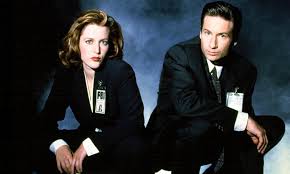
On The X-Files: The Paranoid Style of 1990s Television

Note: This reflection comes out of a long-standing fascination with The X-Files, one of the most distinctive television shows of the 1990s. When it first aired, the series managed to occupy a strange and compelling middle ground between science fiction, horror, conspiracy culture, and something closer to philosophical inquiry. Week after week the show asked the same unsettling question from slightly different angles: what if the world is not quite as stable or intelligible as we assume?

What made the series especially effective was the dynamic between Fox Mulder and Dana Scully. Mulder represented the pull of belief, intuition, and pattern-seeking; Scully stood for skepticism, evidence, and scientific restraint. The tension between those two orientations created a kind of philosophical engine that powered the show for many seasons.

The major episode discussed here is one of the early “mythology-adjacent” stories that sits near the boundary between the show’s monster-of-the-week format and its deeper conspiratorial arc. Watching it again years later, what stands out is not only the eerie storytelling but also the way the series captured a particular cultural mood of the 1990s — a time when technology was expanding rapidly, institutions were increasingly distrusted, and the possibility of hidden systems operating beneath the surface of ordinary life felt strangely plausible.

In that sense, The X-Files was never just about aliens or government cover-ups. It was about uncertainty itself — the uneasy space between explanation and mystery.

Epigraph:

“Autorerotic asphyxiation is not a pleasant way to go, Mr. Mulder.”

Clyde Bruckman, The X-Files

The X-Files is my second favorite television show of all time, behind only The Wire, and it’s not close.

That may sound like a bold claim given the sheer amount of television produced over the past thirty years, but for those of us who came of age in the 1990s the show hit a nerve that very few cultural artifacts ever have. It wasn’t just entertaining. It was atmospheric. It was unsettling. It felt like it was plugged directly into the cultural nervous system of the time.

To understand why, you have to begin with a simple generational fact. I was born in 1974, just eleven short years after the assassination of John F. Kennedy. That event cast a shadow that lingered for decades. My parents’ generation and my grandparents’ generation were deeply scarred by it in ways that people my age never fully understood. Something in the national psyche broke that day. Trust in institutions never really recovered.

Historians later described this cultural mood as “The Paranoid Style of American Politics,” borrowing the famous phrase from the essay by Richard Hofstadter. Whether one agreed with Hofstadter or not, the phrase stuck because it captured a very real undercurrent in American life: the suspicion that unseen forces were operating behind the scenes.

The genius of The X-Files was that it leaned directly into that atmosphere. It didn’t treat paranoia as pathology. It treated it as narrative fuel.


Discovering the Show

I was an early adopter.

The show premiered in 1993, and by 1994 I was already watching it in the dorms at Hamilton College with a group of friends. If possible we’d get a little baked first, which in hindsight may have been perfect. The X-Files is a show that rewards slightly altered states of perception.

At first it was something of a cult discovery. A few people watched it religiously while others barely knew it existed. But by the time the second and third seasons rolled around it had become a communal ritual. Thursday nights meant Mulder and Scully.

The chemistry between the leads was immediately apparent.

David Duchovny and Gillian Anderson had what we would now call “shipping chemistry,” although that term didn’t really exist yet. We simply knew that something electric was happening on screen. The characters worked because they embodied opposing ways of understanding the world. Mulder believed everything. Scully was more skeptical. Between them the truth hovered in an unresolved middle ground.

The show was also disciplined enough to hold that tension for years. In an era before streaming algorithms and social-media speculation, viewers waited week to week to see how the relationship evolved.

Hovering over them was their boss, the enigmatic Walter Skinner. For several seasons it was impossible to tell whether Skinner was helping Mulder and Scully or quietly managing them on behalf of darker forces. That ambiguity was one of the show’s greatest pleasures.

In a delightful twist of pop-culture irony, the actor Mitch Pileggi was at one point named TV’s Sexiest Man by a glossy magazine. Which is hilarious when you remember that Skinner is essentially a bald FBI bureaucrat in a gray suit. Such was the cultural power of the show.


The Smoking Man

Then there was the figure lurking in the shadows.

The Cigarette Smoking Man is one of the great villains in television history. Played with eerie understatement by William B. Davis, he appeared whenever the conspiracy thickened.

He looks exactly like the kind of man who would be at the center of a decades-long government cover-up. Three packs a day. Cheap cologne. A lingering Jameson hangover. The sense that he spends most of his time in dim Washington parking garages and windowless offices and only emerges from his crypt when the conspiracy requires it.

It’s a performance so physical that you can almost smell the character through the screen.


Three Essential Episodes

Every long-running show has defining episodes, and The X-Files produced dozens. But three in particular illustrate what made the series so special.

The first is the pilot itself, which introduces Mulder investigating mysterious disappearances in the Oregon woods. A key moment occurs when the agents experience missing time on a dark forest road. The scene establishes the tone immediately: eerie, ambiguous, and faintly plausible.

The second is Fallen Angel, an early classic that introduces the lovable conspiracy obsessive Max Fenig. Max’s jittery paranoia captures the spirit of the show perfectly. When he remarks that “someone’s always watching, Mr. Mulder,” it feels less like dialogue than like a thesis statement.

The third is the masterpiece of dark humor, Clyde Bruckman’s Final Repose, written by the great Darius Morgan. In it, a weary insurance salesman named Clyde Bruckman discovers that he can foresee the exact circumstances of people’s deaths. Played beautifully by Peter Boyle, the character delivers a hilarious and oddly touching performance. It is Bruckman who also delivers the immortal line that also gives us our epigraph: “Autorerotic asphyxiation is not a pleasant way to go, Mr. Mulder.” Run roh. Take that belt off Fox baby.

What makes the episode remarkable is that it gently mocks the show’s own hero. Mulder spends the entire series searching for hidden meaning in the universe. Clyde Bruckman, by contrast, believes life is largely arbitrary and tragic.

His prediction of Mulder’s death—immortalized in the epigraph above—is both absurd and strangely profound. It’s also a sign that by Season Three the show had gained enough confidence to poke fun at itself.


When the Mythology Expanded

Like many successful serialized shows, The X-Files eventually struggled under the weight of its own mythology. One of the central narrative engines involved Mulder’s missing sister, Samantha Mulder. Early on, the mystery added emotional depth to Mulder’s obsession with the paranormal.

But as the seasons progressed the storyline became increasingly convoluted. Samantha might have been abducted by aliens, or replaced by a clone, or transformed into something else entirely. Meanwhile the conspiracy expanded to include frozen alien ships in Siberian ice, shadowy government syndicates, and the infamous black-oil virus that seemed capable of possessing human hosts.

At a certain point the mythology began to chase its own tail.

Then, as the final blow, David Duchovny left the show. Gillian Anderson remained excellent, but The X-Files was always fundamentally a two-hander. Without Mulder and Scully together the balance of the series shifted in ways it never fully recovered from.


Why It Still Matters

And yet, for all the narrative tangles of the later seasons, the early years of The X-Files remain extraordinary television.

The show captured a very particular moment in cultural history: the twilight of the pre-internet era, when conspiracy theories spread through late-night radio programs, photocopied newsletters, and whispered conversations rather than social media feeds.

It was a time when the idea that powerful institutions might be hiding enormous secrets still felt plausible rather than merely exhausting.

For a few seasons in the 1990s, Thursday nights belonged to the weirdest, smartest, most paranoid show on television.

The truth, as Mulder kept reminding us, was out there

Dedication

For Dana and Fox. You know we still want to know what went down in that motel room baby.

Note: If you enjoyed this essay you may also enjoy the two essays below, both of which, in different ways, take up themes of intrigue and mystery.