Note: There’s a Ryan Adams song that’s always felt like a quiet diagnosis. The emotional math is simple: people give you just enough tenderness to keep you upright, but never quite enough to really move you from wherever you are. It’s from “Oh My God, Whatever, Etc.” — track 5 on Easy Tiger (2007).
You find out you’ve been underpaid, in a sense, for years, not because anyone meant you harm, but because the default setting in some long-forgotten form was never double-checked. The system assumed it was correct. Everyone assumed it was correct. And the thing is, it makes sense—you look like the sort of person who doesn’t need tending. So you stand there with the revised numbers in your hand, not angry exactly, just noticing the symmetry of it all. This is the pattern: people offer small kindnesses, small gestures, small acknowledgments.
Everybody tips.
Just not quite enough to knock me over.
It reminded me of something from years ago at my little IB school here in Japan. Back then I was stretched thin in a way you can only be in your thirties—trying to prove something, mostly to myself. I’d rush through lunch like it was another task to complete. One day Scott, one of our English teachers and a high school homeroom teacher, watched me finish a meal in about two minutes and said, gently, almost to himself, “That’s not good.” It wasn’t an intervention. It wasn’t even advice. Just a small observation from someone who was paying attention in the limited way people do. A tip, not a gesture. A flicker of care that landed, and then the moment passed.
Looking back, I think that’s why the moment stayed with me. It was concern, yes, but it was also something rarer: someone catching a glimpse of the strain I kept tucked under the surface. I wasn’t used to that. Most people saw the polished version—competent, fast, self-sufficient—and adjusted their care accordingly. Scott’s comment didn’t rearrange my life, but it landed in that narrow space where a person can be briefly seen without being exposed. A small kindness with a little weight on it, though not enough to shift anything. Another tip.
When I think about it now, it wasn’t an isolated moment. My life is full of small gestures like that—light touches of concern, half-noticed details, people offering just enough care to register but not enough to alter the trajectory. It’s not their fault; it’s how most of us move through the world. We read surfaces. We assume competence means comfort. We assume steadiness means abundance. So what comes my way is always the manageable version of kindness, the soft-edged form that stays within social limits. It accumulates, in its way, but it never quite tips the balance.
And then there’s the other meaning of the word I keep circling. To tip isn’t only to offer a small gesture—it also means to wobble, to shift the weight of something just enough that it might tilt. In that sense, everybody does tip me. Every small kindness knocks me a little off balance, just not in the dramatic way Adams means. It’s more like a brief lean in the direction of connection, a momentary swerve in the steady line of the day. A soft recalibration, not a collapse. The world nudges, not crashes. It’s movement—just not the kind that bowls you over or forces a change. The cumulative effect is real, but subtle enough that you only notice it in retrospect.
Most days, that’s all life is: a series of micro-tilts. A colleague covering five minutes without comment. A student bowing an extra beat longer than expected. A friend sending a small message at the exact right moment without knowing why. They don’t change your direction, but they do alter your angle by a degree or two. You barely feel it while it’s happening. You just register that your emotional center shifts slightly—a soft lean, a subtle recalibration, the faintest sense of being moved without being moved on. These moments don’t rewrite your story; they just keep it from calcifying. They are the human version of a brushstroke: slight, necessary, almost invisible unless you stand back and look at the whole canvas.
Every once in a while, though, someone doesn’t just tilt you—they land with actual force. It’s rare, but every few years, if you’re lucky, someone steps forward with something closer to full human weight. No calibration, no optics, no politeness. Just the clean, unmistakable feeling of another person showing up without trimming the edges of what they mean. Those are the moments you remember because they interrupt the pattern. They don’t just adjust your angle; they reset your coordinates.
That’s what happened to me in 2018. I’ve told this story in my Bad Moves piece, however to re-state I’d been traveling to see the band Phosphorescent in New York, Boston, Philly, and D.C. I was moving through my own private fog, the kind you don’t mention to anyone because you don’t want to make a spectacle of it. I told the merch gal I’d flown in from Japan, not as a plea for anything, just as passing context. She passed it on to Matthew Houck, the lead singer. And he didn’t do the socially appropriate thing, the small nod or the quick thanks. He came down off the stage and hugged me. A real hug, the full weight of it, twice across two different nights. No hesitation. No half-gesture. He gave me the exact amount of human force the moment called for.
What stayed with me wasn’t the hug itself, but the certainty behind it. Most gestures come wrapped in hesitation or self-consciousness; people soften their own impact before they even reach you. Houck didn’t. And part of the weight was this: he’d been through it himself—not abstractly, not a decade removed, but in the very songs he wrote on Muchacho, the record he made after his own life had come apart. He’d talked about it publicly, openly, without varnish. So when he came down off the stage to hug me, it wasn’t fandom or performance or politeness. It was recognition—one human being who had already walked through his own fire seeing another who was still in it. And the thing about weight is that you feel it instantly. It bypasses the usual filters, lands somewhere deeper, rearranges whatever you were carrying. For a second, you’re not holding yourself up alone. Someone else is taking on a share, however briefly. That’s why I remember it. Not because it was dramatic, but because it was unmistakably real.
I still don’t expect the big gestures. Most people don’t have them to give, and institutions certainly don’t. But my little allowance situation reminded me of something I should probably stop forgetting: I can be steady without letting people assume I’m inexhaustible. I can be competent without accepting the bare minimum as my baseline. Everybody tips, and I do appreciate it. But that doesn’t mean I should be content with being underpaid, overlooked, or treated as some kind of default. The small gestures matter; they keep things from freezing over. They’re just not a substitute for fairness, or for the kind of presence that actually moves you.
And if I’m honest, before the Houck hugs the last time I got knocked over didn’t happen at a show, or in a meeting, or anywhere you could itemize on a form. It was one of those chance crossings where someone walks in at full voltage, doesn’t shrink themselves, and then carries on while you’re still quietly recalibrating. Nothing official changes. Your job is the same, your allowance is the same, your life on paper is the same. But now you know, in your body, what real weight feels like when it lands. And once you know that, it gets a lot harder to pretend that tips—however kind—are the whole story.
Dedication
For the White Russians — the ones who tilt the whole room just by arriving.
Note: This little poem was originally written way back as early as 2008, and is also collected in a piece about John and his dad the pretty famous singer songwriter Bruce Innes, and that can be found here. John and I were together both in high school and college, and had a lot of great times together.
As I’ve written about before, Innes would tell his students marginally true stories about my time at St. Georges’s school and Hamilton College. I did get up to some things, I admit, but Innes does like to exaggerate a bit. All in good fun, and good faith. In any case, one time one of his students became kind of interested in my story, and wrote me asking for information. So I wrote him this back, in verse. This poem is below.
The reason I’m re-printing this today is, I’m finally working on a book. Well, I’ve been working on it all along, and now I’m just arranging things. The book will have, among other things, some oral history in the form of interviews. I have done a few and am doing more, and would like to expand my interview scope a bit. So if that sounds like something you would be interested in, for whatever reason, do let me know. And as always, thanks for reading.
“An Open Book”
Not really in the mood but you’ll think me quite rude if I don’t make a reply around me on the plane folks eat, are entertained no one’s writing save I
So I’ll take a look back to days at the dog track where I ended up by mistake thought we could beat the odds just silly teenage sods there was no money to make
I know not if J.I. has spun a pack of lies concerning my personhood Yes, I wrote poems for girls who told me they were pearls ah–but they weren’t any good
About a cold river, and the rest of his quiver of myths and exaggerations well if someone was shoved it was done out of love or congratulations
So to upstate New York in a trench coat–what a dork but the world took pity the life there was fine but naught was on the line should have gone to the city
I did two things quite well, needing something to sell I wrote brilliant excuses ‘bout ridiculous capers, couldn’t finish my papers I claimed aces, held deuces
My second great skill is one I hold still I fell for crazy ladies locals, Russians, and Turks they all drove me berserk with a boatload of maybes
Four years in the dorms and countless reforms led to little of note I left sans a sob a plan or a job
and without my trench coat
Dedication: For Innes. Let’s rock this little decade baby. And for biographers everywhere. It’s an interesting genre.
Note: If you enjoyed this poem, you may also enjoy “Some B-Side Poems.” You can read that here.
Some nights shine so strangely you can’t parse them/ Sometimes that strangeness is the whole point.
Moonface (Spencer Krug), refracted
New Note: At this point my first book of music, personal, and world history is underway. This book will feature new witting, pieces from my blog edited and expanded or compressed, as well as yet unpublished pieces that I have in my archive. Therefore on the event of tomorrow’s full moon, I will re-print “The Band: A Press Release.”
“The Band: A Press Release” is a second piece of “automatic writing,” writing that comes so fast it’s like it’s downloaded or something. I wrote it in 2018 while standing on a train platform waiting to change trains here in Kyoto. I had met some acquaintances the night before at a bar, and, as detailed in the piece, drew inspiration from their somewhat absurd banter. So I wrote this, in about 8-10 minutes, as if I was the press agent for the group. It was just a little conceit to get the piece going, but it also subtly makes fun of press releases and corporate communication in general.
I really like this piece, despite the fact that it is undeniably odd. Some of the lines still make me laugh, such as “There is a Plan C. Plan C will be referred to as ‘Plan C’. Plan C is cancelation;” and “An extra? A fifth member? Is that a leak? Does the band leak? Does it, after all, hold water?” As I like to say, it’s funny to me.
But this piece is really based on Jungian interpretation of Christianity. So basically as I understand it Christianity has the trinity, the Father, the Son, and the Holy Ghost, which are traditionally recognized. However Jung argued, in essence, that there is a “fourth term,” which is a kind of background term, of the overall dynamic field that helps inform the other three archetypes. I guess I was just trying to outdo Jung; I’m a little competitive that way with my heroes. In any case, here is the piece. The quote toward the end if from David Berman of The Silver Jews.
Note: A few years ago I was working on some major events, and thinking a lot about “event theory.” I’m not even sure event theory is a thing, but it was for me. Anyway, I was at an interesting old bar in North Kyoto called “Brown’s,” (since closed) when I ran into a guy I knew a bit called Jamie. Jamie and I are not, I would say, friends, and in fact I don’t know if I like Jamie all that much. However, I had once been to his apartment where he had a full in-home movie theatre set up and he showed us the film Rockers: It’s Dangerous, which is a bizarre film about some reggae dudes in Kingston Jamaica. The film is kind of hit or miss, however the soundtrack is amazing.
When I met Jamie at Brown’s he was with another friend of his. We were talking some event theory and Jamie started telling me about a “band” he and his buddy were putting together. (I should add here that it was during this evening that Jamie uttered the immortal phrase “an event should be eventful,” which I have appropriated and made my own ever since. So I guess I kind of like Jamie after all). Jamie and his buddy’s band was a fake one, he said, and although they played no music they were planning to travel to Boracay to discuss their plans. Haha, I said, could I join? No said Jamie, they were only recruiting women. That was it—Jamie’s concept was not very well fleshed out, but he gave me a seed of something. The next day I wrote this piece, called “The Band.” It’s tone is not like anything else I’ve ever written. I can’t exactly stand by this piece, but nor can I renounce it, so here it is.
To Whom It May Concern:
Good evening. I am here to introduce to you a new band. You will always remember this evening, as you are the first audience to hear about the band, which will go on to shake the music industry to the core. However, I’m sorry, I’m very sorry, but you will not be hearing from the band this evening. They are very busy preparing for the possibility of contemplating their first show, which you will hear about in a few minutes.
At that time, you will be given a inside tip about how to score FREE TICKETS for this gig, but first I should explain the membership arrangement of the band, as it is a bit special. The band is a trio consisting of two humans and a third member, a “third term”, which is referred to as “the floating concept.” The floating concept triangulates the members and makes the band structure as we know it possible. The band structure is therefore equivalent to a trinity. Without the floating concept, the band would spill apart in a matter of hours due to its own frivolity and according to the second law of thermodynamics.
Who are these band members, you will want to know? Of course you do. When something this special, this fresh, this frankly white hot, comes along it draws all eyes. Well, I can let you in on this much–the members are multi-talented young artistes on the cutting edge of fashion who are even as we speak enacting the first true artistic theory of the 21st century. They are considering and arranging all aspects of their performance, except those aspects that relate to the music to be played. There is a reason for this–the band can play no music, owns no instruments, and is in no hurry to learn their craft. They are instead, busy, very busy, honing their CONCEPT, Just as night follows day, and form follows function, the band believes, as its only tenant of belief, that craft follows concept.
Now, with the three members in place, is there room for more, you may ask. Yes indeed. In fact the band is actively recruiting a fourth member, and the position is wide open. There are some conditions on this member, however. First, the fourth member must be a woman, a female. Second, she must be gorgeous and bewitching. (For the time being, in advance of her arrival, we shall refer to her as the “background term.” Upon her arrival, the band will, momentarily, become a quaternary.) Third, and crucially, she must break up the band almost instantaneously upon joining it. There are no other conditions.
Now, you will be eager to know when and where the band will be playing as the break up of the band could occur at any time, in the blink of an eye, and is entirely at the mercy of the bewitching female, the eternal anima. Fortunately, plans for the band’s first gig are already well underway. The band will be convening in March of 2014 in Boracay, just 11 months from today, to discuss its next move. At this point we are thrilled to be able to announce that in Boracay the agenda point of a concert or live event of some kind IS a distinct possibility. In short, a performance concept MAY be discussed. What that performance might look like is currently a matter of the highest secrecy not to mention massive uncertainty. After all, as I am sure you will agree, the first true artistic theory of the 21st century, the theoretical descendant of surrealism, pop art, and the theater of the absurd, needs some little time to germinate. It cannot be rushed.
However, there is some information that we are prepared to release tonight. First, initial scouting has been undertaken on the island of Gibraltar, and very tentative discussions are being undertaken with representatives of the Zimbabwean government regarding possible locations. At present, we are referring to these as “Plan A,” and “Plan B.” In the event that either Plan A or Plan B materializes, you will be able to score FREE admission by simply attaching yourself to the flash mob which will storm the venue precisely 20 minutes after the band takes “the stage.” In order to join the flash mob, you will simply need to locate third member of the band, the floating concept, who will be leading the mob. Please be aware that the floating concept IS floating, and therefore by definition is subject to frequent re-definition and re-nominalization. In other words, by the time the third term reaches this putative future time/space conjunction it may well be styling itself as something entirely other. There is a Plan C. Plan C will be referred to as “Plan C.” Plan C is cancelation. In the event of cancelation, the concert/event will be simulcast across all platforms for viewing in the comfort of your own home.
I know that at this point you will be salivating to know more, that you will already be scouring the internet for more information about the band and its concept. What we can say is, anything you might read online is the purest of speculation. The band does not leak, in fact it does not even hold water. From an atmospheric point of view, however, the band is currently working under the following umbrella, and I quote:
Guinnevere orders one more beer in the smokey pick-up bar/ A burnt out tramp by the exit ramp waits for one more car/ The Latin teacher always smells like piss/ The census figures come out wrong/ there’s an extra in our midst.”
An extra? A fifth member? Is that a leak? Does the band leak? Does it, after all, hold water? Come and see, follow us across all social media platforms, tell your family, tell your friends, tell your neighbors, don’t tell a soul. The telos of the art world is about to be revolutionized, about to jump the shark, run rampant, build its own contingent, its own motherfucking army. Follow the band, tap into the excitement come and see a legend while it’s still being made! Ladies, gentlemen, I give you, THE BAND.
A hotel room: the same cell in a different city — clean towels, a window, and the sense of being contained but cared for
Mark Sandman, refracted
A haunted hotel room, unblessed, charged with static; objects shifting on their own.
The Church, refracted
New Note:On the kibbitzer (two b’s there Mr. Auto-Correct baby), I am re-printing certain select pieces for a little while while I work on another writing project. Today I am re-printing this piece on hotels. This piece has gone through several iterations over time, it is in fact probably my most heavily edited piece, and concerns the experience of staying at business hotels.In a way this is perhaps my very best piece in that it is one of only three that survive from my first blog Classical Sympathies, which I started in 2008, right around the time I began working to build the IB Course at our school. Of course given later (and earlier) events, this was no coincidence. Essentially, the blogs were, for lack of a better phrase “trauma blogs,” or, to put it more positively, recovery blogs. I like that–let’s stick with it. So this piece was about finding safety, physical and psychological, in a hotel room, while at the same time knowing, paradoxically, that hotels, especially fancy ones, are sometimes, or even often, the target of violence for various reasons.
Note: I have stayed in a number of such hotels over the years and engaged deeply with the room-space in each case. At this point, I am prepared to say that I am “good at” staying in hotels (an absurd claim that I advance nonetheless), and feel authorized to advance some notes toward a general hotel theory. Facility as a hotel guest though not exactly a marketable skill, has yielded some insights about the general, perhaps archetypal, nature of the modern hotel stay. Despite at this point considerable experience in the field, I continue to find the hotel experience at once comforting and bizarre, and hotel rooms, when properly apportioned, womb-like and exercising a specific and fascinating gravity.Also, the first draft of this piece was completed when Larry King was still alive.
This piece also mentions my “fugue state,” and it is true that as a PTSD response to childhood sexual abuse I would sometimes, more than once for sure, slip into a kind of state of taking automatic actions which I recall, but only somewhat. During these states I would arrange and re-arrange the room, the things in my bag, etc. in a way to place little reminders to myself in the future. It is a little hard to explain, however once again psychologically literate folks will follow along.
Finally, in my opinion, this is a pretty funny piece. Not as funny as Mason Anderson but still not bad. And it advances the absurd, yet still somehow defensible, position that I am “good at” staying in hotels. I hope you enjoy it.
Part I:
The TV was turned to CNN, which was focused on violence somewhere. I could not tell where. The experts in their suits and hairsprayed hair presented the conflict as if conflict was inevitable. They agreed it was happening now and could be prevented, but at the same time at the conclusion of the piece they smiled politely and signed off as if the violence was also occurring in a land so distant it might as well be the past.
Emily Maloney
I have stayed in quite a number of business hotels, in quite a number of countries. This piece provides, in essence, a sort of “psychograph” of the business hotel experience. Three features of business hotels that we may want to consider are: i) like airports, all business hotels share a single ethos, an un-pindownable character that feels, wherever one happens to be geographically speaking, of a piece; ii) the effect of the television offerings, in particular CNN International, on the business traveler, is one of overwhelming relaxation, bordering on complacency and even numbness; iii) as a corollary to i), it is far easier to enumerate how business hotels resemble one another than to lay out any salient differences.
Oddly, minor local variations only seem to further reinforce a central sameness. Checking into an 11th floor room at a classic example of the species, for instance the Numzau Tokyu Hotel, half an hour south of Tokyo, Japan, one is affected at once by that strangely pleasant fugue state, a state of mind almost exactly halfway between bliss and malaise, attendant on “business” hotels. Once inside a business hotel, especially those neither top-of-the-line nor quite down-and-out, one is confronted with a kind of disembodied space which seems at once connected to a global network of similar hotels (accomplished in part through the simultaneously soothing and hypnotizing effect of CNN International) and disconnected from the local environment. The traveler is sucked into global weirdness through a combination of the flat, post-political window of CNN, the persistent low hum of the air conditioner, and the anodyne staleness, almost spartan, quality of the decor.
Oddly, any “artwork” or decorative flourishes that a hotel room may possess only serves to further a sense of featurelessness; the art in question being almost exclusively of the most banal nature–bland seascapes, abstracts denuded of all edge or verve, and those odd non-paintings that, try as you might, you forget the second you exit your room. One has to remind oneself that a business trip means that there is work to be done–the TV, the slight high resulting from contact with the bowing attendants, the men in black, and the blushing young lady who carries your bag, the knowledge that your company is footing the bill–all this lulls you into a kind of sleep of the spirit.
Turning on the TV, you feel that you could spend years, lifetimes even, staring at CNN’s Larry King (the long-dessicated one), the post-racial female anchors who bring that special Code 46 feel of the non-overt future, or the exquisitely paralyzing “World Weather,” before awakening in another age, the Rip Van Winkle of the travel world. When CNN finally wears out its welcome, one’s choices of pay channels open up the fascinating worlds of…golf (the Golf Channel), silicone starlets (the Playboy Channel), intimate acts in close-up (the “adult channel”), and, most fittingly, drama set in outer space (the Battlstar Galatica channel). This profile of options, golf, softcore, hardcore, and outer space, the result, presumably, of reams of data on the tastes of business travelers like me, the mobile working male, I want to find depressing, but the menu has something beautifully efficient about it. Not wanting to get sucked into the anesthesizing vortex of any of these choices, I have to force myself to rise from the supine contemplation of the only-vaguely Chinese news anchor and move on with the day.
My senses are momentarily quickened by a report of an attack on a hotel in Pakistan: a horrific assault which has taken place at a Marriott in Islamabad. Oddly, the reality of this event quickly fades, and what Richard Todd calls the “non-ness” of the Marriott up the road strangely becomes the non-ness of violence–the attack in Islamabad conveys, through the lens of the CNN International, not exactly shock, but a continuing and deepening sense of global weirdness only slightly tinged by fear resting on the realization that as a business traveler in exactly this kind of hotel, I am the target. Oddly, this realization is not as disturbing as it ought to be: my fugue state is such that I am more in, more of, Islamabad than Numazu, but not wholly there either. Instead, I am poised somewhere between Islamabad and Battlestar Galactica, cavorting with post-racial android news anchors who bring me news of a planet this 11th floor, air-conditioned bubble of a non-space has left far behind.
Part II:
In part II of this essay will we delve a little deeper into the business hotel experience using as a lens “J.G. Ballard: Conversations.” Ballard probably needs no introduction, but for those who have yet to fall until his influence, he is the author of “Empire of the Sun” and “Crash” who wrote dozens of fantastic semi-Sci Fi short stories in the late 1950s and through the 1960s including “Prima Belladonna,” Thirteen to Centaurus,” and “The Terminal Beach.” Ballard novels, in my opinion, are not as uniformly satisfying as his short stories; at novel length his “obsessions,” beach resorts, empty swimming pools, gated communities, plastic surgery, car crashes, the interplay of sexuality and technology, tend to wear a little thin.
In “Conversations,” Ballard offers the following defense of his insularity and thematic repetition: “I think the values of bourgeois society by and large have triumphed. We’re living in a world where people at the age of 22 and 23 are thinking about their mortgages. It is a fact, and there’s nothing much on can do about it, except cultivate one’s obsessions and one’s own imagination” (144), but this approach works better in his short stories (which Ballard has not written for nearly two decades now), where his limited set of concerns are reflected and replayed through a panoply of settings and situations such that he resembles a virtuoso musician building off of certain stable base elements to create endless riffs and improvisations.
As a boy, Ballard was, famously, incarcerated in a Japanese prison camp in Shanghai, and this formative experience informs both his autobiographical “Empire of the Sun” and his short stories. But instead of literal prisons with externally imposed walls and limitations, Ballard’s characters seem over and over again to be immured within prisons of their own creation. Story after story features some variation on one of two related themes; scientists careening off on private quests that eventually destroy them or people seemingly sequestered or restrained who turn out to be acting in psychic complicity with their imprisonment. Ballard himself admits to the centrality of the prison experience in “Conversations” when Mark Pauline asks him “Writing Empire of the Sun hasn’t helped you forget those horrible years in the camp” and Ballard responds “But I’ve been writing about it all the time–I just wrote about it in disguise” (138).
“J.G. Ballard: Conversations” was overseen by one V. Vale, who, to all appearances, is a full-fledged Ballard maniac, and contains a number of Vale’s telephone conversations with Ballard and other Ballardians including the composer Graeme Revell and Ballard archivist, David Pringle. Ballard has a lot to say about that particular semi-reality fugue state described in my earlier post. As noted above, Ballard has a special fascination with self-imposed psychic incarceration: “I have a nightmare vision of a gated community of extremely expensive houses inside a larger gated community. It’s bizarre” (72). Ballard is also concerned with the dual themes of self-immurement and the mind-meld that occurs between the individual and their media systems. These two themes may not seem to be obviously related, but after reading 300 pages of Ballard on the telephone, all of his particular obsessions do seem intertwined, and connect with my experience of staying in business hotels. Take for example Ballard on why Surrealism no longer obtains:
“Classical surrealism, beginning after the First World War, made a very clear distinction between the outer world of reality {…} and the inner world of imagination {…} But after the Second World War, particularly as the media landscape developed enormously–thanks to television, mass advertising and the whole consumer goods landscape–the distinction between our reality and inner fantasy began to break down {…} This means that it’s very difficult to maintain the dichotomy, that contrast that the Surrealists required {…} As I’ve said before, in the last 20 years if you stop somebody in the street and ask the time, you might look at a watch with Mickey Mouse on the dial {…} It cuts the ground from under classical Surrealism” (166).
When viewing CNN International at a business hotel, I realize, pace Ballard, that the world as reflected does have aspects of the surreal, especially in the consummately inoffensive manner in which it presents horrific international incidents interlaced with “the exquisitely paralyzing World Weather” and 9-ball tournaments from Bangkok replayed several times a day. This approach effectively colonizes my own imagination by rendering the unthreatening creepy and and the unbearable passe.
The oddest thing about CNN International is that the news itself is actually not all that bad. Real news about real, important, global events, comes across the airwaves, but it gets somehow stripped on much of its impact through the presentation. Ballard in 1991: “We get the Newzak all the time. It’s been homogenized, trivialized, and there’s too much filler added to smooth it down so that it comes out like paste from a tube” (178). It’s not that the news isn’t there, it’s just that, pace Ballard, there is no room for either surrealism or real impact. Ballard explains that the Dali/ Bunuel films (Un chien andalou and L’ Âge d’or), so shocking at the time, would not work today: “The sight of people dragging dead donkeys through a dining room would {seem to be} some sort of advertising stunt–a beer commercial” (166). Here is David Pringle on why Ballard is not a Marxist:
“Ballard, being a good Freudian, is much more interested in the individual’s–yours and mine–collusion with what’s going on, our secret wishes, that in the idea of conspiracy–that there are conspiratorial entities out there trying to ‘get us’ {…} Ballard asks, ‘What are you out to do to yourself? What are you own darkest wishes? What are we all doing to ourselves collectively?'” (226).
Ballard also writes “I accept the Surrealist formula: the need to place the logic of the visible at the service of the invisible, to remake the world around us by the power of one’s imagination, which after all is all we’ve got. I mean, the central nervous system is faced with a world of Mariott hotels and ex-actors turned world leaders, dangerous medicines and you name it. The individual central nervous system can only attempt to make sense of this” (276).
Eventually, if she has even the slightest modicum of self-awareness, the business traveler comes face to face with Ballard’s question: “‘What are you out to do to yourself? What are you own darkest wishes? What are we all doing to ourselves collectively?’ This is because the enervating lassitudinal comfort of your standard Mariott is, in the worst possible sense, addictive. When you begin to run down the list of hotel features: airport pickup, bowing attendants, elevators, room service, air conditioning, permanently locked windows, security barrier, ubiquitous carpeting, fresh towels and soap, overpriced but almost appetizing meals, pool and hot tub, 9-ball on a loop, world weather, all these items add up to a simulacrum of a total existence that very quickly begins to edge out the rest of the world–there is no need to leave the compound and submission to the soft tyranny of over-priced conveniences sets in almost immediately.
At the same time, CNN International allows the illusion of connectedness while in fact only furthering one’s suspension in the high-rise ether of the business hotel complex. “One has the illusion you’ve seen a place in fact when you haven’t seen it at all. All you’ve seen are the airports and the hotels” (288). Ballard here hints at something I have long felt to be the case: all airports actually belong to a single country, and the vast majority of business hotels likewise sit uneasily within their supposed national confines; they are more like each other than they are like the buildings or community around them. The overpriced airport hotel in Tokyo resembles nothing so much as the overpriced airport hotel in Vancouver, which in turn is the kissing cousin of the airport hotel in Beijing, etc. Here again, local differences only seem to accentuate a basic central identicalness.
Ballard again: “People use mental formulas that they’ve learned from TV. Even in ordinary conversation, if you’re talking to the mechanic at the garage about whether you need new tires for your car, you and he probably talk in a way that his equivalent thirty years ago would never have done. You use–not catch phrases but verbal formulas. Suddenly you realize you’re hearing echoes of some public-information, accident-prevention commercial. It’s uncanny” (83).
(Ballard has the strange habit of ending thought after thought with “It’s bizarre;” “It’s strange;” “It’s uncanny”–this verbal tick serves as a running indicator of the way that Ballard sees the world and helps explain how, over the course of a novel, he can focus on a certain object, a tennis machine for example, or swimming pool, with such relentless obsessed focus that the formerly normal becomes invested with a kind of pathological creepiness that entirely transcends simplistic one-to-one correlative symbolism.)
Ballard’s central point here hints again at the colonizing power of certain ideas and turns of phrases which seep into our everyday speech, tempered only by feeble attempts to ironize. Thus, when in the course of normal conversation one refers to a storm as “an extreme climatological event,” to a sign as “singage,” or to a car crash as “a simultaenous intersection of vehicular components” the use of such terms, although masked with a patina of apparently self-knowing irony is still, in its own way, perfectly sincere. Here, submission to the linguistic idiocy of corporate non-speak marries submission to the blissful “non-ness” of the business hotel, a paradise of our own collective fantasy where the towels are always clean, the windows are always closed, and 9-ball is always on.
Dedication: For the APA chain. I know it’s kind of a cult, but man are they reasonable, conveniently located, and comfy.
Works Cited:
J.G. Ballard, J.G. Ballard: Conversations, ed. V. Vale (San Francisco: RE/Search Publications, 2005).
Emily Maloney, from an essay in an early-2000s political anthology (exact source lost to time)
Some folks swear by one fighter, others by a different guitarist or a different singer; tastes split and recombine in funny ways. I’ve always had room for all of them.
Mark Kozelek, refracted
New Note: For the time being, the Kibbitzer will be in reprint mode.There are a few reasons for this, the primary being I am working on a new writing project which is a little longer term and will take up most of my time for the foreseeable future. So, I will try to reprint only those pieces that seem of the moment we are in any given day or week. The first of these is this short, but for me very meaningful, piece on shortcuts and back ways. Sometimes the shortest pieces say the most, you know.
This piece is basically about ways to get somewhere, specifically some of the potential traps of shortcuts, and the charms of back ways. I believe the piece pretty much speaks for itself however I will say I have made some medium big life moves recently, and when you do do that it is important to stay alert and minimize mistakes. Shortcuts get you there quicker, but they can be a little dicey. I think, generally speaking, shortcuts are not so scary, the fear, such as it is, is mostly in your head.As for back ways, at all the houses I can remember my parents living at there is the “normal way” and the “backway.” I suspect my parents of being a little sneaky in this respect; I believe they intentionally chose places based to live on this basis. But that’s just my theory.
The epigraph for this piece features the two guitarists for Judas Priest, Glenn Tipton and K.K. Downing. Kozelek is a big music fan, like most musicians, and appreciates both men unlike some. I am not a huge Priest fan, however my friends in high school were, and we would drive around with the Priest blaring. I like “Turning Circles” from 1981’s Point of Entry (track 4 of 11 by the way, batting cleanup), and I have no opinion on the guitarist issue. Both are fine with me.
There are a lot of items in the world. Two of those items are “shortcuts” and “backways.”
Shortcuts and backways are far from identical, however I posit that they belong in the same general category. What is this category? Well, they are both alternative paths to an intended destination. In other words, they are minor (perhaps) but still important navigational options. And, both have unique, and in my opinion potentially attractive, features.
I like both shortcuts and backways. However other folks may well like one and not the other. This is because in a certain sense shortcuts and backways are opposites, or at least on different ends of a continuum. Shortcuts take less time, clearly, and backways usually take more time. The midpoint of this continuum I guess would be “the normal way,” or just “the way.” A lot of folks will just take the normal way because it’s normal. Or, they may not even be aware of a shortcut or a backway. Sometimes we have to scout around a bit to find these items.
What might a shortcut look like in practice? Could be jumping a fence, maybe an alleyway, a tunnel, perhaps cutting through someone’s backyard. Could be a path through the trees on a ski slope, or a secret set of stairs in a mansion (the servants’ stairs perhaps). I would suggest, just float, the hypothesis that shortcuts always, or at least almost always, have a degree of real or perceived danger or risk to them. Alleyways are known to harbor RATS. Paths through the trees may have BUMPS and EXPOSED ROOTS. Sneaking through a backyard, we may encounter AN IRATE PROPERTY OWNER with a BIG FAT GUN. Even the servants’ stairs may have GHOSTS, DARK SECRETS, or even ECTOPLASM floating about. When you take a shortcut it’s best to be a bit on your guard.
What about backways? What do these look like? Here we are in slightly more complex waters. A short cut, as mentioned above, when executed properly, takes less time. That’s kind of the point. But while backways often take more time, they need not. In other words, it’s not definitional. Indeed, if there is a normal way and a backway to your home from your work, for example, you may time the two routes and find they are in fact fairly similar. However, the backway is likely to feel longer. This is because the backway, and I believe this to be more definitional, is more scenic. And scenery (scenicness?), being absorbing, can sort of mentally slow us down. Is that right? I’m not sure, but it’s in the neighborhood of right.
After all, what is a backway really “back” of? I mean, a backway doesn’t like automatically lead to a “back door” or anything. Also, we don’t call the normal way the “frontway,” now do we? It’s just the way. Therefore, the backway is back of the way. In other words, again, it’s kind of minor, less populated, or in some other way odd. That’s why it’s the backway.
Now, an interesting difference between a shortcut and a backway is that a shortcut is not only applicable when navigating physical space, but is also applicable when navigating all other kinds of spaces. You can find shortcuts in decision making, in writing, in computer coding, in all types of places. According to Mr. Google a shortcut is:
1. an alternative route that is shorter than the one usually taken.
2. an accelerated way of doing or achieving something.
You see what I mean. On the other hand a backway is mostly applicable to physical space. Mr. Google in fact simply defines backway as “a back alley.” But Mr. Google is way off here. As outlined above, I don’t even think a back alley is a backway per se. I think it’s a subset of shortcut. Mr. Google needs to re-examine the situation. Mr. Google needs to read this blog. Nonetheless, we don’t generally refer to “a backway to a decision,” we might instead say we took a longer time (time not space), or used an unconventional method to reach a conclusion (process not space). Therefore, “shortcut” as a term is much more capacious than “backway.”
That’s about it on shortcuts and backways. Like Mr. Kozelek, I like ‘em all.
Note: This new series will take up a seriously interesting topic, band break-ups. We will also look at some bands that don’t like each other but somehow stay together, such as The Rolling Stones. Some bands I hope to write about include Jane’s Addiction, The Smiths, and Pink Floyd–these are all situations I know something about and am interested in. Other bands that had a bad break up, or at least serious tension, include of course The Beatles, The Clash, and Guns ‘N Roses. I’m not sure if I’ll write about The Beatles because that has all been heavily covered, but the other two maybe, when I can look into them. But we will start with the breakup of the late 80’s and early 90’s band, Galaxie 500. This piece draws on a collection of snippets about the situation on the website A Head Full of Wishes, which is run by Galaxie and Luna’s biggest fan, who I believe lives in the U.K. Dean knows him well I believe. I think a lot of people are interested in this general topic, so I hope this series reaches some of you.
Galaxie 500 broke up in 1991, when the lead singer and songwriter Dean Wareham quit the band on the phone after a final show at Bowdoin College on the 5th of April of that year. The band had been on an extensive tour, and played some dates as the opener for The Cocteau Twins, which would have been a pretty big deal for what was still an up-and-coming band. Galaxie 500 was set to begin a tour in Japan shortly after this, and Dean quit when his bandmate Damon Krukowski called him to book plane tickets. AI gets the part about Dean quitting, suddenly, at least from Damon’s perspective, but also says that a contributing factor was that Damon and his partner Naomi Yang were becoming “disillusioned” with the band’s situation. However I don’t think this is really right, because Damon and Naomi are on the record saying how devastated they were by the breakup and that they did not see Dean quitting coming at all. It is clear that Dean and Damon were not getting along for a while prior, but Damon definitely wanted to continue the band. Dean would go on to form Luna almost immediately, one of the great bands of all time, and Damon and Naomi would record several records under their own names, some of which are good, however it would take them some years to recover from the ending of Galaxie.
I have actually written about this breakup a bit twice before, in the context of other pieces. I first wrote about it in my piece about seeing Damon and Naomi live in Kyoto in the earlier part of this century. This was the famous night that Damon told me to shut up, and the whole story is pretty funny. I also alluded to the breakup in a different piece about stage banter when I was discussing the Luna record Luna Live. The two extracts below actually tell a good bit of the story.
=====
From my piece on Damon:
Damon and Naomi were members of the late 80s/ early 90’s band Galaxie 500 with Dean Wareham. The band didn’t really know what it was doing at first, like many a band before, and kind of stumbled into near-greatness before Wareham walked and started Luna, the world’s greatest band. Wareham details the reasons behind the break-up in his memoir Black Postcards. Poe is supposed to have said that any man who tells the simple truth of his life would write a masterpiece. Wareham gets pretty close to following Poe’s dictum.
The ending of Galaxie 500 came about, according to Wareham, essentially because Wareham was tired of being treated like a child by the other two, a long-time couple. I think he wanted his own band, and wanted to chill a little. From Black Postcards:
Traveling is stressful. And with Damon tour-managing, it seemed like every hotel check-in, every seat assignment, and every rental car was a problem. Damon would argue about what floor his room was on. He would get annoyed if he didn’t get the seat he wanted on the flight. I shouldn’t have let this bother me. I should have minded my own business. But traveling together highlights your differences.
At one show in late 1990, a techie shone a spotlight on Dean as he stepped downstage for a solo. This seems to have been the breaking point. Black Postcards again:
Damon: “In retrospect I notice that Dean chose the L.A. show to launch this new trick, when the audience was full of music industry people. We hadn’t had any spotlights in Columbus or Dallas!”
Dean in his contemporaneous tour diary: “Damon said he doesn’t like me walking in front of his drum kit–it throws him off. I didn’t tell him to go fuck himself.”
Things were rough, and Dean split in 1991. (Wareham quotes a Damon interview saying “Here are the dirty facts! What happened was simply that Dean quit, more or less out of the blue, on the telephone one day.” Ah oui, les sales faits.) Galaxie 500 is still an interesting band and has a handful of great songs. Then, Damon and Naomi formed their own group, named eponymously. They are pretty good. I like “This Car Climbed Mount Washington,” from More Sad Hits, and the whole record Playback Singers is strong. Still, they are a far cry from Galaxie, much less Luna.
From my piece on Dean’s stage banter:
Luna Live is a showcase record from 2005 from one of the greatest bands ever, Luna. It basically serves as a greatest hits pre-Rendevous (their final album and my personal favorite), and features killer renditions of a number of classics, including “Chinatown,” (their poppiest tune); “Friendly Advice,” (guitar on the original by Sterling Morrison); “23 Minutes in Brussels” (Luna’s “Marquee Moon,” and somehow their most popular song); and, epically, “4th of July,” originally a Galaxie 500 song.
4th of July, from Galaxie 500’s last album This is Our Music, is relevant here as it firmly established Wareham as a comedian. The inter-band dynamic of Galaxie 500 is interesting, suffice it to say here that the sonic and lyrical nature of the band did not obviously lend itself to comedy, although comedy was there in Wareham, the beating heart of the band, all along. In his awesome memoir Black Postcards, Wareham calls This is Our Music the band’s weakest record, and Wareham at the time was in the process of leaving the band. Wareham has his own reasons for his opinion about the final Galaxie record, however 4th of July is the seminal Galaxie song, with “Don’t Let Our Youth go to Waste,” as its only real competition.
The song opens with one of Wareham’s deadpan mini-monologues — a tossed-off poem rejected by a dog, a drunken glance at the Empire State Building, everything reduced to the size of a nickel — all of it funny and self-deflating in the signature Galaxie way.
Later, the narrator holes up on July 4th, staging what he calls a “bed-in” for one, a perfect slacker-era joke that half-mocks and half-honors Yoko-and-Lennon theatrics. Given that his band mate Naomi Yang was heavily influenced by Yoko Ono, that Dean was trying to get out of Galexie and change his style but having a hard time getting up the nerve to make the break, that the song comes from 1991, the beginning of the “slacker” era, and that Wareham himself describes himself as “lazy” on numerous occasions in his memoir, there is no finer kiss-off to the idea of a visibly politically engaged artist than this line. (Of course Wareham was also a big Lennon fan, and his cover of Jealous Guy on The Best of Luna is sweet and cool.) 4th of July also blows Oasis’ “start a revolution from my bed” from the water. Oasis doesn’t come within a million miles of Dean Wareham.
=====
According to A Head Full of Wishes, there were about forty of fifty people at the Bowdoin show, which was kind of normal for shows at a small college back in the day. I have written elsewhere about shows at small colleges in one of my pieces about my time at Hamilton College. In Black Postcards, Dean states that the opening band at the Bowdoin show played too long and the band was irritated about it. After the show Dean left in his car (an attendee of the show said “he packed up and went out the door and drove away. I don’t even think he said thank you”) and apart from the Japan phone call I don’t know if Dean and Damon have ever spoken again. In 1997, Damon stated that they had not, but that’s a long time ago and Galaxie 500 still collects royalties so there must be some communication, at least between business managers. I find the whole royalties situation in general very interesting, and would like to know more about how it all works.
As seen above, in Black Postcards, Dean details some of his running frustrations with Damon and it is clear from this book that he had been getting up the nerve to leave for a while, and had discussed this with Damon and Naomi more than once. “Damon called first. My heart skipped a beat. The moment was upon me. I said don’t buy the tickets to Japan because I was leaving the band, and this time it was for real. They weren’t so nice and understanding this time. They were furious. There were three days of angry phone calls.”
Naomi basically confirms this, saying that, in an out of character moment, she yelled at Dean on the phone. “I couldn’t believe that Dean could just throw everything away so carelessly and not even want to discuss it.”
Now Galaxie 500 were a very good band, but I also suspect that what was happening was that Dean, over and above his frustrations with Damon’s tour managing and the rest, just wanted his own thing. Luna’s first album is Lunapark from 1992, released on Elektra Records, and although there may be traces of the Galaxie sound on it, it basically sounds quite a bit different. Luna is much smoother than Galaxie, less experimental, and, by the time of 1994’s Bewitched (also on Elektra), at least in my opinion, much more polished. For my money, Luna is a far better band, especially after the arrival of the guitarist Sean Eden who played on Bewitched and has played on all of their subsequent records. There is another funny bit from Black Postcards where Dean talks about Sean’s approach to making music:
By the end of the Rendevous sessions, Bryce had come up with a new way to produce Sean. “Sean,” he said. “You can come in at eleven tomorrow morning and play your twenty guitar solos, and figure out which one you like. Adam will record you. I don’t need to be here for that.” “Sean is a brilliant guitarist,” Bryce told me. “But he is one of these people who equates the music-making process with a great deal of pain.”
Dean also talks about in his book how at their final shows (Luna actually also broke up in 2005 but got back together in 2014 and are still together today, although Dean records more under his own name these days) Sean kept pushing to get his own songs (Eden wrote and sang two songs on Rendezvous) on the setlist, and Dean resisted because the songs aren’t much good, which is true, but because Eden is a key part of Luna, Dean was willing to give way. However another member of the Luna universe, not a band member more like a producer of their live shows I kind of forget, would change the setlist at the last minute to remove the Eden songs. Dean approved, but didn’t want to do it himself.
Dean was the beating heart of both Galaxie 500 and Luna, so it is understandable to me that he called the shots in both cases. Damon and Naomi are both interesting musicians, and contributed a lot to Galaxie’s more arty sound, however sans Dean they are ultimately pretty minor, artistically. Damon is known today for two other reasons; the first is he is a prominent and very articulate, critic of Spotify, and secondly he hosted a podcast, and maybe still does, on sound and its various incarnations, which I have listened to and it’s good. So Damon is pretty high level, even if he got in my face in 2005 or 2006.
Overall, the break up of Galaxie 500 (as well as the much less dramatic tension in Luna) is a fascinating example of the push and pull that occurs in bands. Personally, I’m glad the band did break up because the Luna records are indispensable and the Galaxie ones, for the most part, are not, at least for me. I have not, incidentally, had a chance to see Luna play live, however I did see Dean play in 2018 as a kind of support for a guy called Cheval Sombre. They did a record together, which is pretty good, but not great. I didn’t get a chance to talk with Dean after the show, however I did speak with Cheval and he said “now I need to go and hide” and basically told me how miserable he was. Now that was not great, because he was playing with Dean motherfucking Wareham! But Cheval clearly had his own things going on. In any case, I really want to see Luna live. They are still touring, but seem to be only playing a few shows here and there according to Songkick.com, a super great website that tells you where everyone is playing. If I can get my little resources together I’m gonna do it. As for Damon and Naomi, they haven’t played live for about a year, but I wouldn’t be surprised if they added new dates sometime. And if they come to Japan, I’ll be sure to be there with my Pernod.
Dedication: For all three members of Galaxie 500, who have all had a pretty big impact on me one way or another.
Sources: Black Postcards (Dean Wareham), A Head Full of Wishes (galaxie500.com), Prior Kyoto Kibbitzer posts.
I’m seething in the feeling that I’m driving the dynamite truck
Seam (originally by Breaking Circus)
Epigraph III:
Anything can come
John O’Donohue
New Note: I first wrote and published this piece in September of 2018, after I left my job, temporarily, and was casting about in a somewhat indistinct way. It’s about 1200 words, and I wrote in about 12 minutes on my phone, which is not normal. What was happening of course was, I was recovering my childhood abuse through PTSD symptoms, and this led me, at least at this moment, to a kind of hyper-clarity. PTSD is really quite interesting, in that it can lead to hyper-clarity and the total opposite, sometimes within the course of a pretty short amount of time. Such it was with this time period.
This piece was about me trying to enlist my father, specifically, into understanding and taking some kind of action, on the abuse that I had suffered. This was not happening at the time, and I was a little frustrated by it, but then I hadn’t fully worked out all the pieces, so how could he have, I guess? Basically, I was saying “read what I have to say and you be the judge.” Instead, other things occurred, which I won’t get into at this time; I got over the immediate PTSD phase, and went to New York to see rock bands.
I am still working on getting my father to come up to the plate on this whole issue, and I think he is getting there. The other night I discussed with him Oedipus at Colonus, the play by Sophocles, written between 406 and 405 BCE. That’s a while back. Here is the AI summary (yes I’m giving way to AI summaries):
Oedipus at Colonus is a Greek tragedy by Sophocles that follows the blind and exiled king Oedipus as he arrives in Colonus, near Athens. Accompanied by his devoted daughter Antigone, Oedipus learns that this sacred ground is prophesied to be the place of his death, and his burial there will bring blessings to Athens. The play chronicles his final days as he confronts his past, is threatened by his brother-in-law Creon, and is unlimitedly received by King Theseus of Athens, who helps him find a peaceful end.
That’s a pretty heavy plot; the ancients knew their business for sure. My own father is neither blind nor exiled, although he is a little deaf and tends to repeat himself from time to time, but I think he is still on top of things, or has the capacity to be. What I believe is, there is still time, because there is always time.
=====
Original Preface: This little piece alighted on the author a few weeks ago when he was undergoing a bit of a midlife re-orientation. The piece is presented as it presented itself, with edits for cleanliness only.
Karma is simply the field of what you put in place in your last lifetime. As a person you arrange your life in such a way that it leaves clues as to the road you took. When it’s time to switchback, all you have to do is have the courage to take the turn. After the turn, it’s basically just a matter of reading the tree markers in the forest. The challenge is, some of the tree makers have fallen in the leaves, been washed out by rain, or moved by the wind. So you are in new territory. The map, the degraded set of markers you left behind, is not the territory. However the last path was so densely specific that we keep trying to use our old map on the new path. We need that old map for a bit because those markers are the only ones we have. However we need to find our footing pretty darn quick in order to learn to navigate the new territory. Otherwise, we follow the markers and mistake them for fresh signs. Very quickly, the old signals become noise. And then we are in a deep dark wood and are in danger of over-exposure, or, worse, pure confusion and terror about where the path may lie.
The individual is mortal, and beyond mortality is the mystery. Tribes and societies are forms of collectives, and collectives form a spiral pattern that we call a system. Collectives, and spirals, are mortal as well, and when a spiral approaches its switch back point, the map begins to degrade and the particles of the spiral, the people in the current incarnation of the pattern, must attempt to discriminate the signal from the noise. Of course this is a much more difficult task than it is for an individual because there are many more tree markers and the winds and rains are howling all about. This is simply because the field is larger to accommodate so many souls. So instead of just having to read a few old tree markers, folks must try to receive the field.
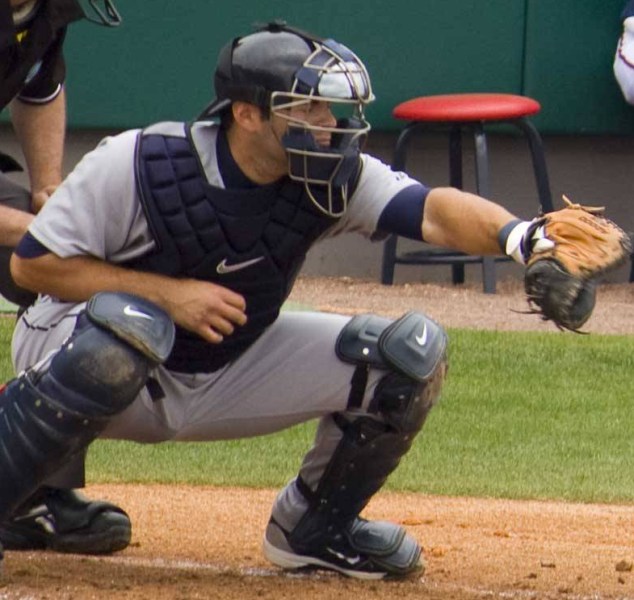
To receive the field you have to read the field, and the only way to read the field is to be looking right at it. In baseball, there is only one position that can see the field and this is the catcher. That’s why catchers are said to be good management material in general. Another way to say this is they have a wider view of the constraint set. However, although the catcher can see the field and understand the constraint set in front of him, there is one variable he cannot control. And this is, of course, the umpire. The ump.
The ump calls the balls and strikes and the ump is a court of no appeal. After all, he has the power to toss you from the ballgame altogether. The only way to deal with this particular variable is to hone the craft of a catcher. The first piece of craft is the act of framing a pitch. Here the catcher subtly adjusts his glove in order to obstruct the ump’s view of the location of the pitch. It is easy for the catcher to whip his glove on a ball in the dirt back to the strike zone, but the ump will spot that in a second. So a catcher, if he wants to be any good, has to learn a little guile.
This guile can taken pretty far; and there are other ways to work an ump as well. The classic, “ah come on ump,” is OK, but it’s the same as whipping the bill out of the dirt really. A more effective trick is chatting the ump up. Becoming his friend and letting him think you are actually on his side. This is effective to a point as well, and extends the craft. However here is where we need to remember our Dylan. From “Just Like the Tom Thumb Blues,” we learn the following:
As Dylan once sang, you can start out soft and end up hitting the hard stuff — thinking people will stand behind you when things get rough, only to find out the bluff was your own. Sometimes you just want to go back to New York City and say you’ve had enough.
— after Bob Dylan
Dylan is saying that though the use of guile helps you work the ump, you can start to mistake guile for the deeper craft. You start to fall into your own trick. You start to think you are the ump. And these are deeper waters indeed. In fact, this is the most dangerous game. And in this zone, we need a secret weapon.
The idea of a secret weapon is apparently popular in many superhero movies these days, and we can read the field just a little to see why. These so-called secret weapons may take the outward form of a literal weapon, one which defends against the apparent enemy and leaves death and destruction in its wake. However when we use this kind of weapon, the forest we are in is in fact that of the irreal, where the furies shriek and howl. However the superhero’s true secret weapon is something altogether different. His true secret weapon is the light within, which can be transmuted into gold and used to navigate the irreal, and hunt the most dangerous game. Where is that light within? To find it, the catcher has to go pretty far back into things to find it. In certain eras, folks may need to do something a little difficult to get there—as the Chinese say, may you live in interesting times. The catcher, here, has to remember.
The first song I remember my own father singing, and one of the only ones I head from him, was from Bob Dylan. I didn’t know who Dylan was, nor did I know the name of the song. The line my father sang was one of those old Dylan riddles — something about a pump that won’t work because someone stole the handles. I didn’t understand it then, but it landed in me like a talisman.
— after Bob Dylan .
If the catcher is blessed to have such a talisman, he has a fighting chance. The thing to do here is to keep your eyes and ears on the field and your gut and your body tuned into the ump. Only this way can the little catcher tell when it’s time to play his card, which is of course the joker. People have sought Dylan in all his guises to the ends of the earth and no one, to my knowledge, has caught onto his tricks. I can’t say for sure that I’m onto all of them either, but I knew one thing. When the vandals have those handles, the pump ain’t working. This is the moment the catcher makes his break with the ump. This is when he calls his bluff.
Dedication: For my Father, who caught me how to catch.
Here on the far side of a fading streak, my thoughts drift too far. Let me share a little solitude, buy the next drink, and try to defend these misunderstood hearts. — after Dawes
The old Molina idea — half your life lived on highways, half of it chosen for you — still hits me hard. — after Jason Molina
This post takes up the song “Leave the City” by Jason Molina. Molina recorded both under his own name and under the name Magnolia Record Co. Leave the City is collected on the record Trials and Errors, released on Secretly Canadian in 2005. It is track 8 of 10, anchoring the back half of the record. It also appears, in a different version, on the record “What Comes After the Blues,” also in 2005 and also on Secretly Canadian. What Comes After the Blues was produced by the Uber-producer, now deceased, Steve Albini, who produced Nirvana among many others and also recorded his own music with a few different bands. On What Comes After the Blues, Leave the City is track 3 of 8. I prefer the Trials and Errors version; it is more acoustic, contains less reverb, and for my money there is just a little more emotion in Molina’s voice, however both versions are great.
This piece will be a little different in that I won’t actually comment on or analyze the lyrics. They totally speak for themselves. What I will say, and if you have been following along with my story you will have already intuited this, if Molina spent half his life on the highway, well I have him beat.
Molina was born just one year before me, and died in 2013 at the age of 40 of advanced alcoholism. On Leave the City, especially again the Trials and Errors version. I don’t know what kind of issues really he may had had, but some for sure. You don’t write Leave the City without issues.
I too left the city, left my place of birth, and moved halfway across the world when I was 22. Before that, I spent my junior year in New Zealand, also a long way from home. I wrote about this year here in my Hamilton College series. I plan to recount more about my moving to Asia and subsequent events in future pieces, however for now if you want to understand why I left, while I think I always had a taste for adventure, but also there’s this.
The song opens with Molina describing how leaving the city shattered what was left of his heart — the part that wasn’t already broken. He admits he once had good reasons for leaving, but can’t name a single one anymore. It was a hard time, and somehow he came through it, grateful in a bruised way for the blues that carried him.
He sings about spending half his life on highways, half in places he never quite chose. He remembers catching the North Star over a freight yard — a moment of lonely illumination that told him just how rough the road had been, and yet how it still carried him forward.
The line that always devastates me is his admission that someone was waiting for him, but he “had so many things to do.” It’s the gentlest explanation and the harshest truth. He knows the person deserved better luck, but his voice softens: with them, he’s not giving up — not tonight.
Dedication: For the road, tiring as it may be. You do meet a lot of interesting folks along the way.
Could you read between the lines Or was it just so obvious?
Bad Moves
New Note: This is an older piece, however I am re-releasing it here. I recently shared a longer piece about some aspects of my life, including, quite centrally, music, so this seemed like a good time.
As with anyone’s story, there are layers to mine. One pretty big layer is when in 2018 I traveled to New York/ Brooklyn, Boston, Philadelphia, and Washington D.C. to see the band Phosphorescent. I saw Phosphorescent four times total on their C’est La Vis tour and they were amazing. I bought a sweatshirt from the merch table and the merch gal told Matthew Houck, the lead singer, about me because I told her I’d come all the way from Japan to see the band. He came down from the stage and gave me a big bearhug, not once but twice at two of the shows. He knew I was going through it, and I needed a hug. He’d been through it too, big time, before and when he was writing Muchacho a few years prior.
As I was seeing Phosphorescent I also took the opportunity to see a few other bands. I saw Yo La Tengo twice at the Borwey Ballroom, Jay Som in Boston, and most memorably The Hold Steady twice at the Brooklyn Bowl where they were playing a three night set. The opener for The Hold Steady was a band called Bad Moves. I had never heard of this band, however, and I don’t say this lightly, they put on a better show than The Hold Steady. Now an opener should try to do just this, to “steal the show,” so to speak. A Bad Moves stole it big time. I was enraptured by their lead singer Katie Park, and met her at the merch table which she was running, which is recounted below. My friend I met at the shows, Austin, pushed me to check out their album Tell No One in depth, which I did, and I loved it. On the train from Washington D.C. back to New York I wrote the first version of this piece, which has been fairly extensively edited since then. This is my sneaky favorite piece, maybe not my best, but you can be the judge. Here it is:
I love live music. More than that, I love live music fans, and music fans in general. This piece is basically about being a music fan, and was inspired when I saw the band Bad Moves open for The Hold Steady in 2018 at the Brooklyn Bowl. They were touring on the back of their first full length, Tell No One. While at the Bad Moves/ Hold Steady show a music geek introduced me to a band called Swearin’. Swearin’ has been around a little longer than Bad Moves, and in 2018 had released Fall Into the Sun. The two bands don’t really sound all that much alike (Bad Moves is basically “Power Pop” and Swearin’ is basically “Indie”) but they write somewhat similarly about matters of love and friendship.
Let’s play a game that we live in a world where a record by a band like Bad Moves or Swearin’ would produce radio hits. I want to live in that world. Or maybe I don’t; maybe it’s better for everyone that bands like these stay a little more on the DL. Let’s first take a look at Fall Into the Sun. (Swearin’s frontwoman is Allison Crutchfield, and the band is mostly her baby.) My pick for the single would be the lead off track, “Big Change.”
The song opens with this soft-spoken reminiscence — basement shows, empty cans, old romances, long nights of half-drunken idealism. Crutchfield sketches a friendship held together by music, chaos, and the sense that they’d accidentally stumbled into their own mutant little world.
I really like what Crutchfield does here. She is basically writing about a friendship solidified over a shared love of music. Now, I know a lot of people. I also have some friends. When you ask an adult, “How many real friends do you have?” the number will vary widely. A lot of people will say “four or five,” something like that. People in general have surprisingly few real friends. I have ten or fifteen, maybe more, but am only in regular contact with about half that number. A good friendship, in my opinion, is one where no matter how long you and your friend have not hung out, if you see them it’s as if not a day has passed. With this sort of friend, I’ve found, there is between yourself and them something fundamental shared. It can be anything really. For example, I first met my good buddy when we were both in graduate school in Arizona, and at first I thought he was a total dick. He was loud, interrupted people constantly, and loved being the center of attention. One night we were drinking as a department and he started razzing me there on the street, just casually insulting me left and right. Suddenly I got where he was coming from. This was, in fact, his way of offering to be friends. Once I understood this, I began to give it right back to him. Called him every name in the book. And he ate it up. By the end of the night we were fast friends and have been ever since, because we share an understanding that our friendship is based, in part, on ripping on each other. Music, obviously, is another great basis for a friendship.
When Crutchfield sings “no art degree, no conservatory/ just Katie and me,” I’m reminded of the refrain from Don DiLillo’s Underworld: “who’s better than us.” If they can do it, why not us? Fuck ’em. That’s what attitude looks like kids–take notes.
So “Big Change” is my single from Fall Into the Sun. (“My single” here just means the song I would choose as the single. For some records, the single is super obvious, while for other records it’s debatable. Bands and producers, in my opinion, do not always get this right.) A good record will tend to have at least two singles; three is a bonus.
For Fall Into the Sun’s second single I’ll go with “Grow into a Ghost.” It opens with a chugging guitar riff with an almost Krautrock drum line. The song is a perfect 3:10–in and out. Do you know anything about lost love? Swearin’ does.
Midway through the record, she writes to an old love with that drifting, half-in-the-desert melancholy she does so well — remembering who she’d been before they met, watching someone fade into absence until they feel more like a ghost than a memory.
Swearin’ is good, but Bad Moves is better. And the star of Bad Moves is the exquisite Katie Park. (I know they are a collective, but my world is my world baby.) Before their show Katie was at the merch table selling…magic eye! That she made by hand. And what did it say? The magic eye said “Bad Moves.” Obviously. I checked it out and chatted for a few minutes with Katie, trying to play it cool. It was the highlight of my year. 20 minutes later she and the band were on stage, crushing it.
The single here is pretty easy. It’s “Crushed Out.” The band released “Crushed Out,” “Spirit FM” and “Cool Generator” as the singles, all of which are excellent. Maybe “Spirit FM” is catchier than “Crushed Out”? Possible. But “Crushed Out” has more lasting power in my opinion. “Crushed Out” is about exactly what it sounds like. It has a basically perfect power pop structure with a killer hook, a classic bridge, and a theme at once super obvious and super deep–the power of a crush.
The whole song is a tumble of infatuation — that feeling where you can’t focus, can’t think straight, and every look or scribbled message feels like it should be obvious to the other person. It captures the power-pop rush of a crush so clearly it almost stings.
Baby, if you are crush-prone that power never goes away. Bad Moves knows this–it’s kind of what the record is about. Crushing out that way can be pretty obvious–do you think I’m crushing out on Katie at all? Nah, this is just a piece of music appreciation.
Cool Generator is my second favorite song on the album, but my “sneaky favorite” is “Missing You.” A sneaky favorite is just what it sounds like: it’s that song that may fly under most people’s radar but that you have a special soft spot for. My all time sneaky favorite song is “Three Drinks” by Craig Finn of the aforementioned Hold Steady. “Three Drinks” shows up on Finn’s 2016 EP Newmyer’s Roof. It’s nearly acoustic, unlike most Hold Steady songs, and sounds just a little bit country. Three Drinks is about a woman (most great songs are) who may have been a child star once upon a time, and is now a drinker. It is an example of a certain type of song that Finn is amazing at, the deeply empathetic look at adult relationships in all of their gloriously flawed complexity. In this sense, Three Drinks fits in with “Spinners” from The Hold Steady’s 2014’s Teeth Dreams, “Tangletown” from Finn’s 2017 solo record We All Want the Same Things, and “Esther” a Hold Steady single from 2018. Finn’s writing on Three Drinks and Tangletown is at its absolute apex.
“Three Drinks” delivers Finn at peak empathy. A woman with a messy past drifts through a hotel lobby filled with minor disasters, trying to hold herself together until that magic window — the hour between the third drink and the one that tips the night over the edge. Finn nails that space between fear and transcendence where people feel briefly holy.
The refrain focuses on that magic hour between drinks 3 and 4, when matters begin to move from the slightly anxious first stage of the evening to something entirely other:
So anyway, my sneaky favorite on Tell No One is “Missing You.” The song starts like the others, high-speed power pop, and after two verses switches to a near-spoken word breakdown of the tug-of-war between a crush and the expectations of the world around. Guess which wins?
“Missing You” turns into a spoken-word confession halfway through: the push-and-pull between what the world tells you not to do and the crush that keeps winning anyway. It’s simple rhyming, almost naive, but devastatingly effective.
I officially support these sentiments. .
So that’s my sneaky favorite –doesn’t mean it’s better than “Crushed Out” (it isn’t) it’s just a little sneaky. I’m all about sneaky babes and sneaky favorites, on all levels.
In addition to the Magic Eye, Bad Moves also engage in a little publishing. A little literature. Specifically they publish a pamphlet called “The Virtues of Wearing White.”
Chatting with Katie, she acknowledged more than a passing familiarity with the literature of the Jehovah Witnesses. I love Witness literature. Both Witness and Bad Moves publications have a real “it’s gonna be a bright, bright sunshiny day” vibe. If you know me this is not a secret, but I’m a hardcore closet New Ager. There, secret’s out. I’ve messed around with all kinds of New Age action. Once I attended a Kabbala meetup in Manhattan. There were some hardcore New Agers there too, seriously. Those folks were not in the closet at all. Shining eyes, whatever color they are wearing. Me, I like black because it’s easier to launder, but Bad Moves have me thinking. (One other publication you should take a look at if you are into this kind of thing is the Christian Science Monitor. It’s a serious piece of literature. God is great baby, god is great.)
When I was younger my parents had a friend called Tom Hutchinson, who, predictably, went by “Hutch.” Hutch owned a boutique coffee shop there in town and I drove a delivery van for him for a bit. But that’s another story. Anyway, Hutch was a weird guy and he hated the Witnesses. It was one of his favorite topics. He’d call them the “Witlesses,” and say: “When they come to my house I turn the hose on ’em.” People thought this was pretty funny, but I was not that into Hutch’s attitude to the Witnesses. I mean, he didn’t want anyone trying to convert him on his property, which is fair; however, I felt, and still feel, that if someone wants to come to my door, give me a little literature, and talk about how god loves me I’m gonna let them. I genuinely like the Witnesses. They seem like lovely people. Read more
Well it’s always been my nature/ to take chances/ my left hand drawn back/ while my left hand advances.
Bob Dylan, Angelina
Epigraph II:
I’m glad I did it all then you know that I didn’t listen/ glad I went and got it all outta my system.
My Morning Jacket, Outta My System
Epigraph III:
It’s never been a fair fight.
Craig Finn. It’s Never Been a Fair Fight
Note: What follows is a direct and somewhat graphic account of my experience of being badly abused as a child. The abuse happened at the hands of my aunt’s (father’s side) first husband when I was six and seven years old in the very early 1980s. As I will recount, the abuse had deep and lasting impacts on me and it took me years, decades, to process and understand what it did to me.
I make absolutely no claim to be an expert on childhood abuse or to speak to anyone else’s experience of this all too common problem. My experience is my own, and that’s all I can really speak to. In addition, although he conducted what I consider to be vicious abuse of my brother, I understand that anyone impacted by abuse may categorize events in different ways. Therefore, I will allude only glancingly to these aspects, and only through the lens of how this impacted me personally. I will, inevitably, make reference to the role of my parents and my aunt in the events, and as I mention below when I began to fully process the abuse I directed a certain degree of anger at these adults. As time has passed, however, I have come to understand that although they were not able, for whatever reason, to stop the abuse, and although it was conducted, at least in my case, in their direct view, the primary responsibility lies with the abuser himself.
In early 2024 I did seek out legal advice from a firm that specializes in childhood sexual abuse, and they gave me a professional and compassionate hearing, however in the end declined to take up my case and directed me instead to the Washington State public system. I will detail those events below. I am not currently pursuing legal avenues, and instead am hoping that by making this public I can finally fully exorcise the lasting damage that was done to me. I take full responsibility for the content of this piece.
I was born in South Bend, Indiana in June of 1974. My father was pursuing a master’s degree at the University of Notre Dame at the time, however when I was around six months old my parents moved back to Santa Clara, California, where my mother’s parents were living. My father did not finish his master’s at Notre Dame because of some issue with the faculty there, however I believe that he did later finish at Santa Cruz University in California. In an interesting side note I also pursued a master’s degree, in History at the University of Northern Arizona in the late 1990s, and did not finish because of a conflict, or disagreement, with my thesis advisor. Life has a funny way of repeating itself.
We lived in Santa Clara until I was, I believe, two years old, and then my parents moved us to Gig Harbor, Washington. My understanding is that my father wanted to move to Washington State to be closer to his sister, Nancy (Nan) Thomas. Nancy is my father’s younger sister and it was she, I believe, that introduced my father to my mother, who was Nancy’s friend when they all attended Santa Clara University.
It just so happened that Nancy was then married to a man who would become my abuser. My first memory of this guy, just some fucking guy as far as I’m concerned, is also my first real memory in life (Note: This has since been revised to happier memories when I was two in California. I will detail these at a later date). It goes like this:
When I was very small, two going on three, (I know I was three in Gig Harbor because my brother Mike was born there in June of 1977), we lived in a small house right next to the Pacific Ocean. What I recall about this time was, we had a dog. My father was working at a nearby lumberyard which I occasionally visited, and, I think, was sort of seeking what would be the next stage of his life. My parents had no money, but I didn’t understand this at the time.
My first vivid memory is of playing a game called “Shovelman” on the beach of the Pacific Ocean right by our house. I don’t remember the rules of Shovelman, but it involved a frisbee. However I do recall, with absolute precision, that one time the frisbee was thrown out into the ocean, which, in western Washington, was very cold. This guy ordered me to swim for the frisbee, and when, predictably, I struggled mightily to reach the frisbee in the freezing water and came out gasping for breath, he laughed and laughed, like a total sadist. Of course I didn’t know what a sadist was at the time, but I recognized his essential nature even then. I knew for sure at that moment that he was a bad guy. Now I don’t fully know if my father and mother liked this guy or considered him a friend. All I know is, he was around some. I later learned that my uncle Kim did not like him. Hated him in fact. Kim has had an interesting and varied life, and is my godfather. I love Kim, and salute him here for his instincts.
While my first memory is a negative one, presaging as we will see later events, I also have positive memories from this time. I recall right around this time the days after my brother was born that some of my mother’s family visited us including her mother Barbara and her youngest sister Leslie. My mother has nine siblings, all, fortunately, still alive and all wonderful people. Leslie was quite young at the time and is only a few years older than myself I believe. Anyway, I looked up to Leslie and thought she was cool, so when we all went to a restaurant I sneaked under the table and pulled on her leg, like little children do. I wanted her attention, but I’m not sure if I got it. As I mentioned above, I also recall visiting my father at the lumberyard and thinking he also was cool and had a cool job. I don’t know if he would remember that line of work the same way or not.
In any case, my family did not stay in Gig Harbor very long, and pretty soon we were back in California, this time in Palo Alto, which is a town adjacent to Santa Clara. These days, Palo Alto, Santa Clara, and the nearby San Jose are well known for being sort of the heart of Silicon Valley, but back then they were not really on the map in that way. My mother was working as a swim coach at Stanford University and my father was working at a school in town. This was a wonderful period of my life as I spent time at Stanford hanging around the pool while my mother was coaching which was a total blast. I may recount this time in more detail at a later date. Suffice it to say I was an outgoing, curious, and happy child, eager to see what the world had in store for me. As I will detail below, I believe I was at this time essentially an extravert, and the primary, from my perspective, impact of the later abuse would be to turn me into a somewhat serious introvert. Over and above all other impacts of the abuse, this is the one I resent the most. It is my belief that my natural extraversion, my interest in and ability to trust and like people, was deeply damaged by the actions of my abuser. I will never fully get over this aspect of the situation, and have had to work very, very hard to overcome what I see as a kind of inversion of my essential nature.
In the year 1980 my family moved once again, this time to Spokane, Washington. And again, this was, as I understand it, for my father to be closer to his sister who was by that time working as a young lawyer in the same city. My abuser was also, I believe, a lawyer. It is certainly true that, although younger, Nancy was on the upswing of her career much more quickly than my father. Other than that I don’t know the exact reasons for this following of his sister, however my father found a teaching job at St. George’s school in Spokane WA. I would attend St. George’s from grade 1 through 12, and have written rather extensively about my time there. Interested readers can find these pieces on this blog.
St. George’s was great, and overall, although my parents were still broke, I had a good childhood. However, there was one dark aspect, which was we would regularly visit Nancy and this guy at their home on the South Hill in Spokane. On occasion, but much less regularly, this couple would visit us at our house on the outskirts of the city. I believe that all of the incidents recounted below occurred in 1980 and 1981. I know this for a couple of reasons, first of all because the volcano Mount Saint Helens erupted in 1980 and at Nancy’s house in the backyard there was a big craggly rock which had pockets of ash residue from the eruption and this event was a big topic at the time. Secondly, I know that I was enrolled in first grade at St. George’s so I must have been six. My brother Mike then would have been three going on four. I wrote about my wonderful brother Mike before here.
The action at the Thomas household there was not all bad–there was the ash and a nearby park called Cannon Hill Park which was pretty cool. The house on the South Hill was pretty large, certainly larger than our own, and I got to know my cousins, both of whom were even younger than myself. I would say we visited dozens of times over the course of a year or two, and I remember the house and its environs well. In any case, ash and parks aside, the main event at the Thomas house turned out to be regular and vicious abuse from this guy which was conducted in full view of everyone in the living room of the house. After a little dinner or whatever, he would “tickle” myself, my brother, for extended periods of time, 20-30 minutes at a time or so or more. This “tickling” was not in any form playing; it was, instead, a totally vicious fully body attack.
It was absolutely excruciating and horrible, and he would touch every single part of my body and dig his fingers in as deep as possible and screw them around. At first I didn’t know what to make of this or what to do, but overtime I came to hate this so much that I began to fight back. My bother Mike, at three, was obviously in no position to do so, and so he, in my recollection, absolutely got the worst of this. The amazing thing, amazing to me to this day, is that the three other adults, my mother and father and this guy’s wife, would just stand there and watch. There is something deeply sad about adults that cannot, for whatever reason, stand up to a bully.
Later, much later, I would confront my mother about all this, and she has since said that her inability to intervene is one of her deepest regrets.
What I think happened was, when I began to fight back he gave up on abusing me. Also, I suspect, from my understanding of abuser psychology, that I had, essentially, “aged out” of whatever his mindframe was. My sense is that he preferred his victims to be as helpless and defenseless as possible, and I was no longer fitting the bill.
Now I should note that I don’t know what his problem was or what he thought he was getting out of this abuse. And, I don’t wish to research it really, because I would prefer to spend as little time as possible engaging with people of this sort. What I know for certain is that in the early 1980s he was a brutal man. That’s a flat fact.
I will detail what I understand to be the effects on myself and some of the later repercussions of his abuse a little later, but first of all I will recount my attempts to engage with the legal system over this issue, as well as indicate, in a compressed form, how I came to process and understand the abuse. Now I wish to tread carefully here because I do not want to get sucked into a discussion of, or really even take a position on, what is known as repressed memory. I understand that this topic is highly controversial, with strong opinions on all sides. Although I have read a lot, I am not an expert on psychology, much less a topic as fraught as this. What I will say is that I never repressed the memory of the abuse; if you had asked me at any given time in my life if I was brutally attacked by this guy, in full view of other adults, I would have said absolutely yes, that happened. However, what took time was to fully work out how deeply and negatively it impacted me, and in what ways. I think I always intuited it, however it took a some very difficult life experiences to get to the bottom of it.
The first of these was in 2010, when I was already 36 years old. It was at that time that I began spiraling into my memories and trying to uncover some kind of nugget that would unlock a range of issues that I was encountering at the time. In this year, and on a few other occasions after, I would, somewhat obsessively, go over events from my sixth and seventh year, always centering around my aunt Nancy, her house, and what I perceived to be my essential ambidexterity. More on this point later. At some point I intuited, in some way, that Nancy may have had a miscarriage before the birth of her first child. My mother, when I asked her, confirmed that this had taken place, and asked how I knew it. I didn’t, but somehow worked it out, just because I was spending so much time thinking this constellation of issues. It was also during this times that I was also trying to get to the bottom of my sexuality, my introversion, and my inability to learn to play the piano because of seriously weak left hand. I will detail these, and other aspects of the situation, later.
In any case, it was in 2022 that I fully worked out the effects that the abuse had had on me over time, and began, for the first time, to identify as a sexual abuse survivor. This was not something that I wanted to have to incorporate into my personal narrative, however it became inevitable. I looked into the law in Washington State, and as I recall, as I understood it at the time, the statute of limitations was three years which began at the moment that the victim became fully aware of their injury. From my point of view, I became fully aware of my injury in 2022, and therefore, after thinking about it, I contacted a law firm in Washington State in early 2024. This firm specialized in sexual abuse cases, however they were pretty high-powered and I got the impression from their website that they specialized in suing institution, schools, churches, and the like. On this basis I felt that it was somewhat unlikely they would take up my case–there was probably just not enough percentage in it. Nonetheless, their website indicated that they meant business, so I contacted them and a little while later had a call with an associate from the firm. He told me that all the lawyers were all in court, but gave me a full and proper hearing and said that he believed my story. He also asked me an interesting question, which was, did the abuse happen more or less than 20 times? I said my recollection was that yes, it was over 20 times, and he took a note of this. My impression was that for a case like mine, 20 times was some kind of legal threshold.
A few weeks later the associate got back to me via email. As mentioned above, he said that the firm would decline to take my case, and recommended I pursue the public legal system. He also said that he hoped that I got justice. I thanked him in response, and was not overly disappointed because it was clear that their focus was on institutions and I had done my best.
Now I should mention that before I contacted the law firm, I did Google this fucking guy to see what came up. It is true that I didn’t want to, and still don’t really want to, research this guy, however I wanted to see at a minimum what internet footprint he had. It turned out that he had a website where he described himself as some kind of elite international mediator and the site had a picture of him climbing a mountain.
So I guess he leveraged his legal background into some kind of mediation role, which is guess is all related. And I have no idea, he may have had success as a mediator. In actual fact, it is not even my intention to comment at any length on who or what he is today (I do believe he is still alive). Is it possible that he cleaned himself up in some respect? Maybe. But actually I doubt it. It is my opinion that someone as twisted as he was in his early adulthood doesn’t really get over that. I can forgive a lot of things–for example taking a life when drunk driving or something of that nature. Mistakes are made, and mistakes of that sort are basically unintentional. However, this guy, with his Shovelman action and his subsequent brutality, in my estimation, doesn’t really ever get better. Am I being unfair? Perhaps. It’s really hard to say.
In any case, although the firm turned me down, reaching out to them was one of the best decisions I have ever made. By attempting to work through the legal system I had engaged, fairly and properly, with the available channels, and I felt immeasurably better about the whole thing. I did not at that time decide to pursue the public option, because I am not located in Washington State, and I didn’t feel that taking this route any further would be feasible. Instead, I thought about using the only real platform I have, my blog, to discuss my thoughts on the matter. Aside from the legal system, this seemed to me to be the next best thing. And so here we are.
In what follows I wish to enumerate what I understand to be the long-term effects of my abuse. I will, in the interest of my own privacy and that of others, somewhat undersell these, and it is not my intention to burden the reader with my own issues over time. In addition, I would like to make clear that my encounter with the legal system as well as my somewhat long-gestating decision to go public with my story and my conversations with a few trusted friends, has ameliorated, to a significant degree, the effects of my personal abuse. In any case, here is what I feel:
From my earliest memories I wanted to play the piano. When I was in first or second grade I asked my mother to enroll me in piano lessons, and she declined, saying that she had no money. A few years later my brother Mike was allowed to take cello lessons, and he became very good very fast. I would wait in the car while my brother and my mother attended cello lessons there on the South Hill in Spokane. Naturally, I never held this against my brother, who was an awesome musician and I was proud of him, however I did resent, for a very long time, being denied the opportunity to pursue music. It is my understanding that although people can learn music at different times in life, the earlier the better. I have subsequently tried to learn the keyboard by myself, and somehow was able to play “Ocean Rain” by Echo and the Bunnymen and “Someone I Care About” by the Modern Lovers. I didn’t dominate Ocean Rain, but it was least passable. But I still can’t really read or play music. I wish, beyond almost anything, that I would have had the chance to learn music at an early age.
However, my strong feeling, underlined by years of reflection and memory spiraling, is that the abuse from this guy essentially crippled my left hand. I don’t know exactly how I know this, but I have always known it. So I probably wouldn’t have been that great at piano anyway, because the left hand is pretty important. And, the destruction of my left hand is intimately and directly connected to my crippled ambidexterity, the inversion of my extraversion, as well as my somewhat ambiguous sexuality. I will take up these issues in turn.
First, as mentioned above, there was as a result of the abuse, a long-term impact on my left hand. When I was very young, maybe four, I learned to swim in the pool at Stanford, and my strong memory is that I was developing a certain ambidexterity. Ambidexterity is related in some respects to dyslexia, which I also have a very mild case of, however it also has some salubrious aspects, for example in sports and music. I understand this intuitively and experientially, that I could have been a good piano player if I had been able to take lessons and if I had not been, essentially, crippled from the repeated abuse. Thus, the epigraph from Dylan at the top. It’s been forty-five years since I was first abused by this guy, and only now is my left hand, so to speak, advancing.
Second, as mentioned above, I was an extravert until I was six years old when I suddenly turned into a pretty serious introvert. Now, I absolutely don’t wish to imply at all that one orientation is better than another–both have great strengths. However, the issue here is that I was one thing, and then became another. And this corresponded to, and was directly triggered by, the abuse that I suffered. Somehow, the repeated and protracted abuse turned me inward. I no longer trusted people, essentially, and although I still liked, and still do, many people, something went off track. This is the reality.
Third, I know for an absolute fact that my sexuality was deeply damaged by this guy. I can’t speak to any other form of abuse, however my case of male on male abuse, which I experienced (and yes I absolutely categorize my experience as sexual abuse because he violated every part of my body including my genitals) led to a situation where it became for me, once I hit puberty, somewhat difficult to work out what my sexuality was and in what direction it ran. I was, without doubt, attracted to girls, however in the back of my mind there was some kind of lingering, and for me uncomfortable, ambiguity, as well as a distinct inability to approach women. Now, I fully understand that the inability to approach women is a pretty normal aspect of heterosexual teenagers, who are awkward at the best of times, but I always sort of knew that there was something else going on. And what was going on was, my genitalia was first touched, without my consent obviously, for lack of a better term, by an adult male when I was six years old. And that damaged me.
In essence, and again I know instinctively this to be the case, the abuse was so brutal and so protracted that it in essence re-wired my brain. As with repressed memory, I don’t wish to take a strong position on the issue of the left-brain and the right-brain, although I have read and deeply integrated the book The Master and His Emissary, by Iain McGilchrist, which goes into this matter in far greater detail, and with far greater insight, than I will ever achieve. What I know is the connections within my brain were compromised, indeed fractured, by the abuse. Although it took years for me to fully work this out, I have absolutely no doubt that this is the case. It was, in my belief, something about the pure digging of his fingers that did the damage. Some light tickling would not, I think, have had this effect, however the intensity and depth of his action were, I know, of a completely different level.
Basically, I have been dealing with long-term PTSD from his attacks, dealing with it for 45 years in one way or another, and 15 years more intensely. And you might say “hey there Matty baby, how do you know that your supposed ambidexterity, for example, was so compromised by this guy’s actions?” In answer to that I wish to make an analogy to the trans issue. Now I understand that the trans issue is highly political, and, I guess, pretty complex. However my basic stance is as follows: I do not believe that people who experience feelings of transsexuality or gender dysphoria, basically, are “making it up.” A few may be for various reasons, however I believe that, generally speaking, the set of feelings they experience are real, and also because I have never had them, I cannot speak to them with any authority. Such it is with sexual abuse. The feelings and understandings of sexual abuse victims are, I believe, valid and need to be understood in the context of they know best what the effects of the abuse were. While I cannot perhaps fully explain how I know what I know, I know.
I have a few final thoughts. The first is, as mentioned above and now underlined, my bother also received similar treatment from this guy. I mention this only because I have, ever since, suffered from a great degree of guilt for my inability to protect my brother at that time. Indeed, it was primarily this aspect of the situation, more so than the damage to myself alone, that caused me to direct my anger at my abuse to my mother, and by extension my father and Nancy. I still carry this guilt, and don’t suppose I will ever really get over it. Once again, there is a good deal more to the story, but that’s all I really wish to say at this point.
The second refers to what I described above as the re-wiring of my entire mind and body. Perhaps there is a more clinical term for this, and I think that psychologically alert readers will be able add understanding around this, however this is the best description I can offer. As the second quote at the top of this piece alludes to, the life we have led has been what it has been. I strongly wish I had never suffered the abuse that I did, and have had as a consequence, some of the most painful imaginable situations, however the mere fact that I cannot turn back the clock means that the life I have lived will have to stand, in all of its glory and messiness. This is true, I think, for everyone.
Finally, and I am in no way being facetious, I want to express my deep indebtedness to the great Craig Finn. Craig Finn is the lead singer and songwriter from the bands Lifter Puller and The Hold Steady, and has also had a substantial solo career. One of my very favorite songs of all time is “It’s Never Been a Fair Fight,” by Finn, which I have written about at some length here, and from which the third epigraph for this piece comes from. I am not exaggerating when I say that Finn saved my life, probably more than once, and has, over time, helped me overcome the damage done by my abuse. Thank you Mr. Finn sir. I love you.
I will choose to close this narrative here. As alluded to above, there is a lot more to the story, however in the interest of the privacy of a range of people, not the least of which myself, I will desist. What I would like to say at the end of the day is, abusing a child is never a fair fight. And so I am deploying the only real tool that I have at my disposal, my pen. Thank you for reading.
Dedication:
For all my friends and family who have taken such good care of me over the years.I wouldn’t be here without you.And for Spencer Krug, the greatest piano player I am aware of.
Note: It you enjoyed this piece, you may also enjoy the other pieces below which take up somewhat similar themes.