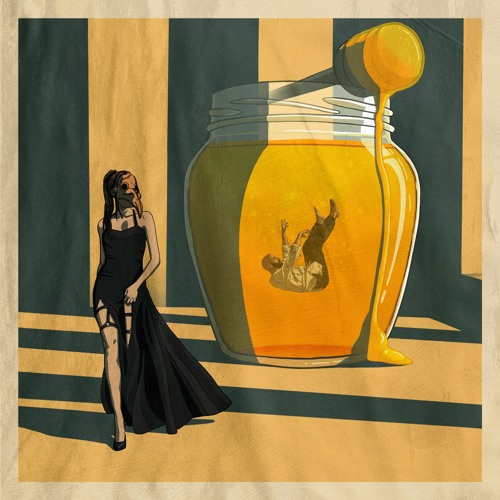
The Anima and the Animus: Dreams as Predictors of Mid-life Re-orientation

New Note: This essay began as a draft conference paper in 2019 and was never delivered in that form. I am publishing it now as a document of a particular period of questioning rather than as a finished thesis. Since writing it, my thinking about archetypes, gender, projection, and mid-life development has continued to evolve. I remain interested in the role dreams play in periods of re-orientation, but I am less certain of universal frameworks and more attentive to context, culture, and personal responsibility. Readers should take this piece as exploratory rather than definitive.

Note: The following is a draft of a conference presentation I was due to give at the International Association for the Study of Dreams (IASD) in 2019. Life, as they say, intervened, and I was not able to give the presentation. The draft below is way too long, and was set to be edited a lot before prime time, however I do think there is material of interest here, perhaps especially for men (and hopefully women) in mid-life.

Stipulated:

The dream examples in this presentation lean heavily toward “anima” dreams, as this is my own experience. I hope that in the discussion period we can re-balance this weighting.

Advance Notice:

This presentation contains frank discussion about sexuality within the context of the main topic.

Postulate I:

The “mid-life crisis” is no less universal and acute than the challenging teenage period. It’s predictably is such that it is better termed “re-orientation” than “crisis.”

Postulate II:

Dreams can provide advanced warning and guidance about how to navigate this period.

Postulate III:

Following Carl Jung, the anima archetype (most commonly in the male) and the animus archetype (most commonly in the female) are the most commonly associated archetypes with the mid-life period, and therefore deserve especially close attention.

Postulate IV:

Although it is not clear how changing norms around gender (e.g. increased visibility of non-binary and other identities) might impact our understanding of the anima and animus in mid-life, we are advised to make space for the possibility that these archetypes develop/ evolve alongside culture.


Question #1:

What dreams have you had that might relate to the anima/ animus archetypes, and to what extent have they predicted/ informed a mid-life re-orientation?

Question #2:

Jung stresses the universal or near-universal nature of the anima/ animus archetypes (as well as other archetypes). To what extent is holding to Jung’s universalistic perspective helpful/ unhelpful for understanding the play of these archetypes today?

Question #3:

Jung says that “when a situation occurs which corresponds to a given archetype, that archetype becomes activated and a compulsiveness appears which {…} gains its way against all reason.” This not a very hopeful prognosis, even if it has an ample experiential basis. To what extent can understanding and attention to our dreams and unconscious decrease the force of an activated archetype?

Question #4: What other kind of dreams/ dream archetypes might also predict/ presage a mid-life re-orientation?

Postulate II expanded:

Dreams, if treated as basically integrative, give us both a heads up and also a faith/ confidence that we can survive and navigate mid-life re-orientation, although when we are in it we can feel totally overwhelmed.


Dream #: 1

7/20/13:

I am in a battle with some quasi-army people, running around a rainy landscape, ducking behind and in and out of cars. I am carrying a very small pistol, possible a “Derringer.” This action goes on for a long time. Finally, the two army factions meet in a parking lot. I am off to to side of where two groups are arguing heatedly. I try to fire my weapon to get everyone’s attention; it makes only a small sound and no one pays attention. However, just then a group forms beside me, to my right. There are quite a lot of people, more than the two factions combined. These people are aligned with one or the other sides in the battle, and are now trying to bring the two sides together. One women, middle aged or a little older and Caucasian, speaks to me very passionately about reconciliation, and grabs me. I put my hands on her shoulders and look deeply into her eyes. The argument is still going; there is a contest to see which group’s energy would prevail.

I disengage from the first women, and there is a younger woman, maybe early 20s with blondish hair. We embrace deeply; I am holding her and stroking her hair. She is “Dusty.” As with the first woman, Dusty and I are involved in some kind of structural reconciliation–we are not simply two people but representing two sides of a conflict.

Dusty has a friend, a thin girl, also in her 20s. The thin girl and Dusty are loosely connected to the older women’s movement. However, the thin girl seems like the prime mover and Dusty is just along for the ride. I get the distinct feeling that Dusty had been around a bit, young as she is. The three of us retire to a sofa—the argument is left behind. Dusty is on my lap, stretched out, while the thin girl, who is also sort of tanned, is to our left. We chat casually, as if we had all known each other for ages. I say, “you are foot soldiers in the women’s movement,” and the thin girl laughs and says yes. I am not in love with Dusty, rather I feel happy and blessed to be able to be connected with her for any amount of time.

THEMES: BATTLE, RECONCILIATION, EMBRACE, YOUNG WOMEN, OLDER WOMAN, CAUCASIAN WOMAN

Dream #: 2

1/17/17:

I arrive late to a pool party with a very deep swimming pool. I am wearing a suit. A lady in an elaborate purple gown falls in the pool (or maybe she jumps in on purpose). In any case, she begins to sink to the bottom. She is underwater for too long, and I decide to jump in and try to save her. I hesitate for a fraction of a second, either because I am fully dressed, or because I am afraid. I feel shame with this delay and dive down. The dive is successful and I go to the bottom of the pool. The woman is only a few feet away however when I try to swim over to her it is like I am swimming through jelly. I can barely move through the water. She drifts away slightly, and I keep trying to make progress aware that my own breath is limited. I resolve to take a few more hard strokes and in so doing try to kind of push the water under her to lift her up because I can’t reach her. Then I head back for the surface and emerge with labored breath—I have used about 90% of my capacity down there. The woman has already surfaced and has been pulled out of the pool by several people on the other side of the pool (the pool is quite large). She is seated on a raised platform kind of similar to a throne. I get out and only one or two people notice that I have been in the pool at all. Later though the woman thanks me for my efforts.

A few noticeable things about this dream are that I had the sense that the woman threw herself in on purpose and also that I knew through the dream that she would get out OK one way or the other. In fact, it was me that was in more danger than her even though she was under water for much longer.

THEMES: LADY, WATER, RESCUE, ROYALTY, INEFFECTIVENESS

Dream #: 3

2/5/17:

I am at an underground concert/ art event late at night. There are multiple acts playing in a series of narrow hallways and spaces between pipes as such with an audience, including myself, who is kind of milling about. All the acts are simultaneously being fed into an audio feed and there is a second audience in a separate, possibly more subterranean, room. I am not in this second room however somehow know of and can visualize it. The audio feed is being controlled be either Richard Branson or Jann Wenner or someone of that stature. This is kind of a big deal in a weird way—definitely an art event.

I am attached to a show that is beginning. The group is the Red Krayola, and the leader is a youngish female with short hair, creamy skin, a little Asian, probably in her mid-twenties. At first, I am appointed to be the lead singer, which is terrifying. Fortunately, the first part of the first song has a long, chugging, guitar and bass buildup which is transporting and awesome. Also fortunately, for me, the leader starts to sign or hum, no words only sounds. Maybe she will be the lead vocal after all? I begin to try to harmonize as best I can and it goes OK. I am deeply hopeful that my harmonies will stay down in the mix and that at no time will I need to be the lead singer as I know I will not be equal to the task.

The lead-in to the song goes on for several minutes, at least three or four, and it is the best music I have ever heard, which is amazing because the act is almost totally unknown—perhaps this is our debut? I start to fall in love with the leading lady, slowly, totally.

Suddenly, the electricity cuts off and so does the music. I hear a voice from the other audience room ask for our band’s signal to be brought back up. People are asking for more. However, Jann’s voice comes over the speaker and says we have lost power. The show is over.

I am both relieved (because I don’t need to sing anymore) and disappointed (because I wanted to hear the rest of the song). The disappointment registers in my stomach. Before she gets swept into the crowd (which is large and active), I approach the leading lady. She is gorgeous, slight, with earrings. She has a range of cards like small index cards with Taoist symbols in front of her as well as some jewellery and beads, not ostentatious—very tasteful. She asks me where I am from, where I live, and my spiritual orientation. I tell her, wondering if I should describe myself as a Taoist or whether she would see that as pretentious. I tell her I am a new-ager, but only in order to access ancient wisdom—things we have always known and have forgotten. As I tell her, we lean closer together and I am falling head over heels for her. I am sure that she has a line of people waiting for her and will move me along soon, however instead we began to kiss as we lean together. This operation is made difficult by a single metal spike in her lower left lip—a piercing that you sometimes see. The piercing is difficult for me to navigate and a little painful.

Scene cut and we are in bed together, unclothed, coupling. However, it turns out she has multiple piercings all over her body and no matter what arrangement we make the operation is too difficult. The dream ends, with a memory of the music.

THEMES: YOUNG WOMAN, SEMI-ASIAN WOMAN, MUSIC, SPIRTUALITY, FEAR, PIERCINGS, KISSING, FAILED SEXUAL INTERCOURSE

Dream #: 4

10/11/17:

I am in a parking lot with somebody, perhaps the parking lot of a gas station. There is a van that a woman is living in, traveling around in. I know this before seeing the woman. The woman leans out of the van which looks a bit like a food truck and may be. She is Asian but also not Asian and she leans right down in front of me. I kiss her, briefly, and she kisses me back, briefly. Then she pulls back and talks about her life on the road. She says her name is Mary. She is very attractive, with curls in the front of her pretty short hair and big cheeks. She gives me a business card that is handmade. The business card calls her “Wild Mary” and there is a drawing of a map which is full of squiggles and impossible to follow. She says this is a map to her live music event which I need to come to. I want to go, however feel like there is no way I will decipher the map.

THEMES: SEMI-ASIAN WOMAN, KISSING, MARY, MUSIC, INCOMPLETE MAP

Dream #: 5

2/27/18:

I am in a pool like a large whirlpool, maybe 8 feet deep or so, with a bunch of other people, mostly Japanese women. One woman is kind of sleeping in the pool and she leans on me like people sometimes will on trains. She is in a bathing suit and young and pretty good looking, wearing glasses. I allow her to lean on me, she floats away, then comes back. She appears to be relaxing. Then, everyone is getting out of the pool which appears to be closing. The woman becomes totally horizontal and looks at me. She asks for a doctor—just says “doctor.” She is unwell and can’t move herself. I scoop her up and swim to the side where various people are getting out and starting to dress. I tell another woman she needs a doctor and then repeat this in Japanese. Several people move off to find a doctor who will be downstairs (we are in some kind of complex and a doctor will be on hand.) The woman is laying comatose by the side of the pool and I hope the doctor comes soon. Then, my wife is there and I try to explain the situation with the woman. While I am doing this I look up and the woman is gone. She has rallied and disappeared without a word. The doctor never arrives.

THEMES: YOUNG WOMAN, ASIAN WOMAN, WATER, RESCUE, WIFE, ELUSIVITY

Dream #: 6

4/5/18:

I have been chasing a man I think I know up to the 7th floor of a tall building. Although I am athletic and running hard, I can’t catch him, and face a variety of set backs. Giving up, I retreat to the back of a dentist’s office where there are an assortment of rooms up some steps. Entering the highest room all the way in the back of this building I see a woman I know. She is from my college and I have a longstanding relationship with her. She is wearing a beige blouse which is buttoned at the neck and looks to be of Asian design. She comes over to me from the wall where she has apparently been waiting. We embrace and are very glad to see one another. We will spend the next few days together and I know in the course of those days I will be unfaithful to her in some way. I hope not to lose her as a consequence.

After waking briefly I try to renter the dream space to find her again. I am unable to do so–instead I see a bunch of filament-like strands in space. A voice says “maybe everything is connected.” It is possible that a single strand connects all elements in the unconscious and in the universe. Still, no woman.

THEMES: MIDDLE AGED WOMAN, ASIAN DRESS, ESCAPE, UNFAITHFULLNESS, METAPHYSICS

Dream #: 7

6/3/18:

I have a distinct feeling I am being called. This is not the first time I have had this feeling however this time it is as or more insistent than ever.

I dream I am seeking wisdom from some underground women spirits/ half women half spirits. They are locked behind a door and only accessible through an intermediary, also a woman. The intermediary takes my request for wisdom and something more to the women and comes back empty handed. She says the women rejected my request because I have the keys to the door. This is not saying that I have the wisdom, only that I have the keys and need to unlock it myself.

Later I dream of a teacher. I am walking down a hillside and there is a kind of encampment on my left. Here there is a teacher. The teacher quickly vacates the encampment. I see a man in purple on the far shore. He is bearded and serene. Perhaps he is a fisherman. I get a full body chill because he is the teacher. Then, another man appears closer to me on a more accessible bank. He is wearing flannel and also bearded. It is clear that the first man, though dignified, is not the teacher and this second man is. I consider approaching him but instead wind up in the encampment. There is a youngish woman, not so young but younger than me, there. She is the real teacher and she is in town for only a day or so. I go over to her and am ecstatic to be with her. She allows me to nuzzle her neck and we begin talking. She has signs like the dao on her body—not exactly tattoos more sort of birthmarks. A man is there who is kind of her minder and he lets me be close to her. I will take her teaching in a day or so.

I am seeking wisdom and instead of getting it from the underground women I need to make my own way. I see a vertical rectangle with three square boxes at the base. In the boxes are letter like SO, XOS, SXO. These are a symbolic alphabet and indicate a deeper knowledge that I should have access too. I understand that these symbols are the key to unlocking the door to the underworld.

THEMES: TEACHER, METAPHYSICS, UNDERWORLD, SELF-KNOWLEDGE, BODY MARKINGS

Dream #: 8

6/25/18:

I am skiing on a smallish yet pretty steep hill. There are some very good skiers who are blasting down and somehow also skiing back uphill, quite quickly. I am getting down ok but can only ski-walk partway back to the top each time. I am capable yet not fully confident on the skis.

A tall young Asian woman is there and I need to protect her a bit. Probably it is her first time on skis. Later, it is suggested that she does a ski jump. The ski jumps are supposed to take place over a 4-5 foot spiral cone of water but the cones aren’t ready today so I hold out a pointed object like a stick laterally at chest height instead. This seems a little dangerous and also I want her to succeed so I resolve to lower the stick as need be without telling anyone. There is a bit of a crowd around and some delay. Then, she is ready to go.

Suddenly I look up and realize that we are in a carpeted room which is only about 10 feet in depth and that there is a wooden ceiling closing the room from the ski slope. To do the jump, she will need to come across from the left side, jump diagonally, and stop almost immediately on carpet. This seems impossible so I try to call off the jump. The crowd protests and the skier also indicates willingness to continue. This is madness, so I try to demonstrate how little space she has by simulating a landing. I feel like I’m calling attention to something super obvious and the others are dense and irresponsible.

THEMES: YOUNG WOMAN, ASIAN WOMAN, SKIING, DANGER, RESCUE, INEFFECTIVENESS

Dream # 9:

7/29/18:

Last day in Bali. Dreams here have been intense and long. This dream is loaded with metaphysics. I will try to describe it carefully.

The dream starts with an image of a large whisky bottle. The bottle is very fat and also ceremic. So in fact it looks nothing like a normal whisky bottle. It is perhaps of Suntory brand. I know before I know that a story of some kind will unfold inside the bottle. I am reminded somehow of a ship inside a bottle. Suddenly I am inside the bottle itself. There is a whole word here and all sorts of people in a city-scape. I come to understand that everyone lives in relative fear of a species or group of overlords.

The overlords are both omni-present and also very distant. They rule by fear and have the power to rub out anyone at any time. Sort of. When a person is marked for removal their status is updated. Their status is displayed on a kind of glowing chip in their shoulder. There are basically theft types of statuses. First is “needing to have the life wrung out of them.” There are marked people and their time is limited. Apparently they are political criminals, thought criminals. Oddly, even when marked these people continue to circulate and take part in oppositional activity. I never actually see one of them removed, although their actions do take on a greater sense of urgency.

The second category is another worded status. This one is more elliptical and I forget the wording. Though safer than the first, this is still a status to be avoided if possible.

Third is a number. A voice tells the city that statuses will be updated and that anything under 40000 is a safe score. I check my update with bated breath, fearing the dreaded worded status. My number is 49500. Not bad I think—although not under 40000 this is perhaps for young people. 49500 seems reasonable for my age.

Suddenly the view shifts and I can see into the bottle from the outside. All of the people and various creatures and scrambling for the mouth of the body. The bottle begins to approach a wall into which is will soon merge. Here, the entrance to he bottle will be sealed. The I character in the dream is also scrambling for the exit although he doesn’t seem to stand much of a chance. Creatures spill over one another and one baby creature somewhere between a human baby and a little mouse slips through the mouth of the bottle to the other side of the wall. The bottle snaps closed and I am once again staring at the large ceremony bottle from the beginning of the dream. I feel a sense of relief that the perfect creature has escaped.

THEMES: DYSTOPIA, DOUBLE IDENTITY, METAPHYSICS, DEATH, REBIRTH, CREATURE

Dream # 10

12/19/18:

Only the second real dream since August and the first since the car crash dream three months ago.

I am in a large and ramshackle house which is apparently part of a larger complex of cabins. This may be some kind of resort, certainly it is out of town. There is a ranger hut as well so I guess we are in the woods.

After some interactions with the ranger which are painless (it is clear that I am welcome here) I begin exploring the house with a small team of people, maybe three or four. We are doing some kind of catalogue or space survey, and every space I see I have to climb in and have my picture taken in it. This means like alcoves, cubby spaces, closets, skylights, etc. Sometimes one of the other people also gets in the space, but I always do. It is unclear what the survey is for, however it is obvious that we need to do it. This process goes on for a long time and we cover much of this large house.

Eventually we come to a kind of alcove carved above a hallway, a space that doesn’t really exist in nature. An attractive Caucasian women in a white swimsuit climbs into the space and someone takes a picture. This picture becomes the definitive record of our whole trip. I don’t think I enter this space.

The group moves to a basement floor and suddenly there are a lot more people, maybe 20 or more. It’s crowded and a little noisy. The complexion of the group has changed. There is a trap door to a sub-basement and I open it and drop down. One person at least follows me, perhaps two, an older couple maybe. The sub-basement is about 4 and a half feet high and I have to stoop. It is full of junk, large foam blocks, other boxes. There is barely any room to move and nothing to see or find. I feel immediately claustrophobic and also have a flash of fear that one of the larger group will close the trap door. This fear comes and goes quickly, but it’s enough for me to ask myself why I have to always be the one exploring the spaces. If there is a group of twenty we can share the load. And, I don’t want to be in this claustrophobic sub-basement anymore.

THEMES: EXPLORATION, PSYCHE, CAUCASIAN WOMAN, BASEMENT, CLAUSTROPHOBIA

On Some Things I Find Interesting

New Note: This is a small, wandering piece built on a simple premise: sometimes the things that stay with us are not the major events, but the minor curiosities that resist tidy explanation. A fragment of stage patter at a concert, a puzzling culinary difference between similar cuisines, the myth and reality of hostel life, the vastly different speeds at which people work, the improvisational courage required to make friends quickly, and the strange cultural persistence of the San Diego Chicken — none of these form a grand thesis, yet each carries its own quiet fascination. On Some Things I Find Interesting is less an argument than a map of attention, a record of the small anomalies and unresolved moments that continue to hover in memory precisely because they never fully resolve themselves.

Note: This is our second “list” piece, following our minor piece on airports. I happen to like “minor” pieces in general, and this piece is dedicated to a reader who said her our airport piece was her “sneaky favorite.” Here, we will simply list a few things I find interesting. There is no particular connection between these items, other than that I am interested in them.

I. Bradford Cox’s Stage Patter at a Deerhunter Concert in Osaka

A few years ago I went to see the band Deerhunter play live in Osaka. The original show I had tickets to was canceled and I didn’t get a notification, so I trekked all the way into Osaka only to find this out. This worked out ok though because I took a picture of some girls in fairy costumes on the trip. Anyway, the show was rescheduled for a few months later and the tickets were still valid.

The frontman for Deerhunter is called Bradford Cox. His side project is called Atlas Sound. Deerhunter is not one of my very favorite bands, but they are pretty awesome. I had seen Deerhunter before at a weekend long event called “Hostess Club Weekender” in Tokyo, which sounds a little edgy but was really just a series of Saturday and Sunday events featuring a bunch of bands. (I also saw the band Mogwai at Hostess Club, a band I thought I liked, but the show was boring and they were kind of bad.) My favorite Deerhunter song is “T.H.M.” from 2013’s Monomania, however my favorite Cox song by far is “The Shakes” from his side project called Atlas Sound. The Shakes opens thusly:

Found money and fame/ but I found them really late

Uh huh. “The Shakes” is more than a sneaky favorite; it contains multitudes. In any case, the re-scheduled Deerhunter show was in January or something and I was excited to see them. They were the headliner, however unfortunately they had an inordinate number of opening bands and by the time Deerhunter took the stage they had like only 45 minutes until the venue had to close. Brief as the show may have been, Cox managed to build in quite a bit of between songs patter. I am a big fan of between songs patter, and wrote about this topic at length here and here.

The one piece of patter I remember from this show was when Cox addressed the issue of Japanese toilets. Now, without getting too graphic, most Japanese toilets these days have a built-in “washlet” which, true to its description, washes your sensitive areas with water after your business is done. Here is Cox on the subject (as I recall, more or less):

“I love your toilets here. In our hotel the toilet has a stream of water which cleans you up after you use it. As a gay man I have to say this is a great feature.”

Now, what was so interesting to me about this patter was not the content per se, which was fairly straightforward and only just a little risqué. What fascinated me was that Cox in various interviews in the American press had referred to himself as asexual. Cox suffers from a serious skin condition, as well as maybe some kind of eating disorder, is super thin and generally has a lot going on. He has been pretty open about all of this, including his supposed asexuality. However here he was in Japan, where maybe only a quarter or so of the audience understood enough English to fully understand what he was saying, identifying as a gay man.

Of course I was and am aware that people’s self-identification, sexual or otherwise, can fluctuate, however I don’t think this is what was going on. Rather, it is my supposition, unproven albeit, that Cox preferred to index his supposed asexuality in the American media for reasons of his own, however in Japan allowed himself to speak his truth as a gay man. Perhaps, as I like to imagine, he thought that no one in the crowd would notice this little slight of hand. In the immortal words of the Lone Gunmen in the X-Files, however, “someone is always paying attention, Mr. Mulder.” In this instance, I was paying attention. And I was interested.

II: The Difference Between North Indian Food and Nepalese Food

In Japan, at least, there are a good number of both North Indian and Nepalese restaurants. The North Indian restaurants, for my money, are, without exception, way better. This is because of one simple reason, Nepalese food, as prepared in Japan, is full of sugar.

There is nothing I want less at lunch than a bunch of fucking sugar. I understand of course that carbohydrates in general are full of sugar and all the rest, so I guess my position is that food already has more than enough sugar without adding more. However, Nepalese restaurants put excess sugar in the curry, and super extra sugar in the nan bread. Sugar is everywhere, and it leaves me feeling bloated and bad. North Indian restaurants do not seem to have this problem. These also feature nans and curries, however they are un-sugared and basically delicious.

Now, I do not wish to demean all Nepalese restaurants, nor indeed Nepali food culture in general as I have never been there. For all I know, Nepali restaurants in Japan just happen to add a bunch of sugar for some reason. But I doubt it. I suppose that somewhere on the North Indian plain there as you move north toward Nepal sugar factors more and more into the cuisine. To each their own, but I don’t like it. This whole matter is of interest to me.

Postscript: As I am now totally gluten-free, I won’t be eating any more nan bread, sugared or un-sugared. Bye bye nan baby.

III: Hostels

Hostels are interesting. I have only really stayed at a hostel once, on the South Island of New Zealand when I was checking out the New Zealand Alps. I don’t remember much about this trip, however the basic features of hostel stays were all in place: the shared room and concomitant lack of a private bathroom and shower, the slight anxiety about getting one’s stuff stolen, and the opposite sense of excitement that one might meet, say, a chick.

A few years ago my buddy Paul (he is actually Tall Paul, but there was already another Tall Paul in Kyoto who kind of owns the nickname) came to town and asked me to catch up. I said yes, and met him at his hostel near downtown. When I got there, he introduced me to two gorgeous and sophisticated Indian-American woman from California. They were his “hostel friends.” (Tall) Paul is a very good looking guy, and this incident confirmed for me what I already suspected, that hostel life could be exciting, even action packed. Me and Paul and the ladies went out on the town and had a great time. My takeaway was that hostels rock.

On the other hand, my buddy Doug checked out of his life and into some Russian hostel action for about six months or so a while back. His plan, as I first heard it, sounded quite romantic, however when he returned from this sojourn he informed me that hostel life was not all it was cracked up to be. Hostel life in Russia, it turns out, was pretty dreary. I had no difficulty believing this, and arrived at a more balanced picture of hostels as a result.

All in all, hostels are interesting, however I don’t think hostel life is for me.

IV: People’s Working Speeds

I have noticed that folks tend to work at very different speeds. I am a teacher, and these days the job of a teacher is basically split between i) teaching in the classroom; ii) working on the computer; iii) taking breaks. Teachers, generally speaking, have a lot of flexibility with break taking, which is nice. And classroom teaching is bounded by the bell, so that’s settled. Which leaves computer work.

Some teachers rip through their computer work in a matter of minutes and are able to move on to other pursuits, such as Wordle. The top-end version of this type of teacher are marvels of efficiency and manage to go home on time every day. Other teachers are super slow, and pick at stuff for days, weeks even. While I respect the fact that everyone has their own process, this is not my style at all. Then there are the teachers in the middle, including myself. These folks are neither hyper-efficient nor super-slow. Rather, they tend to procrastinate around for a bit before settling in to serious work, after which they crunch and get things done.

As an ambivert myself, I like to gather just enough information, Goldilocks style, to be dangerous before I do my computer work. I neither need nor want all the information, however I function best when I have a general “feel” for the landscape. This is just how I work—like I said, everyone’s different.

V: Making Friends Quickly

When I was in university I was trying to hang around some artsy chicks, and was lucky enough to know a few. One day I was hanging out with them and a few girls I didn’t know came over. One of them was called Nadine. These new girls were super cool, and Nadine in particular was so cool as to be a little intimidating. She was from Eastern Europe. I definitely wanted to hang out with Nadine, and sure enough she invited me, right away, to accompany them all somewhere. I hesitated, for some reason. Maybe I didn’t know the first rule of improvisational theater, which is “yes and…” Yes and means, basically, follow the person that goes before you. I would have followed Nadine pretty much anywhere, however I said “I don’t really know you guys,” I said. “Well,” she replied, “this is how you get to know us.”

(The Nadine incident confirms one aspect of my social relations. I’m a Gemini sun with Mars in Leo in my 10th house. I am, basically speaking, not afraid of people. At the same time, I must admit that there is a certain class of beautiful women whom were I to meet them it might take me a second or two to find my tounge. This would include Brit Marling, actress and creator of The OA, Emily Haines, lead singer of Metric, and Kristin Stewart, actress in Personal Shopper. Nadine was not quite in this stratosphere, however she was pretty close.)

Nadine was right of course; I just wasn’t used to making friends quite so quickly. I came to my senses and went with Nadine and the crew. That was a good move.

I find Nadine’s approach to new people fantastic. It can be a little risky to apply it all the time, but in general it’s a good starting point. Love ya Nadine baby.

VI: The San Diego Chicken

Americans of a certain age may remember the San Diego Chicken. The San Diego Chicken was everywhere. As I recall, the San Diego Chicken was originally a mascot for the San Diego Padres baseball team that would run and jump around on the dugout and stuff. What the connection between the Padres (named after the Catholic priests that ran missions into California back in the day) and the chicken was, I have no idea. Nonetheless, the chicken, over time, somehow transcended the role of mere baseball mascot and became an all- purpose mascot for all types of situations. The chicken, in fact, became the uber-mascot, the mascot of mascots if you will.

I have an exact image in my head of the chicken; essentially the chicken was just a dude with a bunch of yellow feathers and a chicken-esque head. The resemblance to a real chicken was decent, however as mentioned the San Diego Chicken was super yellow. Also, the San Diego Chicken was ugly. Like seriously. Nonetheless, the chicken was huge, and became a meme before anyone even knew what a meme was. Therefore, the chicken must have had something going on. The chicken had his own baseball cards; the chicken was everywhere. At the time I didn’t get the chicken at all, and basically still don’t. But as with a lot of topics, there may be something I’m missing. That’s why I find the chicken interesting to this day.

Dedication: For AC, who likes lists, even though this barely is one.

Note: If you enjoyed this piece, you may also enjoy “On Some Airport.” Available below.

On Raymond Carver’s “Fires”

Raymond Carver is not one of my very favorite writers, but his work is full of resonant nuggets that linger long after one puts him down. Fires contains four essays, a number of poems and half a dozen or so stories. Carver has useful things to say about using common language in writing, although he arguably makes a fetish of it. The best things in the book are a handful of poems, and the standout seems to be “The Baker.” Other excellent poems include: “Iowa Summer,” “For Serma with Martial Vigor,” “Looking for Work,” and “Cheers.” Fires also includes a lengthy poem on Bukowski where Carver appears to be recounting an evening’s worth of Bukowski’s conversation. Good stuff, but not of overwhelming interest except to Bukowski fanatics.

The essays, on his father, on writing, are very sharp. Carver’s prose, as he himself admits, tends to be lean, approaching flat, but accumulates force on that account: “If the words are heavy with the writer’s own unbridled emotions, or if they are imprecise and inaccurate for some reason-if the words are in any way blurred-the reader’s eyes will slide right over them and nothing will be achieved” (“On Writing”). This is fundamentally true and great—and I would add if the words are just right the reader’s eyes will stick, and even come back to them for a second look.

Little things register. From the title story: “On the other end of the line was the voice of a man who was obviously a black man, someone asking for a party named Nelson. It was the wrong number and I said so and hung up.” Here, decisiveness of language (“and I said so”) fused with perfect choice of noun phrase “a party named Nelson” achieve a remarkable force.

Carver’s paragraphs tend to close where other writer’s would just be beginning: (his motto: “Don’t explain. Don’t complain.”): “I really don’t feel that anything happened in my life until I was twenty and married and had the kids. Then things started to happen.” That’s it. What does he mean? does he mean happen, like, “that’s really happening man,” or just happen, as in, flatly events transpired. We are left to guess; the paragraph ends.

Here is “The Baker”:

Then Pancho Villa come to town,

hanged the mayor

and summoned the old and infirm Count Vronsky to supper.

Pancho introduced his new girl friend, along with her husband in his white apron,

showed Vronsky his pistol,

then asked the Count to tell him about his unhappy exile in Mexico.

Later, the talk was of women and horses. Both were experts.

The girl friend giggles and fussed with the pearl button on Pancho’s shirt until, promptly at midnight, Pancho went to sleep with his head on the table.

The husband crossed himself and left the house holding his boots without so much as a sign to his wife or Vronsky.

That anonymous husband, barefooted, humiliated, trying to save his life, he is the hero of this poem.

A great poem, I think, nearly perfect. The one line that may have been implicit is “both were experts.” Cut it, and see how it reads. Also, the “promptly” is questionable. The action verbs, “hanged,” “summoned,” “showed” establish Pancho beautifully. “Showed Vronsky his pistol”-does Carver mean he showed it off, or showed it to him as a threat? The line works both ways. He doesn’t let the husband off the hook either; the “humiliated,” at once celebrates his pragmatism and signals his cowardice. Finally, in the second to last line, the additional, grammatically unnecessary, “he” cements the husband as a man, even if a emasculated one.

The poem ends unresolved; the husband is “trying” to save his life. We don’t know whether he succeeds. Carver doesn’t explain.

The Thin Man in Rome, Part I: Meeting the Hired Hand

Dateline Rome: November 5th, 10:00

The plane lands at the airport in Rome around 10 AM and the thin man, feeling semi-human after running a Lysol scented wash towel over his face, deplanes and cleares immigration with the passport from Alejandro. Alejandro does good work, he thinks, not for the first time.

As he departs security, he scans for his name among the line of folks holding placards upon departure. “Jack Bishop,” “thin man,” or any other suitable appellation would have sufficed, but the thin man sees none of these. When he has navigated the whole line, however, he sees a man who appears to be in his early sixties standing with an alert posture at the end of the queue. He stands about 5’10 and has salt and pepper hair cropped close. Ex-military or something, thinks the thin man. The man holds no sign, but nods meaningfully at the thin man. This is the guy.

“Jack Bishop?” the man inquires.

“Yeah, but most people call me thin man.”

“Mitchell Grey,” says the man. “We have a car waiting for you. Right this way.”

The thin man and Mitchell Grey exit the terminal into a parking lot where a dark grey Mercedes is waiting. The thin man slides into the back, where the requisite bottle of water and box of mints await. The driver, who looks to be in his early fifties, and wears a crisp white shirt under his blazer, asks if his new passenger wants any particular kind of music.

“Do you have any Red Krayola,” asks the thin man.

“Best I can do is Pere Ubu,” the driver replies.

“Fair enough.”

Mitchell Grey and the thin man relax for a moment as they cruise through the streets to “Non-Alignment Pact.” Then Grey turns to the thin man.

“Do you know what you are doing here?”

“No idea. Alejandro just told me to come over.”

“OK. Company X has a little problem we need to handle.”

“What kind of problem?”

“A certain senior vice-president has been messing around with a woman who, we have reason to believe, is employed by a competitor, the Pelican Corp. He has, to put it plainly, fallen into a honey trap.”

“I see. Corporate espionage.”

“Indeed. Alejandro said you are a bit of an expert.”

“I just got lucky once.”

“Well, let’s see if you can’t get lucky again. We need to find out what the woman knows and neutralize her position. Then we’ll let the vice-president know his time at the top is done and he needs to skip town.”

“Alejandro said Company X is respectable. I didn’t know we’d have to neutralize anyone.”

“There are various ways to neutralize someone, most of them non-lethal. And Company X is respectable. You and me are just in the respectability management business.”

“I guess we are,” said the thin man. “What’s our first move?”

“There’s a jazz trio playing tonight at a little club downtown. The woman in question will be there with the vice-president. You will ingratiate yourself with her while I have a little warm-up chat with the VP. She is called Maya, and likes intrigue. So intrigue her.”

“I see. Have you done this kind of thing before?”

“I’ve done a lot of things,” said Mitchell Grey. This, muses the thin man, was undoubtedly true.

The driver pulled up to the Westin Excelsior and Grey and the thin man get out.

“Your room is on the 6th floor,” says Grey. The show starts at 19:30, but doors open at 6 for drinks. We’ll get there early to get the lay of the land. See you in the lobby at 17:15.”

Jesus thinks the thin man. Another brutal turnaround, same as it ever was. But he doesn’t let it show.

“17:15, sure thing. What should I wear?”

“Whatever makes you comfortable at a nightclub. And thin man, bring your best smile.”

“Copy,” says the thin man. This all sounds like work, but he allows himself to experience a slight twinge of anticipation for the evening. Honey pots, Maya the goddess of illusion, powerful men behaving badly, a little jazz—it might be fun. He’d try and bring his A-game this time.

to be continued…

Peter Berger and Thomas Luckmann’s “The Social Construction of Reality” and Related Issues

Author’s Note: This piece is a re-write of a piece from my first blog, Classical Sympathies. At that time I was interested in the relationship between the individual and his or her place of work/ organization. Classical Sympathies was fortunate to have a number of regular readers, some of whom took the time to comment, sometimes at length. The blog got a surprising amount of traffic for some reason, although it is now lost to time. Some pieces from back then are, looking back, a little too flowery, however the style was the style. Andrew Inch, a guy that a uncatagorizable cross-section of people here in Japan knew back in the day, was one of the most prolific and interesting commenters, and I have left his remarks in this re-write.

Berger and Luckmann’s The Social Construction of Reality:

This piece will look in some detail at Peter Berger and Thomas Luckmann’s The Social Construction of Reality, and comment on some of the ideas that it raises. Anyone who works in an organization will be aware that the intersection of the individual, in all of her preferences and particularities, and the institution can involve some friction. In The Social Construction of Reality, Berger and Luckmann spend 45 pages on the topic of “institutionalization,” so they had obviously gave the matter some thought.

They make the point that while man (The Social Construction of Reality, published in 1966, uses the gender-specific term), makes his world, he is given to losing sight of this and projecting (or “reifying”) aspects of the social world so that they are perceived as entirely external and beyond his control. They write:

“Man’s self-production is always, and of necessity, a social enterprise. Men together produce a human environment, with the totality of its socio-cultural and psychological formations” (51).

Human culture, then, is invented. However, being prone to reification, people tend to:

“{apprehend} the products of human activity as if there were something else than human products–such as facts of nature, results of cosmic law, or manifestations of divine will. Reification implies that man is capable of forgetting his own authorship of the human world {and experiencing it} as a strange facticity, {…} over which he has no control” (89).

When mis-apprehending social reality as something other than the product of his own action and consciousness, man forgets that:

“the social world was made by men–and, therefore, can be remade by them,” but, ironically that,“reification is a modality of consciousness {…} Even when apprehending the world in reified terms, man continues to produce it” (89).

We can extrapolate the statement “even when apprehending the world in reified terms, man continues to produce it” to suggest that the perception of sedimented, externally controlled or created, facticity continually creates the very facticity in question. Put slightly differently, the denial of agency diminishes, even uncreates, free-will, while the exercise of free-will depends in large part, perhaps entirely, on the strength of one’s belief in it.

Now, this is not to argue that reification is simply false-consciousness, or that groupings within society do not go to considerable trouble to perpetuate and legitimate reification of their activities. Berger and Luckmann make this quite clear in their analysis of what they call “socially segregated subuniverses of meaning” such as “Hindu castes, the Chinese literary bureaucracy, or the priestly coteries of ancient Egypt” (85), (and we would add to this list lawyers, doctors, television pundits, university English departments, etc.). They write that subuniverses:

“become esoteric enclaves {…} to all but those who have been properly initiated into their mysteries {…} The outsiders have to be kept out {but} if the subuniverse requires various special privileges and recognitions from the larger society, there is the problem of keeping out the outsiders and at the same time having them acknowledge the legitimacy of this procedure. This is done through various techniques of intimidation {…} mystification and, generally, the manipulation of prestige symbols” (87).

“And generally the manipulation of prestige symbolsindeed. Those who engage, consciously or unconsciously, in the manipulation of prestige symbols are, in Berger and Luckmann’s language, involved in creating a “typification.” The acceptance of typifications, in turn, sediments social facticity and brings into being a taken-for-grantedness in the performance of social actors.

The authors indicate that while the typified actor may “act-into” a socially authorized way of acting in public, the same actor, in the privacy of their home, the confessional, or the bar may seek to establish a certain “role distance” through behaviors which blur, or indeed outright contradict, their public “face;” this distance is apt to shrink again when the times comes once again for the actor to take up their public role. In so doing, the actor re-activates that segment of the self which is objectified in terms of the currently available socially available typification(s).

When I started my first blog in 2009 I wrote at some length about why I wore a necktie at work, even though I didn’t really have to and some co-workers thought it was a little strange. My buddy Andrew Inch wrote an extensive, and highly perceptive comment on the topic which is instructive here. Mr. Inch, it will be apparent, is one smart dude. It’s kind of long, but it is worth it.

“Reflection on MT’s devotion to this apparently innocuous task, knotting a piece of cloth around his neck each morning, leads us towards what has become a key element of many recent theories of ideology. Derived from Pascal’s advice to non-believers, ‘kneel and pray, and then you will believe’, the French philosopher Louis Althusser sought to assert the materiality of ideas, and how ideology works through our actions as well as our words to define us as certain sorts of subjects. For Michel Foucault, one of Althusser’s students who sought to break with Marxism and the concept of ideology, the knotting of that neck-tie might have been considered a ‘practice of the self’, a way of disciplining oneself in line with a particular matrix of power and knowledge. The question that I think both of these thinkers struggle to address, however, is the extent to which we are able to shape our own selves, rather than simply being shaped by power. What scope do we have to resist the power embedded in these apparently mundane everyday motions? {…} By kneeling to pray, or standing in front of the mirror adjusting the knot, we perform belief and so take on socially available identities. And as for the rest of us in that office – what was the effect of not knotting the tie each morning? At times there were no doubt some who reveled in the non-conformity of that not knotting. In truth, however, did our alternative practices of the self not simply reproduce a slightly different, perhaps less respect-able but nonetheless conformist, relationship to the rules and rituals that regulated life in that particular setting? Was not wearing a necktie not just another kind of necktie after all?”

“In truth, however, did our alternative practices of the self not simply reproduce a slightly different, perhaps less respect-able but nonetheless conformist, relationship to the rules and rituals that regulated life in that particular setting?” This sentence is phenomenal, and predicated on a particularly alert and acute piece of self-knowledge. Mr. Inch is saying that those in the office who refused to put on a tie, or who flaunted the organizational dress code altogether, while thinking that they were “rebelling” and “sticking it to the man,” were in fact playing into a pre-determined archetype every bit as much as I was with my neckties and apparent “conformity.”

Mr. Inch is essentially making the same point that Berger and Luckmann do when they point out that roles and typifications are “endemic to social interaction {…} All institutionalized conduct involves roles.” And then, the authors bring matters home:

“The institution, with its assemblage of ‘programmed’ actions, is like the unwritten libretto of a drama. The realization of the drama depends upon the reiterated performance of its prescribed roles by living actors. The actors embody the roles and actualize the drama by representing it on the given stage. Neither drama nor institution exist empirically apart from this recurrent realization” (75).

In short, both Mr. Inch and Berger and Luckmann do not confine the acting out of prescribed roles, the submission to typification (e.g. “conformism”) to those in positions of authority within an institution. To the contrary, I read them both as saying that both the master and the servant, the “teacher’s pet” and the “bad boy,” the necktie wearer and the necktie shunner, the consummate insider and the professional rebel are all engaged in the recurrent realization of pre-typified activity.

Explication With Reference to Obama and Talleyrand:

Now, it is true that the above reading of Berger and Luckmann may leave the door open a purely cynical outlook by suggesting that all forms of behavior by institutionalized actors are equal. This is not quite what I wish to argue. Barack Obama has defined his political philosophy as “ruthless pragmatism.” While I understand this formulation, it does seem a little cold (as Obama is famously said to be) What if we added the word “principled” here? Could “principled ruthless pragmatism” sustain meaning without slipping irrevocably into the realm of the oxymoronic?

Let’s take a closer look in relation to organizational life as opposed to the political sphere. “Principled” because one’s initial agreement to engage with institutionalization (through the acceptance of a job offer for example) assumes a principled acceptance of the role one will be asked to play and the attendant tasks and behaviors that will be expected.

“Pragmatic” in that in order to accomplish anything in the social world, wherein competing interests, visions, and ideologies are, and ever will be, an unavoidable reality, one must be prepared to lose the battle in the service of, hopefully, winning the war. It has been my experience that the inability to lose a battle is a problem for many people in the modern workplace. Related to the ability to lose a battle is one’s attitude toward “compromise.” Is “compromise” a dirty word? It’s hard to say. On the one hand, the actor who blithely declares “there can be no compromise where my principles are concerned” may sooner or later find their principles encased under glass in their own private shrine to imagined rectitude. In other words, total denial of the possibility of compromise is tantamount to surrendering all hope of getting anything done. In the immortal words of William Jefferson Clinton, “sooner or later, you have to cut a deal.” On the other hand, there are a certain class of situations where certain compromises just do not feel acceptable, situations where one has what we could call an existential objection to the terms of the proposed compromise.

The question does not, I think, concern whether deals should be struck in general, they should, so much as whether any individual deals is in the long term interest of the project in question and the people involved with this project. This is where “ruthless” perhaps applies. At the very least, the pragmatist needs to accept in herself a degree of strategic focus where goals rooted in principle are concerned. We cannot deny, of course, that this is an easily misused sentiment—if we continually apply “pragmatic ruthlessness” to a project which we are deeply attached to there is the real danger of a concomitantly continual shifting of the moral goal-posts. In short, these are muddy waters.

Talleyrand, Napoleon’s foreign minister is, perhaps, most famous for his remark that “treason is a matter of dates.” Gives you the chills, does it not? Benjamin Schwarz writes of Talleyrand:

“Arguably a turncoat, possibly a degenerate {…} certainly a shameless flatterer and world-class bribe taker, Talleyrand was also the most skillful and farsighted diplomat of his age and a man of arresting grace, wit, and style {…} He was as seductive as he was obviously dangerous {…} Talleyrand subscribed to the idea that statecraft’s modest but arduous task is to enable one’s country to survive and prosper in the world as it exists–not to transform international relations and not to further the alleged cause of mankind” (The Atlantic, December 2007, 93-4).

A hero or a villain? Schwarz is not sure, but he is charmed. For my part, I see in Talleyrand perhaps an 18th century form of “principled ruthless pragmatism” where France’s survival and prosperity was the principle from which his ruthless pragmatism stemmed. While your own cause may or may not be the triumph of the French nation, the application of a ruthless pragmatism in the service of a deeper principle does hold a certain appeal. However, I just don’t personally feel that “ruthless” is really the most appealing qualifier for pragmatism in regards to acting within the public sphere.

Comment:

Instead, I am more interested in understanding how and when to “follow the rules” and surrender to form, as opposed to how and when to do a little end-run. To function effectively within an organization it is essential to realize the power inherent in form. At times, often times really, a “surrender to form” is required. However, instead of simply surrendering to form and that being that, we may be able to add a qualifier of our own. Certain situations may call for a “strategic surrender to form” for the moment, while at the same time “bracketing” or “pocketing” the possibility of the end-run. Here, perhaps, we may have a window into a pragmatic post-post-modern stance which takes post-modernism’s relentless questioning of form and turns it inside out, recognizing that the tyranny of form is something we bring upon ourselves by allowing form to tyrannize.

Put another way, we can expand slightly on Berger and Luckmann’s claim that “an apprehension of reification as a modality of consciousness is dependent upon at least relative derefication of consciousness, which is a comparatively late development in history and in any individual biography” (90). I would suggest that an apprehension of reification as a modality of consciousness is dependent upon at least relative dereification of consciousness which may then lead into the ability to either and/or alternately i) embrace reification and role typification as a strategy (that is to inhabit a form which brings with it certain prerogatives and forms of access), and ii) radically overthrow reification and typification through the recognition that the establishment of social facticity is but a spectacular bluff resting on the manipulation of prestige symbols and the shaman’s art whereby an illusory thinness is reflected as an eternal massivity. In so doing, we may be of service to truly worthwhile cause, protecting a space for action and free-will in the face of the ever-expanding institutionalization of both the public and the private sphere. That might be worth working on.

Dedication: For Mr. Inch. Thank you for commenting. You rock baby.

The Thin Man on Assignment

1DBD4BFF-E32B-4584-B058-469BDD270CC4The cry of a peacock, flies buzz in my head/ ceiling fan’s broken, there’s a heat in my bed/ street band playing “Nearer My God to Thee.”


Bob Dylan

Dateline Singapore, late fall during the 100 year anniversary of the end of the Great War

This little country, such an unlikely success story, such a strange winding of forces. The Thin Man has been on land for two weeks and his sea legs have mostly subsided. His stomach is still in limbo; years of gruel below the waves have seen to that.

Now there is nothing more that the Thin Man wanted after washing up here earlier in the season then a long weekend. Say, five years. Five years in the hammock, five years frolicing with the lovely ladies at the bar with the occasional flyer over in Macau. Five years out of the swim of modern capitalism, if you can even call it that. Five years clean. That was the dream. Twelve days in and the Thin Man was looking for work, the money gone in a haze of long days and longer nights. Wine, women, song, and a speedboat ride or two will add up quick. C’est La Vie partner. That’s what comes from burning holes up to heaven, in the words of the bard.

The Thin Man is a gamer, and is constitutionally unable to categorize situations as problems. No problemo senor, no worries mate. Instead, he has a few issues. The first being, he is barely employable. It turns out that a few decades on the ocean floor running the house game prepares him for casino work, underground games, and giving blood. That’s about it; he wants no part of card games and giving blood makes him nauseous. Also, he has a limited quantity. So, he asked around, kept his ear to the wind. A shipmate turned him onto a broker of services of sorts, the kind of individual who specializes in assisting upstanding institutions with their shining mission statements and their CSR campaigns navigate the grey areas of competition and market position. The broker, like all of his kind, couldn’t give a shit who he was pimping as long as he got his 8% commision. It was he that took the Thin Man’s data points and turned them into a resume which accentuated the high stakes, low reference point nature of his previous work. A bite came back within 36 hours. The broker knew his lane, apparently.

The man from Company X introduced himself as Alejandro, and Alejandro came bearing work. “What sort of work,” asked the Thin Man. Alejandro’s smile was thin as a razor. “The best kind, the kind where you get in and out.”

“I deal cards,” replied the Thin Man, “I’m not a safecracker.”

Alejandro’s smile widened fractionally. “Of course not. We are a respectable company with a 400 year history. This work is simple. The company is in negotiations around a merger with Green Group Ltd. They are playing hardball and we need to know their real intentions.”

“Basically you want to know if they are bluffing?”

“Precisely. And who better than an operator such as yourself to find this out?”

“And what do I have to go on?”

“The Green Group will be having a party at the Swissotel downtown tomorrow night. There will be 200 guests. You will infiltrate the party and get the lowdown. That is what you British say yes, “the lowdown.”

The Thin Man was not British but it didn’t matter. “Yes, that’s right. OK, book me a room on the club floor. I’ll need a new suit, a haircut, and a cell phone. How’s $500 a day for expenses and $20,000 for the job?”

Alejandro eyed him carefully. “What about the broker?”

“That’s your end,” said the Thin Man. My end is $20,000.”

“Deal. Don’t fuck up.”

“I don’t intend to.” And with that the conversation was over. The Thin Man had acquitted himself well, but only by the grace of god. Several things were running through his mind. i) Was $20,000 a lot or a little for a one-night stint of corporate espionage? Alejandro had bit right away so perhaps he was underselling his services. Or, Company X was desperate; ii) 200 people at the party and the Thin Man knew not a one of them. He’d have to research, chose a few likely targets. Two weeks of carousing and there wasn’t a lot of research energy to spare. He’d need to make minimal and efficient moves; iii) he had no bank account. His severance had been paid in cash and he did not intend to stay in Singapore forever, however appealing the locale. He’d need to get legal sooner rather than later. The very thought fatigued him, so he grabbed the Handy phone the hotel provided and headed to the bar.

Dateline Singapore, that evening, around 17:07.

Well apart from the things that I touched/ nothing got broke all that much/ and apart from the things that I took/ nothing got stolen babe, and look.

Matthew Houck

The Alligator Pear is the poolside bar at the Swissotel, and the Thin Man figures tomorrow’s party will be at held around the pool. Thus, this visit is classified as reconnasaince. This visit is billable, baby. A single couple lingers over a menu across the way. “What’ll it be?” asks the bartender? “Do you have any eggnog” asks the Thin Man, more out of habit than preference. The bartender gives him a sideways look, as if he is not sure who the joke is on. “No sir, I am afraid we only serve eggnog during the Christmas week. How about one of our signature Manhattans?”

Manhattans, they taste like mouthwash.

“Sure a double Manhattan. And pop an egg in it would you?” This time the bartender doesn’t even blink. “Of course, sir. One Manhattan with a raw egg.” The drink is served and the Thin Man knocks it back straight. It is as disgusting as an adult beverage can be. “Perfection,” says the Thin Man. I’ll take a double martini with a sprig of Rosemary please.” As the barkeep makes his second drink the Thin Man turns to survey the space. Despite knowing no one and nothing about tomorrow evening’s party, he has a few advantages. First, event spaces are inherently permeable. More on this later. Second, he has nothing to lose. Nothing whatsoever. The $20,000 is what you call a titular payment. Hypothetical. His sainted mother has long passed; his poor dear widowed sister may as well exist in a different century. The Costa Rican chick who claimed he’d knocked her up in ’04 was probably still out there, but he had no confidence in her presentation of events. He was only on shore for 48 hours and months under water tends to take a few miles off a guy’s fastball. She was sweet, but it was probably a hustle. So like I say, nothing to lose, and therefore easy to underestimate. That’s what the Thin Man is counting on. He’d better; the bastard’s precious little else.

The martini is served and the Thin Man takes a deep drink. Three men approach the bar, lanyards around their neck, ties beginning to come undone, voices high. The Green Group, thinks the Thin Man, excellent. He takes a deep breath and turns his head slightly to the right, cementing his presence in their field of vision without being in any way threatening or intrusive. “Can you fuckin’ believe Bill?” asks one of the men. Pulling up sick on a day like this, the company going to shit?” “I think he’s faking,” says the second man, a lifer in his early 50s. He’s always been weak like that. Looking to cover his ass.” “Fucking wanker, if you ask me,” replies the first man. “Pussy.”

The Thin Man looks up at the men and smiles. He sympathises. He will be their good friend tonight. Corporate espionage, he decides, is like everything else. It’s just a matter of intention.

to be continued…

Works Cited/ Referenced:

American Music Club. “Myopic Books.”

Dylan, Bob. “Caribbean Wind.”

Phosphorescent. “C’est La Vie.”

Phosphorescent. “Nothing Was Stolen.”

Some Things I’ve Learned by 44

6AD91397-DC97-465E-808C-E0BD7853ACF3.jpeg

There’s a lot I don’t know

and a few things I might

life’s a hell of a show

a bit tough to get right


well, some folks they want you

and other folks don’t

some folks they will

and other folks won’t


you’ll get plenty of chances

you’ll blow the best part

you’ll twirl at some dances

you’ll get shot through the heart


some folks you can trust

up to a point, more or less

others? trust’s a bust

they’ll spilt the joint, leave a mess


try and tell the truth

you’ll take blow after blow

don’t tell the truth and

no one’ll save your soul


anything’s possible, in dreams

who’s better than you?

everyone, it seems

but it just isn’t true


they’re all full of bull

faking til’ they make it

so just push when they pull

baby stand when they sit


cause no one knows shit

and everything’s thin

I’ve been around a bit

a never was, a has-been


but that ain’t you baby

it ain’t me anymore

no one can save me

I’ve outlasted the war


so all you got is today

and maybe not that

that’s all I’ve got to say

take the meat, leave the fat.

FIN


Azerbaijan, 1990. Part I

14F05E5B-56BC-4624-AB18-F05B2E729E12So you think you can tell/ heaven from hell?
Pink Floyd

INTRODUCING MITCHELL GREY

March 7th, 1990. Mitchell Grey waits at a make-shift roadblock on the Iranian side of the Iranian/ Azerbaijani border at Astara. The Azerbaijani populace has been on a 40 day general strike since a desperate and cornered Gorbachev ordered a crackdown on the citizens of Baku. Nerves on the border are stretched thin, to say the least. Grey takes his time, keeps his head down. He turned 30 in November, a mid-Sagittarius, born adventurer. Not that he’d had much choice. Of course, Grey is no more his name than it is yours, unless that is your name happens to be Grey.

Four or five people, all men, are processed and it is Grey’s turn. He turns over his passport for inspection. The customs officer looks it over, gingerly as if it might be edged with arsenic. “What is your profession?” he asks, in perfectly good English. “Engineer,” replies Grey. He had settled on this option after much thought. Grey stands 5 foot 10, with clipped hair, three-day stubble, and work boots. He is operating on a $1500 advance paid three weeks ago in Milan by his handler whom he had met for 10 minutes. Precious little remains, and Grey is in no position, no mood to pretty himself up for the Astara crossing. He does not look like a businessman or financier, and is not about to take the risk of trying. Nor does he look like a writer, despite the capaciousness of that particular category. He looks like what he is, a hand for hire, a mercenary. Engineers are scientists, more or less, and he hoped that at least a patina of respect would be accorded his proffered status.

“Engineer of what? You are here to steal our oil, yes.” Not a question. The border guard gives Grey a look somewhere between a sneer and a smirk. A game player, thought Grey, a patriot perhaps, but a game player first. This is usable information. Grey takes a low deep breath and forced himself to relax. “A structural engineer. I specialize in basements and aqueducts,” he replies. Grey hoped that the word “aqueduct” would escape the guard and that he would tire of the game soon. However the young man was not such an easy mark.

“Basements,” said the guard, with heavy sarcastic emphasis. He turns to the man to his right, an older man, long past fed up with the conversation. “You have business in our country about basements?” It was time for Grey to fall back on the cover story. “I am not here on business. I am meeting an elderly couple in the countryside. They are passionate hunters, and we will be hunting your famous Caucasian snowcock. As well as of course quail and pheasant.”

“So you are on holiday,” askes the guard. “Holiday, now, after the brutal crackdown of the Russians, you are here to shoot birds on holiday.”

Read more

Andrea in the Far East: Night One

Intense silence

As she walked in the room

Her black robes trailing

Sister of the moon

Stevie Nicks

Andrea got off the second leg of the flight to Seoul around 14:30 on Tuesday, military time. She had quasi-slept, faded somewhere into her subconscious, for an hour and a little. Andrea was not a heavy explorer of her subconscious, more like she knew it was there. On the flight, up there under an ocean of ozone, black window spiders jousted with a velvet gloved countess and bunches of green grapes for supremacy of the space. That was all fine, she was essentially sober, Mr. Brown had been rendered comatose by hour one, and as she rolled into customs she felt, if not exactly happy, at least ready. Ready for the industry conference and its banalities, ready for the Lotte Hotel downtown with its wall of kimchi options at breakfast, ready, even, for a puleun or two. Maybe. We’ll just have to see.

The conference “event” is set to kick off at 8 Wednesday morning, and Andrea had no intention of being on time. Events, by and large, are well planned and poorly designed. They are programmed to run and be completed, and the narrative arc conception is, well, bad. The Seoul event would be no different. “An event should be eventful,” someone once told here, and Andrea had held on to that guy like a tailsman. And, sometimes when the event lacks eventfulness, well, you gotta inject a little of that yourself. She giggled at the thought; the possibilities were many. She got game, our girl. Watch the f*** out boys.

Why don’t you ask him what’s going on?

Why don’t you ask him if he’s going away?

Why don’t you tell me what’s going on?

Lindsey Buckingham

Jump cut on account of a lazy writer. Sorry Andrea, you just lost several hours. That’s the breaks baby.

10:47 PM, Andrea is on the STREET. Can’t learn it in the office, gotta learn it on the STREET. Monsieur Puleun 1 is strolling with a feathered friend on the boulavard. Site of a protest from earlier in the day that Andrea missed. Another peanut tantrum? Korean scandels are unrivaled in their bizarre and byzantine nature. And, the assassin chick of the brother of the NK head dude wore an LOL shirt. So 2017. Check the video. Check the record/ check the guy’s track record. (Le) homo sapien sapiens, them’s bizarre. Puleun 1 sees Andrea; she sees him. Opportunity presents itself–Andrea, she needs a token, a takeaway, a reminder that she was here at all.  At the “event” site no doubt volunteers are cross-stressing before cross-dressing. Could not care less—that’s all paid for by the company. Event spaces are super permeable. So is the puleun. Andrea swings into action.

“My friend, do you know how to get to Sungnyemun?”

“Yes I do. Go with me?”

Andrea pondered. On the one hand, well, you know. Street guy? Seriously? And on the other, well, she is on vacation. A. B, she has her needs. Not what you are thinking brother. Andrea’s needs are a little more, well, esoteric. For lack of a better word.

“For a little while. Let’s walk.” Andrea slips her arm under his and feels him thrill to her touch. Hooking, hooking is easy. She’s a natural. It’s pretty clear.

Read more