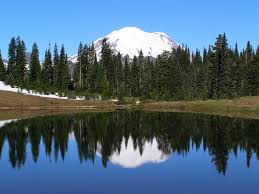
Note: This is a new piece about my dad, Ross Thomas (RO), and his truly unbelievable climbing strategies. The central episode took place in Stehekin, Washington, many years ago, when RO led my brothers and me on an attempt to reach Castle Rock that quickly devolved into heat, dense forest, no water, and general mayhem. There is also a later coda involving a climbing gym in Portland that is, in its own way, even more outta control. This piece is comic in nature, but also affectionate. My dad is a great man, a brave man, and a very game climber. He is just not, in this one specific domain, a planner.
Send lawyers, guns and money — the shit has hit the fan
— Warren Zevon, refracted
RO, is a great man and a terrible climbing strategist. He is brave, energetic, physically game, and in most areas of life basically well organized. He was a good high school English teacher, a very good administrator, and for many years an excellent and meticulous girls’ basketball coach. He is not, in other words, some kind of general life-space incompetent. Quite the opposite. Which is what makes his climbing strategies so difficult to understand.
They are ridiculous. They are unbelievable. They are officially, historically, and totally outta control.
I say this with love.
The central case study here took place in the mid-2000s, let’s say 2005, when our family was staying in Stehekin, Washington, out on Lake Chelan. If you have never been to Stehekin, it is a beautiful and slightly improbable place, the kind of place that already feels like the beginning of a story. Lake Chelan is huge, and you get out there by ferry, which means from the jump there is a sense that you are committing to something. People camp there or stay in cabins. We were in a cabin. My mom Claudia (CL), stayed behind. RO, meanwhile, had a plan.
The plan was that RO and his sons — Mike (MI), Pat (PA), and me — would hike up toward Castle Rock.
Now, one thing about family expeditions is that “the plan” is often not really a collective possession. It belongs to one person. The rest of the group is more or less there to follow along. In this case, the plan belonged entirely to RO. MI and PA and I were, broadly speaking, along for the ride.
As I remember it, we started from Stehekin and walked about three miles just to get to the trailhead, then hiked a few more hours uptrail to where we stopped and camped the first night. It was already a decent undertaking just to get there, but this was, in a sense, merely the prelude. The true RO strategy had not yet fully revealed itself.
At around dusk, after we got to camp and set up the tent and got ourselves sorted for dinner, RO decided he was going to scout the route for the next day. This seemed reasonable enough. It is in fact the sort of thing a prudent leader might do. Only instead of scouting further up the trail, or perhaps generally uphill toward the place we were trying to go, RO for some reason headed downriver.
Why did he do this? We did not know. It was back downhill. It seemed unrelated to the objective. Even at the time it had the feel of one of those decisions that makes perfect sense only to the person making it.
Ross Thomas: The trail kind of petered out eventually and didn’t really lead to Castle Rock anyway.
Fair enough. I want RO’s side of the record included here. But even granting this, and I do grant it, going downriver in the late evening did not strike the rest of us as a strong opening move.
Sure enough, RO fell in the river and got completely soaked.
This was the first of many mistakes he would make on the trip.
He came back to camp late and dripping wet, having apparently developed an immediate a bizarre attachment to that river. The water was cold. The evening was cool. He changed clothes, we had dinner, and we went to bed. At this point, there was still some chance that the next day might somehow become normal.
It did not.
The next morning we got up early, had breakfast, and prepared to head out. My assumption — based on reason, precedent, and the literal existence of trails — was that we would continue on the trail. Instead, RO decided that we were going to bushwhack straight uphill through an extremely dense forest in the blazing heat.
This struck me as a bad plan.
It was a bad plan.
The forest was thick enough that you could not really move with any rhythm. We were not hiking so much as negotiating, arguing, and physically contesting with the landscape. Every movement took extra energy. Progress was incredibly slow. The heat was serious. And the main problem, which quickly became the only problem, was that there was no water. Not a stream. Not a trickle. Not a suspicious puddle. Nothing.
Now, RO for reasons that remain mysterious to me is not a big water drinker. He prefers beer and tea. Under ordinary conditions this is merely a personality trait. On a hot uphill bushwhack through dense forest it becomes a strategic liability.
Naturally, we asked where the water was.
Ross Thomas: I had read in a Fred Beckey book that there was a way to get up to Castle Rock, although I think Beckey had only heard about it and never actually done it himself.
This is, in its way, a perfect Ross Thomas detail. Fred Beckey, the legendary climber, had perhaps heard there was some route, though he had not personally taken it. This was enough for RO. A rumor in a book by a famous climber became an operating plan.
As for the water situation, RO told us — and I remember this vividly — that there might be some in about five miles.
Five miles!!!
We were already fighting for our lives up there, and this crazy man was calmly informing us that in only another five miles there might, possibly, perhaps, be water.
He’s totally outta control.
At some point, after what I recall as roughly three miles of this lunacy, we basically mutinied. Or perhaps mutiny is too strong; let’s call it collective realism. We told RO the obvious, which was that this was not going to work. The route was no good. The heat was too much. There was no water. We had to turn back.
And so we did.
Now the descent was interesting because it brought out our distinct styles. RO, MI, and PA were making their way down carefully, gingerly, responsibly. I, on the other hand, was absolutely flying. Swinging from tree to tree like some kind of deranged monkey, just ripping downhill through the forest. This part RO loves to tell to this day, and I admit it was one of my better athletic showings. I was not going to die of thirst in that forest and I was not going to descend politely either.
Eventually we made it back to camp. Or rather, most of us made it back to camp together. RO, in one of those small but meaningful complications that tend to gather around him in climbing situations, got separated from us and somehow ended up down by the river again.
And yes, he fell in again.
He really must have loved that river.
So now here he comes back to camp once more, drenched, and by this point we are all in total agreement that the trip is over. We are done. It is time to 86 the hell out of there.
So we break camp and head down toward the lake shore. But this presents a new problem. We still have a significant walk to get home — something like another two miles down to the shore and then, as I remember it, another three miles around the lake. And by now it is dusk. So this is not really viable either. We are hot, tired, and in no mood for an elegant final act.
At this point RO does what he often does in these situations, which is simply assume that reality will provide.
He found a guy with a motorboat and asked if he would take us back to Stehekin.
The guy said sure. Fifty bucks.
RO then informed him that he did not actually have fifty dollars on him, but could get it from his wife once we got back to the cabin.
Somehow, by what can only be described as grace, audacity, or a temporary breakdown in the boatman’s judgment, this worked. We got in the boat, got home safely, and made it back in time for dinner.
That was Stehekin.
CODA
You might think the lesson here would have been: bring water, stick to trails, do not base wilderness plans on rumor, avoid rivers if possible, and maybe do not lead your sons into dense forests in the hot sun in search of a semi-mythical route described secondhand by Fred Beckey.
You would be mistaken.
Many years later, when RO was Principal of Valley Catholic High School, he got really into climbing at a gym in Portland. It is a cool place, run by a father and son, and it has beginner, intermediate, and advanced climbs. He took me and MI and PA there, and later my son Hugh as well. Hugh loved it. He scampered up the walls like he had been waiting for exactly this sort of thing his whole life. I like climbing too, though my arms get tired pretty quickly and I tend to fade. MI and PA are both good climbers. RO, to his credit, also has strong stamina.
So one day my wife and Hugh and I were there with him. We’d been climbing for a few hours. I was on the mats, faded, taking a break. Hugh was still going. RO was showing him some moves. Then RO started up one of the big walls — one of the long climbs, the kind where you need the harness.
Only he had forgotten to put the harness on.
Hugh saw this before anyone else did and yelled out:
RO, get down now!
And RO did.
For the next year, RO loved telling the story of how Hugh had saved his life. Quite right too. It is a great story. My son saved my dad from one of my dad’s own ridiculous climbing strategies. The circle was complete.
But then, about a year later, shortly before RO retired from the principal job in 2018, he was back at the gym by himself. This time the only other people there were the owner and his son. And somehow — incredibly, impossibly, yet also in a way entirely consistently with the established Ross Thomas climbing tradition — he forgot the harness again, started up the big wall, and fell.
He crashed all the way down onto the mat.
The mat saved his life, no question. But his feet and knees and legs got absolutely busted up. He was in a wheelchair for months. It was so bad that he had to move temporarily out of the country house in the woods where he lives with CL and into a little bungalow on the Valley Catholic campus owned by the nuns that founded and still run the school. He could barely work. To this day his feet remain a total mess. He has trouble driving and has to drive with his shoes off and wearing some sort of thick sock or something.
At one point we wondered whether he might sue the gym owner for negligence. But RO wanted no part of that. He said it was his own fault, not the owner’s.
Fair enough.
And then, after many months, he mostly recovered. Which means this story has, if not exactly a happy ending, at least a decent one. Better still, as soon as he was recovered he went right back to the gym and started climbing again!
This is what I mean.
His climbing strategies are ridiculous. They are unbelievable. They are officially, historically, and totally outta control. He does not plan for basic things such as the route, the water, or how exactly one might avoid miles of dense forest. He does not always remember the harness. He seems, in climbing situations, to operate according to a distinct internal logic unavailable to the rest of us.
And yet outside of climbing, this makes almost no sense. He is, as I said, a basically well-organized guy. He planned lessons. He coached meticulously. He ran a school. In most areas of life he is not slapdash at all. Which makes the climbing thing not just reckless but anomalous. It is a localized mystery. A glitch in an otherwise coherent system. I do not understand it and at this point I do not expect to.
What I do know is this: to this day I avoid climbing with him because in this one particular area I do not trust his judgment at all.
I love the man. But when it comes to climbing, he is not to be trusted.
Dedication:
For my dad. I love you baby but you are totally outta control.

 The Kyoto Kibbitzer