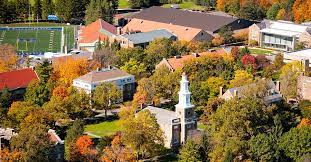
Scenes from Hamilton College I: Meeting Ian and Jake

New Note: It’s been a while since I last posted this piece, and I’m glad to bring it back here as a republication. “Hamilton I” remains one of my favorite entries on the Kyoto Kibbitzer—an early chapter built around friendship, music, and the strange, formative textures of freshman year, especially the central presence of my good friends Ian and Jake, who shaped so much of that time. It’s also one of the more widely read pieces on the site, which I appreciate. Re-reading it now, I’m struck by how much of what came later was already there in embryo: the scenes, the sounds, the late nights, and the people who mattered. As always, thanks for reading.

And I recall the moment
More distant than it seems
When five green queens
On a black bin bag
Meant all the world to me

The Pogues

I attended Hamilton College, and managed to graduate–possibly in linen. At Hamilton I was an English major, and intended to be from when I enrolled. This was a decent choice; however both Hamilton and English were kind of my father’s choices. I also managed to cobble together an Asian Studies minor through the good auspices of my advisor who checked out my credits and told me I could put that together. This was a good call on his part, and even though I kind of stumbled into it, The Asian Studies minor was my choice.

I was pretty unprepared for college. Before going I was asked to fill out a kind of questionnaire to help the college place me with roommates. One of the questions was, are you clean, messy, or in the middle. I chose in the middle, which was sort of a mistake because it turns out men are pigs, and I was cleaner than most. At the same time though it wasn’t a mistake because if I had selected clean I may not have met Ian and Jake. Jake was my roommate, and we lived in a quad. The other two roommates were Brian and Geoff, and although I had a relationship of a sort with both of them freshman year, we were not really on the same page. Jake and I were. Ian was our next door neighbor, and he roomed with Marc Campbell, and two other people. Ian, Jake, and Marc are still in my life.

My parents came with me to upstate New York, and before I moved into the dorm we stayed for a few days in a hotel near campus. I was kind of apprehensive, and spent the days listening to The Pogues and quietly stressing. But when I moved into the quad things were fine. This was mostly because of Jake.

Jake was a bit of a wild character. He was from either New York or Connecticut as I recall, and I think he came from decent money. When I visited his house later that year it was very patrician, for lack of a better word. His father seemed like a super old-school WASP patriarch, and his mother didn’t work I don’t believe. His younger brother held right-wing political views at the time, while Jake was a lefty. This was a point of serious disagreement between the brothers, but other than that the family seemed pretty solid. I believe that his brother has since switched his political views.

I didn’t meet Jake’s family until Thanksgiving however, and got to know him first in the context of the quad. We lived in a dorm called North, on the first floor right by the door. (My buddy John Innes, who joined me at Hamilton from our high school lived in the neighboring dorm Kirkland, and next to that was South.) The door to North would be locked at night, and other dorm folks would regularly misplace their key and crawl through our always open window. Jake and I rarely slept, and I got in the habit of staying up until about five AM. After that I would get a little sleep before first period English class. Then I would attend Geology class, which satisfied some kind of Science graduation credit. For English class I was alert and on top of it, although I was still hand-writing my papers, which changed once I got in the habit of using the computers in the library. English class was small, maybe 12-15 people, whereas Geology was huge and held in a lecture hall. I would go lay down in the back in the aisle and try and sleep. I ended up getting As in almost all my English classes, and a C- in Geology, which was deserved to an extent because of the sleeping. However, the main question on the final was brutal and pretty unfair, which was to draw a seismograph. Literally, draw one, which we had never studied and I did cram for the final. Brutal action. Somehow I still made the honor roll that year, and every year, because of my performance in the humanities.

Jake was an English major as well as far as I recall, I kind of forget, but he knew a lot of the teachers I knew. In any case, we did not bond primarily in the classroom, but in the dorm and then at “Sig,” the frat he was associated with and later pledged. Sig was the alternative frat. I hung out there a bit, but when pledge season started they kind of cracked down on non-pledges attending parties. For Halloween, Jake snuck me in early, and although that night I got a few looks I was good with Jake’s blessing. That night I wore all black with a turtleneck and a paper sign on my back saying “No future for you.” As in the Sex Pistols. I was talking with an older guy, an alum (there were always some alums that hung at the frat parties at Sig) at the party and he said something to the effect of “I like you, but I don’t like your shirt.” OK dude.

That was the same night I believe that inspired the following little ditty I later shared with Jake:

I pissed in the toilet

He pissed in the sink

He said I haven’t got a god above

I haven’t got a drink

Jake later took umbrage with the lines, not the sink part, which was and remains credible, but the god part. I think he is, or was, a believer. In any case, he’s my friend and won’t sue.

I appreciated Jake showing me the ropes at Sig and elsewhere. In the dorm we would play his music–he was into the classics, Beatles and Stones, Kinks, Bowie. We would sing “The Ballad of John and Yoko,” and “Come Together,” mostly the former over and over, no doubt to the annoyance of our roommates. Jake also liked The Pogues, and this made me think even more highly of him.

Jake smoked, Marlboro Reds, and I soon started smoking too, the same brand. This was not out of a desire to be a smoker, but rather as a way to keep my hands occupied and look busy at parties, where I had some difficulty mixing. I picked up, or invented, a little trick where I would fold up the flaps of a cigarette pack so they looked like a paper airplane, and then lob the cigs around the room, usually to any girl that wanted one. This got me some attention and some affection, and I kind of became known for the move. It didn’t get me laid, but at least it was something. Jake and I were fast friends, and hung out a lot in the early part of the year, before he began to branch out. Once he started pledging Sig though I saw less of him, naturally enough I guess.

By the time Jake started pledging, and even before, I was spending more time with Ian. Ian was from Boston and his father was a medical doctor. He lived in a nice house in the suburbs–both Jake and Ian had quite a bit more money than I, a common feature at Hamilton where pretty much everyone had money expect me. I was on a pretty decent scholarship, despite my not so impressive high school record, and could not have afforded the school without the scholarship. I visited Ian once or twice I believe in college, and then stayed with his family for a few months in the fall after college, but that’s a story for a future post.

Ian had a massive record collection in his quad, next door to mine as I have said. I liked Jake’s music, especially “Rebel Rebel,” “Come Dancing,” and The Stones, however his selection was somewhat limited. Ian’s was capacious. He was into bands like The Stone Roses, The Charlatans, Ride, and a bunch of other British bands I didn’t know at the time. But he was really into everything. I spent hours in Ian’s room soaking up his music, and my association with him kind of took over where Dyche Alsaker’s left off. I think it was Ian who also introduced me to Luna, who was coming up at the time and is still one of my favorite bands to this day. Later, in senior year I think, Ian and I had a radio show together and one night we got to play records all night long when a few other people canceled suddenly. I would play The Replacements and the Pogues, and Ian would play his music, but I was also getting deep into the 4AD label and bands like Big Star, This Mortal Coil, and a little known band called The Binsey Poplars (who I’m not sure were even on 4AD), named after a Hopkins poem. But my favorite around that time was Nick Drake, who was on Rykodisc.

Drake is now pretty well known, mostly on the back of his song “Pink Moon,” which was featured on a Volkswagen commercial, but back then he was not well known outside serious music circles. I loved his song “Rider on the Wheel,” and was an evangelist for him, telling all and sundry to listen. Most people didn’t, of course, but the whole move was just odd enough to get a little attention, which I was definitely seeking. (Another friend from that time John mentioned to me a few years ago that I would sit on the front steps of his frat in my trench coat and read a book. I don’t really remember this, but if it’s true it was for sure for attention.) I remember one evening Ian had a kind of band that was playing and I “opened” for them. My act was simply talking about Nick Drake, painting him as a forgotten genius, which he was, and pleading with the crowd to listen. It went over pretty well, like I said probably just because it was different.

Later on, mostly the next year I think, Ian and I went to a few shows in Boston, including The Red House Painters, The Fall, and Love Spit Love. Ian would drive, and blast The Pogues with the window down to stay awake on the way home. Before one of these shows we managed to source a little green, which was enjoyable. We would park, illegally, in some lot Ian knew. In the lot, there were rats.

Jake and I were sort of on the same level–both semi-degenerate English majors–but Ian I looked up to. He was definitely the leader in the friendship, although he must have seen something in me because we hung out a fair bit. Ian was also friends with Marc, but he was perhaps closer to another group of guys who lived in two adjacent quads on the third floor. This included John and a guy called Will. I would go up there too, and Will would ask “what Dead do you want to listen to?” I always went with Reckoning because I liked the country-folk sound and the song “It Must Have Been the Roses.” I liked the third floor guys too, especially John.

Next door to Jake and my quad was Adam and Basmo. Adam and Basmo (a nickname) were seniors who for some reason decided to stay in what was basically a freshman dorm. Adam was cool, but pretty grown up. Basmo was still a kid, and loved to get high. Loved to get high. Early on in the year he would come over and ask “anyone want to get stoned and session?” A session, it turned out, was you would smoke, put on The Beatles, and watch Bugs Bunny or something with the sound down. The idea was the music would synch up with the cartoon and it would be hysterical. It totally worked, although I just liked to listen to music and bullshit rather than session. Real heads will remember the session. (Jake told me that sadly Basmo later took his own life as a result of the worsening effects of ef. That was really too bad because Basmo was just a pure open-hearted soul.) So basically we would get stoned when we could, smoke Reds, and stay up all night and listen to music, which was a pretty decent life all in all. Jake and Ian took me in, and made the first part of freshman year so much better in all ways than it would have been if I hadn’t known them.

Dedication: For Ian and Jake, for seeing something in me, and helping make me a little somebody.

to be continued…

Note: If you liked this piece, you may other like the other pieces below in the Hamilton series.

On the Theory of Condensation

Note: This story is drawn from memory and from an ongoing oral history conducted via group text with the surviving members of the expedition. As with many events that took place more than thirty years ago, certain details remain contested, most notably the identity of the fourth passenger and the exact geographic location of the cigar-ash pasta incident. Mason Anderson, when consulted, quickly clarified that he was not present, as he was living with an uncle in Key West that summer, thereby removing himself entirely from responsibility for the expedition.

Kelly, whose scientific theory regarding condensation remains central to the story, has not yet submitted his official rebuttal, though one is expected shortly. Should further testimony arrive—especially if it sheds light on the fate of the firearm hidden somewhere near the California border—I will append a brief postscript.

In the meantime, the above account represents the best reconstruction available.

Epigraph:

Bullshit baffles brains. 

We graduated from St. George’s in June of 1992 and, like many newly minted high-school graduates, we had what we considered a very solid plan. We were going to drive from Spokane into the Selkirk Mountains in Idaho and spend several days trekking around in the wilderness like the rugged outdoorsmen we assumed we were.

The crew consisted of myself, Kelly, and Richard Barkley, along with a fourth member whose identity I am currently attempting to reconstruct through the miracles of modern group text. Mason Anderson, when contacted for this oral history, quickly clarified that he had nothing to do with the expedition whatsoever, as he was living with an uncle in Key West that summer and therefore cannot be blamed for any of the events that followed.

I had just gotten my driver’s license—rather late by American teenage standards—and was eager to demonstrate that I was now a fully functioning member of the motoring public. Richard had the car, Kelly had the confidence, and somewhere along the way we acquired a gun which I believe belonged to Will Rafferty, a year behind us at school.

Right away you may notice that this was not shaping up to be the most carefully planned expedition in the annals of Pacific Northwest mountaineering.


The Tarp

One of the first disagreements arose over equipment. I had suggested, quite reasonably I thought, that we bring a tent. Kelly rejected this idea outright.

A tarp, he assured us, would suffice.

Now, the Selkirks are a beautiful range, but they are not known for their gentle weather. Sure enough, as soon as we reached the foothills it began to rain. Not a polite drizzle either, but the kind of steady mountain rain that makes you realize nature has the upper hand.

Nevertheless we pressed on and eventually found a place to bivouac for the night.

We rigged Kelly’s tarp as best we could, laid out the sleeping bags, and attempted to cook something on the camp stove while water ran in small rivers through the campsite. At a certain point, after watching the tarp sag ominously under the weight of the rain, I reached what seemed to me the obvious conclusion.

“Dudes,” I said, “I don’t know about you, but I’m sleeping in the car.”

Kelly immediately objected. What followed was one of the great scientific claims of our generation.

“That’s a bad idea,” he said. “You’ll get more wet in the car because of the condensation.”

Now I’m no meteorologist, but even at eighteen this struck me as extremely unlikely. Outside the rain was falling steadily. Inside the car was, well, a car.

Nevertheless Kelly was confident in his theory. I was confident in my skepticism. We agreed to disagree.

Kelly, Richard, and at least one other member of the expedition slept under the tarp. I reclined the passenger seat of the car and slept quite comfortably.

In the morning, everything under the tarp was soaked.

To this day Kelly maintains that the condensation principle was sound.


The Pasta

Having discovered that trekking in the Selkirks during a mountain downpour was not especially enjoyable, we decided to improvise. The road trip continued deeper into Idaho, or perhaps Montana, where we eventually stopped beside a river to camp for the night.

This time tents were involved, which was already a step forward.

Kelly assumed responsibility for dinner and set about cooking pasta on the camp stove. Things seemed to be going well until he produced a cigar, lit it, and began tapping the ash—quite generously, I might add—into the simmering red sauce.

I objected immediately.

“Knock it off,” I said.

Kelly waved away my concerns.

“No, no,” he said. “Italian guy Joe does this. He says it’s the secret to a great sauce.”

I have never met Italian guy Joe, but I remain confident that he does not exist.

Kelly continued tapping ash into the pot. At that point I made the executive decision not to eat the pasta.

Kelly and I, despite being great friends, were at philosophical loggerheads for the first two days of the trip.


The Gun

At some point we decided to drive into California. This raised a new issue, namely that we were traveling with a gun.

I had been against the gun from the start. Kelly, however, had insisted that it was necessary. Necessary for what exactly was never entirely clear, but the gun had come along anyway.

Approaching the California border, we held a brief council and concluded that crossing state lines with a borrowed firearm might not be the wisest course of action.

The solution we arrived at was simple.

We would hide the gun in some bushes and retrieve it on the way back.

I pointed out that once a gun was hidden in random roadside bushes somewhere near the California border, the odds of ever finding it again were approximately zero.

Kelly disagreed.

We hid the gun.

We crossed into California without incident.

Later, as it turned out, we headed east anyway and never went back for it. Somewhere in a patch of roadside shrubbery, the gun presumably remains to this day.


Wyoming

Eventually the road carried us into Wyoming. We drove up onto a plateau above a large spread owned by the Mann family, who were something like Spokane and St. George’s royalty. My family and the Innes family had visited the place in previous summers to fish and wander around.

We had no invitation.

For a moment there was some discussion of whether we might simply camp there anyway, but cooler heads prevailed. As we were debating the matter, a caretaker appeared and asked what we were doing.

We explained that we were friends of the Manns and asked if it would be alright if we camped for the night.

He was entirely copacetic.

“Sure,” he said. “No problem.”

And just like that, after tarp disasters, pasta controversies, and the abandonment of a firearm somewhere in California shrubbery, we finally spent a perfectly pleasant night camping.


The Drive Home

The next day we drove back to Spokane, which I remember as being about fourteen hours straight.

It was Richard’s car. He asked me at one point if I wanted to take the wheel for a while, but I had only recently gotten my license and didn’t feel especially confident about highway driving yet. I declined and slept in the back seat while Richard drove most of the way and Kelly took a few turns.

Eventually we rolled back into Spokane.

We had not trekked the Selkirk Mountains.

We had lost a gun somewhere near California.

And we had proven absolutely nothing about condensation.

But we did come home with stories for life

Dedication:

For legal professionals everywhere.

On Some Meetings and Close Encounters with Musicians II

Note: This is the second piece in our series “On Some Meetings and Close Encounters with Musicians.” You can find the first installment here.

The encounters described here span more than thirty years and several cities — from a first arena concert in Pullman, Washington in 1991 to small club shows in Cambridge, Osaka, and Kyoto over the decades that followed. As with many memories of live music, the exact setlists and dates blur, but the rooms themselves — the sounds, the atmosphere, the strange and fleeting meetings between artists and audiences — remain vivid. These sketches attempt to capture a few of those moments as they were experienced at the time.

Epigraph

No fears alone at night she’s sailing through the crowd

In her ears the phones are tight and the music’s playing loud

— Dire Straits, “Skateaway”

Live music produces strange meetings. Sometimes you meet the musicians themselves. More often you meet a moment — a room, a sound, a feeling that sticks with you for decades while entire years of ordinary life quietly disappear.

Here are a few such encounters.


I. Initiation

My first real concert was the On Every Street tour in 1991.

The band was Dire Straits, the venue was Pullman, Washington, and the company was the usual Spokane crew: Seth, Innes, Kelly.

I was the biggest fan in the car by far. The others liked the band well enough but I was the one who had studied the records, who knew the guitar parts, who was ready for the moment when the lights dropped and the first notes hit the arena. This was the On Every Street tour, which turned out to be their final record.

They played everything: Money for Nothing, Walk of Life, Sultans of Swing. It was a great show, and one of their last before retirement, though at the time I had no real way to judge such things. It was simply enormous — lights, volume, spectacle. I bought the black and blue tour shirt and wore it for five years.

At the time I thought concerts were supposed to be like that: huge, polished, and far away.

I would later learn otherwise.


II. Revelation

Several years later, during the Hamilton years, I saw Red House Painters at the Middle East in Cambridge.

I went with Ian. The room was small, maybe a few hundred people at most. Nothing about it resembled the arena in Pullman. And then, near the end of the set, Mark Kozelek began playing “Little Drummer Boy.” It lasted nine minutes. You could hear a pin drop in the room.

No spectacle. No lights. Just absolute concentration from everyone present. When the final notes faded the silence lingered for a moment before the applause came.

Afterward Ian and I drove back toward New York through the cold night with the windows cracked open, heaters flying out into the darkness, and Hell’s Ditch blasting through the car stereo to keep us awake.

That was the night I realized concerts could be something else entirely.


III. Chaos

Not every show produces reverence.

I once saw The Fall with Ian as well. The band’s leader, Mark E. Smith, seemed to be operating in his traditional mode of total hostility. The set was short — twenty-eight minutes by my estimate. Ian later checked the official record and insisted it was forty-three. Either way it felt brief and volatile. Smith barked into the microphone, glared at the band, and treated the entire enterprise with the air of someone barely tolerating the existence of the audience.

Which, to be fair, was exactly what many people had come to see.


IV. Theatre

The strangest performance I ever witnessed may have been Cat Power at Club Quattro in Osaka.

The evening began badly. An opening act — a woman in what appeared to be a fairy costume — sat at the piano and played for what felt like an eternity. Forty-five minutes at least. Perhaps longer. By the end of it the audience was openly confused.

Then Cat Power appeared.

Or rather she refused to appear in the conventional sense. Instead of remaining on the stage she wandered through the venue with a handheld microphone, singing and rapping while walking amongst the crowd, occasionally placing an arm around a patron or leaning against the bar.

At one point she came right up to where I was standing near the back rail and sang a line or two before drifting off again into the room.

The entire show felt less like a concert than a piece of improvised theatre.


V. Ritual

A few years later I saw Damo Suzuki at Club Metro in Kyoto. Damo had once fronted the legendary German band CAN, but this night bore no resemblance to those recordings. Nothing recognizable from the catalog appeared. And here he stood, just a few feet away from the audience with long black-and-grey hair flowing, bellowing and chanting over a constantly shifting improvisational band.

It was less a performance than a ritual.

Damo passed away not long ago. RIP and prayers up. I’m grateful I saw him when I did.


VI. Canada Night

Not all memorable shows are mystical.

Sometimes they’re simply loud.

One such evening occurred at Club Quattro in Osaka when Broken Social Scene and Death From Above 1979 came through town.

The Canadian ambassador was present and delivered a brief speech before the set explaining that Death From Above 1979 represented a fine example of Canadian enterprise because they were “only two men making so much noise.”

The room was packed with Canadian expats and the atmosphere was celebratory chaos. The ambassador was probably correct.


VII. Breakdown

Not every concert goes well.

I once saw Bonnie ‘Prince’ Billy at the small Kyoto venue Taku Taku. Something had clearly gone wrong with the lineup. The guitarist appeared to be brand new and could barely navigate the chords.

Will Oldham tried to push through but quickly grew frustrated and began openly calling the guitarist out from the stage. It was uncomfortable for everyone involved.

The show never recovered.


VIII. Redemption

Fortunately the story has a better ending.

Some years later I saw Bonnie “Prince” Billy again, this time at the beautiful Kyoto venue Urbanguild and everything worked great. Low benches and tables filled the room, Heartland beer bottles glowed green under the lights, and the band played a relaxed, confident set drawn mostly from the Bonnie “Prince” Billy catalog with a few Palace songs mixed in.

Opening the evening was an instrumental group called Bitchin Bajas whose sound reminded me faintly of early Phosphorescent if Phosphorescent had chosen to make instrumental records. After the show I found myself talking with three members of the band while they drank beer and ate fries. They were humble, friendly, and slightly surprised that anyone in Kyoto knew who they were. We talked for a while about touring and the constant challenge of trying to make a living as working musicians. Eventually the conversation drifted off and the room began to empty.

The music was over. The musicians were just people again, finishing their drinks and preparing to move on to the next city. And that, in the end, may be the most interesting encounter of all

Dedication

For live music fans everywhere. My true people. I love you baby.


Note: If you enjoyed this essay, you may also enjoy the essay below on the four time I met Yo La Tengo. Happy reading!

On The Dubious Anna Delvey

Note: This essay reflects on the curious cultural figure of Anna Delvey, whose rise and fall in the New York art and social scene became one of the stranger morality plays of the late 2010s. Delvey—born Anna Sorokin in Russia—gained notoriety for presenting herself as a wealthy European heiress while attempting to secure loans and social capital for an ambitious but largely imaginary cultural venture known as the Anna Delvey Foundation.

The events described here draw on widely reported elements of the case: Delvey’s years moving through luxury hotels in Manhattan, her efforts to obtain financing for a private art and social club, the unraveling of her financial claims, and the now-famous trip to Dubai in which a friend—later a magazine writer documenting the experience—was left responsible for an enormous hotel bill after promised funds failed to appear.

The piece does not attempt investigative reporting. Instead, it approaches the story in a spirit of cultural anthropology. Cities like New York have always attracted individuals engaged in various forms of self-invention. The line between ambition, performance, exaggeration, and outright fraud can sometimes appear only after events have run their course. Delvey’s story is compelling partly because it dramatizes this thin boundary in unusually vivid form.

If the tone here sometimes drifts toward sympathy rather than condemnation, that is intentional. Many urban cultural scenes—especially art worlds—operate on the energy of strivers who are, in one way or another, attempting to become something slightly larger than their present circumstances allow. Most of them eventually succeed or quietly disappear. A very small number, like Delvey, collapse in public.

Their stories reveal something not only about themselves, but about the environments that briefly believed in them.

Epigraph

“For all the crazy people who can never get it right.”
— Drugstore


I. The Entrance

There is a certain kind of person who arrives in a city not merely to live there but to declare themselves into existence. Cities like New York attract them the way bright lights attract moths. They arrive with luggage, ideas, clothes that signal belonging, and an almost reckless confidence that the future will eventually arrange itself around their intentions.

Anna Delvey was one of these people.

When she appeared in the New York art scene, she seemed to possess the basic ingredients required for entry into that peculiar ecosystem: style, confidence, and an air of European mystery. She wore expensive-looking dresses and shoes. She wore aa lot of make up and had her hair done at expensive salons. She seemed for a while to ooze money. She spoke casually about ambitious cultural projects. She moved through hotels and restaurants as if she had always belonged to that world. In New York, that is often enough.

The city runs on confidence performances. Every ambitious young person who arrives there is, in some sense, performing the life they intend to have. The art world especially is full of people who are not yet what they claim to be but are working very hard to become it.

Delvey fit into that theater perfectly.


II. The Vision

The striking thing about Delvey was that she didn’t simply want to attend the art scene. She wanted to build something inside it. Her idea was the Anna Delvey Foundation: a kind of private cultural club and exhibition space in downtown Manhattan. It would combine gallery spaces, social rooms, events, artists, patrons, and the atmosphere of a private cultural salon. A place where the city’s creative and wealthy classes might gather.

The plan was grand. But it also had a strange plausibility. New York is full of institutions that began with the ambition of a single person who simply decided that something should exist and then spent years convincing others to believe in it.

Delvey spoke about the project with total conviction. She behaved like someone who already possessed the financial backing required to make such a thing happen. And because she behaved that way, many people assumed the money must exist somewhere.

This is one of the basic mechanics of social confidence. If someone carries themselves like a person whose financial arrangements have already been verified by someone else, most people will not ask too many questions.


III. Hotels

Hotels played a central role in the Delvey story.

Luxury hotels are perfect environments for people living inside ambitious performances. They operate on the assumption that their guests are legitimate. The bill will eventually be settled. The credit line exists somewhere. The guest’s presence itself is treated as evidence of solvency.

Delvey floated through some of New York’s most expensive hotels as if she were simply another wealthy European visitor temporarily residing there while arranging various cultural affairs. The lobbies, the restaurants, the rooms—all of it provided a stage set that reinforced the story she was telling.

Hotels also create a particular social atmosphere. Everyone is temporarily suspended between identities. People are traveling, negotiating, arriving, leaving. It is a place where someone can exist slightly outside the ordinary structures of verification.

For a while, the performance worked.


IV. The Father

Like many figures who construct elaborate new identities, Delvey carried with her a somewhat murky origin story.

She spoke of family wealth. Of connections. Of a background that seemed to hover somewhere between Russia and Germany, between modest beginnings and more glamorous narratives.

Her real childhood was more ambiguous. Her father had worked as a truck driver and later operated a heating and cooling business. It was a respectable, ordinary life. But it did not contain the European aristocratic wealth that sometimes appeared in Delvey’s stories.

This kind of ambiguity is not unusual among people attempting radical self-invention. The past becomes something flexible, something that can be rearranged slightly in order to support the person one intends to become.

In cities like New York, such reinvention is practically a tradition.


V. Dubai

The most extraordinary episode in the Delvey saga took place far from Manhattan, on a trip to Dubai. Delvey traveled there with a friend—a magazine writer who was documenting the glamorous world that Delvey seemed to inhabit. The trip was meant to be luxurious: private villas, elaborate dinners, the kind of extravagant travel that confirms a person’s social status.

For a few days everything unfolded according to the script. And then the bill arrived. The charges for the trip reached roughly $60,000. Delvey’s payment arrangements suddenly failed. The promised wire transfers did not appear. The hotel demanded settlement.

And the friend—the magazine writer who had been invited along for the ride—found herself responsible for the enormous bill. So Delvey left her there. Super bad business Anna baby.

It was a moment that perfectly captured the strange mechanics of confidence artistry. The performance works right up until the moment when reality insists on payment.

Someone, eventually, must pay the bill.


VI. Collapse

Once the financial machinery began to fail, the unraveling accelerated. Banks wanted documentation. Hotels wanted payment. Institutions that had briefly entertained the idea of supporting Delvey’s foundation began to ask more detailed questions about the supposed trust fund that would finance it.

The answers did not exist. The performance collapsed. Delvey was eventually arrested, tried, and convicted of fraud.


VII. The Strange Sympathy

And yet the Delvey story produced a strangely sympathetic public response. Perhaps it was because she had not simply been extracting money for luxury purchases. She had been trying, in her own improbable way, to create something. A cultural institution. A social space. A downtown hub for art and ambition.

The plan was impossible, but the ambition was recognizable. Many people—especially those drawn to cities like New York—understand the impulse to reinvent oneself, to construct a future through sheer force of belief. Delvey simply pushed that impulse far beyond the point where the arithmetic could sustain it.


VIII. Coda

In the end, the most interesting thing about Anna Delvey may not be that she fooled people. New York has always been full of people attempting improbable social performances. The interesting thing is that, for a moment, she came very close to building the life she imagined. And perhaps that is why stories like hers continue to fascinate us. They remind us that the line between visionary and impostor is often visible only in hindsight.

Dedication: For Anna baby (you’re hot BTW) and all the beautiful strivers out there. May your world-curated art spaces someday come true.