The Most Insane People of All Time (aka You’re Outta Control!): #2 John McAfee

Note: This second installment in The Most Insane People of All Time (aka You’re Outta Control) looks at John McAfee, tracing his evolution from software pioneer to global fugitive, crypto evangelist, and online cult figure. The piece emphasizes the improvisational chaos of his later life and contrasts it with more conventional tech figures like Elon Musk and Bill Gates, arguing that McAfee’s volatility places him in a category of his own. The tone is impressionistic, comparative, and intentionally informal.

Epigraph: 

“I fought the law and the law won…”

— I Fought the Law, The Clash

John McAfee starts in relatively conventional fashion: brilliant programmer, eccentric personality, builds the first widely adopted consumer antivirus software in the late 1980s, and becomes extremely wealthy when McAfee Associates takes off. But even in the early years there’s instability, and a foreshadowing of things to come — drug use, paranoia, erratic business decisions, and a growing anti-authority streak. He sells his stake, drifts through various ventures, and by the late 2000s relocates to Central America, eventually settling in Belize. There he buys beachfront property, hires armed guards, collects dogs, experiments with quasi-scientific projects, and begins acting like a semi-autonomous local strongman. It’s the first fully “outta control” phase: money, isolation, guns, and a man already well inclined toward paranoia.

Then comes the neighbor incident. In 2012, McAfee’s American neighbor, Gregory Faull, is found murdered. McAfee is named a person of interest — never charged — and instead of lying low, he goes fully theatrical. He claims the authorities are targeting him, allegedly evades police by hiding, disguising himself, and moving between safe houses, all while giving interviews and live-tweeting the saga. With girlfriend (later wife) Janice McAfee and various associates in tow, he flees Belize, surfaces in Guatemala, is detained, then ultimately allowed back to the United States. The whole episode is surreal: a tech millionaire allegedly on the run for murder, narrating the chase in real time on social media. It’s not just outta control — it’s performance art.

Back in the U.S., McAfee briefly lands in Florida but quickly re-enters chaos. He promotes cryptocurrencies, launches bizarre tokens, courts publicity, and cultivates a global cult following. He posts paranoid threads about surveillance, claims he lives inside Faraday cages, talks about government plots, and offers wild schemes — including promises to evade arrest by sea, air, or even paragliding into New Mexico to meet with fans! He pops up in unexpected places, from Caribbean boats to European cities, always accompanied by Janice and a rotating cast of loyalists. At one point he tattoos crypto branding onto himself, predicts conspiracies, and positions himself as both fugitive and prophet. The line between performance and belief dissolves completely.

Eventually, legal trouble catches up. U.S. authorities charge him with tax evasion and crypto-related fraud, and he’s arrested in Spain in 2020. From prison he continues tweeting through intermediaries, hinting at conspiracies and insisting he’ll never kill himself. In June 2021, shortly after a Spanish court approves extradition to the United States, McAfee is found dead in his cell — ruled a suicide. His supporters, including Janice, immediately dispute the finding, pointing to earlier posts and tattoos as supposed foreshadowing. The ending is as chaotic as the life: software pioneer turned fugitive, Twitter antihero, crypto evangelist, paranoid showman, and finally a death that only deepened the mythology. Outta control doesn’t even begin to cover it.

Compared to John McAfee, figures like Elon Musk and Bill Gates still look almost conventional — even when they drift into odd territory. Musk’s public persona is chaotic in a very modern way: late-night posting, impulsive announcements, awkward humor, and personal-life theatrics. The relationship with Grimes, the bizarre naming of children, and the infamous weekend when Azealia Banks claimed she was stranded at Musk’s house amid talk of LSD and general weirdness all add to the sense of volatility. Then there are the dad-joke moments — hauling a sink into Twitter headquarters and posting “let that sink in,” which is either performance art or just terrible humor. It’s eccentric, sometimes cringe, occasionally outta control — but the companies still run, rockets still launch, and the chaos never fully escapes the bounds of reality.

Gates, by contrast, is a more old-school eccentric. Bill Gates has the reputation of a hyper-competitive young executive who mellowed into a philanthropic technocrat, but the quirks linger. The awkward dancing, the slightly rumpled appearance, the perennial jokes about dandruff — he has always projected a kind of brilliant-but-uncool energy. The later-life turbulence — divorce from Melinda after decades, scrutiny over his contacts with Jeffrey Epstein, and the general aura of a private billionaire navigating public controversy — adds complexity but not chaos. Gates remains structured, Musk volatile, but both operate within functioning systems. McAfee, meanwhile, is something else entirely: not just eccentric but improvisationally unstable, a man who turned paranoia, fugitivity, and spectacle into a lifestyle. Musk may be chaotic, Gates may be awkward, but McAfee is outta control in a different register altogether.

In the end, John McAfee feels more outta control than Keith Raniere, Elon Musk, or Bill Gates — and that’s saying something. Raniere was creepy and manipulative but small; Musk is chaotic but still tethered to real-world outcomes; Gates is eccentric but fundamentally structured. McAfee, by contrast, seemed to live entirely outside normal constraints. Guns, boats, dogs, girlfriends, crypto tokens, Faraday cages, live-tweeting alleged manhunts, promising wild escapes, drifting between countries — the whole thing reads less like a biography and more like a fever dream. He wasn’t just eccentric; he appeared to improvise his life day by day, escalating the spectacle each time. That kind of volatility is rare. It’s also why he became a cult hero: he embodied a fantasy of total freedom, however reckless, however unsustainable.

Years after his death, the mythology hasn’t faded. Supporters still debate the circumstances, quote his tweets, and treat him as a kind of outlaw technologist who refused to play by the rules. Whether you see him as mad genius, performance artist, or cautionary tale, the scale of the chaos is undeniable. There may have been more dangerous figures, more powerful figures, even more tragic figures — but few as consistently, flamboyantly outta control. That’s what makes McAfee a legend. Not admirable, not necessarily likable, but unforgettable. And like all true originals, there probably won’t be another. So RIP, prayers up, and pour one out for a real one, John Motherfucking McAfee.

Note: If you liked this piece, you may also like the other ones in out “You’re Outta Control” series.

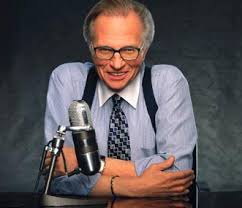
On Larry King, the Radio GOAT

Epigraph:

“I listened to the radio / I waited all night long…”
— Radio Radio, Elvis Costello

Note: This piece reflects my personal memories of listening to Larry King’s overnight radio show in the late 1980s and early 1990s, along with later impressions from television appearances, interviews, and conversations with people who knew him. It is written in the spirit of appreciation and nostalgia rather than media criticism, and emphasizes the uniquely loose, humane, and unpredictable quality of King’s radio work, which for me remains the defining core of his legacy.

I grew up listening to Larry King’s overnight radio show between roughly 1988 and 1992, and in my opinion — which happens to be correct — the radio show was much better than the television version that later made him famous. The TV show was good, even great at times, but radio was longer, looser, freer, and far more unpredictable. It had weird guests, weirder callers, and the feeling that anything might happen at two in the morning. That’s where Larry really lived.

I would listen in my bedroom at my parents’ house in Spokane, Washington, the volume turned low, the house quiet, insomnia hovering. The Spokane AM station — KGA 1510 — carried the show from around 9 PM Pacific time, and then, wonderfully, they would run it again. So I’d listen from nine to midnight, fade, wake at two or three, and hear the same segment again in a half-dream. The effect was surreal. Didn’t I just hear that caller? Didn’t Larry just say that? It created a strange loop of late-night déjà vu that only made the whole thing more atmospheric. The show felt less like programming and more like a continuous nocturnal conversation.

My friend Kelly Rudd loved Larry too. When we were in high school we were both big fans of the radio show, and we talked about it constantly. There were a couple of things that we especially liked. The first was that Larry famously did no preparation. He knew a huge amount about the world, of course, but he didn’t read guests’ books ahead of time. He wanted to come in cold. If his guest was a firefighter, he’d ask, “So what’s it like to be a firefighter?” It sounds lazy, but it was brilliant. By staying open and getting out of the way, he let the conversation go anywhere. This way the show became eventful.

Another thing we loved was what happened after the guest left. Larry would open the lines and take questions about absolutely anything. Most of the time he was generous and patient, but when callers went off the rails he had a signature phrase. He’d cut them off gently: “Cold compress, ma’am,” or “Cold compress, sir.” Basically: lie down, ice your head, regroup. It was hysterical, especially because he used it sparingly. When “cold compress” dropped, you knew things had gotten weird.

Anyway, Kelly and I loved Larry so much that when the station suddenly dropped the show, Kelly proposed we drive to the radio station and protest. So we skipped school, drove across town, and rang the intercom demanding to speak to someone about the cancellation. The station manager eventually came down and heard us out. We knew we weren’t changing anything, but it felt right to try. Larry never came back to Spokane radio, and the show faded not long after, but the whole episode captured what the show meant to us. It wasn’t just background noise. It felt alive.

Larry’s on-air style was the key. He was unbelievably relaxed. By the late ’80s you could tell he had done thousands of hours. Nothing fazed him. Weird guests, drunk callers, eccentrics — all the same to Larry. He absorbed everything. He had pet phrases — “cold compress” chief among them — and he deployed them like a veteran reliever, only when needed. He famously did no prep, and he leaned into naïve questions. He’d ask something simple and let the guest do the work. The effect was disarming. People opened up. He also had real humanity. He listened. He didn’t mock callers. He didn’t rush them. There was compassion there, and I think that’s what I loved most.

And the show could get wonderfully out of control. In one story Larry told from his old Miami days, an adult actress he was interviewing suggested they just have sex during the commercial break. Larry, amused, asked the producers to clear out — but there wasn’t enough time. That kind of anecdote captures the looseness of late-night radio. It wasn’t polished. It was alive.

Larry left the overnight Mutual Radio show in 1994 to focus on television. By then I had already drifted away, but I still caught Larry King Live on CNN over the years. I remember watching during the O. J. Simpson trial while at Otago University in New Zealand, when the show became part of the nightly noise. Later there were the Vladimir Putin interviews — classic Larry, conversational and oddly disarming. And of course there were the great comic moments, like the interview with Jerry Seinfeld where Larry suggested the show had been canceled and Seinfeld snapped back in disbelief, and the Norm Macdonald appearance where Norm kept repeating, “I’m a deeply closeted homosexual,” and Larry tried earnestly to parse it. “So that means you’re gay?” “No, Larry,” Norm replied, “it means I’m deeply closeted.” Pure Larry: sincere confusion meeting absurdist comedy.

Larry’s personal life was famously complicated. He married eight times, had several children — including sons Chance and Cannon later in life — and lived in a kind of perpetual romantic improvisation. The marriages came and went. The last ended painfully and publicly. He once joked he’d never leave his wife unless Angie Dickinson came along — and when she did, he married her. That was Larry: impulsive, affectionate, slightly chaotic. Despite decades of success, he didn’t leave the kind of massive fortune people assumed. The money came and went, as did the marriages. It was a life lived in motion.

My friend Sergio Mandiola actually knew Larry in his later years in Los Angeles. Sergio was running an independent studies program at Beverly Hills High School, and Larry’s sons Cannon and Chance, and he taught his sons for three years. Larry would come by for open nights or just to chat.

Sergio Mandiola: “Larry would come in from time to time and we would talk. He was lovely and open. He talked about his family and his career. One time he told me, ‘Sergio, you should totally have a radio show!’ I was flattered. One thing about Larry is his politics were more to the left than he let on on air. He had strong views and wasn’t afraid to share them in person. Larry was a true mensch and I’m glad I got to spend time with him. I miss him.”

In the end, I’ll say it plainly: for me, Larry King is the radio GOAT. There was no one like him, and there probably never will be. It wasn’t just longevity. It was the curiosity, the looseness, the humanity, the love of people, politics, baseball, and life. He trusted the conversation. He let the night unfold.

And then there was that absurd, wonderful USA Today column, which read like a diary gone completely outta control. Mets lose 6–4…Rain in Baltimore…Clinton flies to Ireland…You’d read it and think, Larry, baby, WTF is this? And also, Mr. USA Today, WTAF are you doing paying for this? But somehow it worked. It was pure Larry — fragmentary, observational, intimate.

And that’s how I remember him most clearly: late nights in high school, the radio turned low, insomnia hanging in the room, Spokane quiet outside.. Sometimes I’d listen from nine to midnight, fade, then wake again to the rerun, half-dreaming, half-aware, caught in that strange déjà vu — didn’t I just hear this? — while Larry kept talking, calm as ever, taking calls from truckers and insomniacs and eccentrics. My listening years were brief, but they stuck. And when I think of Larry now, that’s where I go back to: the low hum of AM radio, the half-fade, and the sweet sounds of his voice in my ear.

Dedication:

For the one and only GOAT, Larry Motherfucking King. RIP baby.

On Being Early to Shows

Note: Getting to shows early, I realized, isn’t really about beating the crowd but about entering the space before it hardens into an event—when the room is still provisional, the bartender relaxed, the band half-mythical figures moving casually through soundcheck, and the whole night feels less like a performance and more like something forming in real time; you notice the lighting before it matters, the empty floor that will later surge, the stray conversations, the merch table still untouched, and sometimes—if you’re lucky—the musicians themselves, unguarded and human, which subtly rewires the experience so that when the set finally begins you’re not just watching a show but inhabiting a continuum that started hours earlier, a private prelude that rewards patience, sharpens memory, and turns what could have been just another concert into a small, self-contained narrative of anticipation, proximity, and the quiet pleasure of being there before everything becomes official.

Epigraph
“There’s a thin line between a guy with a backstage pass /
and a guy walking around with his gut hanging out like a jackass.”

— Sun Kil Moon, “Ben’s My Friend”

I’ve always been fascinated by the green room. First of all, why green? They can’t all be green. Second, there’s the whole rider situation. The rider is where things get really interesting. I think it was Van Halen who had in their rider that all the brown M&Ms had to be removed from a bowl. This sounds totally bizarre, but the point was attention to detail. If the venue screws up the M&Ms, they might screw up something much more important, like stage rigging or pyrotechnics. The M&Ms were just a test.

Other riders go in different directions. Iggy Pop reportedly asked for things like a Bob Hope impersonator and other surreal odds and ends, more like performance art than hospitality. Meanwhile Beyoncé is famous for highly controlled riders: temperature, lighting, water, environment, everything calibrated. One approach is chaos, the other total control. Both happen in the green room, which most of us never see.

My first concert was Dire Straits in Pullman, Washington, in a big arena. I was nowhere near the green room, of course. Most of us aren’t. So the real question becomes: what happens before the show, if you’re not backstage?

One answer came when I saw They Might Be Giants in Spokane with my friend Kelly Rudd. Kelly told me his cousin was in the opening band. They got paid twenty bucks for the show. The whole band. Twenty dollars. Totally unbelievable. Outta fucking control. TMBG were already a pretty big indie band, “Birdhouse in Your Soul” had been a hit, and I liked “Istanbul (Not Constantinople)” quite a bit. But after hearing that story I never quite looked at them the same way. The green room fantasy took a hit. Backstage wasn’t glamorous. It was twenty bucks and a handshake.

Another time I went to see Cat Power at the old Club Quattro in Osaka. I got there early, of course, and there was an opener dressed like a fairy with fuzzy, messed-up hair who sat down at the piano and proceeded to play dirge after dirge for what felt like an hour. Solo piano can be great, but this was brutal. I honestly thought I might have to cap myself. At some point I checked my ticket just to make sure this wasn’t actually Chan Marshall. It wasn’t. Thank god.

Then Chan came on and instead of playing from the stage like other artists do, she wandered through the crowd with a wireless mic, half-rapping, half-singing, talking, improvising. It wasn’t really a concert. It was more like some kind of performance art happening. Totally outta control. If I’d come late I would have missed the whole bizarre prelude. Being early meant enduring the dirges but also getting the full weirdness of the night.

Another early-arriver adventure came when I saw Deerhunter at the Hostess Club Weekender. These shows started early and stacked openers all day long. I once saw Mogwai at one of these and had to leave after fifteen minutes because I was hungry, tired, faded, and they were boring the living shit out of me. It happens.

The Deerhunter show in Osaka was even more outta control. The headliner was scheduled for 7 PM, but there were something like six openers. One of them was Ivo Watts-Russell of 4AD, a legendary figure, but he droned on so long that by the time Deerhunter came on they only had about forty minutes. Bradford Cox introduced him with dripping sarcasm, emphasizing “LABEL BOSS,” clearly taking the piss because the band’s time had been cut. I ended up having to see them again months later in Nagoya to get the full set. That’s the risk of being early: sometimes the openers eat the show.

The flip side came when I saw The Hold Steady at the Brooklyn Bowl in December 2018. I arrived two hours early, ate a hamburger, and smoked up outside. That’s where I met Austin, a total Steadyhead. He knew everything: lineups, labels, deep cuts, all of it. We talked music, smoked, and waited. When doors opened we grabbed territory near the stage with the other early-arrivers, a semi-cliquey group of diehards.

Later, when Austin wanted to get back to the front for the encore, he told me to follow him. He moved through the crowd at a half jog and the people parted in front of him like he was Barry Sanders hitting holes. Seconds later we were hugging the stage. I knew then I was in the presence of greatness. I also knew he was my friend. I didn’t get the VIP meet and greet, but getting there early gave me something better.

My one true VIP experience came when I saw The Afghan Whigs in Amsterdam in 2017 at the Paradiso Amsterdam, a beautiful converted church. I arrived three hours early, met Greg Dulli and the band, took photos, bought merch, and watched soundcheck with maybe fifteen people. They played “Going to Town” acoustically, which was a revelation. Later they crushed the full electric set, ending with “Faded.” I paid fifty bucks for that meet and greet and it was completely worth it. Being early paid off directly.

Getting to shows early, then, is not really about the green room at all. The green room is a kind of fantasy—green walls, bowls of M&Ms, riders with impossible demands. Most of us never see it, and even when we do, it turns out to be smaller and more ordinary than imagined. And probably not even green. The real action happens in that strange in-between space before the show: the smoking area, the empty floor, the long wait while the openers drift on and off.

If you arrive early, you get all of it. You get the terrible fairy-piano dirges and the label boss who drones on too long. You get the moment of doubt when you check your ticket and wonder if this could possibly be the headliner. You get the rail territory battles and the cliquey early crew. You get the conversations with strangers who turn into temporary friends, like Austin, who parts the crowd like a halfback and gets you back to the stage in seconds. You get the soundcheck if you’re lucky, the acoustic revelation, the quiet before the storm.

Most of all, you get time. And time at a show is a funny thing. Once the lights go down, everything compresses. The band plays, the songs blur together, and before you know it the encore hits and everyone spills out into the night. But if you were there early, the show feels bigger. It has a beginning, a middle, and an end. You saw the room empty and then full. You watched the night assemble itself.

So while some people drift in late, grab a drink, and wait for the headliner, I’ve always preferred the long route. Get there early. Kill time. Smoke a cigarette. Talk to whoever’s around. Endure the openers, good or bad. Maybe you meet someone. Maybe you don’t. Maybe the band walks through the room. Maybe nothing happens at all. But every once in a while, if you’re lucky, something does. And that, in the end, is why I like to be early to shows.

Dedication:

For music lovers everywhere. You are my tribe baby.

The Adventures of the Thin Man and Andrea Available Now!

Well everyone, today is the day. My first novel, The Adventures of the Thin Man and Andrea is now available on Amazon and wherever books are sold.

This one took a while—written in fits and starts, in bars and hotel lobbies here in Kyoto—but it finally found its shape. More than anything, today I just want to thank all the readers of The Kyoto Kibbitzer, wherever you hail from; I’ve always thought of this as an ongoing conversation, and a lot of this book grew out of that exchange.

If you do pick it up, I hope you enjoy the ride—and if it lands for you, a quick review on Amazon would mean a great deal. Thank you, as always, for reading.

Matt

On My Early Years in the IB, 2008–2010

Note: This piece belongs to a loose series of reflections on my years working with the International Baccalaureate at Ritsumeikan Uji.

Over the years I have written about various moments and characters from that period — the improbable dinner conversations, the bureaucratic skirmishes, the strange coalition of personalities that somehow managed to build something durable inside a large Japanese school system. Pieces such as On the Eventification of Pre-Identified Incidents, Dr. Fox, and On Good and Great Talkers circle around that same institutional landscape from different angles.

This essay goes further back than those. It describes the early years when the program existed mostly on paper, when the staff could still fit around a single table, and when the whole project balanced uneasily between optimism and administrative chaos.

Looking back now, what strikes me most is not the difficulty of the work itself but the sheer improbability of the outcome. Programs like this often fail quietly long before authorization. The fact that ours did not is largely due to a small group of people who were willing, for a time, to push far harder than their job descriptions required.

This piece is my attempt to record that moment before memory smooths it into something simpler than it really was.

Epigraph

It’s like a visit to the moon

or to that other star

I guess you’ll go for nothing

if you really want to go that far.

— Leonard Cohen, Death of a Ladies’ Man


I. The Call-Up

In February 2008 I was called down to the principal’s office at Ritsumeikan Uji.

At that point I had been at the school for several years already. I had started part-time in 2002–03, moved to full-time shortly after, and by 2007 had landed on what I later called “the man under the bridge contract.” The bridge in question was a middleman arrangement run through a broker named Masaki Yasumoto, a classic education-world intermediary. These figures flourish in private school systems: part fixer, part recruiter, part relationship broker.

Masaki was a funny guy. We were friendly in those days. He invited me to his Christmas parties—cheap hotel buffet affairs—and occasionally took me out for yakiniku. I later fell out with him, but that belongs to another story. At the time we were on good terms.

Through Masaki’s bridge contract the school kept me on staff while avoiding a full tenured appointment.

So in February 2008 I was teaching SEL under Mary Walters and a handful of social studies classes. Business Management was still in my future. That morning Principal Kitamura and Vice-Principal Terada called me in. We sat on the little sofa chairs in the office. They pitched me the role of IB Diploma Programme Coordinator. At the time I knew almost nothing about the International Baccalaureate.

My entire knowledge base consisted of one fact: a school called Katoh Gakuen near Numazu had introduced IB in 1999. That information had come secondhand from Mr. Ogawa, our Head of High School. That was it. No workshops. No training. No background. Just the idea.

When they asked if I would take the job, I said yes—on one condition. I needed a sennin appointment when the bridge contract ended. Kitamura said we could revisit the matter in a year. Good enough. I went home and discussed it with my wife. The next day I accepted. I was 34 years old and this felt like my big break.

I was determined to make the most of it.


II. The Principals

When I first arrived at Ritsumeikan Uji in 2002 the principal was Kawasaki. I barely knew him.

He made speeches at opening ceremonies and graduations but I never interacted with him personally. The gossip around the school was that he was a major power broker in the wider Ritsumeikan system. The other rumor—less flattering—was that he hired office staff based largely on the attractiveness of their legs. Whether true or not, the administrative office at the time did indeed contain several strikingly good-looking employees.

In 2008 Kawasaki left the school and moved to a senior role at Ritsumeikan Suzaku. Later he attempted to become Chancellor of the entire university system. That campaign became a minor drama inside the organization. My immediate boss at the time, Dr. Fox, supported him, as did another senior administrator, Higashitani.

At one point Kawasaki’s campaign team came to Uji to gather support. In the meeting room one of the Suzaku representatives looked at me—sitting there in a suit—and said:“Dr. Fox, we are so happy to have your support.” Fox was about 65 years old at the time. I was 39. But apparently one foreigner looked like another. It was harmless and genuinely funny.

Kawasaki ultimately lost the election by a handful of votes and eventually left the Ritsumeikan system.


III. The Placeholder

Kawasaki’s successor at Uji was Kitamura. This appointment shocked everyone. Kitamura had been Head of the Junior High School and had relatively little senior administrative experience. Overnight he jumped several levels and became principal.

Only later did I learn the reason. Kitamura was essentially a placeholder. The real plan was for Shiozaki, a senior administrator who had been on extended medical leave, to return once his health recovered. Shiozaki was nearing retirement age and the system wanted him back in charge before he finished his career. Kitamura’s job was simply to keep the seat warm. It was brutal, but that’s the old Keichimeikan way. And to his credit, he did exactly that. He also gave me my big break.

Years later I saw him again at the Kyoto girls’ Ekiden race on Christmas Eve. He was wearing a worn sweater and looked slightly down on his luck. I didn’t exactly admire him as a leader. But I always felt compassion for him.

After all, he took the bullet for the squad.


IV. Hashizume

Another key figure in the early IB story was Hashizume. Hashizume occupied a strange position. Officially he was an office administrator. In practice he was the number two power in the building. All major financial decisions flowed through him. Every yen connected to the IB project passed through his hands.

His real passion, however, was American football. He coached the boys’ football team and took the job extremely seriously. Years later he left Uji entirely after being recruited by a major university program in Tokyo.

Dr. Higashitani, who despised him, called the hiring university “idiots and imbeciles” when he heard the news.

Hashizume was also a prodigious drinker. We went out drinking together exactly once. It started at ING, the little rock bar in Kiyamachi. Then we moved to several other bars. Then it was 3 AM. Then Hashizume started calling friends who owned additional bars and asking them to stay open. They agreed. By the time I finally staggered home it was about 4:30 in the morning.

The next day I was violently hungover. Pocari Sweat. Miso soup. Saltines. Nothing stayed down. By noon I was in the hospital on an IV. Hashizume, meanwhile, seemed perfectly fine.


V. VP Terada

The most important administrator in the entire early IB story was Vice-Principal Terada. Terada had spent fifteen years in the school as a homeroom teacher and grade leader before moving into administration. When the IB project began he became my direct ally.

Every Tuesday afternoon the school held the Steering Committee meeting. This was the arena where every IB proposal had to be approved.

My memos would go to Terada first. He rewrote them in polished Ritsumeikan bureaucratic Japanese and presented them to the committee. I usually stayed silent while Terada handled the negotiations.

One day I noticed something interesting. Whenever someone opposed one of our proposals—especially Ms. Ono, my great nemesis—Terada would cover his mouth with his hand and say something like: “That is a very good point. We will have to think about that.”

At first I believed him. Then one day after a meeting I confronted him in a small side room. He laughed. “No,” he said. “We are not thinking about it at all.”

He was simply letting the opposition save face. That was when I realized I could trust him completely.


VI. Pre-Authorization

Our pre-authorization visit came in May 2009. The visiting team included Steve Keegan from the IB regional office and Peter MacKenzie, principal of Hiroshima International School.

At that point we barely had a staff. It was essentially just me and Tim Chanecka, who was helping temporarily until we could hire more teachers. I had written almost all of the program policies myself—language policy, assessment policy, academic honesty—working largely alone.

The visit went reasonably well. At one point Keegan left the room and accidentally left his notebook open. I glanced down. The only thing written on the page was: “Stress in the school.”

Fair enough.

We passed pre-authorization.


VII. The Staff

By the time the authorization visit in May 2010 arrived we had assembled an actual team.

The core group looked like this:

  • Me — DPC, CAS, TOK, Business Management, and History
  • Scott Sim — English A and future homeroom teacher
  • Mike Gurnick— Mathematics, assessment, and scheduling
  • Tomoko Wano — Japanese A and translation powerhouse
  • Nick Sutton — Physics (part-time)
  • Oliver Manlick — Chemistry curriculum design
  • Ayako Kurokawa — Visual Arts

Ms. Wano in particular was indispensable. She attended every senior meeting, translated every document, and essentially kept the program alive during its early phase.

Without her we would not have survived.


VIII. The Dinners

During the authorization visit we hosted the visiting team for two dinners. The first night I chose a small izakaya near Kyoto Station. Mary Walters had warned me that it was “kind of a greasy spoon.” But when we arrived Peter MacKenzie looked around happily and said: “This is great. People usually take us to the fanciest restaurant in town to try and impress us.”

Score one for the hokke and the frosty mugs of beer.

The second dinner took place at Suzaku. Five of us attended: Shiozaki, Keegan, MacKenzie, a sharply dressed Suzaku administrator with a goatee, and me. At one point MacKenzie’s wine glass ran empty. There was no waiter nearby. So I stood up, walked around the table, and refilled his glass. When I sat down the Suzaku administrator gave me a small approving nod.

Another quiet point scored.


IX. The August Scare

The visit ended. Then we waited. Weeks passed. By mid-August there was still no decision. At the time I was in Oregon, visiting my family with Sachie and Hugh. Instead of relaxing I spent the vacation checking email obsessively.

Finally I contacted Keegan. A few days later he replied. There was a problem. Several of our teachers—including me—did not possess formal teaching licenses in our home countries.

I reminded him that we had discussed this already during the visit. The Kyoto Board of Education did not require Western-style teaching licenses. They evaluated subject knowledge based on transcripts and TESL credentials.

Keegan agreed. But Peter MacKenzie was raising objections.

So I pushed back. Politely—but firmly. The IB operates in over 120 countries. Mandatory teaching licenses are not a universal requirement.

Then I gathered examples from elite IB schools in the United States whose hiring requirements explicitly did not require teaching licenses. After that the objection disappeared.

Two weeks later the decision arrived. Ritsumeikan Uji was officially granted IB World School status. The certificate—signed by IB Director General Jeffrey Beard—was hung in the principal’s office.

After months of uncertainty, we finally exhaled.


X. Exhaustion

In truth, by that point I was completely spent.

That summer I had also attended the OACAC conference at Babson College as the school’s overseas college counselor. I had traveled, networked, presented, and worked almost nonstop. By the time authorization finally arrived I felt less triumphant than drained.

Not depressed. Just cooked.

The exhaustion lasted until about November 2010. After that I rallied. Because the next great milestone was coming. In April 2011 we would begin our first actual IB teaching.

But that is another story.


Dedication

For the whole team that carried our little IB program through authorization.

A million thank-yous.

And especially for Vice-Principal Terada. You’re the motherfucking GOAT baby!

Note: If you liked this piece you may like the pieces below which also discuss my time with the IB.

On Living Paycheck to Paycheck

Note: This essay gathers together several different periods of my life when money was tight and the margin for error was thin. Some of these moments go back many years, including a year abroad in Dunedin, New Zealand, at the University of Otago when a bureaucratic oversight left me without a meal plan for most of the academic year and forced me into a very basic daily routine of trail mix, apricot bars, and coffee. Others come from later phases of adulthood: early teaching years in Kumamoto, young family life in Kyoto’s Mukaijima district, the strange suspended months of COVID, and the present day.

I include these episodes not as a complaint but as a recognition of how common this experience actually is. Living paycheck to paycheck is often imagined as the result of bad choices or personal irresponsibility, yet in reality it is frequently the ordinary condition of people who are working hard, raising families, paying tuition bills, navigating institutional decisions, and simply trying to keep their lives moving forward.

The story of my friend Sergio Mandiola, included here with his blessing, illustrates another version of the same pattern. A long career in education, a series of institutional shifts, and one administrative decision were enough to push a once-stable life into years of financial improvisation before things slowly stabilized again.

What these experiences have taught me is less about money than about perspective. Hunger sharpens the mind, small kindnesses matter enormously, and the distance between stability and struggle is often much smaller than we imagine. For that reason, the real lesson of living paycheck to paycheck is not resentment but compassion.

Epigraph

Money won’t save your soul.
— Tim Burgess


A lot of people talk about living paycheck to paycheck as if it were a kind of personal failure. A budgeting problem. A lack of discipline. A mistake someone somewhere made.

In reality it is something far more ordinary than that. It is simply the condition in which millions of people live their lives. Often quietly, often competently, and often without anyone around them quite realizing how narrow the margin really is.

I first learned that margin in Dunedin.

I was on exchange at the University of Otago and through a small bureaucratic mix-up I was not on the meal plan. I had no work visa and no savings. My parents sent twenty dollars here and there, but it took months before anyone realized the full situation.

So for nearly the entire academic year I developed a system.

Breakfast and dinner came from a large white bucket in my room: trail mix, carob chips, raisins, peanuts. Lunch every day was the same: one yoghurt-covered apricot bar and one black coffee at the campus canteen. NZ $3.50.

Day after day after day.

My roommates didn’t know. They just thought I hated the mutton they cooked every night. And to be fair, I did hate the mutton.

Every once in a while a friend named Maren would buy me a Snickers and a Coke at the student club and we would sit there watching the O.J. Simpson chase and the trial coverage on television. Those snacks felt like luxury.

After Dunedin, life improved but the margins never entirely disappeared.

In Kumamoto in 1997 I was earning about ¥250,000 a month teaching English at NOVA. It wasn’t a fortune but it was enough. I could go to the izakaya, drink Asahi, play pool, and date the woman who would later become my wife. It wasn’t abundance, but it was livable.

A few years later, from 2002 to 2004, my wife and I were living in a subsidized apartment in Mukaijima on the Kintetsu Line outside Kyoto. I was working part-time as a social studies teacher and earning roughly the same ¥230,000–250,000 a month. Our rent was only ¥40,000 thanks to her hospital job in Uji, Kyoto. The apartment had three large rooms, a kitchen, a genkan, and it was surprisingly well insulated.

Our son Hugh had just been born and wasn’t yet in daycare. My wife worked night shifts and often made more money than I did. We weren’t rich, but we made it work. And we were happy.

Then years later came another version of the same story. During COVID I took leave from work and drifted into a strange suspended routine. I spent most of my time in my room playing chess online, watching chess streamers, and talking on the phone. My peak rating reached about 1200, which I was absurdly proud of.

My expenses were minimal because my life had contracted. I only went out drinking with a friend named Philip maybe three times a month, usually to places like Takimiya’s, Stones, or Rub-a-Dub.

Things were precarious, but manageable. Barely. And then there is the present.

In January of 2024 I had roughly $60,000 in savings and no debt. My wife and I also had about $20,000 in gold and platinum and a couple of retirement plans. It looked, on paper at least, like stability.

But the final years of my son’s schooling at the University of Auckland slowly drained those savings. As I write this in March of 2026, at age fifty-one going on fifty-two, I have about $3,000 in the bank and another $3,000 on a Kyoto Bank credit card. My ANA card covers most day-to-day expenses, but that line of credit has been cut before and could disappear again at any time.

I am a professional educator with thirty-five years of experience. I am gainfully employed and reasonably skilled at what I do.

And yet the margin remains thin. But my story is hardly unique.

My friend Mandiola is sixty-three years old and has spent most of his life in Los Angeles. He knows that city better than almost anyone I have ever met. His first job after high school was delivering maps for a map store, which meant driving all over the city and learning it street by street. Later he earned a degree from a University of California campus and became a high school teacher in the Beverly Hills public school system.

For a while things were stable. Then life intervened. Divorces, relocations, graduate school that never finished, and years of improvisation eventually brought him back to Los Angeles where he landed what he considered a dream job in an independent study program. He taught the children of show-business families and even got to know people like Larry King through the students he worked with.

He loved the work. He was his own boss and taught every subject except music. After school he played board games with the kids. He was, in his words, in hog heaven. Then a new administration arrived. He calls them the Chicago mafia. They decided he was too expensive and too independent. He was replaced, after years of conflict and legal battles, by what he describes as three bureaucratic drones. A $60,000 settlement kept him afloat for a while, but the money vanished quickly.

When I visited him in Los Angeles in March of 2024 he was essentially broke. He struggled to cover his mortgage, his association fees, his car insurance, and groceries at Trader Joe’s. He borrowed money from friends, from his mother, from anyone willing to help.

Eventually he pieced together work again through substitute teaching and tutoring. Today he earns about $4,100 a month and is just months away from retirement eligibility. Even now he occasionally borrows money. Not because he is irresponsible, but because life sometimes simply runs that way.

And that, in the end, is the point. Living paycheck to paycheck is not a moral failure. It is a structural reality for a huge portion of the population. Careers falter. Administrators make decisions. Tuition bills arrive. Children grow up. Systems fail. Life shifts. Hard times can strike almost anyone.

What those years taught me — from Dunedin to Kumamoto to Mukaijima to the strange suspended months of COVID and the present day — is how little we actually need to survive, how hunger sharpens the mind, and how enormously small acts of kindness can matter.

But most of all they taught me how close to the edge so many people really are. Which is why compassion is not optional. It is necessary. Now more than ever.

Dedication

For the middle and lower classes.
For now and eternity.

On The Dubious Anna Delvey

Note: This essay reflects on the curious cultural figure of Anna Delvey, whose rise and fall in the New York art and social scene became one of the stranger morality plays of the late 2010s. Delvey—born Anna Sorokin in Russia—gained notoriety for presenting herself as a wealthy European heiress while attempting to secure loans and social capital for an ambitious but largely imaginary cultural venture known as the Anna Delvey Foundation.

The events described here draw on widely reported elements of the case: Delvey’s years moving through luxury hotels in Manhattan, her efforts to obtain financing for a private art and social club, the unraveling of her financial claims, and the now-famous trip to Dubai in which a friend—later a magazine writer documenting the experience—was left responsible for an enormous hotel bill after promised funds failed to appear.

The piece does not attempt investigative reporting. Instead, it approaches the story in a spirit of cultural anthropology. Cities like New York have always attracted individuals engaged in various forms of self-invention. The line between ambition, performance, exaggeration, and outright fraud can sometimes appear only after events have run their course. Delvey’s story is compelling partly because it dramatizes this thin boundary in unusually vivid form.

If the tone here sometimes drifts toward sympathy rather than condemnation, that is intentional. Many urban cultural scenes—especially art worlds—operate on the energy of strivers who are, in one way or another, attempting to become something slightly larger than their present circumstances allow. Most of them eventually succeed or quietly disappear. A very small number, like Delvey, collapse in public.

Their stories reveal something not only about themselves, but about the environments that briefly believed in them.

Epigraph

“For all the crazy people who can never get it right.”
— Drugstore


I. The Entrance

There is a certain kind of person who arrives in a city not merely to live there but to declare themselves into existence. Cities like New York attract them the way bright lights attract moths. They arrive with luggage, ideas, clothes that signal belonging, and an almost reckless confidence that the future will eventually arrange itself around their intentions.

Anna Delvey was one of these people.

When she appeared in the New York art scene, she seemed to possess the basic ingredients required for entry into that peculiar ecosystem: style, confidence, and an air of European mystery. She wore expensive-looking dresses and shoes. She wore aa lot of make up and had her hair done at expensive salons. She seemed for a while to ooze money. She spoke casually about ambitious cultural projects. She moved through hotels and restaurants as if she had always belonged to that world. In New York, that is often enough.

The city runs on confidence performances. Every ambitious young person who arrives there is, in some sense, performing the life they intend to have. The art world especially is full of people who are not yet what they claim to be but are working very hard to become it.

Delvey fit into that theater perfectly.


II. The Vision

The striking thing about Delvey was that she didn’t simply want to attend the art scene. She wanted to build something inside it. Her idea was the Anna Delvey Foundation: a kind of private cultural club and exhibition space in downtown Manhattan. It would combine gallery spaces, social rooms, events, artists, patrons, and the atmosphere of a private cultural salon. A place where the city’s creative and wealthy classes might gather.

The plan was grand. But it also had a strange plausibility. New York is full of institutions that began with the ambition of a single person who simply decided that something should exist and then spent years convincing others to believe in it.

Delvey spoke about the project with total conviction. She behaved like someone who already possessed the financial backing required to make such a thing happen. And because she behaved that way, many people assumed the money must exist somewhere.

This is one of the basic mechanics of social confidence. If someone carries themselves like a person whose financial arrangements have already been verified by someone else, most people will not ask too many questions.


III. Hotels

Hotels played a central role in the Delvey story.

Luxury hotels are perfect environments for people living inside ambitious performances. They operate on the assumption that their guests are legitimate. The bill will eventually be settled. The credit line exists somewhere. The guest’s presence itself is treated as evidence of solvency.

Delvey floated through some of New York’s most expensive hotels as if she were simply another wealthy European visitor temporarily residing there while arranging various cultural affairs. The lobbies, the restaurants, the rooms—all of it provided a stage set that reinforced the story she was telling.

Hotels also create a particular social atmosphere. Everyone is temporarily suspended between identities. People are traveling, negotiating, arriving, leaving. It is a place where someone can exist slightly outside the ordinary structures of verification.

For a while, the performance worked.


IV. The Father

Like many figures who construct elaborate new identities, Delvey carried with her a somewhat murky origin story.

She spoke of family wealth. Of connections. Of a background that seemed to hover somewhere between Russia and Germany, between modest beginnings and more glamorous narratives.

Her real childhood was more ambiguous. Her father had worked as a truck driver and later operated a heating and cooling business. It was a respectable, ordinary life. But it did not contain the European aristocratic wealth that sometimes appeared in Delvey’s stories.

This kind of ambiguity is not unusual among people attempting radical self-invention. The past becomes something flexible, something that can be rearranged slightly in order to support the person one intends to become.

In cities like New York, such reinvention is practically a tradition.


V. Dubai

The most extraordinary episode in the Delvey saga took place far from Manhattan, on a trip to Dubai. Delvey traveled there with a friend—a magazine writer who was documenting the glamorous world that Delvey seemed to inhabit. The trip was meant to be luxurious: private villas, elaborate dinners, the kind of extravagant travel that confirms a person’s social status.

For a few days everything unfolded according to the script. And then the bill arrived. The charges for the trip reached roughly $60,000. Delvey’s payment arrangements suddenly failed. The promised wire transfers did not appear. The hotel demanded settlement.

And the friend—the magazine writer who had been invited along for the ride—found herself responsible for the enormous bill. So Delvey left her there. Super bad business Anna baby.

It was a moment that perfectly captured the strange mechanics of confidence artistry. The performance works right up until the moment when reality insists on payment.

Someone, eventually, must pay the bill.


VI. Collapse

Once the financial machinery began to fail, the unraveling accelerated. Banks wanted documentation. Hotels wanted payment. Institutions that had briefly entertained the idea of supporting Delvey’s foundation began to ask more detailed questions about the supposed trust fund that would finance it.

The answers did not exist. The performance collapsed. Delvey was eventually arrested, tried, and convicted of fraud.


VII. The Strange Sympathy

And yet the Delvey story produced a strangely sympathetic public response. Perhaps it was because she had not simply been extracting money for luxury purchases. She had been trying, in her own improbable way, to create something. A cultural institution. A social space. A downtown hub for art and ambition.

The plan was impossible, but the ambition was recognizable. Many people—especially those drawn to cities like New York—understand the impulse to reinvent oneself, to construct a future through sheer force of belief. Delvey simply pushed that impulse far beyond the point where the arithmetic could sustain it.


VIII. Coda

In the end, the most interesting thing about Anna Delvey may not be that she fooled people. New York has always been full of people attempting improbable social performances. The interesting thing is that, for a moment, she came very close to building the life she imagined. And perhaps that is why stories like hers continue to fascinate us. They remind us that the line between visionary and impostor is often visible only in hindsight.

Dedication: For Anna baby (you’re hot BTW) and all the beautiful strivers out there. May your world-curated art spaces someday come true.

On George Santos (aka The Fabulous Kitara)

Note: This piece uses the figure of George Santos as a kind of cultural parable. The story of Santos—his improbable congressional run on Long Island, the famous unraveling of his résumé (including the legendary and totally outta control Baruch volleyball claim), the rapid collapse of political support from fellow New York Republicans, his eventual expulsion from Congress, and his strange second act as a Cameo celebrity—forms one of the more surreal public morality plays of recent American politics.

The apartment story that frames the essay is not meant as a literal equivalence. Kitara is not Santos, and roommates are not members of Congress. The comparison operates at the level of archetype: the charismatic figure who arrives full of sunshine, quickly becomes central to a small social world, and then—through one small but revealing detail—forces everyone around them to confront the uneasy coexistence of charm and opportunism.

The name “Kitara,” Santos’ drag name from back in Brazil where he if from (Santos is gay of course) is used here in the spirit of narrative shorthand rather than biography. Anyone who has lived with roommates long enough will recognize the basic situation. Shared apartments are small republics built on trust, improvisation, and the quiet hope that everyone involved is playing roughly the same game. Most of the time that hope is justified. Occasionally it is not.

If the tone of the piece drifts toward amusement, and even affection, rather than outrage, that is deliberate. Characters like Santos—and the occasional fabulous roommate—have a peculiar ability to provoke both exasperation and reluctant admiration. The performance can be infuriating. But it can also be oddly entertaining.

Such people rarely disappear completely. They simply move on to the next stage. Sometimes that stage is Congress. Sometimes it is Cameo (get that scratch Georgie baby!). And sometimes it is just the memory of a roommate who once seemed almost too good to be true.

Epigraph

“People seldom do what they believe in.
They just do what is convenient, then repent.”

— Bob Dylan


I. The Fabulous Roommate

Every apartment has its mythology.

The quiet one who never emerges from his room except to microwave things at strange hours. The earnest one who tries to establish chore charts that everyone pretends to follow for about ten days. The one who adopts pets with a confidence that suggests the rest of the household has already agreed to care for them.

And then, once in a while, there is the fabulous roommate. Kitara was that roommate.

She arrived with the sort of personality that immediately rearranges the emotional furniture of a place. Cheerful without being cloying. Social without being exhausting. Organized without being smug about it. She seemed to understand, instinctively, the delicate social contract of shared living: when to chat, when to disappear, when to clean something quietly so no one felt guilty.

Visitors loved her. Friends who came by would inevitably say some version of the same thing: “Your roommate is amazing.”

And she was. At least at first.

She was the sort of person who made the apartment feel like a small, cheerful republic. There were occasional dinners, occasional drinks, occasional pets that appeared temporarily in the orbit of the household. Nothing dramatic. Just the easy, slightly improvised domestic life that happens when a handful of semi-adults share a roof and try to keep the machinery of living running smoothly.

There are people who move through life like that—people who bring lightness with them. People who make small environments work better simply by being present. You think, when you meet someone like this: what a lucky break.


II. The Sunshine Personality

There is another category of person, however, that resembles the fabulous roommate from a distance. These people also arrive with sunshine. They are charming. They are energetic. They seem to know how to move through rooms with effortless confidence. They shake hands warmly. They remember names. They tell stories. They radiate the sort of friendliness that makes everyone feel briefly like a co-conspirator in something cheerful.

The difference is subtle, and it often takes time to notice. These are not merely charming people.

These are the performers. And, one of the most remarkable recent examples of this type in American public life was George Santos.

Santos appeared, seemingly out of nowhere, in the political ecosystem of Long Island. His run for Congress was, at least initially, improbable in the way that many modern political stories can be. The district had long been competitive, but his rise through the local Republican apparatus was unusually smooth. There was little serious opposition within the party. The campaign itself unfolded with the sort of confident momentum that often accompanies candidates who seem, at least on paper, to possess a compelling life story.

And what a life story it was.

Santos presented himself as the son of immigrants who had risen through the financial world, a man with an impressive résumé and a philanthropic sensibility. He spoke of professional success, cultural fluency, and various achievements that painted a portrait of upward mobility and cosmopolitan competence.

The voters of Long Island sent him to Congress. And then, almost immediately, the details began to unravel.


III. The Volleyball Player

The first cracks appeared through the ordinary mechanism of local journalism. Reporters from Long Island newspapers began to do what reporters traditionally do: verify things.

The résumé turned out to be an imaginative document. The professional history did not quite match reality. The educational claims were questionable. Various details that had seemed impressive during the campaign began to dissolve under scrutiny.

One of the most memorable revelations involved an oddly specific athletic claim. Santos had described himself as a standout volleyball player during his time at Baruch College. Not merely a participant, but something close to a star—someone whose record-setting performance had been part of his biography.

There was just one problem. Baruch College had no record of him playing volleyball. None at all. Outta control. The story collapsed on that small detail. It is often the small details that do that.

A résumé can contain many large claims, and those claims can hover in a kind of vague plausibility for a surprisingly long time. But one precise, checkable fact—the volleyball team roster, the game statistics, the athletic department archives—can puncture an entire narrative.

The reporters pulled the thread and the sweater unraveled.


IV. The Grifter Archetype

Once the unraveling began, it accelerated. Claims about employment at major financial firms proved dubious. Educational credentials evaporated. Personal history mutated in various directions depending on which previous statement one examined.

Soon the story had migrated from the political pages into the broader theater of American spectacle. Late-night comedians noticed. Cable news panels convened. Social media filled with the strange, almost baroque details of the saga. Members of his own party began to distance themselves.

Several Republican members of the New York congressional delegation—figures who had initially welcomed a new colleague—publicly called for him to resign as the scope of the fabrications became clear. The situation became untenable. The House of Representatives eventually voted to expel him, a rare and historically notable step.

It was a dramatic fall.

And yet even during the collapse, Santos retained something remarkable.

Charm.

He gave interviews. He sparred with reporters. He adopted, at times, an almost mischievous tone about the entire affair. There was a faint air of theatricality to the proceedings, as though the story had become a kind of performance art about the boundaries of credibility.

The grifter archetype has a peculiar resilience. Even when the illusion collapses, the performer often remains oddly entertaining.


V. The Apartment

Watching the Santos saga unfold, I found myself thinking more about Kitara.

Because the thing about grifters is not simply that they deceive.

It is that they charm.

They charm their way into rooms, into institutions, into social networks. They radiate warmth. They build small communities of goodwill around themselves. And for quite a while, everything feels perfectly normal.

Until one day something small happens. Something missing.

In the apartment it was GM’s silver. Not a vast treasure. Not an heirloom of historic significance. Just a small, familiar object that lived in a particular drawer and had always lived there.

One morning it was gone. The initial reaction in situations like this is always practical. Maybe you moved it. Maybe it fell behind something. Maybe someone borrowed it.

The mind runs through a series of benign explanations, each one slightly less convincing than the last.

And then a thought appears.

Quietly.

Oh shit.


VI. The Knowledge You Don’t Want

Roommate life operates on a fragile form of trust.

You share space. You share kitchens. Sometimes you share pets, groceries, furniture, phone bills, music, stories. The arrangement functions because everyone tacitly agrees not to test the boundaries of that trust too aggressively.

When something disappears, the entire structure trembles.

But there is another complication.

Sometimes you realize what probably happened. And you also realize that confirming it would destroy the social equilibrium of the apartment.

So you do a strange psychological maneuver.

You know. But you decide not to know.

Life continues.

The dishes are washed. Conversations occur. The roommate remains charming. The apartment continues to function as a small republic of semi-functional adults.

But a hairline crack now runs through the arrangement.


VII. The Fall

For Santos the crack widened into a canyon.

The congressional investigation intensified. Ethical questions multiplied. Party support evaporated. Eventually the House voted to expel him, ending one of the most surreal political tenures in recent memory.

Yet even after the fall, Santos demonstrated a familiar trait of the charismatic grifter.

He adapted. He appeared on podcasts. He commented on political scandals involving others. He expressed a certain moral indignation about the ethical lapses of fellow politicians—including members of his own party—sometimes with a tone that was almost hilariously sanctimonious given the circumstances.

The performer remained on stage. And then came the truly modern twist.

Santos joined Cameo. And he’s fucking great on it!

For a fee, he would record personalized video messages: birthday greetings, congratulations, small performances of his peculiar brand of post-scandal celebrity.

The internet, as it often does, embraced the absurdity.


VIII. The Cameo

At some point I watched a few of his videos.

There he was, smiling warmly into the camera, delivering a cheerful greeting to a stranger somewhere in America. The tone was friendly, relaxed, slightly mischievous.

And I laughed.

Because the performance was genuinely funny. The charm, infuriatingly, still worked. It reminded me of the old fable about the scorpion and the frog.

The scorpion asks for a ride across the river. The frog hesitates, noting that scorpions have a reputation for stinging frogs. The scorpion assures him that such a thing would be irrational; if he stung the frog mid-crossing, both of them would drown.

The frog agrees.

Halfway across the river the scorpion stings him.

“Why?” the frog asks as they sink.

“I can’t help it,” the scorpion replies. “It’s my nature.”

The scorpion cannot help himself.

But every now and then the scorpion also sends someone a birthday message on Cameo, smiling warmly and wishing them a fantastic year ahead.

And you find yourself laughing anyway.

The truth about characters like Santos—and perhaps about certain roommates—is that their charm is not an illusion.

It’s real.

The trouble is that it coexists quite comfortably with everything else.

Dedication:

For Kitara. May you make a fucking mint on Cameo and look totally gorgeous while doing it.

Note: If you enjoyed this story, you might also enjoy these other pieces about American grifters.

On Craig Finn’s “A Bathtub in the Kitchen”

I. Opening Notes

This is my third piece dealing with the songwriter Craig Finn. I wrote at length about his song “It’s Never Been a Fair Fight,” and a little more in my piece on Katie Park and The Bad Moves. Although my primary allegiance will always be to Dylan, if I am totally honest Finn is my favorite songwriter. Dylan is a transcendent force, world-historical, and therefore also sort of unapproachable. Finn is down-to-earth—I can imagine having a drink or three with Finn, whereas Dylan would probably have his hoodie up.

So, for the record: my favorite band is Luna, my favorite songwriter is Craig Finn, and the greatest is Dylan. My three favorite Finn songs are “It’s Never Been a Fair Fight,” “A Bathtub in the Kitchen,” and “Killer Parties.” This post takes a close look at “A Bathtub in the Kitchen,” with the aim of explicating both the song and Finn’s delivery.


II. Premise and Setup

“A Bathtub in the Kitchen” is track three on Craig Finn’s 2019 album I Need a New War, released by Partisan Records. For my money, it is not only the standout track on the record, but one of the three greatest songs of my all-time favorite songwriter. The song is ostensibly about an old friend of the narrator (I will refer to him as C.) called Francis, but it’s also about trying to make it in the big city, and about moving on from the past. Making it—or not making it—in the big city is a classic Finn theme.


III. Verse One — The Accident and the Past

The song opens with a report of an accident. The nature of the event is unspecified, but my best guess is an overdose.

The lightning clarity typical of Finn is all over these four lines. We learn that C. and Francis have a relationship shaded by deception, that they still move in overlapping circles, and that both originally came from somewhere else. The final line delivers one of those Finn-isms that cut both ways: city transplants trying to recreate a tiny town, while C. himself is still entangled in the very past he’s trying to escape.


IV. Verse Two — Money, Health, and Elegance

By the second part of the verse it seems Francis has recovered somewhat, and C. has met with him again.

Finn’s concision is astonishing. In eight lines we understand the dynamic completely: C. has money he could give, but knows it’s probably enabling; Francis is perhaps an addict, though neither man states it. We also glimpse Francis in better days—The Parkside, elegant companions, a life C. once aspired toward. And already C. is trying, gently, to pass responsibility to someone else.

This touches something universal: the friend who needs more than we can sustainably give. Or the times we’ve been that friend ourselves.


V. The Chorus — Youth, Longing, and New York

The chorus arrives, one of Finn’s most moving and beautiful. His voice rises on I was drinking, I was dancing, packed with emotion.

This is a flashback to young C. in New York—broke, naive, crashing on Francis’s couch. Finn underlines C.’s passivity three times: waiting, hoping, desperate for New York to ask me out. That phrasing is brilliant. It captures the essential vulnerability of arriving in New York with dreams, no plan, and a subway map.

The memory sends me to my own first visit to New York. Stepping out of the station at 42nd Street into the noise, I felt the shock of sensation—an energy I still feel every time I return. I’ve been to many great cities—Tokyo, London, Singapore, Amsterdam, Melbourne, Hong Kong, Kuala Lumpur—but there is nowhere like New York.

And in a city like that, it can be nearly impossible to get your footing. Everyone is already in motion. Finn evokes that perfectly.


VI. Verse Three — Present-Day Francis

Back to the present:

Francis has been in New York for twenty-three years, and C. nearly as long, since he knows the number by heart. The “bathtub in the kitchen” signals the classic New York starter apartment—a detail so iconic it becomes the song’s title. Francis still goes to the roof for better reception. Phones get disconnected. Life is fraying. C. registers all of this without overt judgment, but with distance. A sense of “there but for the grace of God go I.”


VII. Chorus Reprise — Guilt and Gratitude

The chorus returns with slight changes—“doing things I shouldn’t”—and doubled gratitude: Francis let me crash out on his couch. Repetition becomes confession.

My father read my “Fair Fight” draft and, not knowing anything about Craig Finn, immediately said he sensed a strong midwestern Catholic vibe. He was spot-on. Finn grew up Catholic in Minnesota; guilt, forgiveness, and redemption run through almost everything he writes.

There is also a phenomenal YouTube video of Finn performing this at the Murmrr Theatre, and during the post-chorus especially the performance takes on a spiritual intensity you can’t miss.


VIII. Post-Chorus — The Confession

The lines:

I can’t keep saying thank you, Francis…

These cut two ways. C. is saying:

  1. The couch surfing was long ago, and he has done what he can.
  2. And simultaneously: I’m not the person who can save you.

The confession is directed at Francis—but maybe just as much at himself.


IX. Verse Four — The Old Ropes and the New Distance

The final verse returns briefly to the past: Francis teaching C. how to navigate New York nightlife—befriend bartenders, tip big on the first round. These are the rules of the game. C. remembers them vividly.

Then we snap to the present: Francis’s job rumors, his terrible landlord, the $200 that will “help him breathe a bit easy.” And the repeated question: Francis, do you even have a plan? C. has given him money, but not much, and not with much faith. The trust between them has frayed into obligation.


X. Outro — The Spiritual Release

The outro repeats the confession. Again, it’s worth watching the Murmrr Theatre live version to feel how Finn leans into this. It becomes a kind of secular prayer, a release and a resignation all at once.


XI. Closing Thoughts

“A Bathtub in the Kitchen” is about youth and aging, about friendship and how it lasts and decays, about guilt and human selfishness in the face of real need. More than anything, it captures what it feels like to try to survive in New York.

I think this song, like “It’s Never Been a Fair Fight,” is more personal for Finn than some of his strictly narrative pieces. The narrator here has “made it.” Finn himself is an immigrant to New York, from Minnesota, and has sampled deeply from the nightlife he writes about. Few songwriters have chronicled nightlife with more range, consistency, or compassion.

Even if C. can’t keep saying thank you, I can. This song moves me in ways I’ve tried to describe here but still can’t fully encompass.