Note: This is the second piece in our series “On Some Meetings and Close Encounters with Musicians.” You can find the first installment here.
The encounters described here span more than thirty years and several cities — from a first arena concert in Pullman, Washington in 1991 to small club shows in Cambridge, Osaka, and Kyoto over the decades that followed. As with many memories of live music, the exact setlists and dates blur, but the rooms themselves — the sounds, the atmosphere, the strange and fleeting meetings between artists and audiences — remain vivid. These sketches attempt to capture a few of those moments as they were experienced at the time.
Epigraph
No fears alone at night she’s sailing through the crowd
In her ears the phones are tight and the music’s playing loud
— Dire Straits, “Skateaway”
Live music produces strange meetings. Sometimes you meet the musicians themselves. More often you meet a moment — a room, a sound, a feeling that sticks with you for decades while entire years of ordinary life quietly disappear.
Here are a few such encounters.
I. Initiation
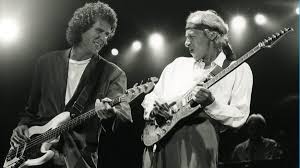
My first real concert was the On Every Street tour in 1991.
The band was Dire Straits, the venue was Pullman, Washington, and the company was the usual Spokane crew: Seth, Innes, Kelly.
I was the biggest fan in the car by far. The others liked the band well enough but I was the one who had studied the records, who knew the guitar parts, who was ready for the moment when the lights dropped and the first notes hit the arena. This was the On Every Street tour, which turned out to be their final record.
They played everything: Money for Nothing, Walk of Life, Sultans of Swing. It was a great show, and one of their last before retirement, though at the time I had no real way to judge such things. It was simply enormous — lights, volume, spectacle. I bought the black and blue tour shirt and wore it for five years.
At the time I thought concerts were supposed to be like that: huge, polished, and far away.
I would later learn otherwise.
II. Revelation
Several years later, during the Hamilton years, I saw Red House Painters at the Middle East in Cambridge.
I went with Ian. The room was small, maybe a few hundred people at most. Nothing about it resembled the arena in Pullman. And then, near the end of the set, Mark Kozelek began playing “Little Drummer Boy.” It lasted nine minutes. You could hear a pin drop in the room.
No spectacle. No lights. Just absolute concentration from everyone present. When the final notes faded the silence lingered for a moment before the applause came.
Afterward Ian and I drove back toward New York through the cold night with the windows cracked open, heaters flying out into the darkness, and Hell’s Ditch blasting through the car stereo to keep us awake.
That was the night I realized concerts could be something else entirely.
III. Chaos
Not every show produces reverence.
I once saw The Fall with Ian as well. The band’s leader, Mark E. Smith, seemed to be operating in his traditional mode of total hostility. The set was short — twenty-eight minutes by my estimate. Ian later checked the official record and insisted it was forty-three. Either way it felt brief and volatile. Smith barked into the microphone, glared at the band, and treated the entire enterprise with the air of someone barely tolerating the existence of the audience.
Which, to be fair, was exactly what many people had come to see.
IV. Theatre
The strangest performance I ever witnessed may have been Cat Power at Club Quattro in Osaka.
The evening began badly. An opening act — a woman in what appeared to be a fairy costume — sat at the piano and played for what felt like an eternity. Forty-five minutes at least. Perhaps longer. By the end of it the audience was openly confused.
Then Cat Power appeared.
Or rather she refused to appear in the conventional sense. Instead of remaining on the stage she wandered through the venue with a handheld microphone, singing and rapping while walking amongst the crowd, occasionally placing an arm around a patron or leaning against the bar.
At one point she came right up to where I was standing near the back rail and sang a line or two before drifting off again into the room.
The entire show felt less like a concert than a piece of improvised theatre.
V. Ritual
A few years later I saw Damo Suzuki at Club Metro in Kyoto. Damo had once fronted the legendary German band CAN, but this night bore no resemblance to those recordings. Nothing recognizable from the catalog appeared. And here he stood, just a few feet away from the audience with long black-and-grey hair flowing, bellowing and chanting over a constantly shifting improvisational band.
It was less a performance than a ritual.
Damo passed away not long ago. RIP and prayers up. I’m grateful I saw him when I did.
VI. Canada Night
Not all memorable shows are mystical.
Sometimes they’re simply loud.
One such evening occurred at Club Quattro in Osaka when Broken Social Scene and Death From Above 1979 came through town.
The Canadian ambassador was present and delivered a brief speech before the set explaining that Death From Above 1979 represented a fine example of Canadian enterprise because they were “only two men making so much noise.”
The room was packed with Canadian expats and the atmosphere was celebratory chaos. The ambassador was probably correct.
VII. Breakdown
Not every concert goes well.
I once saw Bonnie ‘Prince’ Billy at the small Kyoto venue Taku Taku. Something had clearly gone wrong with the lineup. The guitarist appeared to be brand new and could barely navigate the chords.
Will Oldham tried to push through but quickly grew frustrated and began openly calling the guitarist out from the stage. It was uncomfortable for everyone involved.
The show never recovered.
VIII. Redemption
Fortunately the story has a better ending.
Some years later I saw Bonnie “Prince” Billy again, this time at the beautiful Kyoto venue Urbanguild and everything worked great. Low benches and tables filled the room, Heartland beer bottles glowed green under the lights, and the band played a relaxed, confident set drawn mostly from the Bonnie “Prince” Billy catalog with a few Palace songs mixed in.
Opening the evening was an instrumental group called Bitchin Bajas whose sound reminded me faintly of early Phosphorescent if Phosphorescent had chosen to make instrumental records. After the show I found myself talking with three members of the band while they drank beer and ate fries. They were humble, friendly, and slightly surprised that anyone in Kyoto knew who they were. We talked for a while about touring and the constant challenge of trying to make a living as working musicians. Eventually the conversation drifted off and the room began to empty.
The music was over. The musicians were just people again, finishing their drinks and preparing to move on to the next city. And that, in the end, may be the most interesting encounter of all
Dedication
For live music fans everywhere. My true people. I love you baby.
Note: If you enjoyed this essay, you may also enjoy the essay below on the four time I met Yo La Tengo. Happy reading!
 The Kyoto Kibbitzer