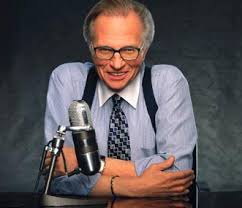
On Larry King, the Radio GOAT

Epigraph:

“I listened to the radio / I waited all night long…”
— Radio Radio, Elvis Costello

Note: This piece reflects my personal memories of listening to Larry King’s overnight radio show in the late 1980s and early 1990s, along with later impressions from television appearances, interviews, and conversations with people who knew him. It is written in the spirit of appreciation and nostalgia rather than media criticism, and emphasizes the uniquely loose, humane, and unpredictable quality of King’s radio work, which for me remains the defining core of his legacy.

I grew up listening to Larry King’s overnight radio show between roughly 1988 and 1992, and in my opinion — which happens to be correct — the radio show was much better than the television version that later made him famous. The TV show was good, even great at times, but radio was longer, looser, freer, and far more unpredictable. It had weird guests, weirder callers, and the feeling that anything might happen at two in the morning. That’s where Larry really lived.

I would listen in my bedroom at my parents’ house in Spokane, Washington, the volume turned low, the house quiet, insomnia hovering. The Spokane AM station — KGA 1510 — carried the show from around 9 PM Pacific time, and then, wonderfully, they would run it again. So I’d listen from nine to midnight, fade, wake at two or three, and hear the same segment again in a half-dream. The effect was surreal. Didn’t I just hear that caller? Didn’t Larry just say that? It created a strange loop of late-night déjà vu that only made the whole thing more atmospheric. The show felt less like programming and more like a continuous nocturnal conversation.

My friend Kelly Rudd loved Larry too. When we were in high school we were both big fans of the radio show, and we talked about it constantly. There were a couple of things that we especially liked. The first was that Larry famously did no preparation. He knew a huge amount about the world, of course, but he didn’t read guests’ books ahead of time. He wanted to come in cold. If his guest was a firefighter, he’d ask, “So what’s it like to be a firefighter?” It sounds lazy, but it was brilliant. By staying open and getting out of the way, he let the conversation go anywhere. This way the show became eventful.

Another thing we loved was what happened after the guest left. Larry would open the lines and take questions about absolutely anything. Most of the time he was generous and patient, but when callers went off the rails he had a signature phrase. He’d cut them off gently: “Cold compress, ma’am,” or “Cold compress, sir.” Basically: lie down, ice your head, regroup. It was hysterical, especially because he used it sparingly. When “cold compress” dropped, you knew things had gotten weird.

Anyway, Kelly and I loved Larry so much that when the station suddenly dropped the show, Kelly proposed we drive to the radio station and protest. So we skipped school, drove across town, and rang the intercom demanding to speak to someone about the cancellation. The station manager eventually came down and heard us out. We knew we weren’t changing anything, but it felt right to try. Larry never came back to Spokane radio, and the show faded not long after, but the whole episode captured what the show meant to us. It wasn’t just background noise. It felt alive.

Larry’s on-air style was the key. He was unbelievably relaxed. By the late ’80s you could tell he had done thousands of hours. Nothing fazed him. Weird guests, drunk callers, eccentrics — all the same to Larry. He absorbed everything. He had pet phrases — “cold compress” chief among them — and he deployed them like a veteran reliever, only when needed. He famously did no prep, and he leaned into naïve questions. He’d ask something simple and let the guest do the work. The effect was disarming. People opened up. He also had real humanity. He listened. He didn’t mock callers. He didn’t rush them. There was compassion there, and I think that’s what I loved most.

And the show could get wonderfully out of control. In one story Larry told from his old Miami days, an adult actress he was interviewing suggested they just have sex during the commercial break. Larry, amused, asked the producers to clear out — but there wasn’t enough time. That kind of anecdote captures the looseness of late-night radio. It wasn’t polished. It was alive.

Larry left the overnight Mutual Radio show in 1994 to focus on television. By then I had already drifted away, but I still caught Larry King Live on CNN over the years. I remember watching during the O. J. Simpson trial while at Otago University in New Zealand, when the show became part of the nightly noise. Later there were the Vladimir Putin interviews — classic Larry, conversational and oddly disarming. And of course there were the great comic moments, like the interview with Jerry Seinfeld where Larry suggested the show had been canceled and Seinfeld snapped back in disbelief, and the Norm Macdonald appearance where Norm kept repeating, “I’m a deeply closeted homosexual,” and Larry tried earnestly to parse it. “So that means you’re gay?” “No, Larry,” Norm replied, “it means I’m deeply closeted.” Pure Larry: sincere confusion meeting absurdist comedy.

Larry’s personal life was famously complicated. He married eight times, had several children — including sons Chance and Cannon later in life — and lived in a kind of perpetual romantic improvisation. The marriages came and went. The last ended painfully and publicly. He once joked he’d never leave his wife unless Angie Dickinson came along — and when she did, he married her. That was Larry: impulsive, affectionate, slightly chaotic. Despite decades of success, he didn’t leave the kind of massive fortune people assumed. The money came and went, as did the marriages. It was a life lived in motion.

My friend Sergio Mandiola actually knew Larry in his later years in Los Angeles. Sergio was running an independent studies program at Beverly Hills High School, and Larry’s sons Cannon and Chance, and he taught his sons for three years. Larry would come by for open nights or just to chat.

Sergio Mandiola: “Larry would come in from time to time and we would talk. He was lovely and open. He talked about his family and his career. One time he told me, ‘Sergio, you should totally have a radio show!’ I was flattered. One thing about Larry is his politics were more to the left than he let on on air. He had strong views and wasn’t afraid to share them in person. Larry was a true mensch and I’m glad I got to spend time with him. I miss him.”

In the end, I’ll say it plainly: for me, Larry King is the radio GOAT. There was no one like him, and there probably never will be. It wasn’t just longevity. It was the curiosity, the looseness, the humanity, the love of people, politics, baseball, and life. He trusted the conversation. He let the night unfold.

And then there was that absurd, wonderful USA Today column, which read like a diary gone completely outta control. Mets lose 6–4…Rain in Baltimore…Clinton flies to Ireland…You’d read it and think, Larry, baby, WTF is this? And also, Mr. USA Today, WTAF are you doing paying for this? But somehow it worked. It was pure Larry — fragmentary, observational, intimate.

And that’s how I remember him most clearly: late nights in high school, the radio turned low, insomnia hanging in the room, Spokane quiet outside.. Sometimes I’d listen from nine to midnight, fade, then wake again to the rerun, half-dreaming, half-aware, caught in that strange déjà vu — didn’t I just hear this? — while Larry kept talking, calm as ever, taking calls from truckers and insomniacs and eccentrics. My listening years were brief, but they stuck. And when I think of Larry now, that’s where I go back to: the low hum of AM radio, the half-fade, and the sweet sounds of his voice in my ear.

Dedication:

For the one and only GOAT, Larry Motherfucking King. RIP baby.

On it, Pete

Note: Some stories get better in the telling. This one doesn’t need to. It arrives fully formed—one line, perfectly placed—and has stayed that way ever since. I’ve told it for years and it still lands exactly the same. No embellishment required.

It’s September, 1989.

Two new teachers had just arrived at St. George’s School in Spokane, WA. These are Paul Hogan and Pete Aiken. Paul would go on to have a long and distinguished career, eventually becoming Principal of Jesuit High School in Portland—a major job, the kind that makes a life. I have no idea where Pete is today.

That night, my dad Ross invited them over to the house for dinner. It was one of those late-summer evenings that still carried a little warmth but hinted at the coming turn. Ross was out back at the grill, working over the barbecue with a beer in hand. The adults clustered nearby, talking, drinking, getting to know the new arrivals. There was that particular tone of adult conversation—half-professional, half-social, everyone just slightly aware of roles and impressions.

Out in the yard, it was just the three of us: Pat, Mike, and me. We were playing catch with a tennis ball. Nothing serious. Just throwing it around, loose, casual, the way kids do when the game isn’t really the point. At some point, either Mike or I made a bad throw. It sailed wide of Pat—too far, too high—and rolled past him.

A completely ordinary moment. The kind of thing that happens a hundred times in a backyard, in a summer, in a childhood.

Pat was six. He didn’t chase the ball. He didn’t complain. He didn’t turn to us. Instead, he turned—calmly, deliberately—and looked over at Pete Aiken, one of the brand-new teachers, a guest in our home, a man he had just met. And in a tone of quiet assurance, as if assigning responsibility in a meeting, he just said:

“On it, Pete.”

That was it. No smile. No wink. No awareness of what had just happened. The ball was recovered. The game went on. The adults kept talking. The evening continued. But something had shifted, just slightly, just enough.

Because in that moment, a six-year-old child had somehow crossed the boundary between worlds—between kids and adults, between play and work—and issued a line that did not belong to him, but fit him perfectly.

I don’t remember what happened next. I only remember that line. And I remember that we have been laughing about it ever since.


The On It Pete Blues (Pete’s POV)

I was new to the city, new shirt, new street,

Standing in a backyard trying hard to be discreet,

Ross on the grill and the talk running deep,

Just another first night—then I heard, “On it, Pete.”

I hadn’t been briefed, hadn’t learned the terrain,

Didn’t know the house or the shape of the game,

Just a beer in my hand, trying not to overreach,

Then a six-year-old turned and delegated to Pete.

Now I’ve worked in schools, I’ve handled my share,

Rooms full of noise, moments needing repair,

But nothing quite like that clean little feat—

Being calmly assigned by a kid in bare feet.

No panic, no pause, no doubt in his beat,

Just a glance and a nod—“On it, Pete.”

And the ball got found, and the night rolled on,

But I knew right then something strange had gone on—

In a yard full of voices, one line cut through the heat:

I wasn’t just visiting.

I was on it.

Pete.

Dedication:

For my brother Pat. And for Pete. Just get on it already baby.

Note: If you liked this story you may also like the stories below, which also cover my time at St. George’s High School.

On Julian Jaynes and the Origins of Consciousness: A Modern Look

Note: This essay is a reflection on the ideas of Julian Jaynes and his remarkable 1976 book The Origin of Consciousness in the Breakdown of the Bicameral Mind. Jaynes’ theory—that human beings once experienced divine voices guiding their actions before the emergence of modern introspective consciousness—remains controversial and widely debated. The purpose of this essay is not to prove or disprove Jaynes’ neurological model but to explore the enduring power of the questions he raised.

In particular, I am interested in two aspects of Jaynes’ work that remain deeply suggestive: his interpretation of early literature such as the Iliad, where modern psychological interiority appears strangely absent, and his observations about how mobility—travelers, shepherds, merchants, and wanderers moving between cultures—may have destabilized older systems of divine authority. These figures, operating in uncertain cultural terrain, may have been among the first people forced into the improvisational reasoning that resembles modern consciousness.

The essay also touches on institutions like the Oracle of Delphi and on the persistence of voice phenomena in modern contexts, ranging from hypnagogic states and exhaustion to more troubling historical cases such as the assassination of Robert F. Kennedy by Sirhan Sirhan. These examples are not presented as proof of Jaynes’ theory but as reminders that the boundary between internal thought and perceived external command may be more complex than we sometimes assume.

Finally, the brief personal anecdote involving an MRI scan is included not as evidence but as illustration: a small modern echo of the ambiguous mental territory Jaynes explored. Moments in which voices seem to arise from somewhere between the inner and outer mind remain part of human experience.

Whether Jaynes was ultimately correct in his sweeping historical claims is still an open question. But his work continues to provoke a fascinating possibility: that consciousness itself has a history, and that the modern reflective self emerged gradually out of older forms of human experience.

If nothing else, Jaynes reminds us that the human mind is not a finished structure. It is something still unfolding—shaped by culture, language, movement, and time.

“She keeps coming closer saying I can feel it in my bones
Schizophrenia is taking me home.”
— Sonic Youth


There are certain books that never quite disappear. They do not settle comfortably into the academic canon, nor are they fully dismissed. They linger. They circulate quietly among curious readers, occasionally resurfacing in conversation decades after publication, as if waiting for another generation to discover them.

One such book is The Origin of Consciousness in the Breakdown of the Bicameral Mind.

Its author, Julian Jaynes, was a psychologist who spent much of his career outside the central institutions of modern neuroscience. When the book appeared in 1976 it created an immediate sensation. Reviewers alternately described it as brilliant, bizarre, visionary, or simply impossible. The theory it proposed was breathtaking in scope. Jaynes suggested that the subjective, introspective consciousness modern people take for granted—the inner sense of “I,” the reflective voice narrating our own thoughts—was not an ancient human constant. It had emerged, he argued, only a few thousand years ago.

According to Jaynes, the minds of early civilizations functioned differently. People did not experience themselves as the authors of their own decisions. Instead they heard the voices of gods.

Not metaphorically. Literally.

Commands issued in auditory form—voices that appeared to come from outside the self—guided action. These voices, Jaynes argued, were generated by one hemisphere of the brain and experienced by the other as divine instruction. He called this earlier mentality the bicameral mind.

The theory has never been accepted in its full neurological form. Archaeologists, classicists, and neuroscientists have raised serious objections. And yet the book continues to circulate, discussed by philosophers, psychologists, historians of religion, and the occasional curious reader who stumbles across it in a used bookstore or late-night internet search.

Why?

Part of the answer is simple: Jaynes was asking a question that remains deeply unsettling.

What if human consciousness has a history?

What if the inner voice we experience as our own—our private mental narrator—was not always there?

I first encountered Jaynes sometime around 2012 or 2013, during a period when I was reading deeply in the work of Carl Jung and writing a small series of reflections that I called Jungian Intimations. Like many readers drawn to Jung, I was interested in symbolism, archetypes, and the strange persistence of mythic imagery in the modern psyche. I briefly considered enrolling in an online course with the Jungian analyst Michael Conforti, though in the end I took a class from his wife, Nancy Qualls-Corbett, on Jung and visual art. Around that time I read the slim but remarkable volume Jung on Art, which argues that artistic creation often emerges when archetypal material pushes through the individual psyche into symbolic form.

Jaynes appeared in my reading not long afterward. At first glance he seemed to be asking a related but far more radical question. Jung had treated mythic figures as symbolic expressions of the psyche. Jaynes suggested that the gods of ancient literature might once have been experienced as genuine voices—psychological events interpreted as divine command.

Whether or not one ultimately accepts his neurological model, Jaynes assembled a body of evidence that continues to provoke thought. In particular, he pointed to a striking feature of early literature. Characters in ancient texts often act without the kind of introspective self-reflection modern readers expect. Decisions appear suddenly, attributed not to inner deliberation but to divine intervention.

Nowhere is this more visible than in the world of the Iliad. When Achilles restrains himself from killing Agamemnon, it is not because he pauses to analyze his emotions. Athena appears beside him and tells him what to do. The boundary between divine command and human action is porous.

Jaynes argued that such passages were not merely literary conventions but traces of an earlier mentality.

Yet perhaps the most fascinating part of his theory lies elsewhere—in the margins of ancient societies, among the people least anchored to a single cultural world.

The wanderers.


Ancient civilizations were more mobile than we sometimes imagine. Even in the Bronze Age there were shepherds drifting across borderlands, merchants following caravan routes between cities, sailors moving from port to port across the Mediterranean and Near East. These figures lived at the edges of cultural systems that otherwise depended on stability and hierarchy.

For Jaynes, such wanderers may have played an unexpected role in the transformation of the human mind.

The bicameral system, as he described it, functioned best within tightly structured societies. Authority flowed downward through clear hierarchies: gods to kings, kings to priests, priests to ordinary people. Ritual, language, and shared myth reinforced the system. The divine voices guiding behavior were embedded within a familiar cultural environment.

But travelers moved beyond those environments.

A shepherd leaving his village might cross into territory where different gods were worshipped. A merchant arriving in a foreign city encountered unfamiliar laws, languages, and customs. A sailor might spend months among people whose rituals and social expectations bore little resemblance to those of home.

In such situations the guiding voices of one’s own culture could become unreliable.

If a divine command urged action in a place where the surrounding society operated under entirely different assumptions, the voice might cease to function as a stable guide. The traveler found himself in a new psychological situation—cut loose from the authority structures that had previously organized experience.

This was not a comfortable position.

To survive, wanderers had to develop different skills. They had to negotiate, observe, and interpret. They had to learn foreign languages and read unfamiliar social signals. They had to improvise.

In other words, they had to think.

Jaynes speculated that these mobile figures—shepherds, traders, sailors—may have been among the first people forced into something like modern reflective consciousness. The birthplaces of that consciousness may not have been temples or palaces but the messy contact zones of ancient trade: caravan routes crossing deserts, harbor towns where languages mingled, frontier markets where strangers bargained with one another under uncertain rules.

If the bicameral system required cultural enclosure to function, then mobility threatened its stability.

And the ancient world was becoming increasingly mobile.


Even as this transformation unfolded, remnants of the earlier mentality persisted in institutional form.

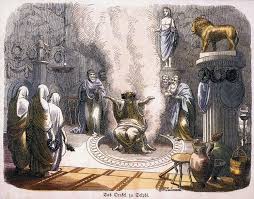
One of the most famous examples was the Oracle of Delphi. For centuries Greek leaders traveled to Delphi seeking divine guidance on matters of war, colonization, and political decision-making. The oracle’s pronouncements—often delivered in trance-like states by the Pythia—were treated as authoritative messages from the god Apollo.

From a Jaynesian perspective, institutions like Delphi may represent cultural technologies designed to preserve the authority of divine voices even as the underlying psychological system weakened. Kings and city-states continued to seek guidance from gods because the tradition of divine command remained embedded in social life.

Gradually, however, new forms of decision-making emerged.

Written law codes appeared. Philosophical reflection developed. Greek drama explored the tensions between divine authority and human responsibility. The shift was not sudden or uniform, but over time a new psychological landscape became visible—one in which individuals increasingly experienced themselves as authors of their own thoughts.

This transition was not simply intellectual. It may have been neurological, cultural, linguistic, and historical all at once.

Jaynes placed the decisive phase of the transformation during the turmoil of the late Bronze Age collapse, roughly between 1200 and 800 BCE—a period when many ancient societies experienced widespread disruption. Cities were destroyed, trade networks collapsed, and populations migrated. In the midst of this upheaval, older forms of authority may have faltered, forcing new modes of self-organization to emerge.

Whether or not Jaynes correctly identified the precise mechanism, he was surely right about one thing: consciousness as we experience it today may not be a timeless given.

It may be an achievement—fragile, historically contingent, and still evolving.


Yet if the bicameral mind truly vanished, one might expect the phenomenon of hearing commanding voices to disappear entirely from modern experience.

It has not.

Under certain conditions, people still report experiences remarkably similar to those Jaynes described. In states of extreme exhaustion, during moments of sensory deprivation, or in the liminal territory between waking and sleep, voices sometimes appear that are difficult to classify as either internal or external.

I had an experience of this kind several years ago while undergoing an MRI scan in a hospital.

Anyone who has had an MRI knows the strange psychological environment it creates. You lie alone inside a narrow tube, immobilized, while the machine produces a sequence of loud mechanical pulses and vibrations. The noise is rhythmic and relentless. There is little sensory input beyond the sound and the awareness of one’s own breathing.

Somewhere in the midst of that experience, a voice appeared.

It was not loud or dramatic. It was simply there—a calm male voice with the unmistakable tone of a father speaking to a child. The message itself was simple, almost reassuring. But what struck me most was the ambiguity of the experience. The voice did not feel exactly like a thought, yet it did not feel entirely external either. It occupied a strange borderland between inner and outer perception.

The moment passed quickly, but the memory lingered.

Experiences of this sort are not uncommon. Psychologists studying hypnagogic states—the transitional zone between waking and sleep—have documented similar phenomena. Auditory hallucinations appear in certain psychiatric conditions, most famously schizophrenia. Hypnotic suggestion can also produce experiences in which subjects perceive commands or messages that seem to originate outside their conscious control.

Jaynes believed such phenomena represented vestiges of the older bicameral mentality.

The voices of the gods, in his view, had not entirely vanished. They had simply retreated to the margins of modern consciousness.


Occasionally these phenomena intersect with darker episodes of modern history.

The assassination of Robert F. Kennedy by Sirhan Sirhan remains one of the most disturbing cases often discussed in connection with hypnosis and altered states of consciousness. Some researchers have argued that Sirhan may have been unusually susceptible to hypnotic suggestion, raising unsettling questions about the relationship between external influence and voluntary action.

It would be irresponsible to claim that Jaynes’ theory explains such events. Human behavior is far too complex for any single model to capture fully. Yet cases like Sirhan’s remind us that the boundary between autonomous decision and externally shaped impulse is not always as clear as modern assumptions suggest.

The mind remains a mysterious territory.


Half a century after its publication, The Origin of Consciousness in the Breakdown of the Bicameral Mind continues to provoke debate not because it solved the problem of consciousness but because it reframed it. Jaynes forced readers to confront the possibility that the human mind has undergone profound historical transformations.

Even if the details of his neurological model prove incorrect, the broader insight may endure. Literature, religion, and psychology all suggest that the experience of selfhood has changed over time. The ancient world did not necessarily perceive the mind in the same way we do.

Something was gained in the transition to modern consciousness.

We gained introspection, philosophical reflection, and the capacity to examine our own motives. We gained the intellectual freedom that made science, democracy, and modern literature possible.

But something may also have been lost.

In the world Jaynes described, human beings lived in a landscape animated by voices of divine authority. Decisions arrived not through anxious deliberation but through commands experienced as sacred guidance. That world may have been more constrained, but it may also have felt more certain.

Modern consciousness offers freedom, but it also brings doubt and solitude. The voices of the gods have largely fallen silent, replaced by the quieter and often less confident voice we call our own.

Perhaps the most we can say is that consciousness, like culture itself, continues to evolve. The wanderers of ancient caravan routes helped shape the first emergence of reflective thought. Today we inhabit a global world of constant movement, translation, and negotiation—a world not entirely unlike those early contact zones where cultures once collided.

We are all wanderers now.

And somewhere, perhaps, the faint echoes of older voices still remain.


For dreamers and wanderers everywhere.

Keeganisms in the Wild: An Exploration

New Note: I’m republishing Keeganisms for colleagues and friends in the IB world. The piece grew out of my early years in international education, when I was trying to understand not just what we teach, but how adults actually grow, change, and make meaning inside institutions.

Readers interested in my time working at Ritsumeikan Uji and for the IB may also enjoy this piece on great and good talkers, and this one, a tougher piece, on being badly overworked in 2012.

This piece remains one of the clearest statements I’ve written about adult development, leadership, and the limits—and possibilities—of institutional life.

Finally, I am happy to report that the great Stephen Keegan is alive and well. Rock on, sir.

Note: This piece is a re-write of my very first piece of linguistic ethnography. For a fuller explanation of linguistic ethnography check out On “Dude” Usage. A “Keeganism” here is simply a notable phrase used by the former head of the IB Diploma Program for Asia-Pacific Stephen Keegan. Keegan was based out of the Singapore office, which was at the time one of three “hub” offices around the world.

Although fitting in with my other efforts at linguistic ethnography, in this piece I approach Keeganisms as if they are a rare species, like a certain kind of elusive salamander or something. If this little conceit if effective, as it hope it is, this is only because the Keeganisms under investigation are themselves so glorious.

Introduction:

When Stephen Keegan spoke, dozens listened. I was one of them. Darwin sailed around on the Beagle, ran across some turtles in the Galapagos, and his investigation of all that changed the world. While I don’t pretend that my little survey of Keeganisms will change the world, I would not be able to forgive myself if the species was simply lost to time.

Keeganisms were known to flourish between the years 2008-2013, in and around the greater Pacific Rim. Without being able to definitively establish the evolutionary arc of the species, naturalists suspect an increasingly florid progression over the years. For my own part, I was marginally aware of the species in 2008-2009, but did not realize the bounty that Keeganisms provided the scientific community until 2010. What follows is an analysis of some of the most common variants of the species as I was able to observe. All of these instances were found at IB events where Keegan was speaking in public.

Keeganism #1:

Here is Keegen in 2010 describing what the IB provides to its schools in the way of services: “We are not special. I mean, of course we are unique and special in many ways.”

Keegan is making the point that there is a consistency across high quality high school curricula and programs, and that the IB is not somehow in a wholly different category. The first sentence, “we are not special” is a bald statement to this effect. Keegan immediately realizes, however, that this is possibly an infelicitous soundbite, and qualifies with a politician’s cover “I mean, of course we are unique and special in many ways.”

Why is it a Keeganism? The classic form common to the first type of a true Keeganisms can be expressed as (A+D=A>D) where A (Affirmation)=a statement that shows an aspect of Keegan’s actual feelings or opinions about a given matter, and D (Denial)=a qualification which serves to qualify and reduce the sting of the truth-telling in A, but which does not fully counterbalance or neutralize the sentiment of A, thus A>D.

In this case, “I mean, of course we are unique and special in many ways,” gets Keegan off the hook for his heresy, however it is rather obviously a cliched cover (although one does appreciate the “in many ways.”) From a formal point of view, then, this is a classic Keeganism, perhaps the prototype; from a content point of view we can find better.

Keeganism #2:

And we did find better later that year or the next at a meeting of East Asian IB Diploma Coordinators. Here, Keegan is commenting on one of two commercially available software products which were competing for market share for IB schools at that time. “I am not promoting their product. I am promoting the concept of their product (….) They are the future. Of course the future will take many forms.

In this case Keegan has an opinion about which product if preferable, however in his capacity as an IB employee he cannot state this outright. Instead, he gives an extended tribute to one of the competing companies before making clear that he is “not promoting their product.” Likewise, when he catches himself saying that their product “is the future,” he hastens to make sure we understand that multivalent nature of said future. Thus, he is again “covered.”

“I am not promoting their product. I am promoting the concept of their product” is actually a structural reversal of the classic Keeganism, which reappears in “they are the future. Of course the future will take many forms.” In the first, Keegan’s true opinion comes second, the denial first. Matters are further complicated by the introduction of the word “concept.” While it may be the case that a concept at times can be a free floating entity, in this case Keegan’s semantic distinction is taken, as it is probably intended, with a large measure of salt. Thus again a key feature of the species–the “denial” is consistently underweighted as compared to the affirmation: D+A=D<A.

With Keegan’s statement about the future, the classic structure is back, with a twist. The sentence “of course the future will take many forms” is so nebulous, so frankly metaphysical in its lineaments, that it verges on absurdity. It is also highly arguable, as while it may be true that the characteristics of the future will vary from place to place, it is at least possible to argue that the future will take precisely the form it takes: not a plurality of forms, but exactly one. Of more direct relevance is the point that if the future will take many forms, and in only one of those forms are “they” that future, then why are they “the future” at all? Of course, this is precisely the genius of this particular Keeganism; the “denial” is so slippery that is dissolves almost entirely, assuming instead a purely formal aspect (f). A+D=A(f).

Keeganism #3:

Not all Keeganisms have such an overt affirmation/ denial or denial/ affirmation structure, however. Others slip their denial/ qualification into the body of the affirmation itself. For example: “This alternative is being described as a valid reliable assessment.”

This Keeganism came at an IB conference for the Asian region, Keegan is describing highly contentious changes to the IB Visual Arts curriculum, which at the time the IB was defending against continued protests from art teachers (a fractious bunch when agitated it turns out). An advanced degree in communication theory is not required in order to parse this Keeganism; simply put the addition of “is being described as” shifts the locus of affirmation to some distant body doing the describing and away from Keegan, who is instead stating an unimpeachable fact–somebody somewhere is describing the assessment as reliable. Nonetheless, Keegan is not entirely distancing himself from the affirmation. In fact, there is no counter-affirmation present here, simply a qualification that insulates Keegan from a bald statement of validity and reliability.

Keeganism #4:

Here is Keegan at his final public appearance in Japan before his resignation: “We are delighted to be part of a global organization with global requirements.

With this one, structurally we are in similar territory, but the valence differs. Keegan is describing some recent “rationalization” of IB services around the world, a change which would reduce some of the autonomy of the Asia Pacific regional office. In fact over the next few years the IB Asia Pacific office, and all of the “hub” offices, would be downgraded from essentially autonomous power centers with a Head of Office of their own to simply branches of the global organization with no clearly assigned leadership of their own. The acute listener will understand that Keegan’s loyalty is more to the region than the global organization; with some justice he feels that Asia-Pacific is the model region. This point has to be borne in mind when approaching this particular Keeganism.

On the face of it this is a fairly simple piece of sarcasm directed at the global infrastructure. However, there are a few complicating factors. First, Keegan uses the plural pronoun–thereby implicating his fellow presenter, and, perhaps, his entire regional office. Of course, the singular here would be far too “on the nose”; still, the “we” puts his colleagues in an interesting position. Second, the repetition of “global” here confers the style we have come to expect from a true Keeganism. Third, there is perhaps more ambiguity here than we might as first suspect. Keegan actually does understand the drive to standardize the regions and the need for global requirements, and he can explain this need in unironic terms. One suspects that an aspect of heart versus head is present here as well. In practice, however, on the communication front lines, Keegan has difficulty standing fully behind the ramifications of certain of these global requirements.

Here is where it gets tricky–the affection with which Keegan was held around the region was in large part a result of his ability to walk a very fine line between representing his employer and representing the region, its Diploma Coordinators, and its Heads of School. In order to sustain this somewhat ambiguous position, Keegan had to be able to ironize, even ridicule, the larger organization. However, were he to cross too far into irony or counter-statements he would risk losing credibility even as he gained affection. Keegan was aware of the bend of this curve, which is why his most overtly heretical affirmations were always immediately qualified. In essence, Keegan was excellent at “triangulating,” and in so doing, it could be argued, simply doing his job.

Keeganism(s) #5:

Then there are a set of statements that fit neither of the above types, but nonetheless qualify as Keeganisms on account of their peculiar word choice/ structure. As the following examples were all taken from a single presentation, one suspects that this category was in fact pretty capacious. Naturalists to this day do not entirely agree as to what counts as a true Keeganism, and there will always be a certain degree of controversy on this point. Here are a couple of examples of these disputed Keeganisms (IB Answers was a kind of help center which would answer stakeholders questions online or by phone):

“Will we be absolutely consistent in absolutely all areas? Absolutely not.”

“IB Answers has provided some answers. They specialize in answers, so it was easy to do.”

First, these enter the realm of possible Keeganisms on account of the repetition of a keyword across sentences. In the first instance, we can imagine the a more normal construction (e.g. a non-Keeganism): “Will we be absolutely consistent in all areas? Probably not.” The meaning here would be similar, however, the addition of the second “absolutely” moves us away from a mere admission of occasional inconsistency to something closer to a statement of purpose. Keegan is not simply stating that inconsistency will occur, he is celebrating it. I believe this to be a Keeganism.

As for the second, one has the suspicion that it may be a standard line, or at least to be making a repeat appearance. A minor area of controversy, of whispered side conversations among modern linguists, is to what extent all Keeganisms are original to their moment. While we have not in fact been able to prove the charge, a line like “they specialize in answers” does raise the antenna of the more conspiratorially minded among us.

Keeganism #6:

Here is Keegan again on IB Answers, which sometimes struggled to get their story straight: “You really have to have more effective answers. It’s a world that really has to be refined.”

The beauty of this Keeganism once again lies in the details. Were we to hear: “You really have to have more effective answers. It’s a process that really has to be refined,” this would account for nothing more than an honest admission of an area of the IB infrastructure that bears improvement. For anyone who knows Keegan, it would be completely unremarkable, as the steps by which an answer is generated through IB Answers are easily imagined as a process. But is IB Answers a “world”? One thinks of Tolkien, of the Wizard of Oz, of the books of Tintin–these are “worlds.” The construction is so odd, so specific, so suggestive of depths and complications unimagined and unimaginable to the listener, that we are swept up in the possibilities, and are once again in the presence of a genuine Keeganism.

Keeganism(s) #7:

“Global PD really has moved in a different way.”

“There is so much happening of a very intriguing nature around the world.”

In this final type of Keeganism we have the apparent qualifier which, under closer examination, turns out to be essentially contentless. After remaking on some recent changes to the IB’s professional development (PD) structure, Keegan’s “global PD really has moved in a different way” is possibly a compliment; however, the use of “different,” instead of any one of a large number of possible alternatives, “better,” “more effective,” “preferable,” etc., so obviously leaves the whole question open that we recognize a stealthy, if minor Keeganism. It is almost as if Keegan, so accustomed to hedging and jousting with language, finds himself here incapable of giving forth a bald, uninflected, statement of praise. From contextual clues we may be able to glean which way Keegan is leaning; on the face of it the sentence could mean absolutely anything.

As for, “there is so much happening of a very intriguing nature around the world,” but of course there is. There is so very much happening that we might almost be tempted to conclude that the future will take many forms.

Dedication: For Steve, thank you for your service.

On Staying in Business Hotels (Featuring a Little 9-ball)

A hotel room: the same cell in a different city — clean towels, a window, and the sense of being contained but cared for

Mark Sandman, refracted

A haunted hotel room, unblessed, charged with static; objects shifting on their own.

The Church, refracted

New Note: On the kibbitzer (two b’s there Mr. Auto-Correct baby), I am re-printing certain select pieces for a little while while I work on another writing project. Today I am re-printing this piece on hotels. This piece has gone through several iterations over time, it is in fact probably my most heavily edited piece, and concerns the experience of staying at business hotels. In a way this is perhaps my very best piece in that it is one of only three that survive from my first blog Classical Sympathies, which I started in 2008, right around the time I began working to build the IB Course at our school. Of course given later (and earlier) events, this was no coincidence. Essentially, the blogs were, for lack of a better phrase “trauma blogs,” or, to put it more positively, recovery blogs. I like that–let’s stick with it. So this piece was about finding safety, physical and psychological, in a hotel room, while at the same time knowing, paradoxically, that hotels, especially fancy ones, are sometimes, or even often, the target of violence for various reasons.

Note: I have stayed in a number of such hotels over the years and engaged deeply with the room-space in each case. At this point, I am prepared to say that I am “good at” staying in hotels (an absurd claim that I advance nonetheless), and feel authorized to advance some notes toward a general hotel theory. Facility as a hotel guest though not exactly a marketable skill, has yielded some insights about the general, perhaps archetypal, nature of the modern hotel stay. Despite at this point considerable experience in the field, I continue to find the hotel experience at once comforting and bizarre, and hotel rooms, when properly apportioned, womb-like and exercising a specific and fascinating gravity. Also, the first draft of this piece was completed when Larry King was still alive.

This piece also mentions my “fugue state,” and it is true that as a PTSD response to childhood sexual abuse I would sometimes, more than once for sure, slip into a kind of state of taking automatic actions which I recall, but only somewhat. During these states I would arrange and re-arrange the room, the things in my bag, etc. in a way to place little reminders to myself in the future. It is a little hard to explain, however once again psychologically literate folks will follow along.

Finally, in my opinion, this is a pretty funny piece. Not as funny as Mason Anderson but still not bad. And it advances the absurd, yet still somehow defensible, position that I am “good at” staying in hotels. I hope you enjoy it.

Part I:

The TV was turned to CNN, which was focused on violence somewhere. I could not tell where. The experts in their suits and hairsprayed hair presented the conflict as if conflict was inevitable. They agreed it was happening now and could be prevented, but at the same time at the conclusion of the piece they smiled politely and signed off as if the violence was also occurring in a land so distant it might as well be the past.

Emily Maloney

I have stayed in quite a number of business hotels, in quite a number of countries. This piece provides, in essence, a sort of “psychograph” of the business hotel experience. Three features of business hotels that we may want to consider are: i) like airports, all business hotels share a single ethos, an un-pindownable character that feels, wherever one happens to be geographically speaking, of a piece; ii) the effect of the television offerings, in particular CNN International, on the business traveler, is one of overwhelming relaxation, bordering on complacency and even numbness; iii) as a corollary to i), it is far easier to enumerate how business hotels resemble one another than to lay out any salient differences.

Oddly, minor local variations only seem to further reinforce a central sameness. Checking into an 11th floor room at a classic example of the species, for instance the Numzau Tokyu Hotel, half an hour south of Tokyo, Japan, one is affected at once by that strangely pleasant fugue state, a state of mind almost exactly halfway between bliss and malaise, attendant on “business” hotels. Once inside a business hotel, especially those neither top-of-the-line nor quite down-and-out, one is confronted with a kind of disembodied space which seems at once connected to a global network of similar hotels (accomplished in part through the simultaneously soothing and hypnotizing effect of CNN International) and disconnected from the local environment. The traveler is sucked into global weirdness through a combination of the flat, post-political window of CNN, the persistent low hum of the air conditioner, and the anodyne staleness, almost spartan, quality of the decor.

Oddly, any “artwork” or decorative flourishes that a hotel room may possess only serves to further a sense of featurelessness; the art in question being almost exclusively of the most banal nature–bland seascapes, abstracts denuded of all edge or verve, and those odd non-paintings that, try as you might, you forget the second you exit your room. One has to remind oneself that a business trip means that there is work to be done–the TV, the slight high resulting from contact with the bowing attendants, the men in black, and the blushing young lady who carries your bag, the knowledge that your company is footing the bill–all this lulls you into a kind of sleep of the spirit.

Turning on the TV, you feel that you could spend years, lifetimes even, staring at CNN’s Larry King (the long-dessicated one), the post-racial female anchors who bring that special Code 46 feel of the non-overt future, or the exquisitely paralyzing “World Weather,” before awakening in another age, the Rip Van Winkle of the travel world. When CNN finally wears out its welcome, one’s choices of pay channels open up the fascinating worlds of…golf (the Golf Channel), silicone starlets (the Playboy Channel), intimate acts in close-up (the “adult channel”), and, most fittingly, drama set in outer space (the Battlstar Galatica channel). This profile of options, golf, softcore, hardcore, and outer space, the result, presumably, of reams of data on the tastes of business travelers like me, the mobile working male, I want to find depressing, but the menu has something beautifully efficient about it. Not wanting to get sucked into the anesthesizing vortex of any of these choices, I have to force myself to rise from the supine contemplation of the only-vaguely Chinese news anchor and move on with the day.

My senses are momentarily quickened by a report of an attack on a hotel in Pakistan: a horrific assault which has taken place at a Marriott in Islamabad. Oddly, the reality of this event quickly fades, and what Richard Todd calls the “non-ness” of the Marriott up the road strangely becomes the non-ness of violence–the attack in Islamabad conveys, through the lens of the CNN International, not exactly shock, but a continuing and deepening sense of global weirdness only slightly tinged by fear resting on the realization that as a business traveler in exactly this kind of hotel, I am the target. Oddly, this realization is not as disturbing as it ought to be: my fugue state is such that I am more in, more of, Islamabad than Numazu, but not wholly there either. Instead, I am poised somewhere between Islamabad and Battlestar Galactica, cavorting with post-racial android news anchors who bring me news of a planet this 11th floor, air-conditioned bubble of a non-space has left far behind.

Part II:

In part II of this essay will we delve a little deeper into the business hotel experience using as a lens “J.G. Ballard: Conversations.” Ballard probably needs no introduction, but for those who have yet to fall until his influence, he is the author of “Empire of the Sun” and “Crash” who wrote dozens of fantastic semi-Sci Fi short stories in the late 1950s and through the 1960s including “Prima Belladonna,” Thirteen to Centaurus,” and “The Terminal Beach.” Ballard novels, in my opinion, are not as uniformly satisfying as his short stories; at novel length his “obsessions,” beach resorts, empty swimming pools, gated communities, plastic surgery, car crashes, the interplay of sexuality and technology, tend to wear a little thin.

In “Conversations,” Ballard offers the following defense of his insularity and thematic repetition: “I think the values of bourgeois society by and large have triumphed. We’re living in a world where people at the age of 22 and 23 are thinking about their mortgages. It is a fact, and there’s nothing much on can do about it, except cultivate one’s obsessions and one’s own imagination” (144), but this approach works better in his short stories (which Ballard has not written for nearly two decades now), where his limited set of concerns are reflected and replayed through a panoply of settings and situations such that he resembles a virtuoso musician building off of certain stable base elements to create endless riffs and improvisations.

As a boy, Ballard was, famously, incarcerated in a Japanese prison camp in Shanghai, and this formative experience informs both his autobiographical “Empire of the Sun” and his short stories. But instead of literal prisons with externally imposed walls and limitations, Ballard’s characters seem over and over again to be immured within prisons of their own creation. Story after story features some variation on one of two related themes; scientists careening off on private quests that eventually destroy them or people seemingly sequestered or restrained who turn out to be acting in psychic complicity with their imprisonment. Ballard himself admits to the centrality of the prison experience in “Conversations” when Mark Pauline asks him “Writing Empire of the Sun hasn’t helped you forget those horrible years in the camp” and Ballard responds “But I’ve been writing about it all the time–I just wrote about it in disguise” (138).

“J.G. Ballard: Conversations” was overseen by one V. Vale, who, to all appearances, is a full-fledged Ballard maniac, and contains a number of Vale’s telephone conversations with Ballard and other Ballardians including the composer Graeme Revell and Ballard archivist, David Pringle. Ballard has a lot to say about that particular semi-reality fugue state described in my earlier post. As noted above, Ballard has a special fascination with self-imposed psychic incarceration: “I have a nightmare vision of a gated community of extremely expensive houses inside a larger gated community. It’s bizarre” (72). Ballard is also concerned with the dual themes of self-immurement and the mind-meld that occurs between the individual and their media systems. These two themes may not seem to be obviously related, but after reading 300 pages of Ballard on the telephone, all of his particular obsessions do seem intertwined, and connect with my experience of staying in business hotels. Take for example Ballard on why Surrealism no longer obtains:

“Classical surrealism, beginning after the First World War, made a very clear distinction between the outer world of reality {…} and the inner world of imagination {…} But after the Second World War, particularly as the media landscape developed enormously–thanks to television, mass advertising and the whole consumer goods landscape–the distinction between our reality and inner fantasy began to break down {…} This means that it’s very difficult to maintain the dichotomy, that contrast that the Surrealists required {…} As I’ve said before, in the last 20 years if you stop somebody in the street and ask the time, you might look at a watch with Mickey Mouse on the dial {…} It cuts the ground from under classical Surrealism” (166).

When viewing CNN International at a business hotel, I realize, pace Ballard, that the world as reflected does have aspects of the surreal, especially in the consummately inoffensive manner in which it presents horrific international incidents interlaced with “the exquisitely paralyzing World Weather” and 9-ball tournaments from Bangkok replayed several times a day. This approach effectively colonizes my own imagination by rendering the unthreatening creepy and and the unbearable passe.

The oddest thing about CNN International is that the news itself is actually not all that bad. Real news about real, important, global events, comes across the airwaves, but it gets somehow stripped on much of its impact through the presentation. Ballard in 1991: “We get the Newzak all the time. It’s been homogenized, trivialized, and there’s too much filler added to smooth it down so that it comes out like paste from a tube” (178). It’s not that the news isn’t there, it’s just that, pace Ballard, there is no room for either surrealism or real impact. Ballard explains that the Dali/ Bunuel films (Un chien andalou and L’ Âge d’or), so shocking at the time, would not work today: “The sight of people dragging dead donkeys through a dining room would {seem to be} some sort of advertising stunt–a beer commercial” (166). Here is David Pringle on why Ballard is not a Marxist:

“Ballard, being a good Freudian, is much more interested in the individual’s–yours and mine–collusion with what’s going on, our secret wishes, that in the idea of conspiracy–that there are conspiratorial entities out there trying to ‘get us’ {…} Ballard asks, ‘What are you out to do to yourself? What are you own darkest wishes? What are we all doing to ourselves collectively?'” (226).

Ballard also writes “I accept the Surrealist formula: the need to place the logic of the visible at the service of the invisible, to remake the world around us by the power of one’s imagination, which after all is all we’ve got. I mean, the central nervous system is faced with a world of Mariott hotels and ex-actors turned world leaders, dangerous medicines and you name it. The individual central nervous system can only attempt to make sense of this” (276).

Eventually, if she has even the slightest modicum of self-awareness, the business traveler comes face to face with Ballard’s question: “‘What are you out to do to yourself? What are you own darkest wishes? What are we all doing to ourselves collectively?’ This is because the enervating lassitudinal comfort of your standard Mariott is, in the worst possible sense, addictive. When you begin to run down the list of hotel features: airport pickup, bowing attendants, elevators, room service, air conditioning, permanently locked windows, security barrier, ubiquitous carpeting, fresh towels and soap, overpriced but almost appetizing meals, pool and hot tub, 9-ball on a loop, world weather, all these items add up to a simulacrum of a total existence that very quickly begins to edge out the rest of the world–there is no need to leave the compound and submission to the soft tyranny of over-priced conveniences sets in almost immediately.

At the same time, CNN International allows the illusion of connectedness while in fact only furthering one’s suspension in the high-rise ether of the business hotel complex. “One has the illusion you’ve seen a place in fact when you haven’t seen it at all. All you’ve seen are the airports and the hotels” (288). Ballard here hints at something I have long felt to be the case: all airports actually belong to a single country, and the vast majority of business hotels likewise sit uneasily within their supposed national confines; they are more like each other than they are like the buildings or community around them. The overpriced airport hotel in Tokyo resembles nothing so much as the overpriced airport hotel in Vancouver, which in turn is the kissing cousin of the airport hotel in Beijing, etc. Here again, local differences only seem to accentuate a basic central identicalness.

Ballard again: “People use mental formulas that they’ve learned from TV. Even in ordinary conversation, if you’re talking to the mechanic at the garage about whether you need new tires for your car, you and he probably talk in a way that his equivalent thirty years ago would never have done. You use–not catch phrases but verbal formulas. Suddenly you realize you’re hearing echoes of some public-information, accident-prevention commercial. It’s uncanny” (83).

(Ballard has the strange habit of ending thought after thought with “It’s bizarre;” “It’s strange;” “It’s uncanny”–this verbal tick serves as a running indicator of the way that Ballard sees the world and helps explain how, over the course of a novel, he can focus on a certain object, a tennis machine for example, or swimming pool, with such relentless obsessed focus that the formerly normal becomes invested with a kind of pathological creepiness that entirely transcends simplistic one-to-one correlative symbolism.)

Ballard’s central point here hints again at the colonizing power of certain ideas and turns of phrases which seep into our everyday speech, tempered only by feeble attempts to ironize. Thus, when in the course of normal conversation one refers to a storm as “an extreme climatological event,” to a sign as “singage,” or to a car crash as “a simultaenous intersection of vehicular components” the use of such terms, although masked with a patina of apparently self-knowing irony is still, in its own way, perfectly sincere. Here, submission to the linguistic idiocy of corporate non-speak marries submission to the blissful “non-ness” of the business hotel, a paradise of our own collective fantasy where the towels are always clean, the windows are always closed, and 9-ball is always on.

Dedication: For the APA chain. I know it’s kind of a cult, but man are they reasonable, conveniently located, and comfy.

Works Cited:

J.G. Ballard, J.G. Ballard: Conversations, ed. V. Vale (San Francisco: RE/Search Publications, 2005).

Emily Maloney, from an essay in an early-2000s political anthology (exact source lost to time)

On “Shortcuts” and “Backways”

Some folks swear by one fighter, others by a different guitarist or a different singer; tastes split and recombine in funny ways. I’ve always had room for all of them.

Mark Kozelek, refracted

New Note: For the time being, the Kibbitzer will be in reprint mode. There are a few reasons for this, the primary being I am working on a new writing project which is a little longer term and will take up most of my time for the foreseeable future. So, I will try to reprint only those pieces that seem of the moment we are in any given day or week. The first of these is this short, but for me very meaningful, piece on shortcuts and back ways. Sometimes the shortest pieces say the most, you know.

This piece is basically about ways to get somewhere, specifically some of the potential traps of shortcuts, and the charms of back ways. I believe the piece pretty much speaks for itself however I will say I have made some medium big life moves recently, and when you do do that it is important to stay alert and minimize mistakes. Shortcuts get you there quicker, but they can be a little dicey. I think, generally speaking, shortcuts are not so scary, the fear, such as it is, is mostly in your head. As for back ways, at all the houses I can remember my parents living at there is the “normal way” and the “backway.” I suspect my parents of being a little sneaky in this respect; I believe they intentionally chose places based to live on this basis. But that’s just my theory.

The epigraph for this piece features the two guitarists for Judas Priest, Glenn Tipton and K.K. Downing. Kozelek is a big music fan, like most musicians, and appreciates both men unlike some. I am not a huge Priest fan, however my friends in high school were, and we would drive around with the Priest blaring. I like “Turning Circles” from 1981’s Point of Entry (track 4 of 11 by the way, batting cleanup), and I have no opinion on the guitarist issue. Both are fine with me.

There are a lot of items in the world. Two of those items are “shortcuts” and “backways.”

Shortcuts and backways are far from identical, however I posit that they belong in the same general category. What is this category? Well, they are both alternative paths to an intended destination. In other words, they are minor (perhaps) but still important navigational options. And, both have unique, and in my opinion potentially attractive, features.

I like both shortcuts and backways. However other folks may well like one and not the other. This is because in a certain sense shortcuts and backways are opposites, or at least on different ends of a continuum. Shortcuts take less time, clearly, and backways usually take more time. The midpoint of this continuum I guess would be “the normal way,” or just “the way.” A lot of folks will just take the normal way because it’s normal. Or, they may not even be aware of a shortcut or a backway. Sometimes we have to scout around a bit to find these items.

What might a shortcut look like in practice? Could be jumping a fence, maybe an alleyway, a tunnel, perhaps cutting through someone’s backyard. Could be a path through the trees on a ski slope, or a secret set of stairs in a mansion (the servants’ stairs perhaps). I would suggest, just float, the hypothesis that shortcuts always, or at least almost always, have a degree of real or perceived danger or risk to them. Alleyways are known to harbor RATS. Paths through the trees may have BUMPS and EXPOSED ROOTS. Sneaking through a backyard, we may encounter AN IRATE PROPERTY OWNER with a BIG FAT GUN. Even the servants’ stairs may have GHOSTS, DARK SECRETS, or even ECTOPLASM floating about. When you take a shortcut it’s best to be a bit on your guard.

What about backways? What do these look like? Here we are in slightly more complex waters. A short cut, as mentioned above, when executed properly, takes less time. That’s kind of the point. But while backways often take more time, they need not. In other words, it’s not definitional. Indeed, if there is a normal way and a backway to your home from your work, for example, you may time the two routes and find they are in fact fairly similar. However, the backway is likely to feel longer. This is because the backway, and I believe this to be more definitional, is more scenic. And scenery (scenicness?), being absorbing, can sort of mentally slow us down. Is that right? I’m not sure, but it’s in the neighborhood of right.

After all, what is a backway really “back” of? I mean, a backway doesn’t like automatically lead to a “back door” or anything. Also, we don’t call the normal way the “frontway,” now do we? It’s just the way. Therefore, the backway is back of the way. In other words, again, it’s kind of minor, less populated, or in some other way odd. That’s why it’s the backway.

Now, an interesting difference between a shortcut and a backway is that a shortcut is not only applicable when navigating physical space, but is also applicable when navigating all other kinds of spaces. You can find shortcuts in decision making, in writing, in computer coding, in all types of places. According to Mr. Google a shortcut is:

1. an alternative route that is shorter than the one usually taken.

2. an accelerated way of doing or achieving something.

You see what I mean. On the other hand a backway is mostly applicable to physical space. Mr. Google in fact simply defines backway as “a back alley.” But Mr. Google is way off here. As outlined above, I don’t even think a back alley is a backway per se. I think it’s a subset of shortcut. Mr. Google needs to re-examine the situation. Mr. Google needs to read this blog. Nonetheless, we don’t generally refer to “a backway to a decision,” we might instead say we took a longer time (time not space), or used an unconventional method to reach a conclusion (process not space). Therefore, “shortcut” as a term is much more capacious than “backway.”

That’s about it on shortcuts and backways. Like Mr. Kozelek, I like ‘em all.

Dedication: For Julian Jaynes.

On Good Talkers and Great Talkers (featuring my friends Kelly Rudd and Marc Campbell)

New Note: I am republishing this piece on the back of a recent exchange in our group chat with Kelly Rudd. As detailed below, Kelly is a great talker, and like many a great talkers he is also periodically full of it. We were reminiscing about a trip to the Selkirk Mountains in 1992 with Kelly, Mason Anderson, Richard Barkley, and myself. We were supposed to spend about a week up in the mountains, however a big storm came in. We had to shelter in place, and then left the next day. Kelly was responsible for the tent situation, and had only packed a tarp–no tent. So we struggled to put up the tarp in the rain and then I said I would sleep in the car rather than under the tarp. The whole area was already soaked, “pre-soaked” in Kelly’s questionable formulation, because at the end of the day, soaked is soaked.

In any case, after I said I would sleep in the car Kelly came up with the immortally absurd formulation: “Well you will actually get just as wet because of the condensation.” Uh huh. I slept in the car and was, predictably, bone dry and the boys were pre-soaked, regular soaked, and post-soaked. We drove on to Wyoming and had a great trip, but the condensation episode has stuck with me ever since.

This piece also features my friend from Hamilton College, Marc Campbell, as well as some fast talking by me. I hope you enjoy it.

I think I’m a pretty good talker. But I’m not a great talker. The reason I know this is because my friend Kelly is a great talker. And I can’t hold a candle to him.

In this piece I want to explore what makes a good talker good and a great talker great. Here, our conclusion can be partially stated upfront: a good talker will almost always also be a good BSer. Everyone knows what BS is, of course, and the term is usually used pejoratively, more or less, for example in phrases such as “oh that’s a bunch of BS,” or “come on dude, cut the BS.” However, BS is clearly also an essential element of the talker’s toolkit (from now on we will simply use the term “talker” unless specifically delineating between a good and a great talker). BS alone though does not a great talker make. There has to be something else involved. Let’s see if we can figure out what this might be.

We will start with an example from my professional life. I work in a high school in Japan, and it’s a fairly complex place. Although a Japanese school, it also features two different international courses and over time we have welcomed a wide variety of visitors from around the world for various reasons. A few years back, we hosted a group of educators from Abu Dhabi, including at least one representative of the Abu Dhabi Ministry of Education. My boss at the time was a Japanese gentlemen who spoke decent, but not phenomenal, English. He was set to give a welcome speech to this group, and my boss loved, absolutely loved, networking and hosting visitors at our school. It was his singular passion. The higher ranked or more “prestigious” they were the better. A visiting teacher from Elton College would be treated like the Pope, accorded all of the pomp and ceremony of a royal visit. Although an inveterate networker, my boss was not a natural public speaker, and he was uncomfortable making such an important speech in English, so he asked me to write something for him. Some people might have found this request to be annoying or even insulting, but I relished it. The role of the ghostwriter is one I greatly enjoy, because it gives me a chance to slip a few little things in there just for me. I have a bit of a weakness for inside jokes.

The Abu Dhabi visit was in early April, just in time for cherry blossom season in Japan. A few places around the world, including Washington D.C., celebrate cherry blossom season; however, in Japan it’s huge. People come from around the world to see the blossoms, and there’s even a special type of event called the hanami where folks from salarymen to universities students and everyone in between will set up tarps or blankets by the river or in a park under the cherry blossoms and get blasted. The Japanese refer to the cherry blossoms as sakura. So, I thought, what would be more natural than to open the speech with a reference to the sakura?

I don’t remember much about the speech, but I do remember the first few lines. They went like this:

It is my great pleasure to offer you a very warm welcome to Japan and (school name). We are deeply honored to receive such a prestigious group from the wonderful country of Abu Dhabi. And indeed, you have fortunately come at the perfect time to see the famous Japanese cherry blossoms, the sakura.

Now this might not sound too out of the ordinary, however for me the genius lay in the last comma. In my head I heard a deep and pregnant pause between “the famous Japanese cherry blossoms” and “the sakura.” As I like to say, it was funny to me. I sent the speech to my boss and we didn’t really have time to go over it, so I just hoped for the best. Now my boss wasn’t much of a writer, but he was, in his own way, a showman. He had clearly spent time practicing the speech, and when he spoke these first lines his delivery exceeded even my wildest expectations. Not only was the pregnant pause there, it was deeper and more profound than I had dreamed. He has perfectly grasped the import of the comma. This dude fucking nailed it.

What does this have to do with BS? Well, when I wrote the lines above, in my own way I was BSing. I knew my boss’s taste for VIPs ran deep and so made sure to lay it on pretty thick (“great pleasure,” “very warm welcome,” “wonderful country,” etc.). Also, the comma, in its own way, was total BS. And the fact that my boss killed his delivery meant that he not only understood BS on an elemental level, he relished it too.

Later on during that same meeting with the Abu Dhabi folks my boss presented about some English vocabulary system our school was using as part of the English curriculum. This was a software program designed by my boss’ buddy that the school had paid an absurd amount of money to lease. It was, predictably, a piece of trash. However, my boss built it up as the greatest piece of educational tech since whatever, and showed a little of it on an overhead screen. The visitors were no dummies though, and one of them asked a sensible question: “why did you decide to go with this essentially handmade program where there are a lot of well-known and tested commercial programs available?” My boss wasn’t going to touch that one, so he turned it over to me. Now, I knew this thing was complete garbage; however, I also recognized, in addition to the need to save face, the opportunity to lay on a little BS. So I said something like:

“Well, that’s a really good question (always start with this when BSing an answer because it gives you time to think)

we chose this program after looking carefully at the alternatives (not true—we had looked at no alternatives)

and we felt in the end that this program best met the very specific needs of Japanese learners (also total nonsense—there is nothing so specific about Japanese learners that a software program needs to be so tailored).

In all our experience working with Japanese students, we felt like we needed something bespoke and fit-for-purpose, and we are really happy with our choice… (when BSing it is advised to throw around words like “bespoke” and “fit-for-purpose” in the hopes of throwing your listener(s) off the scent).

I probably went on some more, but you get the idea. The questioner thanked me and we moved on, however I knew that I had not in fact thrown him off the scent. He knew that I was BSing; I knew that he knew that I was BSing; and I like to think that maybe he knew that I knew that he knew that I was BSing. If so, he played his part in our little production to a T as well.

How did I feel about packing so much BS into one afternoon? I felt great about it. In the long history of bullshit corporate communications, the exaggerations and white lies I told that day rank pretty low down the list in terms of negative externalities if you will, and our visitors went away feeling welcomed and catered to, BS vocabulary programs aside. I guess in this instance I was a “pretty good talker.” However a great talker needs to do more than smooth over an awkward question in an education meeting. A great talker needs to prove it when there is substantially more on the line. To explicate this point, let’s take a look at an incident where my friend Kelly talked some dude out of murdering us.

My friend Kelly is a great talker. Ever since I’ve known him, he’s been a serial exaggerator, however, far from being a limitation to his conversational ability, it’s a huge asset. This is because, unlike another type of exaggerator who exaggerates their own role or place in a story (let’s call this the “narcissistic exaggerator,”) Kelly instead downplays his own role while simultaneously boosting usually one other player into comic, even mythic heights (let’s call this the “comic exaggerator”). Kelly is a lawyer, and if he’s telling a story about a country lawyer he’s run across, for instance, this fellow gets built up and built up, his every mannerism and turn of phrase turned up to 11, until we have not just a comic figure, but a heroic one. As for Kelly’s own role in whatever drama he is recounting, that gets dismissed with an “aw shucks, I was just kind of there” wave of his metaphorical hand. Kelly has had this ability forever, and has honed it to an art form. I have good reason to think that his abilities as a talker are instinctual, rather than learned, however, because of an instance where he had to draw on skills far different than his normal style.

One time my friend Kelly and I decided (well he decided and I went along) to walk from suburban Spokane where he lived all the way up to a kind of resort/ lodge place high up on Mount Spokane. The walk was about 20 miles, and would take all day. Now, a 20 mile hike is one thing—that’s pretty long—however hikes can be quite pleasant for those so inclined. This was not a hike though, as the whole thing was on public roads, most of them out in the middle of nowhere. All in all, this was not the best plan Kelly ever came up with, however we set out and were about 10 or 12 miles into the trek, outside of town, when a reddish car came flying down the hill in front of us. The driver saw us and swerved right at us. This, unfortunately, is something that sometimes happens in the U.S. for reasons passing understanding. This dude though didn’t just swerve toward us a bit, he full on tried to take us out. So much so in fact that his car went perpendicular to the road and halfway into the ditch and got stuck.

This seemed bad, and my instinct was to run with Kelly into the nearby field. Kelly, however, had other ideas. The guy got out of the car and started yelling at us: “you fucking kids…, fuck you…, etc.” Not very creative, but still pretty worrying. Kelly though had the situation in hand from the get-go. He walked right over to the guy (who was at least 10 or 15 years older than us) and started talking to him:

Hey buddy, what’s going on? You having a bad day man? Anything I can do? Looks like your car get a bit stuck there—that’s OK, my friend and I will help dig you out.

Now I knew Kelly pretty well and knew he was a good talker from way back as mentioned. But this was another level. And the effect on the irate driver was incredible. In no time at all the guy was apologizing to Kelly, telling him his woes, and asking how we could get his car out together. Sure enough a few minutes later we were all three pushing and pulling his car out of the ditch and he went on his way.

What was going on here? Kelly must have realized somehow that the driver didn’t bear any specific ill-will toward us and was just engaging in a little road-rage because he was an angry about something or other. Also, the guy’s car was truly stuck, and neither Kelly nor I are small dudes, so he might not have liked his odds if it came to a fight. But there was just something about the way Kelly approached and disarmed him so quickly that I couldn’t really wrap my mind around. I realized then that my friend Kelly was not just a good talker, he was a great talker.

Although I’ve never seen anyone else pull off what Kelly did on that day, the general form of what he did I have seen before. In fact, a very similar, but slightly lower-stakes, incident happened when I was in university and attended a fraternity party. I was not in a fraternity and didn’t want to be. I did go to some fraternity parties just because that was what people did. Occasionally these parties could be creative, but mostly usually they were every bit as cliched as you might imagine—bros broing out and trying to get laid, women doing whatever the female equivalent of broing out might be, drunk billiards in the basement, people passing out on jungle juice, etc. Not only do these sound like terrible parties now, they were pretty terrible even back then. Nonetheless, I was at one, along with some friends from my dorm including Marc Campbell. Marc is maybe not the purest form of great talker that Kelly is, but he’s pretty darn good. While Kelly’s style is often oratorical (and BS laden—more on that in a moment), Marc’s style is smoother and has more of a cool jazz feel. Where Kelly goes for the comedically dramatic exaggeration, Marc stays more in the realm of gentle patter. Both talkers though achieve a sort of hypnotic effect through their respective styles, and Marc’s patter came in handy at this particular party.

We were a group of about five, and had barely entered the door when some guy I didn’t know came up and started getting in our face for no apparent reason. He was directing his attention to another member of our group—maybe they had run into each other before? It wasn’t clear, but what was clear is that this guy was itching for a fight right out of the gate. Now I have been in plenty of situations where I have had to try to defuse something or someone from kicking off, and have some skills in this arena. However, most people’s instincts, my own included, still tend to be a little defensive. Most people, even if committed to defusal, might say something like: “hey dude, settle down. There’s no need to be so aggro man. Just chill.” This kind of approach can work, however there is no guarantee that it will. Sometimes people who are looking to pick a fight will fall back on a kind of bizarre and unwarranted self-righteousness, coming back with something like “I’m not gonna fucking chill man—don’t tell me what to do. You wanna see aggro, I’ll give you aggro.” So the “dude settle down” approach is a bit hit or miss. Marc Campbell could do better.

Instead of telling the guy to chill, Marc Campbell pulled out a Kelly-like move. Although he was not the direct object of the guy’s ire, he went right over to the guy and stuck his hand out. “Hi I’m Marc,” he said “nice to meet you. What’s your name?” Just like that. Marc didn’t even reference the fact that this guy was acting like a total ass-clown for no reason at all—in fact he acted like he didn’t even notice it. The effect on this guy was exactly the same as with the angry driver. The guy calmed down immediately and he and Marc started rapping. In no time at all the situation was completely defused and everyone was friends.

Read more

Scenes from St. George’s, Part IV: Mason Anderson’s Seven-Step Method for Picking Up Women

Note: This is installment four of our scenes from Saint George’s (SGS). Part I is here, Part II is here, and Part III is here.

Mason Anderson Fails to Pick Up Chicks

Classes at Saint George’s were not so large; I think our class graduated around 28 or so. The school is a private school, and relatively expensive for Eastern Washington, but I don’t believe it was that expensive, so I wonder what the school’s budget was like. I bet it was tight. There were a handful of students, including J.T., Kelly, our friend S.C., his younger brother Ben, L.W., and a few others, who were there from lower school all the way through high school. Others, tragically including N.C., left, while others still joined later on.

One student who joined I think in 9th grade was Mason Anderson. Mason’s had a younger brother named Mark whom Mason called “Marky J. Muffin” for some reason. Mason and Marky J.’s parents were divorced and they lived with their mother who Mason called Robbie A. (A for Anderson.) My sense is that Robbie A. was working pretty hard to keep everything organized on the financial front. Mason’s dad was a big churcher, and I don’t think Mason saw him all that much. Sometimes Mason would report that his dad had given him some money, but overall I think his dad was too busy churching to provide much oversight. As a result of all of this, Mason was pretty much left to his own devices most of the time. Also, whatever the family situation, Mason didn’t do much to keep things together because although he’s a great guy and totally hysterical, he was, and still is, chronically lazy.

Lazy as he may have been, Mason actually had a job at a sports cards shop called Chalmer’s. I guess Chalmer’s was owned by some guy called Chalmer, and this dude thought it would be a good move to just leave the shop in Mason’s hand for extended periods of time so he could enjoy the sweet life of a successful businessman. This, however, was not a good move at all, because Mason stole all his baseball cards and all his money and Chalmer’s had to go out of business. Mason never stole from his classmates as far as I know, but he felt Chalmer was fair game.

As I mentioned, our class was pretty small and John Innes, who joined in middle school, and I got to know Mason pretty quickly. High school life can be a little repetitive and it’s good to break things up with a little humor. Mason may have been a lazy thief (or perhaps more charitably an indolent appropriator) but in the humor department he was a solid addition to the school. Mason had a particular way of speaking where he would add emphasis to certain words to make them funny, and he also loved the words “total” and “totally.” My own speech and writing has been totally influenced by this habit of Mason, an influence apparent on this blog. Mason also liked to abbreviate noun phrases.

All these quirks came together in Mason’s favorite term, which was “total babe,” or more commonly, “TB.” He would use this appellation dozens of times a day to describe various girls in our class and the classes above and below us. Although SGS classes were small, there were definitely some TBs running around, and some regular old Bs as well. My own tastes in this area were less for the TBs and more for the SBs (“sneaky babes”). I like sneaky anything, sneaky babes, sneaky favorites, sneaky staircases, the whole deal. Probably my theory was that TBs were already out of my league, and SBs were just more on my level. Also, I just thought SBs were cuter than TBs. I still think I’m right about this, but Mason disagreed. He was into the TBs, the totaller the better. Now one thing about TBs, obviously, is they can be super selective. Craig Finn says “boys go for looks/ and girls go for status.” I’ve found this to be pretty true, and TBs also like money as well as, I think, funny guys (or gals depending on a given TB’s particular orientation). Although he played on the baseball team, Mason was not exactly “high status,” whatever that consisted of back then, and although he had the Chalmer’s money he certainly wasn’t loaded. He was very funny, and should have leaned into this with the TBs, but for some reason his method for TB intriguing didn’t quite see him leaning into his strengths.

Mason’s interest in TBs was not limited to mere expressions of appreciation; instead he would work out elaborate TB seduction campaigns in his head, which he would describe to John Innes and me at great length. Mason was, for some unknown reason, a huge fan of the professional hockey team the Philadelphia Flyers and their goalie Ron Hextall, and he had one, or maybe several, Philadelphia Flyers pins that he would wear on the outside of his jacket. His TB pick-up plans always revolved around the Flyers’ pin and associated Flyers paraphernalia. I am not going to be able to do justice to the complexity of Mason’ campaign plans, however they would have gone something like this (I don’t believe he has taken the time to patent this method so I think this is fair use):

Step 1: Select a TB to approach.

As mentioned, Mason would choose one of the biggest TBs, a girl who was obviously completely out of his league, and start putting together a sequence of moves.

Step 2: Name the campaign.

Mason’s campaigns would be named after the first initial of the TB’s first name; thus if the TB was called “B…” the B campaign would just be “Plan B.”

Step 3: Pick a location to approach the TB.

Mason would specify a certain spot where he planned to initiate his campaign, say at the TB’s locker, while waiting for the bus before a basketball game, or when she first came in the door of the school in the morning.

(As a side note, John Innes also employed the locker move when in 9th grade he offered me 10 dollars to switch lockers with him so he could have the locker next to a certain TB called S. I agreed, but John Innes didn’t really have any money because his father had spent it all on his political aspirations, and I don’t think he ever paid me. That was a bad deal on my part; I should have stuck with the locker.)

Step 4: Lead with the Flyers’ pin.

Mason would design the first actual contact with the TB to center on the Flyers’ pin, as noted above. In John Innes’ and my opinion, this is where the plan started to wobble. Mason would specify exactly what he would say to the TB as an opening salvo. This would be something like:

“Hey there B, I couldn’t help but see you hanging out by your locker here. I wonder if you’ve seen my new Philadelphia Flyers pin?“

Now I don’t know a huge amount about hitting on women, but I know a little bit, and I’m just not sure this is the right first move. Guys who are really good at picking up women (I’m not referring to the super sus subculture of PUAs, but to individual guys who just happen to have a lot of game) usually start with something a little more open-ended, and also maybe focussed on some aspect of the girl, not one of their own accessories. I mean I don’t know, maybe this can work—can you picture a guy at a bar approaching a woman and saying something like:

“Hey there, I don’t know you but I just wanted to let you know I bought this new scarf today. Isn’t it something?”

The more I look at it the more I lean no. The Flyers’ pin opener was not, however, the biggest issue with Mason’s approach. The biggest issue was that he expected the TB to come back with a very specific, indeed exact, reply.

Step 5: Elicit a specific TB response.

After Mason had asked the TB to check out his Flyers’ pin, she was supposed to come back with the right answer, which is this case would be something like:

“Wow there Mason Anderson. I didn’t know you had a new Flyers pin. That’s a pretty sexy pin you got there.”

Now I respect the effort that Mason put into his plans, but I’m sorry, this is just all wrong. First of all, this is a pretty unlikely answer for a TB. I mean, something like this is theoretically possible; however there are a lot of other possibilities that Mason was not accounting for. You see, he needed the TB to stick pretty much exactly to the script in order to get to his next move. But the problem was, the TB didn’t have the script in advance. I mean imagine you’re a TB and some medium dorky guy comes up to you and flashes his new Flyers’ pin. I think you might respond in one of the following ways, ranging from more to less promising:

i) “I haven’t seen your pin. Where did you get it?”

ii) “Who are the Philadelphia Flyers?”

iii) “Why are you showing me this?”

iv) “What are you talking about?”

v) “You’re weird. Go away.”

My theory is that Mason really needed to be prepared for all of these possible responses, and many others. He needed, in other words, to build a little flexibility into his plan. And John Innes and I would tell him this.

“I don’t know Mason, I mean the Flyers’ pin is great and all, but I don’t think you can count on her telling you it’s sexy. She might come back with something else you know.”

“No,” Mason would reply. “She’ll come back with what I have planned. It’ll work.”

But she wasn’t going to come back with what he had planned. She just wasn’t. John Innes and I knew this, but there was no talking Mason out of it. Plan B was full steam ahead.

Step 6: Get to the end game.

After the TB came back with the right Flyer’s pin response, the next two items in the plan would be designed to get Mason to the close. This would go like something like this:

Mason: This is a sexy pin. But it’s not as sexy as you are.

TB: Oh my god, you’re so charming and funny.

Now, the dialogue is approximate, however the idea remained the same—the conversation had to go exactly this way. In military circles there is a saying that goes something like “no battle plan survives the first shot fired” or whatever. The point being, once a campaign kicks off there is no telling what the actual sequence of events is going to be. A good plan, in war, with TBs, or just in life in general, needs to be adjustable. Or, in NLP terms, the planner needs to understand that the map is not the territory. Mason had the map, but his map was not going to get him safely though the territory.

In any case, by this point Plan B would be pretty far advanced. It was time to seal the deal.

Step 7: Close.

This stage, obviously, was where Mason would throw down his final zinger and the TB would be won. The last part of Plan B would have Mason saying something like:

“I know I’m charming and funny. I guess I just can’t help it. Hey I’ve got a great idea. Why don’t you and me get together and call ourselves an institute?”

And the TB would swoon into his arms.

=====

Now, we have already identified a number of holes in Mason Anderson’s Seven-Step Method for Picking Up Women. And these holes are significant. But the biggest hole in Plan B, or Plan C, and any of his other plans is that he never tried to implement any of them even once. All of this, the casual approach, the Flyers’ pin, the elaborate conversational sequencing, was entirely theoretical. Mason would talk about Plan B incessantly, workshop it with us, and generally refine and tinker with it, but he would never actually put in to the test. I don’t know why this was. Was it because Mason knew the TBs were out of his league and just enjoyed fantasizing about his campaigns? Or did he actually intend to put Plan B into practice sometime and just never had the nerve to try it? Or, perhaps, the plan was never totally good enough in his own eyes and just needed that last little tweak to get it perfect? I don’t know, but man were Plan B and Plan C entertaining.

Today Mason lives in the tri cities area of Washington State where he messes around with nuclear energy or something, believe it or not. In his free time he makes a lot of pizza and instagrams about it. I believe he has also had some success on the Tinder there—John Innes told me he was mixed up with at least one women of that ilk a few years back. I’ve never met any of Mason’s Tinder connections, and I don’t know if they are TBs or not, but I know one thing. Deep down Mason still wants to lead with that Flyer’s pin.

to be continued…

Dedication: For Mason, you totally rock baby.

Postscript: It turns out that Mason Anderson will be cooking pizza for my brother Mike’s wedding this coming summer. Weddings are a good place to score, so I do hope he is working on a plan. Pizza might just be a better hook than the Flyers…

Scenes from St. George’s Part III: Mr. Dreyer, French Teacher Extraordinaire (with a cameo from Richard Marx)

When I was in middle school I took French from one Monsieur Dreyer. I had already been studying (the verb is used loosely) French for a couple of years, and had some of the basics. In Mr. Dreyer’s class I learned a little more, and could actually kind of hack it in French there for a bit. But any actual language learning that took place in Mr. Dreyer’s class was seriously secondary to the excellent action that took place around his class.

I wasn’t first introduced to Mr. Dreyer in middle school, however. In fact, I first met him when I was in elementary school around the time he began teaching at the school where my father taught, and I attended, in the early 1980s. I remember going to the apartment he shared with his wife, who is Japanese, when they had an exchange student called Atsushi from Japan staying with them. Atsushi was my age, and he showed us how to make onigiri (rice balls). Making rice balls is not all that tough, just rice, water, and salt. Still, I thought onigiri were pretty exotic and Atsushi pretty cool. Some time later Mr. Dreyer and his wife must have come up a bit short of ready cash, because they lived in a tent in my family’s front yard for a while. This seems a little strange looking back, but it wasn’t then. I have no idea what the bathroom or shower situation looked like, but something must have happened.

(My brother Mike also lived out in a tent in the front yard during the summer for a number of years. Maybe it was the same tent. Mike would run an extension cord out to the tent and play his boombox. This was a few years after the Dreyer clan was tenting it, and Mike was deep into the singer Richard Marx. I thought Richard Marx was alright, but he didn’t seem to have a lot of songs. This mattered not at all to Mike who played the same Richard Marx tunes over and over again.

Today Richard Marx is, strangely enough, bigger than ever. But not as a musician. He runs a popular Twitter account where he is a big liberal and also pretty funny. Marx is like Rex Chapman but less problematic. Rex Chapman is super-problematic. I’m not sure exactly how, I just know he is.)

Mr. Dreyer also played a little chess with my father, although my impression is that both of them were pretty bad. Certainly they were not pulling out a lot of “hard-to-find” moves. At that time, I knew Mr. Dreyer was a French teacher, but didn’t know if he was in fact French. Today I believe it to be the case that he is not French, is in fact from California, and just somehow became proficient in the language. Good for him.

Even before I took his class, I was aware that Mr. Dreyer was, let’s say, a different sort of fellow. He liked to tell a story about his brother who lived on a massive contour map of the San Francisco Bay area. The map was located in an enclosed structure that hung under a bridge in Oakland or something. And his brother just chilled there full time, so the story went. So Mr. Dreyer, apparently, was the normal one in his family.

(I remember Mr. Dreyer talking to me about John Lennon one day as well. This was maybe when I was taking his class, but I think it might have been before that. “John Lennon’s assassination was really sad,” he said, “he was just starting to put his life back together.” I had heard of John Lennon but at that time knew nothing of the circumstances of his death. And I certainly didn’t know about his ups and downs in the 1970s. Mr. Dreyer must have been a Lennon fan though, and wanted to tell me about it.)

In any case, when I got to middle school I was assigned Mr. Dreyer, as mentioned. Mr. Dreyer wore a mustache that looked pretty Frenchy to me—maybe that’s why I kind of thought he was a French native. There were also a number of the Tintin books in French on a shelf in the back of the room. I had read most of the Tintin books in English by then, so it was fun to browse the French versions and take in some of the action from a new lens.

In Mr. Dreyer’s class everyone got a “French name,” and I was called “Philippe.” I don’t really care for all these fake names in language class, although I recognize that some people do adopt them as a kind of alter ego. I mean, if a Japanese gal called “Sari” wants to go by “Sally” in English class that’s great. Makes sense. But my actual name sounds nothing like Philippe, so it just seemed kind of random. In any case, little Phillippe was not a bad French student, but he was a restless one. Mr. Dreyer’s classroom opened from the back door onto a kind of grassy area, and for reasons passing understating Philippe would leave class in the middle of the lesson and then try to crawl back in through the back door and up through the room, hoping to escape Mr. Dreyer’s attention. Mr. Dreyer did notice, of course, but he was pretty cool about it.

“What you doing there Philippe? Sneaking back into the room again? Welcome to French class si vous plait.” Something like that. I wasn’t trying to aggravate Mr. Dreyer or anything because I really liked him as a teacher, I was just doing what 12 year old boys do. However, Mr. Dreyer did not view every student as leniently as myself. One of my classmates was a guy we’ll call “E.P.” E.P. was a trouble-maker, and was known to pull the fire alarm in the middle school there on a regular basis. His parents were called, repeatedly, but he didn’t care. He loved pulling that fire alarm. E.P. would also prank call mothers of other students for whom he somehow had phone numbers from the school phone and talk dirty to them in a fake voice. So, yeah.

One week, E.P. and some other students had started throwing wadded up pieces of paper toward a metal garbage can located at the front right corner of Mr. Dreyer’s classroom. Mr. Dreyer let this roll for a few days, however one day before lunch he decided to crack down. “Mr. E.P.,” he said, “I’ll make you a deal.” “You can have one more throw of a paper at that trash can. If you make it, you can go to lunch. If you miss, you have lunch detention.”

Now this struck me as a pretty fair deal, because E.P. didn’t have to accept the challenge. He could have just passed and gone about his day. That, of course, is not what happened. Instead, E.P. wadded up yet another piece of paper and lobbed it at the trash can. He missed. This was the last straw for Mr. Dreyer who, instead of keeping him in detention as promised, took matters a step further. He grabbed the trash can (which was about three and a half feet high) and carried it over to where E.P. was sitting.

“You like garbage!” he shouted. “I’ll show you garbage.” And sure enough Mr. Dreyer, onigiri expert, former tent dweller, and French teacher extraordinaire, emptied the whole thing right on top of E.P.’s dome. Now you might think this was some bad action, and from today’s perspective sure, it probably was. But for us middle schoolers it was hysterical.

“Did you hear what Mr. Dreyer did?” we whispered for the rest of the week. “He dumped a full garbage can on E.P.’s head.” This was the biggest thing to happen all month, and we milked it, obviously. Again, if this happened today, Mr. Dreyer might have faced some kind of sanction, but the 1980’s were not like that. E.P. had been dumped on, and life moved on.

Mr. Dreyer eventually left that school and moved to Kyoto where he taught for a while at Kyoto International School before ultimately moving back to California where his brother lived on a map. Years later I reconnected with Mr. Dreyer on Facebook, where he regularly posts groaningly bad, yet still somehow funny, visual puns. “Cyrano wins by a nose” with a drawing of Cyrano crossing the finish line in a foot race, that sort of thing. Anyway, I wanted to get his perspective on the whole the garbage can situation so I sent him a message. What did he recall of the incident?

He didn’t remember it at first, but then he said “oh yes, that was with a student called “J.”

“No,” I replied, “it was with E.P.”

“No, no, no,” he replied, it was “J. JFK.”

Now I knew that Mr. Dreyer is prone to making some strange jokes, and at first I thought he was making some kind of oblique assassination reference. Was he suggesting that there must have been a second shooter?

“This was not JFK related,” I said. “It was some E.P. action. I‘m sure of it.”

Mr. Dreyer was not sold though, and it occurred to me that there may have been more than one dumping. This may, in fact, have been Dreyer’s go-to-move. After all, his treatment of E.P. was, in truth, pretty unfair—the deal was advertised as sink the shot or detention. Dumping was never mentioned. Was Dreyer moving about the globe and dumping full garbage cans on students left and right? It was a possibility. Maybe I was smart to stay low to the ground after all.

These days, Mr. Dreyer is living in California where he enjoys the warm climate. And he reads this blog. Hey there Mr. Dreyer baby, you’re a cool guy but that garbage can move could maybe use a little reflection. E.P. was a troublemaker, sure, but dumping just wasn’t part of the deal.

to be continued…

Peter Berger and Thomas Luckmann’s “The Social Construction of Reality” and Related Issues

Author’s Note: This piece is a re-write of a piece from my first blog, Classical Sympathies. At that time I was interested in the relationship between the individual and his or her place of work/ organization. Classical Sympathies was fortunate to have a number of regular readers, some of whom took the time to comment, sometimes at length. The blog got a surprising amount of traffic for some reason, although it is now lost to time. Some pieces from back then are, looking back, a little too flowery, however the style was the style. Andrew Inch, a guy that a uncatagorizable cross-section of people here in Japan knew back in the day, was one of the most prolific and interesting commenters, and I have left his remarks in this re-write.

Berger and Luckmann’s The Social Construction of Reality:

This piece will look in some detail at Peter Berger and Thomas Luckmann’s The Social Construction of Reality, and comment on some of the ideas that it raises. Anyone who works in an organization will be aware that the intersection of the individual, in all of her preferences and particularities, and the institution can involve some friction. In The Social Construction of Reality, Berger and Luckmann spend 45 pages on the topic of “institutionalization,” so they had obviously gave the matter some thought.

They make the point that while man (The Social Construction of Reality, published in 1966, uses the gender-specific term), makes his world, he is given to losing sight of this and projecting (or “reifying”) aspects of the social world so that they are perceived as entirely external and beyond his control. They write:

“Man’s self-production is always, and of necessity, a social enterprise. Men together produce a human environment, with the totality of its socio-cultural and psychological formations” (51).

Human culture, then, is invented. However, being prone to reification, people tend to:

“{apprehend} the products of human activity as if there were something else than human products–such as facts of nature, results of cosmic law, or manifestations of divine will. Reification implies that man is capable of forgetting his own authorship of the human world {and experiencing it} as a strange facticity, {…} over which he has no control” (89).

When mis-apprehending social reality as something other than the product of his own action and consciousness, man forgets that:

“the social world was made by men–and, therefore, can be remade by them,” but, ironically that,“reification is a modality of consciousness {…} Even when apprehending the world in reified terms, man continues to produce it” (89).

We can extrapolate the statement “even when apprehending the world in reified terms, man continues to produce it” to suggest that the perception of sedimented, externally controlled or created, facticity continually creates the very facticity in question. Put slightly differently, the denial of agency diminishes, even uncreates, free-will, while the exercise of free-will depends in large part, perhaps entirely, on the strength of one’s belief in it.

Now, this is not to argue that reification is simply false-consciousness, or that groupings within society do not go to considerable trouble to perpetuate and legitimate reification of their activities. Berger and Luckmann make this quite clear in their analysis of what they call “socially segregated subuniverses of meaning” such as “Hindu castes, the Chinese literary bureaucracy, or the priestly coteries of ancient Egypt” (85), (and we would add to this list lawyers, doctors, television pundits, university English departments, etc.). They write that subuniverses:

“become esoteric enclaves {…} to all but those who have been properly initiated into their mysteries {…} The outsiders have to be kept out {but} if the subuniverse requires various special privileges and recognitions from the larger society, there is the problem of keeping out the outsiders and at the same time having them acknowledge the legitimacy of this procedure. This is done through various techniques of intimidation {…} mystification and, generally, the manipulation of prestige symbols” (87).

“And generally the manipulation of prestige symbolsindeed. Those who engage, consciously or unconsciously, in the manipulation of prestige symbols are, in Berger and Luckmann’s language, involved in creating a “typification.” The acceptance of typifications, in turn, sediments social facticity and brings into being a taken-for-grantedness in the performance of social actors.

The authors indicate that while the typified actor may “act-into” a socially authorized way of acting in public, the same actor, in the privacy of their home, the confessional, or the bar may seek to establish a certain “role distance” through behaviors which blur, or indeed outright contradict, their public “face;” this distance is apt to shrink again when the times comes once again for the actor to take up their public role. In so doing, the actor re-activates that segment of the self which is objectified in terms of the currently available socially available typification(s).

When I started my first blog in 2009 I wrote at some length about why I wore a necktie at work, even though I didn’t really have to and some co-workers thought it was a little strange. My buddy Andrew Inch wrote an extensive, and highly perceptive comment on the topic which is instructive here. Mr. Inch, it will be apparent, is one smart dude. It’s kind of long, but it is worth it.

“Reflection on MT’s devotion to this apparently innocuous task, knotting a piece of cloth around his neck each morning, leads us towards what has become a key element of many recent theories of ideology. Derived from Pascal’s advice to non-believers, ‘kneel and pray, and then you will believe’, the French philosopher Louis Althusser sought to assert the materiality of ideas, and how ideology works through our actions as well as our words to define us as certain sorts of subjects. For Michel Foucault, one of Althusser’s students who sought to break with Marxism and the concept of ideology, the knotting of that neck-tie might have been considered a ‘practice of the self’, a way of disciplining oneself in line with a particular matrix of power and knowledge. The question that I think both of these thinkers struggle to address, however, is the extent to which we are able to shape our own selves, rather than simply being shaped by power. What scope do we have to resist the power embedded in these apparently mundane everyday motions? {…} By kneeling to pray, or standing in front of the mirror adjusting the knot, we perform belief and so take on socially available identities. And as for the rest of us in that office – what was the effect of not knotting the tie each morning? At times there were no doubt some who reveled in the non-conformity of that not knotting. In truth, however, did our alternative practices of the self not simply reproduce a slightly different, perhaps less respect-able but nonetheless conformist, relationship to the rules and rituals that regulated life in that particular setting? Was not wearing a necktie not just another kind of necktie after all?”

“In truth, however, did our alternative practices of the self not simply reproduce a slightly different, perhaps less respect-able but nonetheless conformist, relationship to the rules and rituals that regulated life in that particular setting?” This sentence is phenomenal, and predicated on a particularly alert and acute piece of self-knowledge. Mr. Inch is saying that those in the office who refused to put on a tie, or who flaunted the organizational dress code altogether, while thinking that they were “rebelling” and “sticking it to the man,” were in fact playing into a pre-determined archetype every bit as much as I was with my neckties and apparent “conformity.”

Mr. Inch is essentially making the same point that Berger and Luckmann do when they point out that roles and typifications are “endemic to social interaction {…} All institutionalized conduct involves roles.” And then, the authors bring matters home:

“The institution, with its assemblage of ‘programmed’ actions, is like the unwritten libretto of a drama. The realization of the drama depends upon the reiterated performance of its prescribed roles by living actors. The actors embody the roles and actualize the drama by representing it on the given stage. Neither drama nor institution exist empirically apart from this recurrent realization” (75).

In short, both Mr. Inch and Berger and Luckmann do not confine the acting out of prescribed roles, the submission to typification (e.g. “conformism”) to those in positions of authority within an institution. To the contrary, I read them both as saying that both the master and the servant, the “teacher’s pet” and the “bad boy,” the necktie wearer and the necktie shunner, the consummate insider and the professional rebel are all engaged in the recurrent realization of pre-typified activity.

Explication With Reference to Obama and Talleyrand:

Now, it is true that the above reading of Berger and Luckmann may leave the door open a purely cynical outlook by suggesting that all forms of behavior by institutionalized actors are equal. This is not quite what I wish to argue. Barack Obama has defined his political philosophy as “ruthless pragmatism.” While I understand this formulation, it does seem a little cold (as Obama is famously said to be) What if we added the word “principled” here? Could “principled ruthless pragmatism” sustain meaning without slipping irrevocably into the realm of the oxymoronic?

Let’s take a closer look in relation to organizational life as opposed to the political sphere. “Principled” because one’s initial agreement to engage with institutionalization (through the acceptance of a job offer for example) assumes a principled acceptance of the role one will be asked to play and the attendant tasks and behaviors that will be expected.

“Pragmatic” in that in order to accomplish anything in the social world, wherein competing interests, visions, and ideologies are, and ever will be, an unavoidable reality, one must be prepared to lose the battle in the service of, hopefully, winning the war. It has been my experience that the inability to lose a battle is a problem for many people in the modern workplace. Related to the ability to lose a battle is one’s attitude toward “compromise.” Is “compromise” a dirty word? It’s hard to say. On the one hand, the actor who blithely declares “there can be no compromise where my principles are concerned” may sooner or later find their principles encased under glass in their own private shrine to imagined rectitude. In other words, total denial of the possibility of compromise is tantamount to surrendering all hope of getting anything done. In the immortal words of William Jefferson Clinton, “sooner or later, you have to cut a deal.” On the other hand, there are a certain class of situations where certain compromises just do not feel acceptable, situations where one has what we could call an existential objection to the terms of the proposed compromise.

The question does not, I think, concern whether deals should be struck in general, they should, so much as whether any individual deals is in the long term interest of the project in question and the people involved with this project. This is where “ruthless” perhaps applies. At the very least, the pragmatist needs to accept in herself a degree of strategic focus where goals rooted in principle are concerned. We cannot deny, of course, that this is an easily misused sentiment—if we continually apply “pragmatic ruthlessness” to a project which we are deeply attached to there is the real danger of a concomitantly continual shifting of the moral goal-posts. In short, these are muddy waters.

Talleyrand, Napoleon’s foreign minister is, perhaps, most famous for his remark that “treason is a matter of dates.” Gives you the chills, does it not? Benjamin Schwarz writes of Talleyrand:

“Arguably a turncoat, possibly a degenerate {…} certainly a shameless flatterer and world-class bribe taker, Talleyrand was also the most skillful and farsighted diplomat of his age and a man of arresting grace, wit, and style {…} He was as seductive as he was obviously dangerous {…} Talleyrand subscribed to the idea that statecraft’s modest but arduous task is to enable one’s country to survive and prosper in the world as it exists–not to transform international relations and not to further the alleged cause of mankind” (The Atlantic, December 2007, 93-4).

A hero or a villain? Schwarz is not sure, but he is charmed. For my part, I see in Talleyrand perhaps an 18th century form of “principled ruthless pragmatism” where France’s survival and prosperity was the principle from which his ruthless pragmatism stemmed. While your own cause may or may not be the triumph of the French nation, the application of a ruthless pragmatism in the service of a deeper principle does hold a certain appeal. However, I just don’t personally feel that “ruthless” is really the most appealing qualifier for pragmatism in regards to acting within the public sphere.

Comment:

Instead, I am more interested in understanding how and when to “follow the rules” and surrender to form, as opposed to how and when to do a little end-run. To function effectively within an organization it is essential to realize the power inherent in form. At times, often times really, a “surrender to form” is required. However, instead of simply surrendering to form and that being that, we may be able to add a qualifier of our own. Certain situations may call for a “strategic surrender to form” for the moment, while at the same time “bracketing” or “pocketing” the possibility of the end-run. Here, perhaps, we may have a window into a pragmatic post-post-modern stance which takes post-modernism’s relentless questioning of form and turns it inside out, recognizing that the tyranny of form is something we bring upon ourselves by allowing form to tyrannize.

Put another way, we can expand slightly on Berger and Luckmann’s claim that “an apprehension of reification as a modality of consciousness is dependent upon at least relative derefication of consciousness, which is a comparatively late development in history and in any individual biography” (90). I would suggest that an apprehension of reification as a modality of consciousness is dependent upon at least relative dereification of consciousness which may then lead into the ability to either and/or alternately i) embrace reification and role typification as a strategy (that is to inhabit a form which brings with it certain prerogatives and forms of access), and ii) radically overthrow reification and typification through the recognition that the establishment of social facticity is but a spectacular bluff resting on the manipulation of prestige symbols and the shaman’s art whereby an illusory thinness is reflected as an eternal massivity. In so doing, we may be of service to truly worthwhile cause, protecting a space for action and free-will in the face of the ever-expanding institutionalization of both the public and the private sphere. That might be worth working on.

Dedication: For Mr. Inch. Thank you for commenting. You rock baby.