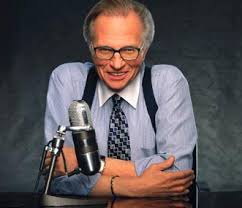
On Larry King, the Radio GOAT

Epigraph:

“I listened to the radio / I waited all night long…”
— Radio Radio, Elvis Costello

Note: This piece reflects my personal memories of listening to Larry King’s overnight radio show in the late 1980s and early 1990s, along with later impressions from television appearances, interviews, and conversations with people who knew him. It is written in the spirit of appreciation and nostalgia rather than media criticism, and emphasizes the uniquely loose, humane, and unpredictable quality of King’s radio work, which for me remains the defining core of his legacy.

I grew up listening to Larry King’s overnight radio show between roughly 1988 and 1992, and in my opinion — which happens to be correct — the radio show was much better than the television version that later made him famous. The TV show was good, even great at times, but radio was longer, looser, freer, and far more unpredictable. It had weird guests, weirder callers, and the feeling that anything might happen at two in the morning. That’s where Larry really lived.

I would listen in my bedroom at my parents’ house in Spokane, Washington, the volume turned low, the house quiet, insomnia hovering. The Spokane AM station — KGA 1510 — carried the show from around 9 PM Pacific time, and then, wonderfully, they would run it again. So I’d listen from nine to midnight, fade, wake at two or three, and hear the same segment again in a half-dream. The effect was surreal. Didn’t I just hear that caller? Didn’t Larry just say that? It created a strange loop of late-night déjà vu that only made the whole thing more atmospheric. The show felt less like programming and more like a continuous nocturnal conversation.

My friend Kelly Rudd loved Larry too. When we were in high school we were both big fans of the radio show, and we talked about it constantly. There were a couple of things that we especially liked. The first was that Larry famously did no preparation. He knew a huge amount about the world, of course, but he didn’t read guests’ books ahead of time. He wanted to come in cold. If his guest was a firefighter, he’d ask, “So what’s it like to be a firefighter?” It sounds lazy, but it was brilliant. By staying open and getting out of the way, he let the conversation go anywhere. This way the show became eventful.

Another thing we loved was what happened after the guest left. Larry would open the lines and take questions about absolutely anything. Most of the time he was generous and patient, but when callers went off the rails he had a signature phrase. He’d cut them off gently: “Cold compress, ma’am,” or “Cold compress, sir.” Basically: lie down, ice your head, regroup. It was hysterical, especially because he used it sparingly. When “cold compress” dropped, you knew things had gotten weird.

Anyway, Kelly and I loved Larry so much that when the station suddenly dropped the show, Kelly proposed we drive to the radio station and protest. So we skipped school, drove across town, and rang the intercom demanding to speak to someone about the cancellation. The station manager eventually came down and heard us out. We knew we weren’t changing anything, but it felt right to try. Larry never came back to Spokane radio, and the show faded not long after, but the whole episode captured what the show meant to us. It wasn’t just background noise. It felt alive.

Larry’s on-air style was the key. He was unbelievably relaxed. By the late ’80s you could tell he had done thousands of hours. Nothing fazed him. Weird guests, drunk callers, eccentrics — all the same to Larry. He absorbed everything. He had pet phrases — “cold compress” chief among them — and he deployed them like a veteran reliever, only when needed. He famously did no prep, and he leaned into naïve questions. He’d ask something simple and let the guest do the work. The effect was disarming. People opened up. He also had real humanity. He listened. He didn’t mock callers. He didn’t rush them. There was compassion there, and I think that’s what I loved most.

And the show could get wonderfully out of control. In one story Larry told from his old Miami days, an adult actress he was interviewing suggested they just have sex during the commercial break. Larry, amused, asked the producers to clear out — but there wasn’t enough time. That kind of anecdote captures the looseness of late-night radio. It wasn’t polished. It was alive.

Larry left the overnight Mutual Radio show in 1994 to focus on television. By then I had already drifted away, but I still caught Larry King Live on CNN over the years. I remember watching during the O. J. Simpson trial while at Otago University in New Zealand, when the show became part of the nightly noise. Later there were the Vladimir Putin interviews — classic Larry, conversational and oddly disarming. And of course there were the great comic moments, like the interview with Jerry Seinfeld where Larry suggested the show had been canceled and Seinfeld snapped back in disbelief, and the Norm Macdonald appearance where Norm kept repeating, “I’m a deeply closeted homosexual,” and Larry tried earnestly to parse it. “So that means you’re gay?” “No, Larry,” Norm replied, “it means I’m deeply closeted.” Pure Larry: sincere confusion meeting absurdist comedy.

Larry’s personal life was famously complicated. He married eight times, had several children — including sons Chance and Cannon later in life — and lived in a kind of perpetual romantic improvisation. The marriages came and went. The last ended painfully and publicly. He once joked he’d never leave his wife unless Angie Dickinson came along — and when she did, he married her. That was Larry: impulsive, affectionate, slightly chaotic. Despite decades of success, he didn’t leave the kind of massive fortune people assumed. The money came and went, as did the marriages. It was a life lived in motion.

My friend Sergio Mandiola actually knew Larry in his later years in Los Angeles. Sergio was running an independent studies program at Beverly Hills High School, and Larry’s sons Cannon and Chance, and he taught his sons for three years. Larry would come by for open nights or just to chat.

Sergio Mandiola: “Larry would come in from time to time and we would talk. He was lovely and open. He talked about his family and his career. One time he told me, ‘Sergio, you should totally have a radio show!’ I was flattered. One thing about Larry is his politics were more to the left than he let on on air. He had strong views and wasn’t afraid to share them in person. Larry was a true mensch and I’m glad I got to spend time with him. I miss him.”

In the end, I’ll say it plainly: for me, Larry King is the radio GOAT. There was no one like him, and there probably never will be. It wasn’t just longevity. It was the curiosity, the looseness, the humanity, the love of people, politics, baseball, and life. He trusted the conversation. He let the night unfold.

And then there was that absurd, wonderful USA Today column, which read like a diary gone completely outta control. Mets lose 6–4…Rain in Baltimore…Clinton flies to Ireland…You’d read it and think, Larry, baby, WTF is this? And also, Mr. USA Today, WTAF are you doing paying for this? But somehow it worked. It was pure Larry — fragmentary, observational, intimate.

And that’s how I remember him most clearly: late nights in high school, the radio turned low, insomnia hanging in the room, Spokane quiet outside.. Sometimes I’d listen from nine to midnight, fade, then wake again to the rerun, half-dreaming, half-aware, caught in that strange déjà vu — didn’t I just hear this? — while Larry kept talking, calm as ever, taking calls from truckers and insomniacs and eccentrics. My listening years were brief, but they stuck. And when I think of Larry now, that’s where I go back to: the low hum of AM radio, the half-fade, and the sweet sounds of his voice in my ear.

Dedication:

For the one and only GOAT, Larry Motherfucking King. RIP baby.

On My Dad’s Ridiculous Climbing Strategies

Note: This is a new piece about my dad, Ross Thomas (RO), and his truly unbelievable climbing strategies. The central episode took place in Stehekin, Washington, many years ago, when RO led my brothers and me on an attempt to reach Castle Rock that quickly devolved into heat, dense forest, no water, and general mayhem. There is also a later coda involving a climbing gym in Portland that is, in its own way, even more outta control. This piece is comic in nature, but also affectionate. My dad is a great man, a brave man, and a very game climber. He is just not, in this one specific domain, a planner.

Send lawyers, guns and money — the shit has hit the fan
— Warren Zevon, refracted

RO, is a great man and a terrible climbing strategist. He is brave, energetic, physically game, and in most areas of life basically well organized. He was a good high school English teacher, a very good administrator, and for many years an excellent and meticulous girls’ basketball coach. He is not, in other words, some kind of general life-space incompetent. Quite the opposite. Which is what makes his climbing strategies so difficult to understand.

They are ridiculous. They are unbelievable. They are officially, historically, and totally outta control.

I say this with love.

The central case study here took place in the mid-2000s, let’s say 2005, when our family was staying in Stehekin, Washington, out on Lake Chelan. If you have never been to Stehekin, it is a beautiful and slightly improbable place, the kind of place that already feels like the beginning of a story. Lake Chelan is huge, and you get out there by ferry, which means from the jump there is a sense that you are committing to something. People camp there or stay in cabins. We were in a cabin. My mom Claudia (CL), stayed behind. RO, meanwhile, had a plan.

The plan was that RO and his sons — Mike (MI), Pat (PA), and me — would hike up toward Castle Rock.

Now, one thing about family expeditions is that “the plan” is often not really a collective possession. It belongs to one person. The rest of the group is more or less there to follow along. In this case, the plan belonged entirely to RO. MI and PA and I were, broadly speaking, along for the ride.

As I remember it, we started from Stehekin and walked about three miles just to get to the trailhead, then hiked a few more hours uptrail to where we stopped and camped the first night. It was already a decent undertaking just to get there, but this was, in a sense, merely the prelude. The true RO strategy had not yet fully revealed itself.

At around dusk, after we got to camp and set up the tent and got ourselves sorted for dinner, RO decided he was going to scout the route for the next day. This seemed reasonable enough. It is in fact the sort of thing a prudent leader might do. Only instead of scouting further up the trail, or perhaps generally uphill toward the place we were trying to go, RO for some reason headed downriver.

Why did he do this? We did not know. It was back downhill. It seemed unrelated to the objective. Even at the time it had the feel of one of those decisions that makes perfect sense only to the person making it.

Ross Thomas: The trail kind of petered out eventually and didn’t really lead to Castle Rock anyway.

Fair enough. I want RO’s side of the record included here. But even granting this, and I do grant it, going downriver in the late evening did not strike the rest of us as a strong opening move.

Sure enough, RO fell in the river and got completely soaked.

This was the first of many mistakes he would make on the trip.

He came back to camp late and dripping wet, having apparently developed an immediate a bizarre attachment to that river. The water was cold. The evening was cool. He changed clothes, we had dinner, and we went to bed. At this point, there was still some chance that the next day might somehow become normal.

It did not.

The next morning we got up early, had breakfast, and prepared to head out. My assumption — based on reason, precedent, and the literal existence of trails — was that we would continue on the trail. Instead, RO decided that we were going to bushwhack straight uphill through an extremely dense forest in the blazing heat.

This struck me as a bad plan.

It was a bad plan.

The forest was thick enough that you could not really move with any rhythm. We were not hiking so much as negotiating, arguing, and physically contesting with the landscape. Every movement took extra energy. Progress was incredibly slow. The heat was serious. And the main problem, which quickly became the only problem, was that there was no water. Not a stream. Not a trickle. Not a suspicious puddle. Nothing.

Now, RO for reasons that remain mysterious to me is not a big water drinker. He prefers beer and tea. Under ordinary conditions this is merely a personality trait. On a hot uphill bushwhack through dense forest it becomes a strategic liability.

Naturally, we asked where the water was.

Ross Thomas: I had read in a Fred Beckey book that there was a way to get up to Castle Rock, although I think Beckey had only heard about it and never actually done it himself.

This is, in its way, a perfect Ross Thomas detail. Fred Beckey, the legendary climber, had perhaps heard there was some route, though he had not personally taken it. This was enough for RO. A rumor in a book by a famous climber became an operating plan.

As for the water situation, RO told us — and I remember this vividly — that there might be some in about five miles.

Five miles!!!

We were already fighting for our lives up there, and this crazy man was calmly informing us that in only another five miles there might, possibly, perhaps, be water.

He’s totally outta control.

At some point, after what I recall as roughly three miles of this lunacy, we basically mutinied. Or perhaps mutiny is too strong; let’s call it collective realism. We told RO the obvious, which was that this was not going to work. The route was no good. The heat was too much. There was no water. We had to turn back.

And so we did.

Now the descent was interesting because it brought out our distinct styles. RO, MI, and PA were making their way down carefully, gingerly, responsibly. I, on the other hand, was absolutely flying. Swinging from tree to tree like some kind of deranged monkey, just ripping downhill through the forest. This part RO loves to tell to this day, and I admit it was one of my better athletic showings. I was not going to die of thirst in that forest and I was not going to descend politely either.

Eventually we made it back to camp. Or rather, most of us made it back to camp together. RO, in one of those small but meaningful complications that tend to gather around him in climbing situations, got separated from us and somehow ended up down by the river again.

And yes, he fell in again.

He really must have loved that river.

So now here he comes back to camp once more, drenched, and by this point we are all in total agreement that the trip is over. We are done. It is time to 86 the hell out of there.

So we break camp and head down toward the lake shore. But this presents a new problem. We still have a significant walk to get home — something like another two miles down to the shore and then, as I remember it, another three miles around the lake. And by now it is dusk. So this is not really viable either. We are hot, tired, and in no mood for an elegant final act.

At this point RO does what he often does in these situations, which is simply assume that reality will provide.

He found a guy with a motorboat and asked if he would take us back to Stehekin.

The guy said sure. Fifty bucks.

RO then informed him that he did not actually have fifty dollars on him, but could get it from his wife once we got back to the cabin.

Somehow, by what can only be described as grace, audacity, or a temporary breakdown in the boatman’s judgment, this worked. We got in the boat, got home safely, and made it back in time for dinner.

That was Stehekin.

CODA

You might think the lesson here would have been: bring water, stick to trails, do not base wilderness plans on rumor, avoid rivers if possible, and maybe do not lead your sons into dense forests in the hot sun in search of a semi-mythical route described secondhand by Fred Beckey.

You would be mistaken.

Many years later, when RO was Principal of Valley Catholic High School, he got really into climbing at a gym in Portland. It is a cool place, run by a father and son, and it has beginner, intermediate, and advanced climbs. He took me and MI and PA there, and later my son Hugh as well. Hugh loved it. He scampered up the walls like he had been waiting for exactly this sort of thing his whole life. I like climbing too, though my arms get tired pretty quickly and I tend to fade. MI and PA are both good climbers. RO, to his credit, also has strong stamina.

So one day my wife and Hugh and I were there with him. We’d been climbing for a few hours. I was on the mats, faded, taking a break. Hugh was still going. RO was showing him some moves. Then RO started up one of the big walls — one of the long climbs, the kind where you need the harness.

Only he had forgotten to put the harness on.

Hugh saw this before anyone else did and yelled out:

RO, get down now!

And RO did.

For the next year, RO loved telling the story of how Hugh had saved his life. Quite right too. It is a great story. My son saved my dad from one of my dad’s own ridiculous climbing strategies. The circle was complete.

But then, about a year later, shortly before RO retired from the principal job in 2018, he was back at the gym by himself. This time the only other people there were the owner and his son. And somehow — incredibly, impossibly, yet also in a way entirely consistently with the established Ross Thomas climbing tradition — he forgot the harness again, started up the big wall, and fell.

He crashed all the way down onto the mat.

The mat saved his life, no question. But his feet and knees and legs got absolutely busted up. He was in a wheelchair for months. It was so bad that he had to move temporarily out of the country house in the woods where he lives with CL and into a little bungalow on the Valley Catholic campus owned by the nuns that founded and still run the school. He could barely work. To this day his feet remain a total mess. He has trouble driving and has to drive with his shoes off and wearing some sort of thick sock or something.

At one point we wondered whether he might sue the gym owner for negligence. But RO wanted no part of that. He said it was his own fault, not the owner’s.

Fair enough.

And then, after many months, he mostly recovered. Which means this story has, if not exactly a happy ending, at least a decent one. Better still, as soon as he was recovered he went right back to the gym and started climbing again!

This is what I mean.

His climbing strategies are ridiculous. They are unbelievable. They are officially, historically, and totally outta control. He does not plan for basic things such as the route, the water, or how exactly one might avoid miles of dense forest. He does not always remember the harness. He seems, in climbing situations, to operate according to a distinct internal logic unavailable to the rest of us.

And yet outside of climbing, this makes almost no sense. He is, as I said, a basically well-organized guy. He planned lessons. He coached meticulously. He ran a school. In most areas of life he is not slapdash at all. Which makes the climbing thing not just reckless but anomalous. It is a localized mystery. A glitch in an otherwise coherent system. I do not understand it and at this point I do not expect to.

What I do know is this: to this day I avoid climbing with him because in this one particular area I do not trust his judgment at all.

I love the man. But when it comes to climbing, he is not to be trusted.

Dedication:

For my dad. I love you baby but you are totally outta control.

On it, Pete

Note: Some stories get better in the telling. This one doesn’t need to. It arrives fully formed—one line, perfectly placed—and has stayed that way ever since. I’ve told it for years and it still lands exactly the same. No embellishment required.

It’s September, 1989.

Two new teachers had just arrived at St. George’s School in Spokane, WA. These are Paul Hogan and Pete Aiken. Paul would go on to have a long and distinguished career, eventually becoming Principal of Jesuit High School in Portland—a major job, the kind that makes a life. I have no idea where Pete is today.

That night, my dad Ross invited them over to the house for dinner. It was one of those late-summer evenings that still carried a little warmth but hinted at the coming turn. Ross was out back at the grill, working over the barbecue with a beer in hand. The adults clustered nearby, talking, drinking, getting to know the new arrivals. There was that particular tone of adult conversation—half-professional, half-social, everyone just slightly aware of roles and impressions.

Out in the yard, it was just the three of us: Pat, Mike, and me. We were playing catch with a tennis ball. Nothing serious. Just throwing it around, loose, casual, the way kids do when the game isn’t really the point. At some point, either Mike or I made a bad throw. It sailed wide of Pat—too far, too high—and rolled past him.

A completely ordinary moment. The kind of thing that happens a hundred times in a backyard, in a summer, in a childhood.

Pat was six. He didn’t chase the ball. He didn’t complain. He didn’t turn to us. Instead, he turned—calmly, deliberately—and looked over at Pete Aiken, one of the brand-new teachers, a guest in our home, a man he had just met. And in a tone of quiet assurance, as if assigning responsibility in a meeting, he just said:

“On it, Pete.”

That was it. No smile. No wink. No awareness of what had just happened. The ball was recovered. The game went on. The adults kept talking. The evening continued. But something had shifted, just slightly, just enough.

Because in that moment, a six-year-old child had somehow crossed the boundary between worlds—between kids and adults, between play and work—and issued a line that did not belong to him, but fit him perfectly.

I don’t remember what happened next. I only remember that line. And I remember that we have been laughing about it ever since.


The On It Pete Blues (Pete’s POV)

I was new to the city, new shirt, new street,

Standing in a backyard trying hard to be discreet,

Ross on the grill and the talk running deep,

Just another first night—then I heard, “On it, Pete.”

I hadn’t been briefed, hadn’t learned the terrain,

Didn’t know the house or the shape of the game,

Just a beer in my hand, trying not to overreach,

Then a six-year-old turned and delegated to Pete.

Now I’ve worked in schools, I’ve handled my share,

Rooms full of noise, moments needing repair,

But nothing quite like that clean little feat—

Being calmly assigned by a kid in bare feet.

No panic, no pause, no doubt in his beat,

Just a glance and a nod—“On it, Pete.”

And the ball got found, and the night rolled on,

But I knew right then something strange had gone on—

In a yard full of voices, one line cut through the heat:

I wasn’t just visiting.

I was on it.

Pete.

Dedication:

For my brother Pat. And for Pete. Just get on it already baby.

Note: If you liked this story you may also like the stories below, which also cover my time at St. George’s High School.

On George Santos (aka The Fabulous Kitara)

Note: This piece uses the figure of George Santos as a kind of cultural parable. The story of Santos—his improbable congressional run on Long Island, the famous unraveling of his résumé (including the legendary and totally outta control Baruch volleyball claim), the rapid collapse of political support from fellow New York Republicans, his eventual expulsion from Congress, and his strange second act as a Cameo celebrity—forms one of the more surreal public morality plays of recent American politics.

The apartment story that frames the essay is not meant as a literal equivalence. Kitara is not Santos, and roommates are not members of Congress. The comparison operates at the level of archetype: the charismatic figure who arrives full of sunshine, quickly becomes central to a small social world, and then—through one small but revealing detail—forces everyone around them to confront the uneasy coexistence of charm and opportunism.

The name “Kitara,” Santos’ drag name from back in Brazil where he if from (Santos is gay of course) is used here in the spirit of narrative shorthand rather than biography. Anyone who has lived with roommates long enough will recognize the basic situation. Shared apartments are small republics built on trust, improvisation, and the quiet hope that everyone involved is playing roughly the same game. Most of the time that hope is justified. Occasionally it is not.

If the tone of the piece drifts toward amusement, and even affection, rather than outrage, that is deliberate. Characters like Santos—and the occasional fabulous roommate—have a peculiar ability to provoke both exasperation and reluctant admiration. The performance can be infuriating. But it can also be oddly entertaining.

Such people rarely disappear completely. They simply move on to the next stage. Sometimes that stage is Congress. Sometimes it is Cameo (get that scratch Georgie baby!). And sometimes it is just the memory of a roommate who once seemed almost too good to be true.

Epigraph

“People seldom do what they believe in.
They just do what is convenient, then repent.”

— Bob Dylan


I. The Fabulous Roommate

Every apartment has its mythology.

The quiet one who never emerges from his room except to microwave things at strange hours. The earnest one who tries to establish chore charts that everyone pretends to follow for about ten days. The one who adopts pets with a confidence that suggests the rest of the household has already agreed to care for them.

And then, once in a while, there is the fabulous roommate. Kitara was that roommate.

She arrived with the sort of personality that immediately rearranges the emotional furniture of a place. Cheerful without being cloying. Social without being exhausting. Organized without being smug about it. She seemed to understand, instinctively, the delicate social contract of shared living: when to chat, when to disappear, when to clean something quietly so no one felt guilty.

Visitors loved her. Friends who came by would inevitably say some version of the same thing: “Your roommate is amazing.”

And she was. At least at first.

She was the sort of person who made the apartment feel like a small, cheerful republic. There were occasional dinners, occasional drinks, occasional pets that appeared temporarily in the orbit of the household. Nothing dramatic. Just the easy, slightly improvised domestic life that happens when a handful of semi-adults share a roof and try to keep the machinery of living running smoothly.

There are people who move through life like that—people who bring lightness with them. People who make small environments work better simply by being present. You think, when you meet someone like this: what a lucky break.


II. The Sunshine Personality

There is another category of person, however, that resembles the fabulous roommate from a distance. These people also arrive with sunshine. They are charming. They are energetic. They seem to know how to move through rooms with effortless confidence. They shake hands warmly. They remember names. They tell stories. They radiate the sort of friendliness that makes everyone feel briefly like a co-conspirator in something cheerful.

The difference is subtle, and it often takes time to notice. These are not merely charming people.

These are the performers. And, one of the most remarkable recent examples of this type in American public life was George Santos.

Santos appeared, seemingly out of nowhere, in the political ecosystem of Long Island. His run for Congress was, at least initially, improbable in the way that many modern political stories can be. The district had long been competitive, but his rise through the local Republican apparatus was unusually smooth. There was little serious opposition within the party. The campaign itself unfolded with the sort of confident momentum that often accompanies candidates who seem, at least on paper, to possess a compelling life story.

And what a life story it was.

Santos presented himself as the son of immigrants who had risen through the financial world, a man with an impressive résumé and a philanthropic sensibility. He spoke of professional success, cultural fluency, and various achievements that painted a portrait of upward mobility and cosmopolitan competence.

The voters of Long Island sent him to Congress. And then, almost immediately, the details began to unravel.


III. The Volleyball Player

The first cracks appeared through the ordinary mechanism of local journalism. Reporters from Long Island newspapers began to do what reporters traditionally do: verify things.

The résumé turned out to be an imaginative document. The professional history did not quite match reality. The educational claims were questionable. Various details that had seemed impressive during the campaign began to dissolve under scrutiny.

One of the most memorable revelations involved an oddly specific athletic claim. Santos had described himself as a standout volleyball player during his time at Baruch College. Not merely a participant, but something close to a star—someone whose record-setting performance had been part of his biography.

There was just one problem. Baruch College had no record of him playing volleyball. None at all. Outta control. The story collapsed on that small detail. It is often the small details that do that.

A résumé can contain many large claims, and those claims can hover in a kind of vague plausibility for a surprisingly long time. But one precise, checkable fact—the volleyball team roster, the game statistics, the athletic department archives—can puncture an entire narrative.

The reporters pulled the thread and the sweater unraveled.


IV. The Grifter Archetype

Once the unraveling began, it accelerated. Claims about employment at major financial firms proved dubious. Educational credentials evaporated. Personal history mutated in various directions depending on which previous statement one examined.

Soon the story had migrated from the political pages into the broader theater of American spectacle. Late-night comedians noticed. Cable news panels convened. Social media filled with the strange, almost baroque details of the saga. Members of his own party began to distance themselves.

Several Republican members of the New York congressional delegation—figures who had initially welcomed a new colleague—publicly called for him to resign as the scope of the fabrications became clear. The situation became untenable. The House of Representatives eventually voted to expel him, a rare and historically notable step.

It was a dramatic fall.

And yet even during the collapse, Santos retained something remarkable.

Charm.

He gave interviews. He sparred with reporters. He adopted, at times, an almost mischievous tone about the entire affair. There was a faint air of theatricality to the proceedings, as though the story had become a kind of performance art about the boundaries of credibility.

The grifter archetype has a peculiar resilience. Even when the illusion collapses, the performer often remains oddly entertaining.


V. The Apartment

Watching the Santos saga unfold, I found myself thinking more about Kitara.

Because the thing about grifters is not simply that they deceive.

It is that they charm.

They charm their way into rooms, into institutions, into social networks. They radiate warmth. They build small communities of goodwill around themselves. And for quite a while, everything feels perfectly normal.

Until one day something small happens. Something missing.

In the apartment it was GM’s silver. Not a vast treasure. Not an heirloom of historic significance. Just a small, familiar object that lived in a particular drawer and had always lived there.

One morning it was gone. The initial reaction in situations like this is always practical. Maybe you moved it. Maybe it fell behind something. Maybe someone borrowed it.

The mind runs through a series of benign explanations, each one slightly less convincing than the last.

And then a thought appears.

Quietly.

Oh shit.


VI. The Knowledge You Don’t Want

Roommate life operates on a fragile form of trust.

You share space. You share kitchens. Sometimes you share pets, groceries, furniture, phone bills, music, stories. The arrangement functions because everyone tacitly agrees not to test the boundaries of that trust too aggressively.

When something disappears, the entire structure trembles.

But there is another complication.

Sometimes you realize what probably happened. And you also realize that confirming it would destroy the social equilibrium of the apartment.

So you do a strange psychological maneuver.

You know. But you decide not to know.

Life continues.

The dishes are washed. Conversations occur. The roommate remains charming. The apartment continues to function as a small republic of semi-functional adults.

But a hairline crack now runs through the arrangement.


VII. The Fall

For Santos the crack widened into a canyon.

The congressional investigation intensified. Ethical questions multiplied. Party support evaporated. Eventually the House voted to expel him, ending one of the most surreal political tenures in recent memory.

Yet even after the fall, Santos demonstrated a familiar trait of the charismatic grifter.

He adapted. He appeared on podcasts. He commented on political scandals involving others. He expressed a certain moral indignation about the ethical lapses of fellow politicians—including members of his own party—sometimes with a tone that was almost hilariously sanctimonious given the circumstances.

The performer remained on stage. And then came the truly modern twist.

Santos joined Cameo. And he’s fucking great on it!

For a fee, he would record personalized video messages: birthday greetings, congratulations, small performances of his peculiar brand of post-scandal celebrity.

The internet, as it often does, embraced the absurdity.


VIII. The Cameo

At some point I watched a few of his videos.

There he was, smiling warmly into the camera, delivering a cheerful greeting to a stranger somewhere in America. The tone was friendly, relaxed, slightly mischievous.

And I laughed.

Because the performance was genuinely funny. The charm, infuriatingly, still worked. It reminded me of the old fable about the scorpion and the frog.

The scorpion asks for a ride across the river. The frog hesitates, noting that scorpions have a reputation for stinging frogs. The scorpion assures him that such a thing would be irrational; if he stung the frog mid-crossing, both of them would drown.

The frog agrees.

Halfway across the river the scorpion stings him.

“Why?” the frog asks as they sink.

“I can’t help it,” the scorpion replies. “It’s my nature.”

The scorpion cannot help himself.

But every now and then the scorpion also sends someone a birthday message on Cameo, smiling warmly and wishing them a fantastic year ahead.

And you find yourself laughing anyway.

The truth about characters like Santos—and perhaps about certain roommates—is that their charm is not an illusion.

It’s real.

The trouble is that it coexists quite comfortably with everything else.

Dedication:

For Kitara. May you make a fucking mint on Cameo and look totally gorgeous while doing it.

Note: If you enjoyed this story, you might also enjoy these other pieces about American grifters.

Why It Is So Hard to Get Breakfast in Japan (with a dream cameo from the Gemini Donald Trump)

New Note (2025): Since this piece was first published, Japanese Breakfast the band has gotten even bigger, Michelle Zauner wrote another book, and the cultural universe has shifted enough times that some aspects of this essay may be outdated. I’ve kept the original text intact because the dream-logic and breakfast-logic still stand.

I live in Kyoto, Japan, and after many years here I’ve traveled pretty widely—especially in the greater Tokyo area. Traveling in Japan is pretty easy as long as you can manage a little spoken Japanese and read a train map. The trains are famously efficient and connect most of the country, including every major city.

I haven’t driven a car here in more than fifteen years and don’t miss it at all. Trains and taxis get the job done just fine. Overall, I love traveling in Japan and I love exploring Tokyo, a city that contains worlds within worlds. I have almost no complaints about Japanese travel.

Except for one.

It is nearly impossible to get a good breakfast—or really any breakfast—when you’re on the road.

Now, it’s not that Japanese people don’t eat breakfast. They do. The archetypal morning meal—rice, miso soup, maybe a little fish—is as recognizable in its way as the “full English” of sausages and beans. But the Japanese breakfast is overwhelmingly a home operation. Once you’re traveling, the options narrow to two—two and a half, if we’re being generous.

I. The Hotel Breakfast

Mid-price and nicer hotels usually offer a breakfast buffet with “Japanese” (rice, miso, maybe grilled fish) and “Western” (toast, jam, and some ambivalent eggs) selections. Except at the truly top-tier hotels, these buffets manage to be both overpriced and bad. A traveler is lucky to escape for ¥1,500–¥1,800 (about fifteen dollars before the yen weakened), and more commonly pays north of ¥2,000 for a pretty uninspired spread.

Budget hotels often don’t offer breakfast at all.

In my experience, Japanese hotel breakfasts are among the weakest anywhere in the world. I take this as symptomatic of a broader truth: Japanese people simply don’t care about breakfast when they’re on the road—and maybe not all that much at home either.

II. The Convenience Store (“Combini”) Breakfast

When I have raised the issue of the lack of decent breakfast in Japan, Japanese people usually point me to the convenience store. And it’s true: you can purchase food and coffee at any of the ubiquitous combinis—Family Mart, 7/11, Daily, Lawson, and the rest. They’re open 24 hours, and they stock a range of items that theoretically qualify as breakfast. Hard-boiled eggs, yogurt, rice balls, steamed buns, fried chicken, sometimes bananas, and of course hot and cold coffee.

I’ve certainly been in situations where I had no choice but to fall back on the combini for breakfast while traveling. And this is…fine, to an extent. But most combinis have nowhere to actually sit and eat, and in any case you can’t really call a combini breakfast nice.

Most Japanese folks seem to regard a combini breakfast as perfectly acceptable—desirable even. And while one can admire the low expectations, or the cultural pragmatism behind them, it’s possible to admire those qualities and still wish for more.

III. Starbucks or a Local Coffee Shop

Starbucks are fairly common in major cities and usually open at 7 a.m. (if you’re lucky) or, more commonly, 8 a.m. They should really open at 6. The food offerings are overpriced, and Starbucks has never truly figured out its food—which remains baffling. Still, one can grab a few combini items and smuggle them in, or settle for a four-dollar fragment of quiche with your Americano. I would not classify Starbucks as having breakfast, per se, but they are pleasant enough to sit in, and one can create a simulacrum of breakfast there.

Then there are the local coffee shops. These, fortunately, often open at 7 a.m. or even earlier, and serve strong coffee—often brewed by hand at the counter with a drip filter—and a breakfast that nearly always consists of a single piece of white toast and an egg. White toast, egg, and handmade coffee with old guys reading the paper around you is, I admit, at least an approximation of breakfast, and I have certainly relied on this setup while on the road.

But it’s still not quite what we are looking for if we want a hearty, balanced breakfast. There is no French toast, no fruit bowl, no omelette, and only very occasionally a strip of bacon. None of the staples one might reasonably expect from a decent, full breakfast.

And that’s more or less the list. You can also find 24-hour beef-bowl restaurants, but they are cheap as and not exactly the sort of thing you look forward to when greeting the day. Beyond that, most restaurants simply don’t open until 11:00 or 11:30 for lunch. The concept of brunch—dicey even under ideal circumstances—barely exists outside the swankiest of upmarket hotels.

It is, put bluntly, really hard to find a proper breakfast in Japan unless you make it yourself. And that fact continues to puzzle me. I understand that most people here eat rice and miso at home, or grab something at the convenience store. Fine. But metropolitan Tokyo has roughly 30 million people. None of these 30 million want a real breakfast at 7:00 or 7:30 a.m.? Not even a few hundred thousand?

It seems incomprehensible. And yet, incomprehensible or not, this is simply the reality. There is no broad Japanese market for breakfast. I mean, I’m in the market—but apparently one man does not a demographic make.

Go figure.

Now, I’ve covered the issue of Japanese breakfast—its scarcity, its odd cultural positioning—to the best of my ability. But before we move on, I want to add a few details that may seem unrelated. Let’s see if we can get them to connect.

Because the truth is, I dream about getting breakfast in Japan. And in a surprising number of these dreams, the Trumpster shows up.

More precisely: the dreams focus on the fact that the Trumpster and I share a birthday (June 14th), which makes us both late Geminis. Late Geminis, I have good reason to believe, are uniquely dangerous and slippery. But in my dreams the Trumpster isn’t dangerous at all. He shows up as basically an empty suit.

Trump/ Breakfast Dream I:

I am at a breakfast buffet in Japan. This is at a hotel that I am not staying at, and I may indeed be attempting to crash the buffet while masquerading as a hotel guest. Trump is there with an entourage, and he sees me staking out the buffet. I make a comment to him that we are both late Gemini, and he nods, curtly but with some minimal consideration. He sees me trying to steal the breakfast, does not care, and would probably provide cover if it came to that. He and I are not aligned, but nor are we enemies.

Trump/ Breakfast Dream II:

I am outside in the morning, standing on a dock or something of that nature. I am looking for breakfast, and not finding it. There is a commotion above me to the east, and I realize that Trump is being rolled out, literally on like coaster wheels, for a speech. He is on some kind of sliding seat and when this seat hits the balcony he stands up and postures about like Mussolini. I am watching and he sees me watching, but continues with his Mussolini act. I realize quickly that this is a total act and that he doesn’t even want to be there. He is not dangerous in this moment or in this speech, just faintly ridiculous. Still, no breakfast.

=====

What do Trump and breakfast have to do with one another? I’m not sure yet. But I do know that Trump, although maligned by nearly everyone I know (I know a bunch of liberals), and apart from being an egotistical, mafia-adjacent, easily flattered, shape-shifting sociopath, is also pretty funny. Before I lose half of my readership, I’ll just nod to the comedian Shane Gillis, who made this point several months after Trump left office.

Has enough time passed that we can admit Trump was funny? Can we finally admit that he was funny? (…) He was funny (…) I saw it. I’d show my friends I’d say look at that. They’d be like “what?”

“It’s funny.”

“There’s nothing funny about Donald Trump.”

I don’t know, during Hurricane Dorian he was like “maybe we should nuke it” (…) Like that was a real suggestion from the President (…) “Hey we got a big storm coming, you want me to blow it up?”

They were like “no, what the fuck are you talking about?”

“I don’t know, I fuck around dude. It’s what I do.”

“I fuck around, it’s what I do,” is a great summary of Trump’s whole approach to governing. Now, is there anything funny about his terrible immigration policies, his attempted pressure of the Georgia secretary of state to “find” 1800 votes, his total disregard of democratic norms? No, not really. But is there anything funny about his speculation that maybe a little light and a little bleach could cure COVID? Why yes, there is. Is there anything funny about his noting that Frederick Douglas is getting bigger and bigger these days? Yes indeed. Is the way he pronounces “huge” funny? It’s funny to me anyway. And in my dreams, the two above being part of a series of about four or five total Trump breakfast dreams, he always shows up as semi-defanged, basically neutered, and non-dangerous. I think this is because, as a fellow late Gemini, I kind of have Trump’s number. It takes a late Gemini to know one, and I know this guy. In fact, I see right through him, to the extent that I know he’s not even there.

One other salient piece of data, there is an indie rock band called Japanese Breakfast that is getting bigger and bigger these days (they tell me “sir, this Japanese Breakfast is getting bigger and bigger these days, and I say look at that, wow, this Japanese Breakfast is really getting huge”). I don’t know them that well, but they sound like the kind of band I would like. I do wonder though if their name is not an ironic nod to the fact that Japanese breakfast is not a thing. Is the band name self-effacing, or even self-erasing? Does Japanese Breakfast the band exist at all? Does Trump? There is a way in which the Trump presidential term has come to feel like a fever dream or collective delusion, a set of events that cannot really have occurred as we recall them. In this sense, the Trump presidency may in the future be subject to Phantom Time Hypothesis speculation. And he and his handlers have already played right into this speculation what with their first lady doubles, the totally unhinged press conferences with the ubiquitous helicopter waiting in the wings, and the classic Trumpism, “we’ll see what happens.”

Here is what I think. Japanese Breakfast as a band exists. The Trumpster exists, but his wife spent most of her time in the White House being doubled. Trump and I are dream doubles, and I have his number. Japanese people don’t care about breakfast. And I am always starving at around 9 AM when on the road in Japan. Someone should look into the matter. I hear the Trumpster is free these days, maybe he’s the guy for the job.

Note: If you enjoyed this piece, you may also like the pieces below which also deal with American politics, albeit from a slightly different angle.

https://thekyotokibbitzer.wordpress.com/2025/11/25/on-the-federal-age-of-consent-a-reply-to-alan-dershowitz/

On Kris Kristofferson’s “To Beat the Devil”

This piece takes a look at Kris Kristofferson’s “To Beat the Devil.” The song appears on Kristofferson’s self-titled debut album from 1970 on Monument, which is, by any standard, an astonishingly good record. The album features “Me and Bobby McGee,” “Sunday Morning Coming Down,” and “Just the Other Side of Nowhere,” along with the ol’ Devil. That’s four absolute classics right there for ya.

Sunday Morning features an opening quatrain that most other songwriters would trade their career for:

Well I woke up Sunday morning/ with no way to hold my head that didn’t hurt/ and the beer I had for breakfast wasn’t bad/ so I had one more for dessert

(I could play this game all day—Jason Isbell’s Southeastern features another couple life-work worthy couplets:

The first two lines of “Super 8”:

Don’t wanna die in a super 8 motel/ just because somebody’s evening didn’t go so well

And from “Different Days”:

Time went by and I left and I left again/ Jesus loves a sinner but the highway loves a sin.

If I’d written lines that great I’d call it a career and sip martinis on the house for the duration.)

Sunday Morning and Bobby are probably objectively better songs than To Beat the Devil, yet what I like about this one is that Kristofferson states very clearly a kind of founding intention for his life in song and art, right out of the gate. The only parallel I can think of is Craig Finn’s The Hold Steady, whose first album Almost Killed Me kicks off with “A Positive Jam.”

(Here’s Finn telling it like it is:

I got bored when I didn’t have a band/ so I started a band/ we’re gonna start it with a positive jam/ hold steady.

Rock on Craig baby.)

Anyway, let’s get to the focus of this piece. Kristofferson opens with a spoken intro.:

A couple of years back I come across a great and wasted friend of mine in the hallway of a recording studio. And while he was reciting some poetry to me that he had written, I saw that he was about a step away from dying, and I couldn’t help but wonder why. And the lines of this song occurred to me.

Here the singer is looking up at his idol who is both “great and wasted.” I wasn’t around quite yet in 1970, yet I can easily imagine Ginsberg’s “best minds” line hanging over talented folks across a lot of zones. Klosterman wasn’t quite there either (June 5, 1972–a mid Gemini of course), but he was close, and to indulge not for the last time in a little Klostermania, the zeitgeist seemed to be making people thirsty.

The singer receives some scraps of poetry, shards of shattered inspiration, and a song “occurs” to him. He doesn’t state it directly, however we imagine the song arrives fully formed, like “Pancho and Lefty,” or “Kubla Khan.” Thus, To Beat the Devil is also both an answer and an offer of redemption to his idol, who here is John(ny) Cash.

I’m happy to say he’s no longer wasted, and he’s got him a good woman. And I’d like to dedicate this to John and June, who helped showed me how to beat the devil.

The singer takes up the mantle of the master, and in so doing opens a possibility window onto redemption for his senior. This is no exaggeration—Cash also recorded To Beat the Devil in 1970 and we are basically stipulating that Kristofferson’s genius, descended from Cash while also original to himself, helped rescue Cash from addiction and the whole deal there. We won’t be deep diving into the archive on this one—as we said we’re just keeping it local and breaking it down, so you’ll have to take my word on it or search it up your own self.

Here’s the first verse; the words speak for themselves:

It was wintertime in Nashville/ down on Music City Row/ and I was looking for a place/ and to get myself out of the cold/ to warm the frozen feeling that was eating at my soul/ keep the chilly wind off my guitar

A classic down and out in the big city piece of scene-setting. The singer is physiologically and psychologically frozen, a cold wind gusts across his art. The man needs a break.

My thirsty wanted whiskey/ my hungry needed beans/ but it had been a month of paydays/ since I’d heard that eagle scream/ so with a stomach full of empty/ and a pocket full of dreams/ I left my pride and stepped inside a bar

You might think that the operative nouns here would be “thirst” and “hunger,” but no. This is not a man with a thirst; this is a thirsty man. We also hear an echo of a now-ancient American past where a man with an empty stomach would go in search of, of all things, “beans.”

Anyway, he’s got no money, can’t really bring himself to care. So, a singer walks into a bar.

Actually I’d guess you’d call it a tavern/ cigarette smoke to the ceiling
and sawdust on the floor/ friendly shadows/ I saw that there was just one old man sitting at the bar/ and in the mirror I could see him checking me and my guitar/ and he turned and said/ come up here, boy, and show us what you are/ I said I’m dry, and he bought me a beer

The man in the mirror, the devil himself. The singer comes face to face with the man who checks him out and summons him over. Kristofferson then enters into a bargain–offers up the terms of an encounter: a beer on the old man’s tab. Score one for the thirsty man. The singer faces the old man; it’s to be a showdown. He doesn’t have much, but he’s got some “friendly shadows,” traces of an older map perhaps, an older memory.

I can’t help here but engage in a bit of presumption. When I play the song in my head, I want to hear “in the mirror I saw him casing me and my guitar,” (listen to the way he pronounces “guitar” on the track. Kristofferson was born in Brownsville, Texas in ‘36 and behind the laid back folksinger you can here some roots here baby).

If I could make one edit to the song, it would be to replace “checking me,” with “casing me.” What a great verb “to case” is.

Lexical Interlude: “To case the joint”

1. slang To observe a place in order to familiarize oneself with its workings in preparation for some criminal activity (often robbery). Judging from the security footage, those men cased the joint hours before robbing it.

2. slang By extension, to thoroughly examine a place. In this usage, no devious motive is implied. As soon as my kids walking into the hotel room, they started casing the joint, exclaiming about everything from the TV to the mini-fridge.

The seminal use of this verb phrase comes from Bill Callahan, formerly of Smog. Callahan is an odd duck—he is so artificial, so obviously self-created as an entertainer, that he has become almost post-authentic.  Callahan contains multitudes.

My favorite Smog album, well in the top two, is Red Apple Falls, which features “Ex-Con,” on which Callahan sings: 

Jean jacket and tie/ feel like such a lie/ when I go to your house/ I feel like I’m/ casing the joint

Devious motive implied.

=====

He nodded at my guitar and said/ it’s a tough life, ain’t it?/ I just looked at him/ he said “you ain’t making any money, are you?/ I said, you been reading my mail/ he just smiled and said, let me see that guitar/ I got something you ought to hear/ and then he laid it on me

The devil has a bead on the singer, and he’s not far off.  Yes he’s broke.  Yes he’s down and out.  Whaddaya want?

=====

Filmic Interlude I: The Long Goodbye

In Robert Altman The Long Goodbye, written by Leigh Brackett, the main character Philip Marlowe gets out of jail somewhere in the first act and heads to a all-purpose pit stop restaurant who’s owner apparently collects Marlowe’s mail. The dialogue is exquisite.

Marlowe: You got any messages for me?

Owner: Believe we’ve got a few over there. As a matter of fact, you’ll find my phone bill in there too.

Marlowe: I wouldn’t worry about that.

When you ain’t got nothing you got nothing to lose. Kristofferson’s got nothing to hide in his mail. Those bills go straight to the wastebasket.

=====

If you waste your time a talkin’ / to the people who don’t listen/ to the things that you are saying/ who do you thinks gonna hear?/ and if you should die explaining how/ the things that they complain about/ are things they could be changing/ who do you thinks gonna care?

there were other lonely singers/ in a world turned deaf and blind/ who were crucified for what they tried to show/ and their voices have been scattered by the swirling winds of time/ ‘cause the truth remains that no one wants to know

The devil’s words speak for themselves. The path of the troubadour is a dead end. The world has not ears to hear nor eyes to see. Truth tellers meet a bad end. Whiners gonna whine. It’s a strong opening bet, made, we presume, with his red right hand.

Well the old man was a stranger/ but I’d heard his song before/ back when failure had me locked out/ on the wrong side of the door/ when no one stood behind me/ but my shadow on the floor/ and lonesome was more than a state of mind

The singer is on familiar territory; he’s has been tempted by this cynical incantation, he’s not immune to tuning out his calling when out in the cold. Who is?

You see, the devil haunts a hungry man/ if you don’t want to join him/ you gotta beat him/ I ain’t saying I beat the devil/ but I drank his beer for nothing/ then I stole his song

This is the key verse in our little tale. You see, when we tango with the devil the devil usually gets to lead. That’s just the way it goes. But the thing about the devil is, his game is a bit of a bluff. A couple of low pairs, maybe. You just gotta call.

and you still can hear me singing/ to the people who don’t listen/ to the things that I am saying/ praying someone’s gonna hear/ and I guess I’ll die explaining how/ the things that they complain about/ are things they could be changing/ hoping someone’s gonna care

I was born a lonely singer/ and I’m bound to die the same/ but I’ve gotta feed the hunger in my soul/ and if I never have a nickel/ I won’t ever die ashamed/ ‘cause I don’t believe that no one wants to know

Kristoffeson flips it right around. The devil’s got a point; the singer may die dead broke, that’s fine. Songs are borne on the wind in any case. The thing is to have faith in your audience. To believe someone is out there, heart in their hands and ear to the wind. And to hold this faith as a mantra. That’ll keep ‘em guessing, cause then you’re not playing their game, you’re playing your own.

Overall, To Beat the Devil is a young man’s song. It’s got a confidence, a swagger, even a hubris. So, after drafting most of this piece I wanted to find a recent live version, see how it’s aged. I stumbled on a version from a live set with Lou Reed released in 2017. The set is part of The Bottom Line Archive, and it finds Kristofferson in a Waitsian stage of life. The voice is richer than ever, but he’s not exactly singing. Then again, that’s what they said about Dylan and it’s B.S. The voice is the voice; singing is just a category.

The set is interspersed with short interviews of the two songwriters. Here is Kristofferson’s spoken introduction that precedes To Beat the Devil. It is instructive.

Interviewer: The devil figures in some of your songs, you know there’s that silver tongued devil and he pops up from time to time. Who’s the devil? What’s the devil for you? What are your demons?

K.K.: Well, I, I’ll do that song then. Ahhh…

Interviewer: Is that a metaphor or is that something real for you?

K.K.: Well here’s a song called To Beat the Devil. Maybe it’ll explain it. I can’t.