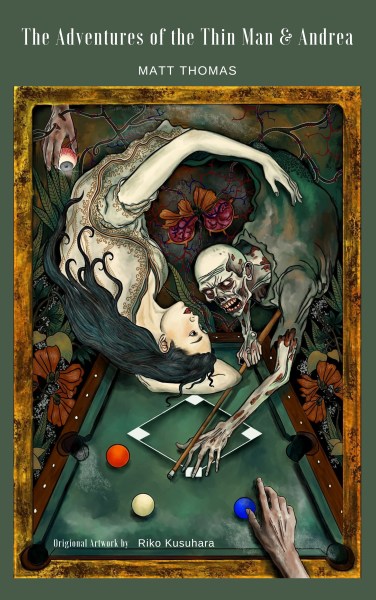
Well everyone, today is the day. My first novel, The Adventures of the Thin Man and Andrea is now available on Amazon and wherever books are sold.
This one took a while—written in fits and starts, in bars and hotel lobbies here in Kyoto—but it finally found its shape. More than anything, today I just want to thank all the readers of The Kyoto Kibbitzer, wherever you hail from; I’ve always thought of this as an ongoing conversation, and a lot of this book grew out of that exchange.
If you do pick it up, I hope you enjoy the ride—and if it lands for you, a quick review on Amazon would mean a great deal. Thank you, as always, for reading.
Note: This reflection comes out of a long-standing fascination with The X-Files, one of the most distinctive television shows of the 1990s. When it first aired, the series managed to occupy a strange and compelling middle ground between science fiction, horror, conspiracy culture, and something closer to philosophical inquiry. Week after week the show asked the same unsettling question from slightly different angles: what if the world is not quite as stable or intelligible as we assume?
What made the series especially effective was the dynamic between Fox Mulder and Dana Scully. Mulder represented the pull of belief, intuition, and pattern-seeking; Scully stood for skepticism, evidence, and scientific restraint. The tension between those two orientations created a kind of philosophical engine that powered the show for many seasons.
The major episode discussed here is one of the early “mythology-adjacent” stories that sits near the boundary between the show’s monster-of-the-week format and its deeper conspiratorial arc. Watching it again years later, what stands out is not only the eerie storytelling but also the way the series captured a particular cultural mood of the 1990s — a time when technology was expanding rapidly, institutions were increasingly distrusted, and the possibility of hidden systems operating beneath the surface of ordinary life felt strangely plausible.
In that sense, The X-Files was never just about aliens or government cover-ups. It was about uncertainty itself — the uneasy space between explanation and mystery.
Epigraph:
“Autorerotic asphyxiation is not a pleasant way to go, Mr. Mulder.”
Clyde Bruckman, The X-Files
The X-Files is my second favorite television show of all time, behind only The Wire, and it’s not close.
That may sound like a bold claim given the sheer amount of television produced over the past thirty years, but for those of us who came of age in the 1990s the show hit a nerve that very few cultural artifacts ever have. It wasn’t just entertaining. It was atmospheric. It was unsettling. It felt like it was plugged directly into the cultural nervous system of the time.
To understand why, you have to begin with a simple generational fact. I was born in 1974, just eleven short years after the assassination of John F. Kennedy. That event cast a shadow that lingered for decades. My parents’ generation and my grandparents’ generation were deeply scarred by it in ways that people my age never fully understood. Something in the national psyche broke that day. Trust in institutions never really recovered.
Historians later described this cultural mood as “The Paranoid Style of American Politics,” borrowing the famous phrase from the essay by Richard Hofstadter. Whether one agreed with Hofstadter or not, the phrase stuck because it captured a very real undercurrent in American life: the suspicion that unseen forces were operating behind the scenes.
The genius of The X-Files was that it leaned directly into that atmosphere. It didn’t treat paranoia as pathology. It treated it as narrative fuel.
Discovering the Show
I was an early adopter.
The show premiered in 1993, and by 1994 I was already watching it in the dorms at Hamilton College with a group of friends. If possible we’d get a little baked first, which in hindsight may have been perfect. The X-Files is a show that rewards slightly altered states of perception.
At first it was something of a cult discovery. A few people watched it religiously while others barely knew it existed. But by the time the second and third seasons rolled around it had become a communal ritual. Thursday nights meant Mulder and Scully.
The chemistry between the leads was immediately apparent.
David Duchovny and Gillian Anderson had what we would now call “shipping chemistry,” although that term didn’t really exist yet. We simply knew that something electric was happening on screen. The characters worked because they embodied opposing ways of understanding the world. Mulder believed everything. Scully was more skeptical. Between them the truth hovered in an unresolved middle ground.
The show was also disciplined enough to hold that tension for years. In an era before streaming algorithms and social-media speculation, viewers waited week to week to see how the relationship evolved.
Hovering over them was their boss, the enigmatic Walter Skinner. For several seasons it was impossible to tell whether Skinner was helping Mulder and Scully or quietly managing them on behalf of darker forces. That ambiguity was one of the show’s greatest pleasures.
In a delightful twist of pop-culture irony, the actor Mitch Pileggi was at one point named TV’s Sexiest Man by a glossy magazine. Which is hilarious when you remember that Skinner is essentially a bald FBI bureaucrat in a gray suit. Such was the cultural power of the show.
The Smoking Man
Then there was the figure lurking in the shadows.
The Cigarette Smoking Man is one of the great villains in television history. Played with eerie understatement by William B. Davis, he appeared whenever the conspiracy thickened.
He looks exactly like the kind of man who would be at the center of a decades-long government cover-up. Three packs a day. Cheap cologne. A lingering Jameson hangover. The sense that he spends most of his time in dim Washington parking garages and windowless offices and only emerges from his crypt when the conspiracy requires it.
It’s a performance so physical that you can almost smell the character through the screen.
Three Essential Episodes
Every long-running show has defining episodes, and The X-Files produced dozens. But three in particular illustrate what made the series so special.
The first is the pilot itself, which introduces Mulder investigating mysterious disappearances in the Oregon woods. A key moment occurs when the agents experience missing time on a dark forest road. The scene establishes the tone immediately: eerie, ambiguous, and faintly plausible.
The second is Fallen Angel, an early classic that introduces the lovable conspiracy obsessive Max Fenig. Max’s jittery paranoia captures the spirit of the show perfectly. When he remarks that “someone’s always watching, Mr. Mulder,” it feels less like dialogue than like a thesis statement.
The third is the masterpiece of dark humor, Clyde Bruckman’s Final Repose, written by the great Darius Morgan. In it, a weary insurance salesman named Clyde Bruckman discovers that he can foresee the exact circumstances of people’s deaths. Played beautifully by Peter Boyle, the character delivers a hilarious and oddly touching performance. It is Bruckman who also delivers the immortal line that also gives us our epigraph: “Autorerotic asphyxiation is not a pleasant way to go, Mr. Mulder.” Run roh. Take that belt off Fox baby.
What makes the episode remarkable is that it gently mocks the show’s own hero. Mulder spends the entire series searching for hidden meaning in the universe. Clyde Bruckman, by contrast, believes life is largely arbitrary and tragic.
His prediction of Mulder’s death—immortalized in the epigraph above—is both absurd and strangely profound. It’s also a sign that by Season Three the show had gained enough confidence to poke fun at itself.
When the Mythology Expanded
Like many successful serialized shows, The X-Files eventually struggled under the weight of its own mythology. One of the central narrative engines involved Mulder’s missing sister, Samantha Mulder. Early on, the mystery added emotional depth to Mulder’s obsession with the paranormal.
But as the seasons progressed the storyline became increasingly convoluted. Samantha might have been abducted by aliens, or replaced by a clone, or transformed into something else entirely. Meanwhile the conspiracy expanded to include frozen alien ships in Siberian ice, shadowy government syndicates, and the infamous black-oil virus that seemed capable of possessing human hosts.
At a certain point the mythology began to chase its own tail.
Then, as the final blow, David Duchovny left the show. Gillian Anderson remained excellent, but The X-Files was always fundamentally a two-hander. Without Mulder and Scully together the balance of the series shifted in ways it never fully recovered from.
Why It Still Matters
And yet, for all the narrative tangles of the later seasons, the early years of The X-Files remain extraordinary television.
The show captured a very particular moment in cultural history: the twilight of the pre-internet era, when conspiracy theories spread through late-night radio programs, photocopied newsletters, and whispered conversations rather than social media feeds.
It was a time when the idea that powerful institutions might be hiding enormous secrets still felt plausible rather than merely exhausting.
For a few seasons in the 1990s, Thursday nights belonged to the weirdest, smartest, most paranoid show on television.
The truth, as Mulder kept reminding us, was out there
Dedication
For Dana and Fox. You know we still want to know what went down in that motel room baby.
Note: If you enjoyed this essay you may also enjoy the two essays below, both of which, in different ways, take up themes of intrigue and mystery.
Note: This essay takes up my personal four favorite books from the marvelous Adventures of Tintin series. I make no claim for these to be the best, and the list omits the very popular Moon books, however this is the list as it stands. I hope you enjoy Tintin as much as I do, and as always, thank you for reading.
I first encountered Tintin in Grade 5, checking two slim volumes out of my elementary school library: The Blue Lotus and Tintin in America. I remember the physicality of them—the glossy covers, the bright blocks of color, the uncanny clarity of the drawings. They felt different from the other books on the shelf. Most children’s adventure stories required you to imagine the action. Tintin showed it to you panel by panel, with a confidence that made the whole world feel precise and alive.
Even before I fully understood the stories, I had the sense that I had stumbled onto something like treasure. The pages moved quickly. Cars skidded across city streets, gangsters hid in back rooms, deserts stretched into the distance. Tintin himself was fearless and tireless, a boy reporter who seemed capable of appearing anywhere in the world with little more than a notebook, a trench coat, and his small white dog.
But even at ten years old it was clear that the two books belonged to the same universe but not quite the same stage of its development. Tintin in America was energetic and funny but also loose and episodic, closer to a cartoon chase story than a carefully constructed narrative. The Blue Lotus, by contrast, felt deeper. The stakes seemed real. The world seemed larger and more dangerous. The book hinted at forces—politics, empire, war—that I could not yet name but could somehow feel moving behind the story.
Before going further, it’s worth acknowledging briefly the long-running controversy surrounding the politics of Tintin’s creator, Hergé. Some of the early Tintin stories reflect the colonial assumptions and stereotypes common in Europe during the interwar period, and Hergé himself worked for a newspaper in German-occupied Belgium during World War II. These facts have generated decades of debate. They are real and worth knowing. But they are also only one part of a much larger story. Over time Hergé’s work grew more humane, more attentive to other cultures, and more morally complex. For the purposes of this essay, it is enough to acknowledge the controversy and then move on to the books themselves, which remain among the most remarkable achievements in modern popular storytelling.
Mr Dreyer’s Class, 7th Grade:
Even before I took his class, I was aware that Mr. Dreyer was, let’s say, a different sort of fellow. He liked to tell a story about his brother who lived on a massive contour map of the San Francisco Bay area. The map was located in an enclosed structure that hung under a bridge in Oakland or something. And his brother just chilled there full time, so the story went. So Mr. Dreyer, apparently, was the normal one in his family.
(I remember Mr. Dreyer talking to me about John Lennon one day as well. This was maybe when I was taking his class, but I think it might have been before that. “John Lennon’s assassination was really sad,” he said, “he was just starting to put his life back together.” I had heard of John Lennon but at that time knew nothing of the circumstances of his death. And I certainly didn’t know about his ups and downs in the 1970s. Mr. Dreyer must have been a Lennon fan though, and wanted to tell me about it.)
In any case, when I got to middle school I was assigned Mr. Dreyer, as mentioned. Mr. Dreyer wore a mustache that looked pretty Frenchy to me—maybe that’s why I kind of thought he was a French native. There were also a number of the Tintin books in French on a shelf in the back of the room. I had read most of the Tintin books in English by then, so it was fun to browse the French versions and take in some of the action from a new lens.
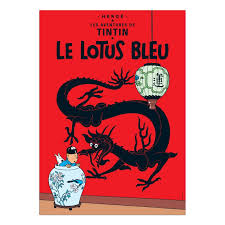
The Blue Lotus
If the early Tintin books were clever adventure cartoons, The Blue Lotus was the moment the series entered history.
The story takes place in Shanghai during the turbulent 1930s, amid Japanese expansion and international intrigue. What distinguishes the book is not simply the exotic setting but the sudden moral seriousness that runs through it. Tintin is no longer merely chasing criminals. He is navigating a world shaped by imperial ambition, propaganda, and cultural misunderstanding.
Central to this shift is the introduction of Chang Chong-Chen. Chang’s friendship with Tintin humanizes the story in a way earlier books never attempted. Through Chang, the reader glimpses the everyday life of Chinese citizens caught between foreign powers and internal turmoil. The relationship is warm, sincere, and quietly revolutionary for its time.
One sequence has stayed with me since childhood: Tintin being smuggled into an opium den hidden inside barrels. As a child I read the scene simply as a thrilling act of infiltration. As an adult it evokes something darker—the lingering shadow of the opium trade and the colonial exploitation that shaped China’s nineteenth and early twentieth centuries. Even if young readers do not consciously grasp the historical weight behind it, they feel that something serious is at stake.
With The Blue Lotus, Tintin steps out of the cartoon world of early adventure stories and into a recognizably historical landscape. The hero is still brave and resourceful, but the world around him has grown more complicated.
The Crab with the Golden Claws
If The Blue Lotus deepened Tintin’s world morally, The Crab with the Golden Claws transformed it emotionally. The reason can be summed up in a single name: Captain Haddock.
Before Haddock appears, Tintin himself is almost too perfect. He is brave, clever, and incorruptible. Admirable, yes—but also somewhat distant. Haddock brings chaos into this orderly universe. When we first meet him he is a drunken wreck aboard a cargo ship, bullied by the crew and prone to bursts of confused outrage. In his introduction scene he is literally knocked around by events, bonked on the head and stumbling through the narrative like a man who has wandered into the wrong story.
Yet Haddock quickly becomes indispensable. His flaws—his temper, his drinking, his explosive vocabulary—make him recognizably human. Over the course of the series he evolves into the lord of Marlinspike Hall, a man readers root for not because he is flawless but because he struggles, blunders, and ultimately proves loyal beyond measure.
The mystery at the heart of the story—those curious tins of crab that conceal a narcotics smuggling ring—is classic Hergé plotting. An ordinary object becomes the gateway to a hidden criminal network. But what readers remember most is Haddock: the lovable rogue who changes the emotional chemistry of Tintin forever.
Land of the Black Gold
Land of Black Gold is one of the most unusual Tintin stories, blending geopolitical intrigue with comic delirium.
The plot centers on sabotage of the world’s gasoline supply, drawing Tintin into a web of international conspiracies in the Middle East. Yet what makes the book memorable is its sense of narrative labyrinth. The trader and raconteur Oliveira da Figueira talks endlessly, spinning stories within stories, improvising explanations that seem to circle back on themselves. His rambling style mirrors the complicated, byzantine nature of the intrigue unfolding around Tintin.
At the same time, chaos erupts in the form of the child Abdullah, whose relentless practical jokes push everyone toward exasperation.
And then there is the unforgettable desert sequence in which Thomson and Thompson pursue mirages while unknowingly driving in circles along their own tire tracks. The scene borders on hallucination. Heat, confusion, and comic misunderstanding combine to create one of the series’ most surreal episodes.
Where The Blue Lotus introduced moral depth and Crab introduced emotional warmth, Black Gold revels in controlled absurdity—the sense that the modern world is a maze of conspiracies, misunderstandings, and comic misadventures.
The Calculus Affair
By the time we reach The Calculus Affair, Tintin has entered an entirely new landscape: the Cold War.
The story begins with the kidnapping of Professor Calculus, whose research has attracted the interest of rival governments. Tintin and Haddock pursue him across borders, into secret fortresses and heavily guarded territories.
What makes this adventure distinctive is the absence of a clear moral center. Earlier Tintin stories often feature obvious villains. Here the lines blur. Rival states compete for technological advantage, intelligence services manipulate events, and even the heroes seem slightly overwhelmed by the scale of the intrigue surrounding them.
Tintin and Haddock are no longer simply solving a mystery. They are wandering into the murky machinery of international espionage.
Yet Hergé never abandons humor. The action sequences—helicopter pursuits, roadblocks, sticky-tape tricks, and frantic car chases—are thrilling while remaining faintly absurd. The tension builds like a spy thriller, but the comic timing prevents the story from becoming grim.
The result is perhaps the most sophisticated Tintin adventure: a tale in which suspense, humor, and geopolitical intrigue coexist in perfect balance.
Why Tintin Endures
Across these four books we can see the remarkable evolution of Tintin.
The Blue Lotus brings the series into history. The Crab with the Golden Claws introduces human imperfection through Haddock. Land of the Black Gold revels in the comic chaos of modern intrigue. The Calculus Affair confronts the morally ambiguous world of Cold War espionage.
Through it all, Hergé’s storytelling remains astonishingly clear. Each panel advances the narrative. Each scene unfolds with the precision of a well-designed machine.
Tintin may begin as a boy adventurer, but over time he becomes something else: a traveler moving through the complicated landscape of the twentieth century. History deepens, friendships form, conspiracies multiply, and the world grows ever more ambiguous.
Yet the clarity of the storytelling never falters. That combination—simplicity of form paired with depth of experience—is the secret of Tintin’s endurance.
For many readers, the journey begins exactly as it did for me: a small book taken from a library shelf, opened with curiosity, and discovered to contain an entire world.
Note: This essay is written in the spirit of amused inquiry rather than firm conclusion. Human history is filled with reports of strange visions, unexplained lights, divine visitations, and unidentified aerial phenomena. The interpretation of such experiences has tended to shift with the cultural vocabulary of the time. Medieval Europeans often described encounters with saints or angels. In the twentieth century the language of extraterrestrials became available.
The psychologist Carl Jung famously suggested that UFO sightings may function partly as modern mythologies—symbolic attempts by societies to understand mysterious experiences in technological terms. Jung also observed, with characteristic dry humor, that UFOs often appear to be “somehow not photogenic.”
The present investigation was prompted by my brother Mike, who recently asserted via text message that extraterrestrials are currently residing in Earth’s oceans. His wife Coleen agreed. “They are everywhere,” she said. While this claim remains unverified, the oceans themselves are vast, poorly explored, and capable of sustaining a wide range of speculative hypotheses.
The purpose of the essay is therefore not to prove or disprove the existence of extraterrestrial life in the ocean. Rather, it is to examine why such ideas persist, how they resemble earlier historical visions—from medieval religious phenomena to modern UFO culture—and why the possibility continues to feel strangely plausible to otherwise reasonable adults.
Epigraph
There are aliens in our midst.
Wussy
The Jung Problem
At this point in the investigation one is reminded of a dry observation by the Swiss psychiatrist Carl Jung.
Jung noted that UFOs possess a curious property: they are “somehow not photogenic.” Sightings multiply, witnesses speak with conviction, yet the documentation remains just slightly blurry.
Jung’s larger argument was that such phenomena often behave like modern myths. They appear at moments when societies are under stress, technological change is accelerating, and people are searching for new symbolic explanations of the world.
In other words, the sky fills with things.
Medieval Precedents
This pattern is not entirely new.
During certain periods of medieval Europe, particularly when grain supplies were contaminated by the fungus ergot, communities reported vivid religious visions: glowing figures in the sky, saints appearing in fields, the Virgin Mary materializing in unexpected places.
Ergot poisoning, now understood scientifically, can produce powerful hallucinations. But to the people experiencing them the visions were not chemical side effects. They were divine manifestations.
Entire crowds could witness miraculous shapes in the heavens or detect holy images in the crust of bread. A modern observer might diagnose environmental intoxication or collective suggestion. The participants experienced revelation.
The important point is that the content of the vision reflected the cultural vocabulary available at the time.
Medieval Europe saw saints. Modern America sees aliens.
One can see this dynamic clearly in the case of Joan of Arc. Joan reported hearing voices and receiving instructions from heavenly figures whom she identified as saints.
Historians generally accept that Joan sincerely believed these visions were divine communications.
But it is difficult not to notice that saints were the most advanced category of non-human intelligence available in fifteenth-century France. The conceptual vocabulary for extraterrestrials would not be invented for several hundred years.
Had Joan lived in the late twentieth century, it is at least possible that the same experience might have been interpreted somewhat differently.
She might have reported a craft.
The Cold War Sky
By the late 1940s the heavens had acquired a new cast of characters.
The famous incident near Roswell occurred in 1947, just as the Cold War was beginning to reorganize the world’s imagination. Reports of flying saucers multiplied. The mysterious visitors were described with increasing consistency: small grey beings with large heads and enormous eyes.
The explanation most often offered by the authorities was considerably less glamorous.
Weather balloons.
Strange objects falling from the sky during the early Cold War often turned out to be classified surveillance equipment. Unfortunately, the phrase “weather balloon” never fully satisfied the public imagination.
Aliens, after all, are much more interesting than meteorology.
The Mulder Doctrine
By the 1990s the entire mythology had been carefully systematized by American television.
The X-Files:
In the series, FBI agent Fox Mulder dedicates his career to investigating extraterrestrial activity after his sister Samantha is abducted from their home during childhood.
The abduction occurs at night. A strange light fills the room. The sister disappears.
Mulder spends the rest of his life attempting to prove that what he witnessed was real.
His partner, Dana Scully, is assigned to bring scientific skepticism to the enterprise. Their relationship gradually becomes one of the most beloved partnerships in television history, built on the productive tension between belief and doubt.
Entire generations of viewers absorbed the idea that somewhere in the sky—or possibly beneath the ocean—extraterrestrial activity might be quietly unfolding.
A Modern Lens
Seen from a slightly greater distance, the pattern begins to look familiar.
Medieval villagers saw saints because saints were the explanatory language available to them. Cold War Americans saw aliens because aliens had become the new vocabulary of the unknown.
Both phenomena may reflect the same basic human impulse: when confronted with mysterious experiences, we populate the heavens with the most compelling figures our culture provides.
Which brings us back to Mike.
So Are There Aliens In Our Oceans?
It must be admitted that if an advanced civilization from another planet wished to observe humanity without attracting attention, the deep ocean would offer several practical advantages. The environment is dark, difficult to access, and rarely visited by surface-dwelling primates equipped with submarines that can only remain operational for limited periods of time.
From a strategic standpoint, it would be an excellent hiding place.
This possibility has occurred to more than one observer, including my friend Mason, who recently suggested that a technologically sophisticated off-world civilization might simply have decided that the bottom of the ocean was the most convenient place to avoid the rest of us.
Provisional Conclusions
My brother Mike believes there are aliens in the ocean.
Carl Jung might have suggested that mysterious phenomena often adopt the symbolic clothing of their era. The Middle Ages had saints. The twentieth century produced extraterrestrials.
Mike has simply moved the story offshore.
The oceans remain vast and poorly explored. The woods remain dark and occasionally unsettling at night. Both environments have the correct atmospheric conditions for unexpected encounters.
If extraterrestrials are present, they may well prefer the sea.
But it would be a mistake to rule out the woods.
In either case, it seems wise to remain polite.
Footnote: The Ocean Logic
It must be admitted that if extraterrestrials wished to establish a long-term observational presence on Earth, the ocean would offer several advantages. Humans rarely visit the deep sea, and when we do we tend to leave fairly quickly due to crushing pressure, darkness, and the general inconvenience of breathing water.
From the perspective of an advanced extraterrestrial civilization attempting to avoid unnecessary interaction with our species, the ocean may therefore represent the single most sensible real estate on the planet.
Mike may, in other words, be thinking strategically.
POSTSCRIPT: Supplemental Testimony
Shortly after the investigation began, the primary witness—my brother Mike—provided additional clarification regarding his position.
According to Mike, extraterrestrial life has not only visited Earth’s oceans but has been present there for a considerable period of time. The aliens, he explained, appear to prefer the environment and have constructed bases beneath the sea.
When asked for supporting evidence, Mike cited the well-known Navy pilot videos showing unidentified aerial objects performing unusual maneuvers.
These videos—often referred to as the “Tic Tac” incidents—have circulated widely in recent years and are frequently interpreted as evidence of advanced technology of unknown origin.
Mike considers them decisive.
A second observer, his wife Colleen, agreed with this general assessment while expanding the hypothesis somewhat.
In her view, extraterrestrials may not be confined to the ocean at all. Rather, they may be present around us at all times.
According to Colleen, it is entirely possible that aliens walk among us.
At this stage of the investigation, these claims remain under review.
Dedication: For my brother Mike. I love you bro, but I still thinks them shits are in the woods.
Note: If you liked this piece, you may also like the pieces below, which also discuss the famous psychologist Carl Jung.
Note: This piece uses the figure of George Santos as a kind of cultural parable. The story of Santos—his improbable congressional run on Long Island, the famous unraveling of his résumé (including the legendary and totally outta control Baruch volleyball claim), the rapid collapse of political support from fellow New York Republicans, his eventual expulsion from Congress, and his strange second act as a Cameo celebrity—forms one of the more surreal public morality plays of recent American politics.
The apartment story that frames the essay is not meant as a literal equivalence. Kitara is not Santos, and roommates are not members of Congress. The comparison operates at the level of archetype: the charismatic figure who arrives full of sunshine, quickly becomes central to a small social world, and then—through one small but revealing detail—forces everyone around them to confront the uneasy coexistence of charm and opportunism.
The name “Kitara,” Santos’ drag name from back in Brazil where he if from (Santos is gay of course) is used here in the spirit of narrative shorthand rather than biography. Anyone who has lived with roommates long enough will recognize the basic situation. Shared apartments are small republics built on trust, improvisation, and the quiet hope that everyone involved is playing roughly the same game. Most of the time that hope is justified. Occasionally it is not.
If the tone of the piece drifts toward amusement, and even affection, rather than outrage, that is deliberate. Characters like Santos—and the occasional fabulous roommate—have a peculiar ability to provoke both exasperation and reluctant admiration. The performance can be infuriating. But it can also be oddly entertaining.
Such people rarely disappear completely. They simply move on to the next stage.Sometimes that stage is Congress. Sometimes it is Cameo (get that scratch Georgie baby!). And sometimes it is just the memory of a roommate who once seemed almost too good to be true.
Epigraph
“People seldom do what they believe in. They just do what is convenient, then repent.” — Bob Dylan
I. The Fabulous Roommate
Every apartment has its mythology.
The quiet one who never emerges from his room except to microwave things at strange hours. The earnest one who tries to establish chore charts that everyone pretends to follow for about ten days. The one who adopts pets with a confidence that suggests the rest of the household has already agreed to care for them.
And then, once in a while, there is the fabulous roommate. Kitara was that roommate.
She arrived with the sort of personality that immediately rearranges the emotional furniture of a place. Cheerful without being cloying. Social without being exhausting. Organized without being smug about it. She seemed to understand, instinctively, the delicate social contract of shared living: when to chat, when to disappear, when to clean something quietly so no one felt guilty.
Visitors loved her. Friends who came by would inevitably say some version of the same thing: “Your roommate is amazing.”
And she was. At least at first.
She was the sort of person who made the apartment feel like a small, cheerful republic. There were occasional dinners, occasional drinks, occasional pets that appeared temporarily in the orbit of the household. Nothing dramatic. Just the easy, slightly improvised domestic life that happens when a handful of semi-adults share a roof and try to keep the machinery of living running smoothly.
There are people who move through life like that—people who bring lightness with them. People who make small environments work better simply by being present. You think, when you meet someone like this: what a lucky break.
II. The Sunshine Personality
There is another category of person, however, that resembles the fabulous roommate from a distance. These people also arrive with sunshine. They are charming. They are energetic. They seem to know how to move through rooms with effortless confidence. They shake hands warmly. They remember names. They tell stories. They radiate the sort of friendliness that makes everyone feel briefly like a co-conspirator in something cheerful.
The difference is subtle, and it often takes time to notice. These are not merely charming people.
These are the performers. And, one of the most remarkable recent examples of this type in American public life was George Santos.
Santos appeared, seemingly out of nowhere, in the political ecosystem of Long Island. His run for Congress was, at least initially, improbable in the way that many modern political stories can be. The district had long been competitive, but his rise through the local Republican apparatus was unusually smooth. There was little serious opposition within the party. The campaign itself unfolded with the sort of confident momentum that often accompanies candidates who seem, at least on paper, to possess a compelling life story.
And what a life story it was.
Santos presented himself as the son of immigrants who had risen through the financial world, a man with an impressive résumé and a philanthropic sensibility. He spoke of professional success, cultural fluency, and various achievements that painted a portrait of upward mobility and cosmopolitan competence.
The voters of Long Island sent him to Congress. And then, almost immediately, the details began to unravel.
III. The Volleyball Player
The first cracks appeared through the ordinary mechanism of local journalism. Reporters from Long Island newspapers began to do what reporters traditionally do: verify things.
The résumé turned out to be an imaginative document. The professional history did not quite match reality. The educational claims were questionable. Various details that had seemed impressive during the campaign began to dissolve under scrutiny.
One of the most memorable revelations involved an oddly specific athletic claim. Santos had described himself as a standout volleyball player during his time at Baruch College. Not merely a participant, but something close to a star—someone whose record-setting performance had been part of his biography.
There was just one problem. Baruch College had no record of him playing volleyball. None at all. Outta control. The story collapsed on that small detail. It is often the small details that do that.
A résumé can contain many large claims, and those claims can hover in a kind of vague plausibility for a surprisingly long time. But one precise, checkable fact—the volleyball team roster, the game statistics, the athletic department archives—can puncture an entire narrative.
The reporters pulled the thread and the sweater unraveled.
IV. The Grifter Archetype
Once the unraveling began, it accelerated. Claims about employment at major financial firms proved dubious. Educational credentials evaporated. Personal history mutated in various directions depending on which previous statement one examined.
Soon the story had migrated from the political pages into the broader theater of American spectacle. Late-night comedians noticed. Cable news panels convened. Social media filled with the strange, almost baroque details of the saga. Members of his own party began to distance themselves.
Several Republican members of the New York congressional delegation—figures who had initially welcomed a new colleague—publicly called for him to resign as the scope of the fabrications became clear. The situation became untenable. The House of Representatives eventually voted to expel him, a rare and historically notable step.
It was a dramatic fall.
And yet even during the collapse, Santos retained something remarkable.
Charm.
He gave interviews. He sparred with reporters. He adopted, at times, an almost mischievous tone about the entire affair. There was a faint air of theatricality to the proceedings, as though the story had become a kind of performance art about the boundaries of credibility.
The grifter archetype has a peculiar resilience. Even when the illusion collapses, the performer often remains oddly entertaining.
V. The Apartment
Watching the Santos saga unfold, I found myself thinking more about Kitara.
Because the thing about grifters is not simply that they deceive.
It is that they charm.
They charm their way into rooms, into institutions, into social networks. They radiate warmth. They build small communities of goodwill around themselves. And for quite a while, everything feels perfectly normal.
Until one day something small happens. Something missing.
In the apartment it was GM’s silver. Not a vast treasure. Not an heirloom of historic significance. Just a small, familiar object that lived in a particular drawer and had always lived there.
One morning it was gone. The initial reaction in situations like this is always practical. Maybe you moved it. Maybe it fell behind something. Maybe someone borrowed it.
The mind runs through a series of benign explanations, each one slightly less convincing than the last.
And then a thought appears.
Quietly.
Oh shit.
VI. The Knowledge You Don’t Want
Roommate life operates on a fragile form of trust.
You share space. You share kitchens. Sometimes you share pets, groceries, furniture, phone bills, music, stories. The arrangement functions because everyone tacitly agrees not to test the boundaries of that trust too aggressively.
When something disappears, the entire structure trembles.
But there is another complication.
Sometimes you realize what probably happened. And you also realize that confirming it would destroy the social equilibrium of the apartment.
So you do a strange psychological maneuver.
You know. But you decide not to know.
Life continues.
The dishes are washed. Conversations occur. The roommate remains charming. The apartment continues to function as a small republic of semi-functional adults.
But a hairline crack now runs through the arrangement.
VII. The Fall
For Santos the crack widened into a canyon.
The congressional investigation intensified. Ethical questions multiplied. Party support evaporated. Eventually the House voted to expel him, ending one of the most surreal political tenures in recent memory.
Yet even after the fall, Santos demonstrated a familiar trait of the charismatic grifter.
He adapted. He appeared on podcasts. He commented on political scandals involving others. He expressed a certain moral indignation about the ethical lapses of fellow politicians—including members of his own party—sometimes with a tone that was almost hilariously sanctimonious given the circumstances.
The performer remained on stage. And then came the truly modern twist.
Santos joined Cameo. And he’s fucking great on it!
For a fee, he would record personalized video messages: birthday greetings, congratulations, small performances of his peculiar brand of post-scandal celebrity.
The internet, as it often does, embraced the absurdity.
VIII. The Cameo
At some point I watched a few of his videos.
There he was, smiling warmly into the camera, delivering a cheerful greeting to a stranger somewhere in America. The tone was friendly, relaxed, slightly mischievous.
And I laughed.
Because the performance was genuinely funny. The charm, infuriatingly, still worked. It reminded me of the old fable about the scorpion and the frog.
The scorpion asks for a ride across the river. The frog hesitates, noting that scorpions have a reputation for stinging frogs. The scorpion assures him that such a thing would be irrational; if he stung the frog mid-crossing, both of them would drown.
The frog agrees.
Halfway across the river the scorpion stings him.
“Why?” the frog asks as they sink.
“I can’t help it,” the scorpion replies. “It’s my nature.”
The scorpion cannot help himself.
But every now and then the scorpion also sends someone a birthday message on Cameo, smiling warmly and wishing them a fantastic year ahead.
And you find yourself laughing anyway.
The truth about characters like Santos—and perhaps about certain roommates—is that their charm is not an illusion.
It’s real.
The trouble is that it coexists quite comfortably with everything else.
Dedication:
For Kitara. May you make a fucking mint on Cameo and look totally gorgeous while doing it.
Note: If you enjoyed this story, you might also enjoy these other pieces about American grifters.
Note: This essay is not an attempt to defend Ryan Adams the person. It’s an attempt to defend the continued seriousness of the music. The distinction matters, even if our cultural conversations sometimes pretend it doesn’t. Also, I fucking love Ryan Adams. He is the motherfucking man.
Epigraph:
“When the stars go blue.” — Ryan Adams
For several years now it has been socially safer to treat Ryan Adams as a closed case: talented songwriter, personal flaws, cultural exile. The outline is familiar enough that most people no longer bother to revisit the work itself. But the strange thing about Adams is that the songs refuse to cooperate with the narrative. They remain stubbornly alive — hundreds of them scattered across albums, demos, and late-night recordings — carrying the same bruised intelligence that first made people pay attention twenty-five years ago. At some point the question stops being whether Ryan Adams is an admirable person. The real question becomes harder and less comfortable: what do we do with an artist whose flaws are obvious but whose music continues to tell the truth in ways very few writers can manage?
Part of the problem is that Ryan Adams belongs to an older model of songwriting — the kind where the emotional life of the artist is inseparable from the work. The songs are confessional without being literal, personal without being autobiographical in any simple way. From Heartbreaker on to today, Adams has always written like someone sitting in the wreckage of his own choices and trying to understand what just happened. That voice — raw, impulsive, often heartbroken, sometimes self-pitying, often painfully perceptive — was never tidy. It wasn’t supposed to be. The appeal of Adams at his best has always been that the songs arrive before the moral cleanup crew.
When the accusations against him surfaced in 2019, the cultural machinery moved quickly. Adams’s shows were cancelled for a while, he was dropped from projects, and reclassified overnight as an artist whose work had become morally contaminated. Some listeners stopped immediately. Others quietly kept listening but stopped talking about it in public. The silence that followed was oddly complete. In a culture that usually thrives on argument, the Ryan Adams conversation simply evaporated.
That disappearance is revealing. It suggests that many people were less interested in wrestling with the complexity of the situation than in resolving it as quickly as possible. Once the story had a clear villain, the cultural instinct was to move on.
But the songs remain.
Listen again to Come Pick Me Up, and you hear a man cataloguing his own emotional incompetence with surgical clarity. Oh My Sweet Carolina still carries that strange mixture of homesickness and resignation that only a handful of songwriters ever capture. Later work — Ashes & Fire, Prisoner, Chris, the better moments of the sprawling archive that followed — continues the same project: the slow documentation of a person trying, often unsuccessfully, to live with himself.
None of this absolves Adams of anything. It doesn’t erase the accounts of people who describe him as manipulative, volatile, or worse. If anything, the songs themselves suggest that those accounts are not entirely surprising. Adams has been writing about his own volatility for decades. The records are full of it — jealousy, insecurity, emotional chaos, the constant sense of someone struggling to regulate the intensity of his own personality.
What the songs also reveal, though, is a rare level of self-awareness about his own condition. Adams’ best work doesn’t present him as a romantic hero. It presents him as part of the problem.
And that distinction matters.
One of the stranger habits of contemporary cultural criticism is the belief that the value of a work of art should track the moral cleanliness of the person who made it. This is a comforting idea, but it collapses under the slightest historical pressure. Much of the art people still revere emerged from personalities that were messy, selfish, unstable, or worse. Songwriters, perhaps more than most artists, tend to write directly from the fault lines of their own lives.
If we demanded perfect character from every songwriter whose music we admire, the history of popular music would shrink dramatically.
The more interesting question is not whether Ryan Adams deserves redemption. That is not something critics or listeners are qualified to grant. The question is whether the songs themselves still carry meaning once the mythology surrounding the artist has been stripped away.
In Adams’ case, the answer seems to be yes.
The songs are still precise. The emotional details still land. Lines that once felt like romantic exaggeration now sound more like documentation — the sound of a man who understands, perhaps too late, the patterns that keep repeating in his life.
There is something oddly honest about that.
The best Ryan Adams songs have always sounded like dispatches from someone who knows he is partly responsible for the wreckage he is describing. They are not pleas for sympathy so much as attempts at recognition — moments where the singer steps outside himself long enough to see the pattern clearly.
That is why the music persists even when the cultural narrative surrounding it has hardened.
The songs were never about innocence. They were about self-knowledge.
And self-knowledge, even when it comes from flawed people, is still one of the things art is uniquely good at revealing.
Dedication
For Ryan, one of the five greatest songwriters ever and the motherfucking man. I love you baby.
Note: If you like this essay, you may like these others in the same “In Defense Of” series.




 The Kyoto Kibbitzer