Scenes from Hamilton College II: Freshman Year Continued (with cameos from Honey, the Print Shop, and Billy Bragg)

Note: In Part I of this series I wrote about my freshman year at Hamilton, focusing on two friends, Ian and Jake. Part II will branch out and cover a fairly wide, and somewhat random, set of memories.

Epigraph:

I had an uncle who once played for Red Star Belgrade
He said some things are really best left unspoken
But I prefer it all to be out in the open

Billy Bragg

I have already written quite a bit about the characters who lived in the North Dorm freshman year at Hamilton, however there are a few more to cover. First were the first floor stoners. Basmo was a stoner, and he lived on my side of the dorm, but on the other side of the first floor lived the hardcore stoners. This consisted of a quad of guys whose names I don’t totally recall, but one was Peter Kimber, and who got baked at all waking hours and played Roger Waters’ Amused to Death solo on repeat. Next to them, in a double I believe, lived Keys. Keys’ actual name was Caleb, but everyone called him Keys because of the six to eight keys he had dangling from around his neck at all times. What on earth did he need all those keys for? One for the dorm, maybe one for a car (although he should not have been driving at all because he was the single biggest stoner in the dorm and perhaps on campus), what else? I can’t imagine.

Keys and I were not that close, but I did see a lot of him because we had the same job, which was in the school print shop. I don’t know if print shops still exist in the same form in this digital age, but back then the print shop was busy as. We held the campus down. There were two slightly older women who worked at the print shop full-time and three of us students helping out. The full-timers were Sally and Deb. Deb was the boss, and she was kind of motherly and kind to the students. Sally was nice too, but she could be tough. She would bark at us when we made mistakes, which was often because we were running large machines that would glitch pretty frequently. Sally was both the little sister to Deb and also the enforcer. I liked them both, even though Deb ended up firing me, which I’ll get to later.

So Keys would come in lit every day and sort of fumble through his work, which consisted mostly of stapling and collating. I was trusted more than Keys, with good reason, so I ran the machines, but I also did stapling and collating. We printed things for professors, menus for the dining halls, the school newsletter, and a bunch of other stuff. The third student was a girl whose name I don’t recall, and she was a super-hardcore feminist. Everything in the world that was wrong was men’s fault, and it was her only topic. She didn’t seem to dislike me so much as just want to lecture Keys and I all through work, which usually lasted two to three hours in the afternoon, about the ills of men. I was, and am, up for a little feminist theory but Keys was no help and I don’t even think he noticed her, so it was kind of just me and her. Serious feminism and collating are, perhaps, not best paired.

I didn’t originally want the print shop job. I needed work, and there was kind of an intake for all working students where you put your first choice. I put library, but didn’t get the gig. John Innes put audio/video and he got it, which meant he often had to get up early to set up videos for professor’s classes. I would not have been good at that. The print shop was more my speed, but eventually it got really repetitive and I started skipping work more and more. I would go walk in the woods behind campus, or just drink coffee with about a half cup of honey and hang around after class. I also improved as a student through the year, and took my English classes pretty seriously so I was spending more time in the library, although still not sleeping much.

My money situation was tight, although not as bad as it would later be during my junior year abroad in New Zealand where it was super tight. I had a little income from the print shop and my parents sent a small allowance once in a while, but I usually didn’t have more than about 15 bucks in my pocket at any one time. What money I did have went mostly to CDs, as many as I could afford. I had a dining hall pass, but the dining hall food was not really my style so I mostly lived on toast and coffee with honey. Then at night people would order pizza from a local shop, but that was too expensive for me so I would get “friend dough.” Fried dough is just what it sounds like–deep friend pizza dough with powdered sugar, and it cost about $1.50 for a big box. Not the best diet, but it was what I could afford.

One time the father of one of my classmates from high school visited for some reason; he must have been in the area. We met for lunch, and when he left he handed me $100 bucks. This was a serious windfall, and I immediately blew it on CDs, perhaps Neil Young’s Harvest Moon and others. My CD collection, although no rival to Ian’s was slowly increasing and I liked it.

Back in the dorm, in addition to the guys I have discussed, there were also girls, who lived on the second and fourth floor. I got to know the girls directly above us on the second floor pretty well, although not many of the others in the dorm. Among these was Rochelle, who was the girl I was closest to. Rochelle was, I think, from New York, and when she arrived on campus she made a big deal about having a boyfriend. This didn’t last long however, and although I didn’t want her to be my girlfriend I did like hanging out with her. She kind of mothered me a bit though, which I wasn’t so into, because I was going to do what I was going to do. I still have her contact, and I believe she might even read this piece! I think I also met Marie Bishko freshman year, and Marie is someone I thought was really cool.

I don’t really remember any us North guys hooking up with the second floor girls, but it must of happened. Another incident which occurred around this time had to do with my roommate B. and his girlfriend from high school. Like Rochelle, and even more so, he made a big deal of his girlfriend and told us all kind of semi-salacious details. Then one day he told us she was coming to visit and he wanted the three of us in the quad to go to a hotel for a night. I told him sure, if you pay, but he said no. He was dead serious but we told him to forget it, so sure enough she arrived and they hooked up while we all pretended to sleep. That only happened once, thankfully, and it still strikes me as pretty odd. He later broke up with her and fell in love with a Jewish girl, but that didn’t last either because he wasn’t Jewish.

I mentioned in Part I that Jake pledged the fraternity Sig. Ian and John Slack also pledged, Chi Psi (I had to Google the spelling). I spent some time at Chi Psi as well as, where I was alleged to sit on the steps in my trench coat, but I preferred Sig. There was another frat called Deke, and that was where the wildest, and the worst parties were. At Deke there was copious amounts of Milwaukee’s Best (the fabled Beast) and jungle juice. The parties were terrible, but there was a pool table which was a bonus. I didn’t drink much at college, mostly because I had no money, but I did drink some at Deke, with exactly the results you would imagine. I believe it was at Deke where Marc Campbell pulled off his famous pacification move. I didn’t pledge a frat, and I was and remain glad I didn’t. Greek life wasn’t for me.

One guy who I believe lived in North was called Gabe. Gabe was super popular at first in freshman year, and he played guitar on the grass outside the dorm. He was pretty good and he would play “Sexuality” by Billy Bragg which was surprisingly popular in 1992. People, including girls, would flock around him, but over time something seemed to happen to Gabe. He ran for class president and lost to a guy called Kerry who was African American. Kerry lived down the hill in a different part of campus, and he ran really hard for the job. I think Gabe’s ran mostly on a music ticket, and although he got a lot of votes I think he came in second. He may have taken this hard, because he kind of faded into the background, or maybe he just changed up his action. I think I voted, but may have voted for Kerry.

As I mentioned, Jake and I saw less of one another once he started pledging, however we still saw each other in English class and in the English building. We overlapped professors, although he knew some I did not. The two best professors in the English department were George Balkhe and Fred Wagner. Balkhe was still in his prime, maybe late 50’s, whereas Wagner was older and I believe in a semi-emeritus role. I wasn’t even sure I ever took a class from Wagner, but it’s been confirmed that I did, Modern British and American Drama, which makes sense. I didn’t much like 20th century American plays, as plays are mostly blueprints anyway. In any case, Mr. Wagner knew me early in the year because Balkhe praised my reading knowledge to him. Jake and I would go to Wagner’s house, also down the hill toward the town of Clinton (the closest town to Hamilton, about a 15 minute walk), and I recall once we played him the song “Marlene Dietrich’s Favorite Poem” by Peter Murphy, formerly of Bauhaus, with Peter Murphy murmuring “sad-eyed pearl and drop lips…”

Peter Murphy is super underrated by the way, and Wagner liked the song, which just showed how cool he was.

I took a few classes with Balkhe, and we studied poems, and novels–typical choices mostly. I enjoyed these and read most of them, even Faulkner who is really dense. For the ones I didn’t I just faked it. Like I said, Balkhe thought I was amazing because on the first day of class he asked for a list of books we had read and I listed like 200. These were mostly Agatha Christie and John LeCarre and such, but I guess it was good enough. Balhke liked the singer Donovan and the song “Mellow Yellow.”

Electrical banana
Is gonna be a sudden craze

(I later saw Donovan at a new age convention in Boston when I was visiting Ian after college, which I will recount later).

Wagner and Balkhe are both passed away now, so rest in peace to two great English teachers and mentors.

That’s about all I have on freshman year. The last thing is about the featured image for this post, which is the album cover for Bob Dylan’s Oh Mercy. I have written about The Pogues quite a bit, but the album I listened to most freshman year was Oh Mercy. After geology class had a break before lunch and would go back and semi-sleep to Oh Mercy. The quad was always empty at that time of day, and this was the best rest I would get. The album still makes me sleepy to this day, and features excellent production from the famed producer Daniel Lanois. So thank you Bob and Daniel.

Dedication: For Fred. And for George–I hope you are enjoying a little electrical banana up there in heaven.

to be continued…

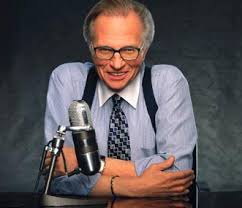
On Larry King, the Radio GOAT

Epigraph:

“I listened to the radio / I waited all night long…”
— Radio Radio, Elvis Costello

Note: This piece reflects my personal memories of listening to Larry King’s overnight radio show in the late 1980s and early 1990s, along with later impressions from television appearances, interviews, and conversations with people who knew him. It is written in the spirit of appreciation and nostalgia rather than media criticism, and emphasizes the uniquely loose, humane, and unpredictable quality of King’s radio work, which for me remains the defining core of his legacy.

I grew up listening to Larry King’s overnight radio show between roughly 1988 and 1992, and in my opinion — which happens to be correct — the radio show was much better than the television version that later made him famous. The TV show was good, even great at times, but radio was longer, looser, freer, and far more unpredictable. It had weird guests, weirder callers, and the feeling that anything might happen at two in the morning. That’s where Larry really lived.

I would listen in my bedroom at my parents’ house in Spokane, Washington, the volume turned low, the house quiet, insomnia hovering. The Spokane AM station — KGA 1510 — carried the show from around 9 PM Pacific time, and then, wonderfully, they would run it again. So I’d listen from nine to midnight, fade, wake at two or three, and hear the same segment again in a half-dream. The effect was surreal. Didn’t I just hear that caller? Didn’t Larry just say that? It created a strange loop of late-night déjà vu that only made the whole thing more atmospheric. The show felt less like programming and more like a continuous nocturnal conversation.

My friend Kelly Rudd loved Larry too. When we were in high school we were both big fans of the radio show, and we talked about it constantly. There were a couple of things that we especially liked. The first was that Larry famously did no preparation. He knew a huge amount about the world, of course, but he didn’t read guests’ books ahead of time. He wanted to come in cold. If his guest was a firefighter, he’d ask, “So what’s it like to be a firefighter?” It sounds lazy, but it was brilliant. By staying open and getting out of the way, he let the conversation go anywhere. This way the show became eventful.

Another thing we loved was what happened after the guest left. Larry would open the lines and take questions about absolutely anything. Most of the time he was generous and patient, but when callers went off the rails he had a signature phrase. He’d cut them off gently: “Cold compress, ma’am,” or “Cold compress, sir.” Basically: lie down, ice your head, regroup. It was hysterical, especially because he used it sparingly. When “cold compress” dropped, you knew things had gotten weird.

Anyway, Kelly and I loved Larry so much that when the station suddenly dropped the show, Kelly proposed we drive to the radio station and protest. So we skipped school, drove across town, and rang the intercom demanding to speak to someone about the cancellation. The station manager eventually came down and heard us out. We knew we weren’t changing anything, but it felt right to try. Larry never came back to Spokane radio, and the show faded not long after, but the whole episode captured what the show meant to us. It wasn’t just background noise. It felt alive.

Larry’s on-air style was the key. He was unbelievably relaxed. By the late ’80s you could tell he had done thousands of hours. Nothing fazed him. Weird guests, drunk callers, eccentrics — all the same to Larry. He absorbed everything. He had pet phrases — “cold compress” chief among them — and he deployed them like a veteran reliever, only when needed. He famously did no prep, and he leaned into naïve questions. He’d ask something simple and let the guest do the work. The effect was disarming. People opened up. He also had real humanity. He listened. He didn’t mock callers. He didn’t rush them. There was compassion there, and I think that’s what I loved most.

And the show could get wonderfully out of control. In one story Larry told from his old Miami days, an adult actress he was interviewing suggested they just have sex during the commercial break. Larry, amused, asked the producers to clear out — but there wasn’t enough time. That kind of anecdote captures the looseness of late-night radio. It wasn’t polished. It was alive.

Larry left the overnight Mutual Radio show in 1994 to focus on television. By then I had already drifted away, but I still caught Larry King Live on CNN over the years. I remember watching during the O. J. Simpson trial while at Otago University in New Zealand, when the show became part of the nightly noise. Later there were the Vladimir Putin interviews — classic Larry, conversational and oddly disarming. And of course there were the great comic moments, like the interview with Jerry Seinfeld where Larry suggested the show had been canceled and Seinfeld snapped back in disbelief, and the Norm Macdonald appearance where Norm kept repeating, “I’m a deeply closeted homosexual,” and Larry tried earnestly to parse it. “So that means you’re gay?” “No, Larry,” Norm replied, “it means I’m deeply closeted.” Pure Larry: sincere confusion meeting absurdist comedy.

Larry’s personal life was famously complicated. He married eight times, had several children — including sons Chance and Cannon later in life — and lived in a kind of perpetual romantic improvisation. The marriages came and went. The last ended painfully and publicly. He once joked he’d never leave his wife unless Angie Dickinson came along — and when she did, he married her. That was Larry: impulsive, affectionate, slightly chaotic. Despite decades of success, he didn’t leave the kind of massive fortune people assumed. The money came and went, as did the marriages. It was a life lived in motion.

My friend Sergio Mandiola actually knew Larry in his later years in Los Angeles. Sergio was running an independent studies program at Beverly Hills High School, and Larry’s sons Cannon and Chance, and he taught his sons for three years. Larry would come by for open nights or just to chat.

Sergio Mandiola: “Larry would come in from time to time and we would talk. He was lovely and open. He talked about his family and his career. One time he told me, ‘Sergio, you should totally have a radio show!’ I was flattered. One thing about Larry is his politics were more to the left than he let on on air. He had strong views and wasn’t afraid to share them in person. Larry was a true mensch and I’m glad I got to spend time with him. I miss him.”

In the end, I’ll say it plainly: for me, Larry King is the radio GOAT. There was no one like him, and there probably never will be. It wasn’t just longevity. It was the curiosity, the looseness, the humanity, the love of people, politics, baseball, and life. He trusted the conversation. He let the night unfold.

And then there was that absurd, wonderful USA Today column, which read like a diary gone completely outta control. Mets lose 6–4…Rain in Baltimore…Clinton flies to Ireland…You’d read it and think, Larry, baby, WTF is this? And also, Mr. USA Today, WTAF are you doing paying for this? But somehow it worked. It was pure Larry — fragmentary, observational, intimate.

And that’s how I remember him most clearly: late nights in high school, the radio turned low, insomnia hanging in the room, Spokane quiet outside.. Sometimes I’d listen from nine to midnight, fade, then wake again to the rerun, half-dreaming, half-aware, caught in that strange déjà vu — didn’t I just hear this? — while Larry kept talking, calm as ever, taking calls from truckers and insomniacs and eccentrics. My listening years were brief, but they stuck. And when I think of Larry now, that’s where I go back to: the low hum of AM radio, the half-fade, and the sweet sounds of his voice in my ear.

Dedication:

For the one and only GOAT, Larry Motherfucking King. RIP baby.

On Coming Through

New Note: This essay sits roughly in the middle of my writing life online. By the time it was written I had already spent several years experimenting with ideas and forms in earlier blogs—first Classical Sympathies, which was more academic and literary in tone, and later Jungian Intimations, which tried to bring Jungian psychology, symbolism, and dream material into a more personal register. Both projects were attempts to understand the terrain of the mind and the pressures placed on a thinking person trying to live inside modern institutions.

“On Coming Through” belongs to that same line of inquiry, but it also marks a turning point. At the time I felt strongly that one phase of life—what might loosely be called early adulthood—was coming to a close. The essay reflects an effort to make sense of that closing: the roles I had played, the ambitions that had driven me, and the ways in which those ambitions both clarified and constrained the direction of my life.

The language of Jung, Hollis, and Rudhyar appears throughout the piece because those writers were the tools I was using at the time to think about cycles of development, identity, and what Jung famously called individuation. Looking back now, some of the terminology feels a little grand, but the underlying questions remain ones I still care about: how a person develops a provisional identity in youth, how that identity eventually exhausts itself, and how one finds the courage to begin again.

In hindsight this essay also foreshadows something that had not yet fully taken shape for me: the idea that writing itself might become the primary vehicle through which I would explore those questions. The project I mention near the end—“Where I’m Coming From: A Straight Answer to the Smart Kids”—was never completed in the form imagined here. But in another sense it never really went away either. Many of the later essays I would write over the following decade, including those that eventually appeared on The Kyoto Kibbitzer, are variations on that same impulse: to record honestly what it feels like to move through the world as a reflective person trying to make sense of culture, relationships, and the shifting terrain of the self.

For that reason I have left the essay largely as it was originally written. It captures a particular moment in the middle of the journey—after the early experiments of Classical Sympathies and Jungian Intimations, but before the more narrative, outward-facing voice that would later emerge. Seen from that vantage point, it reads less like a conclusion and more like a bridge between phases of thought and writing.

Original Note: This little piece is a lightly structured meditation on aspects of the past and clarification of intentions concerning the future.  It appends my previous statement of intent from four years ago (posted below).  Although there is some continuity of concern, specifically around the nature of the demands that playing a role or roles in society places on the individual actor, and some continuity of theory through the continued influence of Peter Berger and Thomas Luckmann, hopefully there is some new material and new thinking as well.  I should acknowledge a debt to several writers whom I have read intensively over the past four years: most especially this piece bears the fingerprints of Carl Jung, James Hollis, and Dane Rudhyar, and many of the ideas here would not exist, or at least not be as fully articulated, without their assistance.  I should also acknowledge that I have been experimenting with different means of writing, different approaches to producing a text, and to the extent that anything herein bears traces of the spirit I can claim no credit.

Epigraph:

“I wanna dedicate this to someone out there watching tonight, I know she knows who she is.”

Bob Dylan, spoken introduction to “Oh Sister.”  From the bootleg record “Songs for Patty Valentine.”

Today I feel as if I stand at the edge of a new world.  The journey through early adulthood has drawn itself to a close, in stages, over the past several years, and I am alive to the fact that a new journey must now be set out upon.  In order to face any new journey properly, with intelligence and intention, we are called upon first to recognize the altered nature of the landscape we will make our way across in the new phase.

The longer I live, the more I understand the words of Ecclesiastes, “to every thing there is a season, and a time to every purpose under the heavens.”  Each era of our lives, each season, sometime even each week or set of weeks, seems to take on a certain coloring and certain characteristics that differentiate it from what came before, just as each zone of time seems to require different things of us.  The strength of our intention and will, as well as the quality and effectiveness of our reactions and decision making, are forever put to the test in small ways, and large ones, and we are forced to define, if only to ourselves, the nature of our relationship to our surroundings, our community, our dharma, our fate.

When we are young, time seems to stretch on almost indefinitely.  The summer of my eighth year, for example, was experienced as a vast expanse of almost undifferentiated time; two or three weeks would pass in a barely conscious haze of biking around my parent’s property, hiking and collecting stones from quarries in the area, or sitting on the roof in the sun, a child in the flow of nature, without “problems” of his own.  Looking back on such a period today, it indeed has a coloring of a kind, and this coloring is so loaded with low-grade nostalgia and barely remembered circumstances that my memories exist not so much in the form of events, rather in the form of a “feel.”  I have a sense of what it felt like to be eight, a sense of the patterns into which life energy fell or was collected, pooled, also a sense of my budding interests, which would in time round into what we are pleased to call “personality.”  There was nothing specific that I was “up to,” and I never had the need to think more than a day or so in advance.  The expression of my energy was essentially aligned with the desires of my heart as much as at that age we can know these at all–or perhaps that is just the point, in a state of primitive unknowingness we are naturally and effortlessly aligned with the desires of our heart, and only when we begin to have to analyze or ask after these do we begin to lose connection with them.

As we grow, the process of socialization begins to crowd in on us, and no person, no personality, is wholly free from the pressures of socialization, of collective expectation, of the reactive categorizations and projections of the always slightly behind-the-curve zeitgeist.  Depending on our own type and manner of apprehending the world as it appears to us, we react and position ourselves in some relation to, at some angle toward, the categories and projections that surround us.  Indeed, both the conformist and the rebel define themselves in relation to and reaction to “the system,” and in many ways their respective positioning is far more similar than otherwise.  Dane Rudyhar makes this point clearly, as do, in more elliptical and elaborated terms, Berger and Luckmann.  Even those (myself for example) who purport or imagine to be able to live outside of collective expectations, to create their own life and write their own script, yet define themselves primarily through the categories that the zeitgeist makes available–it takes work, huge, lasting work, to even begin to transcend one’s era and circumstance in even the smallest part.

The first part of life is necessarily a struggle to find one’s footing in the swim of society, to demonstrate value, usefulness, and the ability to check whichever boxes one is asked to check.  Occasionally, we meet someone who in significant ways seems to have wrenched herself free of some of this static at an earlier age, but even such persons habitually define themselves in terms of existing categories and remain to some extent still a prisoner of them.  For most of us, the child turned young adult, buffeted by external events and demands, adjusts herself over a period of years by applying her core characteristics, tendencies, and abilities to the game as it seems to present itself, and in the process slowly relinquishes immediate touch with that inner voice that provided direction to the child of nature who knew instinctively what was and wasn’t good for her, what was and wasn’t desirable.

At the same time, the goals that one identifies for oneself in youth are not to be lightly dismissed.  They do often provide a symbol sufficient, to borrow Jung’s phrase, to drive libido up a gradient steeper than nature; one learns to accomplish “work,” and to appreciate both the material and ego-related satisfactions that comes from this accomplishment.  Jung says as much when he tells us that it is essentially heathy and necessary when a young person becomes “entangled with fate” which “(involves) him in life’s necessities and the consequent sacrifices and efforts through which his character is developed and his experience matured.”  This dance with fate leads us into a variety of positions and stances, some of which we may carry out with grace and ease, others of which require contortions which we preform without a clear sense of the relationship between the presented or required form and our ability to functionally engage with that form.

Under the pressure to make something of ourselves, to build a career, a business, an image, a body of work, to make more of time by trying to subdue it, we may come to feel that we have found the game, we are on the fast track, we are properly situated under the stage lights, playing the part as it is supposed to be played.  A little light, a little attention, these things classically and nearly inevitably lead to a degree of what Jung calls “inflation,” the expansion of ego-consciousness and the over-identification with the product of one’s work in the world as the summum bonum.  The small still voice of the spirit recedes, or expresses itself through fantasy and other forms of idle ideational free association–fantasies of setting out to sea, of starting over with a new name in an unknown land, of being orphaned and having to fend for oneself, intriguing as these dreams may be they most often serve to cement through counterpoint the existence we actually live out and the style, or lack thereof, in which we do so.

My favorite singer, Matthew Houck from Phosphorescent has a song called Los Angeles where he describes the deeply ambivalent relationship one can have toward one’s accomplishments in the world.  He sings:

The road is alive/ And everybody’s all here/ I’m closing my eyes/ Till the colours appear/ Oh me oh my/ Ain’t it funny up here/ To stand in the light/ Said I ain’t come to Los Angeles just to die

They told me my eyes/ Would never be clearer/ To hold on to mine/ Make good money out here/ They told me those lies/ Just a grinning from ear to ear/ They said ‘here is our offer, ain’t it fine’

Are you getting a lot of attention now/ Are you bleeding in every direction now/ Are they covering you up with affection now/ Are they giving you a lot of attention now…Said I ain’t came here to Los Angeles, baby, just to die

I know, in exquisite and painful detail, exactly what Houck means (or I know exactly what he means to me, which is all the audience can ever really claim to know).  He means that when you bring your interior goods, your art, your vision, your beauty and light, out into the public eye and when some part of that is seen as having value or serving the purposes of established interests, an offer is made whereby your specific value, your original genius and spark, is rewarded at the same time as it is strangled, rewarded through exposure and compensation, and strangled as established interests nearly always (but perhaps not absolutely always) want and need to tie you to a set of projections and definitions that have already taken external form and are recognized as valid, and therefore commodifiable, categories.

At the same time, the singer in this equation is not without culpability in the narrowing of his own genius.  He knows that the kind of attention he is getting is dangerous for him, that it threatens to bring out his worst tendencies, his tendency toward excess, and to distance him from the source of his own art, but he is getting a little addicted to the attention, to the light.  The paradox, or trap, turns out to be that it is very, very difficult for a younger person in the first flush of ego-development to stand in the stage lights for too long without beginning to mistake this external light for the light inside.  Although the singer is trapped, he recognizes the trap, recognizes that he is dying out there, and the song remains hopeful, hopeful that the singer will be able to relocate the reasons for coming to Los Angeles in the first place.  After all, if he didn’t come all the way to Los Angles just to die, he came for some other purpose.

However, what the singer maybe does not recognize is that sometimes a death is necessary in order for life to begin anew.  Most ancient cultures, perhaps all, practiced sacrifice, and the idea at the heart of sacrifice is precisely this–new life follows inexorably from the exhaustion of the old.  The ancients, being literal minded and without the ability to metaphorize as fully as humanity has since learned to, could only see this sacrifice as taking physical form–thus human and animal sacrifice entailed actual bloodletting.  The story of Issac in the Bible, as well as the story of Job, are in fact kind of metaphors for a psychological hinge point in the development of consciousness among the people of the ancient Eastern Mediterranean, a development which eventually led, among other things, to the dwindling of the use of such literal forms of religious sacrifice, but the core idea remains in our present culture in all sorts of places.  (Indeed, much of the Old Testament deals with the development of what we call “consciousness” and the alterations in the character of the Old Testament god mirror alterations in the fundamental psychological character and mentality of the swim of generations over a period of several hundred or a thousand years leading up to to the birth of Christ.)  That is kind of another story, so let us just say that all nature seems to be structured around cyclicality, not so much linearity.  From the ashes of the old comes the living spark of the new.  

The above outline of the first flush of adulthood and its inevitable compromises is not original to me, and those who have looked honestly and hard at the development of the human life have set out this process much more precisely.  James Hollis puts it this way: “What I have called the middle passage arises from the collision of the provisional personality–that group of behaviors, attitudes toward self and other, and reflexive responses which the child is obliged to assemble and manage its relationship with an all powerful environment–with the insurgency of the natural, instinctual Self (…) The passage is experienced as an enervation of the former way of seeing oneself or of one’s functioning in the world (…) The exhaustion of the old is the occasion for the advent of the new, though we are seldom pleased to suffer that death which is necessary for older values to be supplanted.  In fact, one may wander, alone and afraid, for a very long time in the great In-Between before a new psychic image will arise to direct libido into the required development channel.”  Enervation means weakening, loss of vigor, and what Hollis points to in his description of mid-life is a kind of inflection point that I think actually occurs periodically through life, a juncture where one is obliged to examine that agglomeration of the “provisional personality” and the diminishing returns it may be receiving.  Once again, constructing an effective set of behaviors and approaches to the work of life turns out not to be a fully linear process, rather it seems to be cyclical and to necessitate periods of emptiness and exhaustion as well as periods of zenith and culmination.

The last three years of my own life have been but stages toward the exhaustion of this provisional personality.  A character from the television show “The Wire,” explaining to another character that when he says he is ready he means it, says something to the effect of: “you have no idea what I had to do to get to where I am today.”  To the extent that I have embodied and carried out my statement of intent from 2010, I can with some justification say the same.  Being in a position to say this is not necessarily the most pleasant place to be, and I cannot really recommend my process and progress through the proverbial belly of the whale to anyone, certainly not to anyone with a faint heart.  However, along the way I have been blessed, there is no better word, to have met extraordinary people who have given me essential clues as to from where and in which direction my second journey would launch.  I have also been fortunate beyond all measure and worthiness to have received several “big dreams,” and if this indeed characteristic of the stellium in my astrological ninth house (Rudhyar writes that a ninth house person will be drawn to “whatever expands a person’s field of activity or the scope of his mind–long journeys, close contacts with other cultures and with foreigners in general, and (…) ‘great dreams'”) I will take it.  Finally, through periods of intense work and strain which have combined, sometimes combustibly and unpredictably with both great people and great dreams, my consciousness has pulsed or rippled open a fraction, in the process integrating to some extent my inferior functions, first feeling, and then, more challengingly, sensing.

Coming to terms with one’s inferior functions is an essential part of coming to terms with one’s limitations, as these are much the same thing.  However, in some mysterious way that I can barely begin to name, I feel as if I am carrying, and trying to pay off, a larger karmic debt of some kind.  To be honest, I don’t even know how to begin to write about this.  Two years ago, in the autumn, I consulted a humanistic astrologer based in the United Kingdom.  Very well known in her field, she turned out, over Skype, to be deeply learned as well as deeply open and generous.  Her reading was strong, interesting in every respect, but still it was a reading–she has a professional method which she applied with ease and confidence.  Except in one respect–twice during the reading she stumbled, paused, lot her train of thought and said that she couldn’t put her finger on something.  The first time was when she said that I was on the verge of leaving behind an ancestral inheritance 500 years in the making.  She didn’t know what this was, but said it was in my bloodline.  Thirty minutes later or so she cycled back to it, saying she couldn’t make it out but that I was poised to see something or break out of a way of reacting or thinking that had held back my ancestors for generations.  Her reading took place a few months after my inheritance dream, which occurred in the summer of 2011.  Here is the dream:

My father is due to receive an inheritance, and his acceptance of it somehow enables others (his extended family) to also share in the inheritance.  My mother is telling me this in a darkened bedroom with my father outside the door.  She doesn’t want him to hear that she is telling me this, and keeps lowering her voice.  I get the impression that my father’s portion of the inheritance is relatively small, but somehow his taking of it is key to everyone’s access.  While at first I think that it is only a medium sized inheritance, suddenly the television comes on and begins to give more backstory.  It turns out, according to the program, that my father is attached, in a roundabout way, to one of the largest fortunes in the world, and one that is intimately connected to shadowy political power in some unnamed European countries (perhaps Germany, Austria, but spilling westward as well).  The program is a fairly typical expose of networks and hidden hands behind the throne, but nonetheless absolutely riveting.  There is a single male figure at the center of this network, shown briefly in the dream standing behind a spokesman who is speaking into a microphone.  This takes place on a lawn in front of a large and well-to-do house, but both the male figure and the house appear relatively normal and not obviously terrifying or malevolent.  My father’s reluctance to take up his inheritance thus represents a reluctance to involve himself in the political power networks, but the program makes clear through implication that failure to take up the inheritance poses a danger both to himself, and perhaps to my mother and myself.  Much or all of the action in the dream takes place indirectly–through implication or (literally) through a screen.

Humankind being a pattern seeking animal, of course I immediately connected the two data points with a third, the moment in which Ruth Van Reken, the author of “Third Culture Kids” and basically co-founder of this field of study, told me in a hotel lounge in Singapore in March of that same year that god had a mission for me, and a fourth, a quiet but persistent inner voice telling me I had a gift that was not being fully given to others, a gift I was holding inside, that I had another gear, that perhaps I hadn’t come to Los Angeles just to die.

What, in hindsight, I was dealing with and trying to make sense of was in fact Hollis’ insurgent self, a self which was seeking a new psychic image, a new core myth around which a fresh tapestry of charged energy could be woven.  I was living Jung’s individuation, or it was living through me.  This quest was apparent as the subtext to the inheritance dream, and many others of that period.  After writing down the inheritance dream I commented as follows:

There is a lot of context for the dream, best summarized as a fluid and somewhat wild/ chaotic/ noisy social night scene.  This kind of backdrop is quite common in my dreams, so much so I am inclined to refer to my ‘long night dreams’.  These usually take place over several ‘hours’ and spill late into the night or early morning.  They generally build through escalating events/ imagery and crystalize in a single memorable and stirring image.  The dream about an inheritance is in this larger category, but the specific incident in question feels broken out of its immediate context and stands alone in the dreamspace.

Another memorable long night dream from a slightly earlier period culminated in a scene where I came upon a group of revelers around a bonfire, deep in the forest, swinging in hammocks or dancing unrestrainedly some hours after midnight–maybe two in the morning.  Although I was not, knew I was not, of them, I longed to join in their joyous communal frenzy.  This image of a revelry around a bonfire possessed an energetic charge that animated all that came into contact with it, in other words this image, the image of the inheritance, and other images buried late in these long night dreams, were presenting themselves as possible material for my personal myth.  I can imagine a life founded on the idea of an enormous inheritance or a communal dance just as the grail image has, as Robert Johnson convincingly argues, served as the founding myth for western masculinity for a thousand years.

Standing back a little, and thinking about how it is that I have the courage to face a new journey, certain steps, some fairly conventional, others rather more esoteric and specific, have been necessary for me to face the future with confidence and with nerve, to lay the past to rest, to open a new channel to life.  Life, sounds, smells, textures, colors, spill into me and swirl around as never before, and a multi-year process has certainly reached exhaustion, and cleared the way for a realized rebirth.  Rudhyar writes revealingly about the ending of a cycle: “Any person who has had to improvise a speech after a dinner party knows how difficult it is to bring his talk to a convincing and significant end.  When coming to the close of their speech many speakers fumble, repeat themselves, go from climax to anticlimax, and perhaps let their words die out wearily and inconclusively (…) The composer of music, the dramatist, and the novelist often find the same difficulty when confronted with the obvious necessity of bringing their works to a conclusion.”  He goes on: “the natural end of everything is exhaustion–one gets exhausted and so do the people around you.  The speech or the individual himself, dies rather meaninglessly of old age.  Unless the self, the spiritual being, takes control and, binding up all the loose strings of the great lifelong effort, gathers the most essential elements into an impressive and revealing conclusion, there is danger that the great moment will become obscured by the settling dust of the struggle.”

Here, Rudhyar seems to be talking about the end of life, but a little later it becomes clear that he is actually talking about all acts, all events: “The art of bringing every experience to a creative end is the greatest of all arts (…) What this art demands first of all is the courage to repudiate the ‘ghosts’ of the past.  It is this repudiation that is also called severance (…) One must have the courage to dismiss the things unsaid, the gestures unloved, the love unexperienced, and to make a compelling end on the basis of what has been done.”  In other words, a graceful ending acknowledges that there is a great deal more that could have been done, and nonetheless strives to encapsulate and put into perspective that which was done.

With exhaustion of the old comes, as we have seen, the first breath of the new.  In what areas, to what purpose, and up which gradient ought I to apply my newfound energies and intent?  I suspect that the paying off of whatever karmic debt I am holding is a necessary feature of taking up whatever inheritance is to be assumed.  Once again, Rudhyar gives us a hint when he writes of crossing the threshold of rebirth: if the individual “has absorbed and assimilated the darkness represented by the ‘Guardian of the Threshold’–the memories and complexes of the personal and collective Unconscious–then the Tone of the new cycle can ring out clearly.  The individual, conscious of his true Identity, is able to use for his purpose of destiny whatever conditions have been inherited from his past and the past of his race, from his parents and from humanity” (italics in the original).

I love this phrase, “the Tone of the new cycle,” capitalized Tone, (by which we could also understand to mean “style”).  If indeed I am saddled with some sort of baggage from centuries past, an idea which I do not advance lightly in the least, then clearly it is my duty as a future directed individual who simultaneously “believes” in cyclicality as a basic principle of human and natural operations, to transform the elements of this baggage, this ragged tune, into a new tone which can ring clear to anyone who might benefit in some way from hearing it.  My listeners, my audience, are those smart kids who, blessed and cursed with preciosity, struggle to make sense of the terrain of their own mind which, in the immortal words of Gerard Manly Hopkins has mountains, O the mind, mind has mountains.

In order to reach authentically another I need then to perform in my own style.  Arriving at an original style is the first great challenge for any artist; in the arts formally this generally entails assimilating the style of others with one’s own insurgent urge toward expression such that the resulting product is recognizably your own and resonates with your inner sense of what you are about.  The effort to live one’s life with style, to make of one’s life a work of art, is harder still, for instead of working toward a finished product, a song, a novel, poem, or canvas, we are instead seeking to infuse each moment, each encounter, each event pocket, with creative intent and energy.  This effort requires attention as well as imagination, and here attention and imagination exist in a delicate and precise balance. Without attention the mind quickly loses itself in projection, in maya, the mist of illusion and fantasy.  However, without imagination attention may be overly focussed in the immediately apparent and explicable.  Hollis quotes Gaston Bachelard: “Psychically, we are created by our reverie–created and limited by our reverie–for it is the reverie which delineates the furthest limits of our mind.”  The courage to imagine, to wander, and to bring back to and integrate into diurnal consciousness the imprints and impressions of our furthest wanderings, this is the courage we may need in order to live at the highest levels of creativity.

This essay is beginning to feel the pressure to make a compelling end.  The other evening, I ran into an acquaintance from an earlier incarnation and we started talking event theory.  He summarized his own view of events in five words: “an event should be eventful.”  The eventfulness of an event depends on both the arrangement and combination of space, time and energy to create an event arc with pockets of luminosity and on the willingness of the participant to experience eventfulness, to happen.  Oddly, happenings are neither entirely willed and created nor entirely received.  Instead, happenings and events transpire in the liminal band between will and fate, writer and muse, figure and ground.  Phosphorescent again: “See I was the wounded master/ oh then I was the slave/ my hands and my mouth, aw honey/ they would not behave/ See, I was the holy writer/ then I was the page/ I was the bleeding actor/ then I was the stage.”  Who are we in our journey through life, around, and back again?  Are we the maker, or the made?  The master, or the slave?  The writer, or the page?  The actor, or the stage?  The happening, or the happened to?  Are we in charge of our own destiny or awash and afloat in a current so much stronger than we are?  Are we all of these things simultaneously?  What is my mission on this new journey I am called to alight upon?  What is the mission of my young friends, a generation younger than I, who face the difficult transition to adulthood in the keening wind of the 21st century?

My deepest wish is simply this, that today’s smart kids may navigate the delicate relationship between their mind and their life during the first half of life in a more graceful and integrated manner than have I, that they receive, if only from a handful of people, compassionate help and understanding to this end, and that the experiences visited upon me may in some small way assist this integration, if necessary as a sort of sacrifice.  Perhaps in the end this makes me too an “established interest.”  However, I hope I have no specific requirements any more than I have specific requirements for myself, no program, no method, no dogma other than the welling hope that when they reach their own Los Angeles they are able to negotiate their own terms upon being asked to stand for a while in the light.

On the last page of Italo Calvino’s masterpiece Invisible Cities, the Great Khan and Marco Polo are concluding their conversation about Polo’s travels across the globe.

Already the Great Khan was leafing through his atlas, over the maps of the cities that menace in nightmares and maledictions: Enoch, Babylon, Yahooland, Butua, Brave New World.

He said: “It is all useless, if the last landing place can only be the infernal city, and it is there that, in ever-narrowing circles, the current is drawing us.”

And Polo said: “The inferno of the living is not something that will be; if there is one, it is what is already here, the inferno where we live every day, that we form by being together.  There are two ways to escape suffering it.  The first is easy for many: accept the inferno and become such a part of it that you can no longer see it.  The second is risky and demands constant vigilance and apprehension: seek and learn to recognize who and what, in the midst of the inferno, are not inferno, then make them endure, give them space.”

The philosopher Ludwig Wittgenstein, who worked at Cambridge, once advised a colleague to leave the university as there was “no oxygen” for him there.  Upon being asked why then he, Wittgenstein, stayed, the philosopher is said to have replied: “It doesn’t matter…I manufacture my own oxygen.”  While I am deeply grateful to those handful of people who have gone out of their way to give me space, in some ways I feel as if I have to too great a degree, had to manufacture my own oxygen.  Perhaps the atmosphere of the coming journey will consist of some other arrangement of elements such that oxygen, or whatever allows one to breath there, is made more freely available.  In the meantime, I intend to give the only gift that I have to whichever smart kids might take something away from it.  This gift is simply the truthful and open record of what it has been like for one relatively smart kid to navigate life, relationships, and his own psychology and mentality–a primer on the basic aspects of living the first half of life as a semi-ambitious introverted intuitive living between centuries and shuttling between east and west.

Before any new journey can be set out upon, passage must be secured–I know this because I have dreamt it.  Possessing no riches of my own, the price of the new journey will have to be paid by the brokering of an inscription, a text, of the old one.  This text will necessarily be partial, incomplete, subject to criticism for what it redacts, a map that barely begins to reflect the territory as was the dream text itself, as are all dream texts.  This has to be accepted at the outset; after all even the holy writer is perpetually bound by the constraints of form.  And even as we are writing the record of our coming through that earlier landscape, the greater work of embodying the living word such that the opulent and decorative higher floors of our co-constructed mansion are made manifest through our participation in reverie and revelry, of ascending the far-flung mountains of a new Aeon, will already have begun.

Dedication:

For all the smart kids.

Works Cited/ Referenced:

Peter Berger and Thomas Luckmann, The Social Construction of Reality.

Italo Calvino, Invisible Cities.

Ecclesiastes.

Gerard Manly Hopkins, “Mind Has Mountains (No Worst, There is None).”

James Hollis, Creating a Life: Finding Your Individual Path.

Julian Jaynes, The Origins of Consciousness in the Bicameral Mind.

Robert Johnson, He.

Carl Jung, On the Nature of the Psyche.

Van Morrison, “No Guru No Method, No Teacher.”

Phosphorescent, “Los Angeles,” from Here’s to Taking it Easy.

Phosphorescent, “Terror in the Canyons,” from Muchacho.

Dane Rudhyar, The Astrological Houses.

Andrei Tarkovsky, Stalker.

On the Safe Space (aka Corner Girl)

Epigraph:

Heather, remind me how this ends

Dolorean

I’ve been trying, lately, to understand the early spaces in my life where safety and memory intersect — the brief rooms in time that opened something in me before I even had language for it. Some moments don’t turn into stories, but they still leave a shape. This is one of those moments.

The Christmas Dance wasn’t held in the high school that year at all. It was downtown, in one of those Spokane venues that tried to look older than the city around it — chandeliers, carpeted floors, bathrooms with real mirrors. We had been dancing all night, the kind of teenage drifting where everyone is shy and bold by turns. And then it was over, and people were peeling away, breaking into rides and carpools and winter air.

She and I ended up in the hallway.

We were already wrapped into each other — that soft, accidental teenage cuddle that feels both unplanned and absolutely right. The near-near kiss wasn’t something either of us aimed for. It was just the way our faces happened to be turned, the warmth, the pause, the sense that one more inch would have turned the moment into something else entirely. Instead it stayed suspended, held in the exact shape it needed to take.

Her name was Blythe.

I used to say I wrote poems “for girls who told me they were pearls,” but that was just self-mythology. In truth, I only ever wrote for one girl. And she never asked for anything.

Most of the real fun we had wasn’t during dances at all. It was in the gym at Saint George’s in Spokane. For high school games, boys and girls, the gym would be packed, and during the boys games she would sit in the front-row, and every single time I did anything even vaguely ok — a decent pass, a shot that actually went in, a little rebound — I’d look over mid-play and smile, and she’d already be smiling. She was in my corner before I understood what that meant. She didn’t push. She didn’t need to. She just stayed.

There was a suspended electricity in those years — innocent, unclaimed, lightly glowing. We never really dated. We never made a move beyond the moment that almost happened and didn’t. But she calibrated me. She was my corner girl. And that mattered.

The ending came the way some endings do when you’re young — clean as scissors. She graduated. Life tilted. The season shifted. Nothing dramatic, nothing painful. Just a quiet snap. A door that didn’t slam but simply shut.

I miss what we could have been, but I don’t regret a thing.
Some connections aren’t meant to become stories.
They’re meant to become orientation.

I don’t go back to that time for longing. I go back because that was the first time safety arrived before desire — and because that pattern stayed with me. It’s how I know when something is real.

I don’t need anyone to remind me how it ends.
A hallway, a graduation, a clean break.
What I keep going back for isn’t the ending anyway.
It’s the part before — the girl in my corner,
the room that opened in front of me,
the feeling I carried forward.


Dedication


For Blythe, who stood in my corner before I even understood what that meant.

Note: If you enjoyed this piece, you might also enjoy the ones below which take up somewhat similar themes.

https://thekyotokibbitzer.com/2026/02/10/simona/

On Craig Finn’s “A Bathtub in the Kitchen”

I. Opening Notes

This is my third piece dealing with the songwriter Craig Finn. I wrote at length about his song “It’s Never Been a Fair Fight,” and a little more in my piece on Katie Park and The Bad Moves. Although my primary allegiance will always be to Dylan, if I am totally honest Finn is my favorite songwriter. Dylan is a transcendent force, world-historical, and therefore also sort of unapproachable. Finn is down-to-earth—I can imagine having a drink or three with Finn, whereas Dylan would probably have his hoodie up.

So, for the record: my favorite band is Luna, my favorite songwriter is Craig Finn, and the greatest is Dylan. My three favorite Finn songs are “It’s Never Been a Fair Fight,” “A Bathtub in the Kitchen,” and “Killer Parties.” This post takes a close look at “A Bathtub in the Kitchen,” with the aim of explicating both the song and Finn’s delivery.


II. Premise and Setup

“A Bathtub in the Kitchen” is track three on Craig Finn’s 2019 album I Need a New War, released by Partisan Records. For my money, it is not only the standout track on the record, but one of the three greatest songs of my all-time favorite songwriter. The song is ostensibly about an old friend of the narrator (I will refer to him as C.) called Francis, but it’s also about trying to make it in the big city, and about moving on from the past. Making it—or not making it—in the big city is a classic Finn theme.


III. Verse One — The Accident and the Past

The song opens with a report of an accident. The nature of the event is unspecified, but my best guess is an overdose.

The lightning clarity typical of Finn is all over these four lines. We learn that C. and Francis have a relationship shaded by deception, that they still move in overlapping circles, and that both originally came from somewhere else. The final line delivers one of those Finn-isms that cut both ways: city transplants trying to recreate a tiny town, while C. himself is still entangled in the very past he’s trying to escape.


IV. Verse Two — Money, Health, and Elegance

By the second part of the verse it seems Francis has recovered somewhat, and C. has met with him again.

Finn’s concision is astonishing. In eight lines we understand the dynamic completely: C. has money he could give, but knows it’s probably enabling; Francis is perhaps an addict, though neither man states it. We also glimpse Francis in better days—The Parkside, elegant companions, a life C. once aspired toward. And already C. is trying, gently, to pass responsibility to someone else.

This touches something universal: the friend who needs more than we can sustainably give. Or the times we’ve been that friend ourselves.


V. The Chorus — Youth, Longing, and New York

The chorus arrives, one of Finn’s most moving and beautiful. His voice rises on I was drinking, I was dancing, packed with emotion.

This is a flashback to young C. in New York—broke, naive, crashing on Francis’s couch. Finn underlines C.’s passivity three times: waiting, hoping, desperate for New York to ask me out. That phrasing is brilliant. It captures the essential vulnerability of arriving in New York with dreams, no plan, and a subway map.

The memory sends me to my own first visit to New York. Stepping out of the station at 42nd Street into the noise, I felt the shock of sensation—an energy I still feel every time I return. I’ve been to many great cities—Tokyo, London, Singapore, Amsterdam, Melbourne, Hong Kong, Kuala Lumpur—but there is nowhere like New York.

And in a city like that, it can be nearly impossible to get your footing. Everyone is already in motion. Finn evokes that perfectly.


VI. Verse Three — Present-Day Francis

Back to the present:

Francis has been in New York for twenty-three years, and C. nearly as long, since he knows the number by heart. The “bathtub in the kitchen” signals the classic New York starter apartment—a detail so iconic it becomes the song’s title. Francis still goes to the roof for better reception. Phones get disconnected. Life is fraying. C. registers all of this without overt judgment, but with distance. A sense of “there but for the grace of God go I.”


VII. Chorus Reprise — Guilt and Gratitude

The chorus returns with slight changes—“doing things I shouldn’t”—and doubled gratitude: Francis let me crash out on his couch. Repetition becomes confession.

My father read my “Fair Fight” draft and, not knowing anything about Craig Finn, immediately said he sensed a strong midwestern Catholic vibe. He was spot-on. Finn grew up Catholic in Minnesota; guilt, forgiveness, and redemption run through almost everything he writes.

There is also a phenomenal YouTube video of Finn performing this at the Murmrr Theatre, and during the post-chorus especially the performance takes on a spiritual intensity you can’t miss.


VIII. Post-Chorus — The Confession

The lines:

I can’t keep saying thank you, Francis…

These cut two ways. C. is saying:

  1. The couch surfing was long ago, and he has done what he can.
  2. And simultaneously: I’m not the person who can save you.

The confession is directed at Francis—but maybe just as much at himself.


IX. Verse Four — The Old Ropes and the New Distance

The final verse returns briefly to the past: Francis teaching C. how to navigate New York nightlife—befriend bartenders, tip big on the first round. These are the rules of the game. C. remembers them vividly.

Then we snap to the present: Francis’s job rumors, his terrible landlord, the $200 that will “help him breathe a bit easy.” And the repeated question: Francis, do you even have a plan? C. has given him money, but not much, and not with much faith. The trust between them has frayed into obligation.


X. Outro — The Spiritual Release

The outro repeats the confession. Again, it’s worth watching the Murmrr Theatre live version to feel how Finn leans into this. It becomes a kind of secular prayer, a release and a resignation all at once.


XI. Closing Thoughts

“A Bathtub in the Kitchen” is about youth and aging, about friendship and how it lasts and decays, about guilt and human selfishness in the face of real need. More than anything, it captures what it feels like to try to survive in New York.

I think this song, like “It’s Never Been a Fair Fight,” is more personal for Finn than some of his strictly narrative pieces. The narrator here has “made it.” Finn himself is an immigrant to New York, from Minnesota, and has sampled deeply from the nightlife he writes about. Few songwriters have chronicled nightlife with more range, consistency, or compassion.

Even if C. can’t keep saying thank you, I can. This song moves me in ways I’ve tried to describe here but still can’t fully encompass.

Why It Is So Hard to Get Breakfast in Japan (with a dream cameo from the Gemini Donald Trump)

New Note (2025): Since this piece was first published, Japanese Breakfast the band has gotten even bigger, Michelle Zauner wrote another book, and the cultural universe has shifted enough times that some aspects of this essay may be outdated. I’ve kept the original text intact because the dream-logic and breakfast-logic still stand.

I live in Kyoto, Japan, and after many years here I’ve traveled pretty widely—especially in the greater Tokyo area. Traveling in Japan is pretty easy as long as you can manage a little spoken Japanese and read a train map. The trains are famously efficient and connect most of the country, including every major city.

I haven’t driven a car here in more than fifteen years and don’t miss it at all. Trains and taxis get the job done just fine. Overall, I love traveling in Japan and I love exploring Tokyo, a city that contains worlds within worlds. I have almost no complaints about Japanese travel.

Except for one.

It is nearly impossible to get a good breakfast—or really any breakfast—when you’re on the road.

Now, it’s not that Japanese people don’t eat breakfast. They do. The archetypal morning meal—rice, miso soup, maybe a little fish—is as recognizable in its way as the “full English” of sausages and beans. But the Japanese breakfast is overwhelmingly a home operation. Once you’re traveling, the options narrow to two—two and a half, if we’re being generous.

I. The Hotel Breakfast

Mid-price and nicer hotels usually offer a breakfast buffet with “Japanese” (rice, miso, maybe grilled fish) and “Western” (toast, jam, and some ambivalent eggs) selections. Except at the truly top-tier hotels, these buffets manage to be both overpriced and bad. A traveler is lucky to escape for ¥1,500–¥1,800 (about fifteen dollars before the yen weakened), and more commonly pays north of ¥2,000 for a pretty uninspired spread.

Budget hotels often don’t offer breakfast at all.

In my experience, Japanese hotel breakfasts are among the weakest anywhere in the world. I take this as symptomatic of a broader truth: Japanese people simply don’t care about breakfast when they’re on the road—and maybe not all that much at home either.

II. The Convenience Store (“Combini”) Breakfast

When I have raised the issue of the lack of decent breakfast in Japan, Japanese people usually point me to the convenience store. And it’s true: you can purchase food and coffee at any of the ubiquitous combinis—Family Mart, 7/11, Daily, Lawson, and the rest. They’re open 24 hours, and they stock a range of items that theoretically qualify as breakfast. Hard-boiled eggs, yogurt, rice balls, steamed buns, fried chicken, sometimes bananas, and of course hot and cold coffee.

I’ve certainly been in situations where I had no choice but to fall back on the combini for breakfast while traveling. And this is…fine, to an extent. But most combinis have nowhere to actually sit and eat, and in any case you can’t really call a combini breakfast nice.

Most Japanese folks seem to regard a combini breakfast as perfectly acceptable—desirable even. And while one can admire the low expectations, or the cultural pragmatism behind them, it’s possible to admire those qualities and still wish for more.

III. Starbucks or a Local Coffee Shop

Starbucks are fairly common in major cities and usually open at 7 a.m. (if you’re lucky) or, more commonly, 8 a.m. They should really open at 6. The food offerings are overpriced, and Starbucks has never truly figured out its food—which remains baffling. Still, one can grab a few combini items and smuggle them in, or settle for a four-dollar fragment of quiche with your Americano. I would not classify Starbucks as having breakfast, per se, but they are pleasant enough to sit in, and one can create a simulacrum of breakfast there.

Then there are the local coffee shops. These, fortunately, often open at 7 a.m. or even earlier, and serve strong coffee—often brewed by hand at the counter with a drip filter—and a breakfast that nearly always consists of a single piece of white toast and an egg. White toast, egg, and handmade coffee with old guys reading the paper around you is, I admit, at least an approximation of breakfast, and I have certainly relied on this setup while on the road.

But it’s still not quite what we are looking for if we want a hearty, balanced breakfast. There is no French toast, no fruit bowl, no omelette, and only very occasionally a strip of bacon. None of the staples one might reasonably expect from a decent, full breakfast.

And that’s more or less the list. You can also find 24-hour beef-bowl restaurants, but they are cheap as and not exactly the sort of thing you look forward to when greeting the day. Beyond that, most restaurants simply don’t open until 11:00 or 11:30 for lunch. The concept of brunch—dicey even under ideal circumstances—barely exists outside the swankiest of upmarket hotels.

It is, put bluntly, really hard to find a proper breakfast in Japan unless you make it yourself. And that fact continues to puzzle me. I understand that most people here eat rice and miso at home, or grab something at the convenience store. Fine. But metropolitan Tokyo has roughly 30 million people. None of these 30 million want a real breakfast at 7:00 or 7:30 a.m.? Not even a few hundred thousand?

It seems incomprehensible. And yet, incomprehensible or not, this is simply the reality. There is no broad Japanese market for breakfast. I mean, I’m in the market—but apparently one man does not a demographic make.

Go figure.

Now, I’ve covered the issue of Japanese breakfast—its scarcity, its odd cultural positioning—to the best of my ability. But before we move on, I want to add a few details that may seem unrelated. Let’s see if we can get them to connect.

Because the truth is, I dream about getting breakfast in Japan. And in a surprising number of these dreams, the Trumpster shows up.

More precisely: the dreams focus on the fact that the Trumpster and I share a birthday (June 14th), which makes us both late Geminis. Late Geminis, I have good reason to believe, are uniquely dangerous and slippery. But in my dreams the Trumpster isn’t dangerous at all. He shows up as basically an empty suit.

Trump/ Breakfast Dream I:

I am at a breakfast buffet in Japan. This is at a hotel that I am not staying at, and I may indeed be attempting to crash the buffet while masquerading as a hotel guest. Trump is there with an entourage, and he sees me staking out the buffet. I make a comment to him that we are both late Gemini, and he nods, curtly but with some minimal consideration. He sees me trying to steal the breakfast, does not care, and would probably provide cover if it came to that. He and I are not aligned, but nor are we enemies.

Trump/ Breakfast Dream II:

I am outside in the morning, standing on a dock or something of that nature. I am looking for breakfast, and not finding it. There is a commotion above me to the east, and I realize that Trump is being rolled out, literally on like coaster wheels, for a speech. He is on some kind of sliding seat and when this seat hits the balcony he stands up and postures about like Mussolini. I am watching and he sees me watching, but continues with his Mussolini act. I realize quickly that this is a total act and that he doesn’t even want to be there. He is not dangerous in this moment or in this speech, just faintly ridiculous. Still, no breakfast.

=====

What do Trump and breakfast have to do with one another? I’m not sure yet. But I do know that Trump, although maligned by nearly everyone I know (I know a bunch of liberals), and apart from being an egotistical, mafia-adjacent, easily flattered, shape-shifting sociopath, is also pretty funny. Before I lose half of my readership, I’ll just nod to the comedian Shane Gillis, who made this point several months after Trump left office.

Has enough time passed that we can admit Trump was funny? Can we finally admit that he was funny? (…) He was funny (…) I saw it. I’d show my friends I’d say look at that. They’d be like “what?”

“It’s funny.”

“There’s nothing funny about Donald Trump.”

I don’t know, during Hurricane Dorian he was like “maybe we should nuke it” (…) Like that was a real suggestion from the President (…) “Hey we got a big storm coming, you want me to blow it up?”

They were like “no, what the fuck are you talking about?”

“I don’t know, I fuck around dude. It’s what I do.”

“I fuck around, it’s what I do,” is a great summary of Trump’s whole approach to governing. Now, is there anything funny about his terrible immigration policies, his attempted pressure of the Georgia secretary of state to “find” 1800 votes, his total disregard of democratic norms? No, not really. But is there anything funny about his speculation that maybe a little light and a little bleach could cure COVID? Why yes, there is. Is there anything funny about his noting that Frederick Douglas is getting bigger and bigger these days? Yes indeed. Is the way he pronounces “huge” funny? It’s funny to me anyway. And in my dreams, the two above being part of a series of about four or five total Trump breakfast dreams, he always shows up as semi-defanged, basically neutered, and non-dangerous. I think this is because, as a fellow late Gemini, I kind of have Trump’s number. It takes a late Gemini to know one, and I know this guy. In fact, I see right through him, to the extent that I know he’s not even there.

One other salient piece of data, there is an indie rock band called Japanese Breakfast that is getting bigger and bigger these days (they tell me “sir, this Japanese Breakfast is getting bigger and bigger these days, and I say look at that, wow, this Japanese Breakfast is really getting huge”). I don’t know them that well, but they sound like the kind of band I would like. I do wonder though if their name is not an ironic nod to the fact that Japanese breakfast is not a thing. Is the band name self-effacing, or even self-erasing? Does Japanese Breakfast the band exist at all? Does Trump? There is a way in which the Trump presidential term has come to feel like a fever dream or collective delusion, a set of events that cannot really have occurred as we recall them. In this sense, the Trump presidency may in the future be subject to Phantom Time Hypothesis speculation. And he and his handlers have already played right into this speculation what with their first lady doubles, the totally unhinged press conferences with the ubiquitous helicopter waiting in the wings, and the classic Trumpism, “we’ll see what happens.”

Here is what I think. Japanese Breakfast as a band exists. The Trumpster exists, but his wife spent most of her time in the White House being doubled. Trump and I are dream doubles, and I have his number. Japanese people don’t care about breakfast. And I am always starving at around 9 AM when on the road in Japan. Someone should look into the matter. I hear the Trumpster is free these days, maybe he’s the guy for the job.

Note: If you enjoyed this piece, you may also like the pieces below which also deal with American politics, albeit from a slightly different angle.

https://thekyotokibbitzer.wordpress.com/2025/11/25/on-the-federal-age-of-consent-a-reply-to-alan-dershowitz/

On Kris Kristofferson’s “To Beat the Devil”

This piece takes a look at Kris Kristofferson’s “To Beat the Devil.” The song appears on Kristofferson’s self-titled debut album from 1970 on Monument, which is, by any standard, an astonishingly good record. The album features “Me and Bobby McGee,” “Sunday Morning Coming Down,” and “Just the Other Side of Nowhere,” along with the ol’ Devil. That’s four absolute classics right there for ya.

Sunday Morning features an opening quatrain that most other songwriters would trade their career for:

Well I woke up Sunday morning/ with no way to hold my head that didn’t hurt/ and the beer I had for breakfast wasn’t bad/ so I had one more for dessert

(I could play this game all day—Jason Isbell’s Southeastern features another couple life-work worthy couplets:

The first two lines of “Super 8”:

Don’t wanna die in a super 8 motel/ just because somebody’s evening didn’t go so well

And from “Different Days”:

Time went by and I left and I left again/ Jesus loves a sinner but the highway loves a sin.

If I’d written lines that great I’d call it a career and sip martinis on the house for the duration.)

Sunday Morning and Bobby are probably objectively better songs than To Beat the Devil, yet what I like about this one is that Kristofferson states very clearly a kind of founding intention for his life in song and art, right out of the gate. The only parallel I can think of is Craig Finn’s The Hold Steady, whose first album Almost Killed Me kicks off with “A Positive Jam.”

(Here’s Finn telling it like it is:

I got bored when I didn’t have a band/ so I started a band/ we’re gonna start it with a positive jam/ hold steady.

Rock on Craig baby.)

Anyway, let’s get to the focus of this piece. Kristofferson opens with a spoken intro.:

A couple of years back I come across a great and wasted friend of mine in the hallway of a recording studio. And while he was reciting some poetry to me that he had written, I saw that he was about a step away from dying, and I couldn’t help but wonder why. And the lines of this song occurred to me.

Here the singer is looking up at his idol who is both “great and wasted.” I wasn’t around quite yet in 1970, yet I can easily imagine Ginsberg’s “best minds” line hanging over talented folks across a lot of zones. Klosterman wasn’t quite there either (June 5, 1972–a mid Gemini of course), but he was close, and to indulge not for the last time in a little Klostermania, the zeitgeist seemed to be making people thirsty.

The singer receives some scraps of poetry, shards of shattered inspiration, and a song “occurs” to him. He doesn’t state it directly, however we imagine the song arrives fully formed, like “Pancho and Lefty,” or “Kubla Khan.” Thus, To Beat the Devil is also both an answer and an offer of redemption to his idol, who here is John(ny) Cash.

I’m happy to say he’s no longer wasted, and he’s got him a good woman. And I’d like to dedicate this to John and June, who helped showed me how to beat the devil.

The singer takes up the mantle of the master, and in so doing opens a possibility window onto redemption for his senior. This is no exaggeration—Cash also recorded To Beat the Devil in 1970 and we are basically stipulating that Kristofferson’s genius, descended from Cash while also original to himself, helped rescue Cash from addiction and the whole deal there. We won’t be deep diving into the archive on this one—as we said we’re just keeping it local and breaking it down, so you’ll have to take my word on it or search it up your own self.

Here’s the first verse; the words speak for themselves:

It was wintertime in Nashville/ down on Music City Row/ and I was looking for a place/ and to get myself out of the cold/ to warm the frozen feeling that was eating at my soul/ keep the chilly wind off my guitar

A classic down and out in the big city piece of scene-setting. The singer is physiologically and psychologically frozen, a cold wind gusts across his art. The man needs a break.

My thirsty wanted whiskey/ my hungry needed beans/ but it had been a month of paydays/ since I’d heard that eagle scream/ so with a stomach full of empty/ and a pocket full of dreams/ I left my pride and stepped inside a bar

You might think that the operative nouns here would be “thirst” and “hunger,” but no. This is not a man with a thirst; this is a thirsty man. We also hear an echo of a now-ancient American past where a man with an empty stomach would go in search of, of all things, “beans.”

Anyway, he’s got no money, can’t really bring himself to care. So, a singer walks into a bar.

Actually I’d guess you’d call it a tavern/ cigarette smoke to the ceiling
and sawdust on the floor/ friendly shadows/ I saw that there was just one old man sitting at the bar/ and in the mirror I could see him checking me and my guitar/ and he turned and said/ come up here, boy, and show us what you are/ I said I’m dry, and he bought me a beer

The man in the mirror, the devil himself. The singer comes face to face with the man who checks him out and summons him over. Kristofferson then enters into a bargain–offers up the terms of an encounter: a beer on the old man’s tab. Score one for the thirsty man. The singer faces the old man; it’s to be a showdown. He doesn’t have much, but he’s got some “friendly shadows,” traces of an older map perhaps, an older memory.

I can’t help here but engage in a bit of presumption. When I play the song in my head, I want to hear “in the mirror I saw him casing me and my guitar,” (listen to the way he pronounces “guitar” on the track. Kristofferson was born in Brownsville, Texas in ‘36 and behind the laid back folksinger you can here some roots here baby).

If I could make one edit to the song, it would be to replace “checking me,” with “casing me.” What a great verb “to case” is.

Lexical Interlude: “To case the joint”

1. slang To observe a place in order to familiarize oneself with its workings in preparation for some criminal activity (often robbery). Judging from the security footage, those men cased the joint hours before robbing it.

2. slang By extension, to thoroughly examine a place. In this usage, no devious motive is implied. As soon as my kids walking into the hotel room, they started casing the joint, exclaiming about everything from the TV to the mini-fridge.

The seminal use of this verb phrase comes from Bill Callahan, formerly of Smog. Callahan is an odd duck—he is so artificial, so obviously self-created as an entertainer, that he has become almost post-authentic.  Callahan contains multitudes.

My favorite Smog album, well in the top two, is Red Apple Falls, which features “Ex-Con,” on which Callahan sings: 

Jean jacket and tie/ feel like such a lie/ when I go to your house/ I feel like I’m/ casing the joint

Devious motive implied.

=====

He nodded at my guitar and said/ it’s a tough life, ain’t it?/ I just looked at him/ he said “you ain’t making any money, are you?/ I said, you been reading my mail/ he just smiled and said, let me see that guitar/ I got something you ought to hear/ and then he laid it on me

The devil has a bead on the singer, and he’s not far off.  Yes he’s broke.  Yes he’s down and out.  Whaddaya want?

=====

Filmic Interlude I: The Long Goodbye

In Robert Altman The Long Goodbye, written by Leigh Brackett, the main character Philip Marlowe gets out of jail somewhere in the first act and heads to a all-purpose pit stop restaurant who’s owner apparently collects Marlowe’s mail. The dialogue is exquisite.

Marlowe: You got any messages for me?

Owner: Believe we’ve got a few over there. As a matter of fact, you’ll find my phone bill in there too.

Marlowe: I wouldn’t worry about that.

When you ain’t got nothing you got nothing to lose. Kristofferson’s got nothing to hide in his mail. Those bills go straight to the wastebasket.

=====

If you waste your time a talkin’ / to the people who don’t listen/ to the things that you are saying/ who do you thinks gonna hear?/ and if you should die explaining how/ the things that they complain about/ are things they could be changing/ who do you thinks gonna care?

there were other lonely singers/ in a world turned deaf and blind/ who were crucified for what they tried to show/ and their voices have been scattered by the swirling winds of time/ ‘cause the truth remains that no one wants to know

The devil’s words speak for themselves. The path of the troubadour is a dead end. The world has not ears to hear nor eyes to see. Truth tellers meet a bad end. Whiners gonna whine. It’s a strong opening bet, made, we presume, with his red right hand.

Well the old man was a stranger/ but I’d heard his song before/ back when failure had me locked out/ on the wrong side of the door/ when no one stood behind me/ but my shadow on the floor/ and lonesome was more than a state of mind

The singer is on familiar territory; he’s has been tempted by this cynical incantation, he’s not immune to tuning out his calling when out in the cold. Who is?

You see, the devil haunts a hungry man/ if you don’t want to join him/ you gotta beat him/ I ain’t saying I beat the devil/ but I drank his beer for nothing/ then I stole his song

This is the key verse in our little tale. You see, when we tango with the devil the devil usually gets to lead. That’s just the way it goes. But the thing about the devil is, his game is a bit of a bluff. A couple of low pairs, maybe. You just gotta call.

and you still can hear me singing/ to the people who don’t listen/ to the things that I am saying/ praying someone’s gonna hear/ and I guess I’ll die explaining how/ the things that they complain about/ are things they could be changing/ hoping someone’s gonna care

I was born a lonely singer/ and I’m bound to die the same/ but I’ve gotta feed the hunger in my soul/ and if I never have a nickel/ I won’t ever die ashamed/ ‘cause I don’t believe that no one wants to know

Kristoffeson flips it right around. The devil’s got a point; the singer may die dead broke, that’s fine. Songs are borne on the wind in any case. The thing is to have faith in your audience. To believe someone is out there, heart in their hands and ear to the wind. And to hold this faith as a mantra. That’ll keep ‘em guessing, cause then you’re not playing their game, you’re playing your own.

Overall, To Beat the Devil is a young man’s song. It’s got a confidence, a swagger, even a hubris. So, after drafting most of this piece I wanted to find a recent live version, see how it’s aged. I stumbled on a version from a live set with Lou Reed released in 2017. The set is part of The Bottom Line Archive, and it finds Kristofferson in a Waitsian stage of life. The voice is richer than ever, but he’s not exactly singing. Then again, that’s what they said about Dylan and it’s B.S. The voice is the voice; singing is just a category.

The set is interspersed with short interviews of the two songwriters. Here is Kristofferson’s spoken introduction that precedes To Beat the Devil. It is instructive.

Interviewer: The devil figures in some of your songs, you know there’s that silver tongued devil and he pops up from time to time. Who’s the devil? What’s the devil for you? What are your demons?

K.K.: Well, I, I’ll do that song then. Ahhh…

Interviewer: Is that a metaphor or is that something real for you?

K.K.: Well here’s a song called To Beat the Devil. Maybe it’ll explain it. I can’t.