Subtitle: I didn’t sleep with her so I had to quit my job.
Mistakes were made tonight
The Mendoza Line
Note: This piece is about a single week in my life that reordered things for good. At a minimum it’s an interesting story; at maximum it is the hinge between two versions of myself. I do not pretend to be the hero of it, and I take full responsibility for everything contained here.
It begins with a dream I had in Bali at the very end of July 2018. I was the lead trainer for the IB Asia Pacific workshop leader and school visitor training — my first time in that role after five years of apprenticeship. At the same time I was working at Ritsumeikan Uji as shukan, a kind of junior administrator. By mid-2018 I was burnt out: long days, multiple roles stacked on top of one another, and, most of all, a boss I no longer trusted. I was scheduled to go to the Faculty of Astrological Studies (FAS) at Exeter College, Oxford at the end of August, and in the meantime I would attend John Innes’s wedding to his fiancee Kristi. All this occurred, and here is that dream.
PROLOGUE: DREAM I
7/29/2018:
The dream starts with an image of a large whisky bottle. The bottle is very fat and also ceremic. So in fact it looks nothing like a normal whisky bottle. It is perhaps of Suntory brand. I know before I know that a story of some kind will unfold inside the bottle. I am reminded somehow of a ship inside a bottle. Suddenly I am inside the bottle itself. There is a whole word here and all sorts of people in a cityscape. I come to understand that everyone lives in relative fear of a species or group of overlords.
The overlords are both omni-present and also very distant. They rule by fear and have the power to rub out anyone at any time. Sort of. When a person is marked for removal their status is updated. Their status is displayed on a kind of glowing chip in their shoulder. There are basically three types of statuses. First is “needing to have the life wrung out of them.” There are marked people and their time is limited. Apparently they are political criminals, thought criminals. Oddly, even when marked these people continue to circulate and take part in oppositional activity. I never actually see one of them removed, although their actions do take on a greater sense of urgency.
The second category is another worded status. This one is more ellitipcal and I forget the wording. Though safer than the first, this is still a status to be avoided if possible.
Third is a number. A voice tells the city that statuses will be updated and that anything under 40000 is a safe score. I check my update with bated breath, fearing the dreaded worded status. My number is 49500. Not bad I think—although not under 40000 this is perhaps for young people. 49500 seems reasonable for my age.
Suddenly the view shifts and I can see into the bottle from the outside. All of the people and various creatures and scrambling for the mouth of the body. The bottle begins to approach a wall into which is will soon merge. Here, the entrance to the bottle will be sealed. The I character in the dream is also scrambling for the exit although he doesn’t seem to stand much of a chance. Creatures spill over one another and one baby creature somewhere between a human baby and a little mouse slips through the mouth of the bottle to the other side of the wall. The bottle snaps closed and I am once again staring at the large ceremony bottle from the beginning of the dream. I feel a sense of relief that the perfect creature has escaped. End of dream.
This dream is about reincarnation.
(The me on the treadmill does not survive. Dream group says whisky is a spirit which takes 50 years to mature. That gives me a book deadline I guess-49.5 the book and the end of the provisional personality.)
PART I — Sunday → Wednesday
Sunday, late August 2018
I flew into London from Osaka and took a pre-arranged bus to Oxford, then walked to Exeter College. Check-in, dorm keys, linens. The halls smelled like old plaster and a little like soap — an old building. I carried my bag upstairs, opened the door to the room that would be mine for the week, and sat on the bed for a moment to locate myself. New country, new rhythm, no context yet.
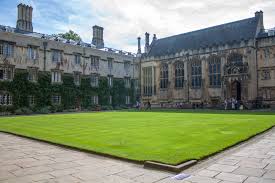
I walked the campus — stone walls, grass cut low, shaded paths. The quad had that contained feeling of a place that already had its stories. I didn’t know I was about to enter one.
I went to dinner at a taco place just outside campus and had a beer or two. Back in the room I read a little astrology to warm up for the week and listened to the band The Mendoza Line. Little did I know they would end up playing a surprisingly large role in what followed.
Around 10 PM the fire alarm went off. Everyone in the building stumbled outside in pajamas and stood around talking for a few minutes. Odd, but fitting — a small communal disturbance to start the week off.
Monday
I woke up, showered and dressed and grabbed my notebook for the astrology sessions. At this time I was fully committed to attending sessions and making the most of them. Breakfast opened early and I liked that — fruit, eggs, strong coffee. The hall had a low hum, people still new to each other. I walked to the first seminar which was given by Ms. Claire Martin. Claire was in her 70s, and a very comforting presence. She’d been doing astrology forever and has a couple of books which are helpful. The seminar was on the first floor, window onto one of the gardens. The air had that mild, hopeful tone of a first session.
Claire spoke on the 1890s — fields of meaning, ectoplasm, etc. I offered something Jung-coded because that’s where my mind goes when the border between psyche and symbol starts to move. I didn’t know she was in the room yet, Isobel (not her real name), though she already was.
At one point Claire mentioned an Aries Moon. I said, simply, “I’m an Aries Moon.” Nothing loaded, nothing aimed. Lecture ended, chairs moved, and she came to me from the back of the room.
“I am an Aries Moon too.”
We walked to the next session together. That was it — no delay, no drift. We sat side-by-side for the rest of the day. Chatting between sessions, coffee break close but not touching, her chart in her bag. She showed me her own chart print-outs — hers and her fiancé’s — and we compared placements. Similarities everywhere.
Lunch in the dining hall. More sessions in the afternoon. Light talk, no electricity announced but already there. Monday night we ate with a group — tutors, a few new friends. We were beside each other the whole time, not hiding it. Later we drifted to the courtyard bar, opened wine bottles, and someone lit a cigarette. I hadn’t smoked more than a dozen cigarettes in sixteen years, but I took one with her, and then another. Not ceremony, more like instinct, more like inevitable.
We ended the night late. I walked back to the dorm alone and put on The Mendoza Line again. I already knew I was in trouble so in addition to “It’s a Long Line (But It Moves Quickly)” I was listening over and over again to “Mistakes Were Made” from which the epigraph comes. Sometimes you just know.
Tuesday
We had planned to have breakfast together, not at Exeter but at Pret, about an eight minute walk away. We both ate and she helped me pick my breakfast. We were acting like a couple already. We attended the morning sessions, seated right next to each other and then the day started to open. In the afternoon we did not attend sessions, instead we spent the time in one of the beautiful gardens. We sat close on the bench by the open window, listening to the session through the gap. I talked about muses and how I work best with one. She talked about photography, stalled career energy, her family, and Swiss-Russian split. Russian women, I reflected not for the first time, are a problem, and I knew deep down I was already in trouble.
Tuesday night the singer-songwriter Lucy Dacus was scheduled to play Oxford, and I had a ticket, but she canceled. Instead we went out for dinner, just the two of us, at an Indian restaurant near campus. We were already deep into our relationship, and everything came easy; I could feel it inside ten minutes. This was one of the best meals I have ever had for reasons bigger than taste. I told her about my two epiphanies, one when I was four years old and one when I was seventeen. The whole evening felt like a third epiphany.
Back at campus everyone was drinking in the courtyard again. There was Mystery and her daughter, tutors, people rotating. We stayed late, drank wine, smoked, and flirted like teenagers. I went to my room around 1:30 AM, playing The Mendoza Line over my headphones again. I was seeking their counsel, essentially, and they are a great band.
Wednesday
I woke up and this day we had breakfast at the dining hall. By this time, people were noticing us. Comments here and there, sideways smiles. Morning and lunch blurred into one long conversation — the garden, the bench, a little grass, nothing hidden. We were finishing each other’s thoughts, and I was in deeper than I had ever been. We didn’t attend much of anything. Afternoon break she went to change. I went back to my room and put on Mendoza Line with the full weight of obsession. She came back later and said, without shame, that she’d pleasured herself during the break — just stated it directly. This was a complication.
For dinner that night she changed again — a red dress, short but not careless. Stunning. Whispering at the table, touching lightly, laughing against each other. Everyone knew by then. After dinner was wine again, talking with the tutors, including the lovely Rod Chang and Mystery the long courtyard. I met Darby Costello in person for the first time. Darby is my astrologer and we had already had a number of phone consultations by this point. She was fully alive drinking wine, and talking like someone who knows how to hold a room. I was so happy that she was my astrologer. Isobel and I stayed late once more, and cleared the courtyard. Around two in the morning we parted, cheeks touched, no bedroom, no act.
Back in my room, lights low, I lay on the narrow bed with Mendoza Line in my ears. I knew exactly where I was standing:
I would keep going. I would see where this led. But I would not sleep with her. I couldn’t.
That was the shape. That was the decision. Wednesday ended on that line.