On the Other City

Note: This piece grew out of a long fascination of mine with what might be called the “night economy” — the network of bartenders, servers, managers, taxi drivers, and late-shift workers who keep a city alive after most people have gone home. If the daytime city is governed by office hours and commuter rhythms, the nighttime city runs on a different clock entirely.

The two figures mentioned here, Haku and Haru, are part of that world in Kyoto. Haku runs the bar at ING and seems to operate on a schedule that would puzzle most daylight citizens, opening in the evening and closing well into the small hours while somehow producing food, music, and atmosphere in a space not much larger than a good-sized living room. Haru manages a shisha lounge in eastern Gion and moves easily between the daytime and nighttime rhythms of that neighborhood, which has its own distinct ecosystem of bars, touts, and late-night wanderers.

The small bar Ishimaru Shoten, tucked down an alley off Pontocho in the Kiyamachi district, serves in the essay as a kind of neutral ground — one of those places where the various inhabitants of the nocturnal city briefly cross paths once their shifts end.

The central idea is simple enough: most cities contain two cities. The first is the one that tourists and office workers see during the day. The second comes into view only after midnight, when the people who keep the lights on, the drinks pouring, and the plates spinning begin their own quieter rounds.

Epigraph:

Last night, I told a stranger all about you
They smiled patiently with disbelief
I always knew you would succeed no matter what you tried
And I know you did it all
In spite of me

Morphine, In Spite of Me


Most people believe a city goes to sleep around midnight. This is not true. Around that time a city simply changes populations.

The day city winds down: office workers, shopkeepers, commuters heading home, lights switching off floor by floor. But another population wakes up. The bartenders. The shisha managers. The taxi drivers. The people who work the strange hours when the streets are quieter but the human drama is often louder.

This is the other city.

If you spend enough nights wandering around it, you begin to recognize its citizens. They are the people who actually know how the place works after midnight.

One of them is Haku.

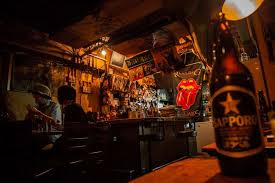
Haku runs the bar at ING. He opens around seven in the evening and closes somewhere between three and four in the morning. Prep starts around six. By the time the first customers wander in, the night has already begun for him.

He has long greying hair and rotates through a collection of Rolling Stones T-shirts, something like twenty-eight of them. I have never seen him wear anything else. He smokes constantly, drinks Sapporo if he is drinking at all, and otherwise survives on black coffee.

Somehow he produces a full menu in a kitchen that appears to consist primarily of a Bunsen burner and sheer stubbornness.

Haku’s bar has rules. No Japanese music is the main one. The other rule is that the bar itself is reserved for singles. Groups can sit elsewhere. The bar is for individuals who have come out into the night alone.

But Haku’s real gift is music. He reads the room the way a card player reads a table.

If the crowd is German he might throw on Rammstein. If Scandinavians wander in the speakers might suddenly fill with black metal. Australians get The Saints. If I’m there he might put on My Morning Jacket. The world rotates through the speakers depending on who happens to be occupying the stools that night.

Simply and totally the original man.

Another citizen of the other city is Haru.

Haru manages the shisha lounge in eastern Gion, a part of town where the nightlife becomes a little more ambiguous. The streets there are full of micro-touts, men and women both, gently trying to guide passersby into Thai or Japanese dancer clubs. Small space heaters glow outside doorways and mama-sans smile from behind them like patient spiders.

I never go into those places, though the invitations are often persuasive.

Haru opens the shisha lounge most days at noon sharp. If she is not there, someone named B. or a long-haired young guy handles things until she arrives. She tends the charcoal, mixes my Malibu Milk, and quietly extends the session when the official time runs out.

She knows my habits well enough by now that when I head up the stairs she doesn’t assume I am leaving. She knows I am just stepping outside to smoke.

For a long time she existed in my mind simply as the shisha girl, one of the many figures who keep the other city functioning. But then one night I ran into her somewhere unexpected.

The place was Ishimaru Shoten, a tiny late-night bar down an alley just west of Pontocho in the heart of Kiyamachi. Outside the entrance hang bright red, green, and blue lamps that glow like a small carnival in the dark.

I first discovered the place at four in the morning on a very long night. I was broke that evening, absolutely skint, and there was a very aggressive Japanese guy at the bar who clearly believed the entire establishment belonged to him.

The bar woman, who is about forty-five and still hot as blazes, was batting her eyes at me with what seemed like professional enthusiasm. Meanwhile I realized with growing clarity that I did not actually have the money to pay for the large bottle of beer I had just ordered.

But men are predictable creatures.

I understood immediately that if I played my cards right the territorial guy would buy the drink for me. So I joked with him, gave him a friendly punch on the shoulder, made it clear I recognized him as the reigning emperor of the room. He razzed me a little but saw that I was no threat to his throne.

Sure enough, he covered the beer.

I stumbled home to the Royal Park Hotel on Sanjo Street as the sky was turning pale, crashing into bed around five-thirty in the morning.

Weeks later I returned to Ishimaru and found Haru sitting there.

I teased her gently about sometimes opening the shisha lounge five or ten minutes late when she bikes over from home. I suggested she must be hungover. She laughed, not the polite laugh people sometimes use for customers but a bright, real laugh.

She said she was happy to see me.

And that was when I learned her name. Haru.

We talked for a while. I drank a White Russian and ate dashi maki while she sipped something that might have been shochu or nihon-shu. I felt a strange rush of adrenaline the whole time, those goosebumps that run up both arms when the night suddenly opens into possibility.

Not necessarily romantic possibility. Just the larger sense that anything could happen.

Anything can come.

After twenty or thirty minutes she said goodnight and promised we would meet there again sometime. We did run into each other once more about a week and a half later, though the evening remained just as light and brief as the first.

But something had shifted.

She was no longer simply the shisha worker in my mental map of the city. She was Haru, a fellow traveler in the other city.

And that is the thing about the people who live their lives after midnight. They know parts of the city the rest of us never really see. They watch the celebrations and the arguments, the flirtations and the quiet breakdowns. They see who walks home alone and who finds someone to share the long dark streets.

Every city has two maps.

The one everyone uses during the day.

And the other one that only appears after midnight.

Dedication:

For the men and women of the night. Who keep the drinks coming and the plates spinning. It’s a rocky world, and you rock it baby.

Note: If you enjoyed this essay, you may also enjoy the two essays below, which also feature Kyoto and Osaka nightlife in all it’s beautiful glory.

On Some Meetings and Close Encounters with Musicians II

Note: This is the second piece in our series “On Some Meetings and Close Encounters with Musicians.” You can find the first installment here.

The encounters described here span more than thirty years and several cities — from a first arena concert in Pullman, Washington in 1991 to small club shows in Cambridge, Osaka, and Kyoto over the decades that followed. As with many memories of live music, the exact setlists and dates blur, but the rooms themselves — the sounds, the atmosphere, the strange and fleeting meetings between artists and audiences — remain vivid. These sketches attempt to capture a few of those moments as they were experienced at the time.

Epigraph

No fears alone at night she’s sailing through the crowd

In her ears the phones are tight and the music’s playing loud

— Dire Straits, “Skateaway”

Live music produces strange meetings. Sometimes you meet the musicians themselves. More often you meet a moment — a room, a sound, a feeling that sticks with you for decades while entire years of ordinary life quietly disappear.

Here are a few such encounters.


I. Initiation

My first real concert was the On Every Street tour in 1991.

The band was Dire Straits, the venue was Pullman, Washington, and the company was the usual Spokane crew: Seth, Innes, Kelly.

I was the biggest fan in the car by far. The others liked the band well enough but I was the one who had studied the records, who knew the guitar parts, who was ready for the moment when the lights dropped and the first notes hit the arena. This was the On Every Street tour, which turned out to be their final record.

They played everything: Money for Nothing, Walk of Life, Sultans of Swing. It was a great show, and one of their last before retirement, though at the time I had no real way to judge such things. It was simply enormous — lights, volume, spectacle. I bought the black and blue tour shirt and wore it for five years.

At the time I thought concerts were supposed to be like that: huge, polished, and far away.

I would later learn otherwise.


II. Revelation

Several years later, during the Hamilton years, I saw Red House Painters at the Middle East in Cambridge.

I went with Ian. The room was small, maybe a few hundred people at most. Nothing about it resembled the arena in Pullman. And then, near the end of the set, Mark Kozelek began playing “Little Drummer Boy.” It lasted nine minutes. You could hear a pin drop in the room.

No spectacle. No lights. Just absolute concentration from everyone present. When the final notes faded the silence lingered for a moment before the applause came.

Afterward Ian and I drove back toward New York through the cold night with the windows cracked open, heaters flying out into the darkness, and Hell’s Ditch blasting through the car stereo to keep us awake.

That was the night I realized concerts could be something else entirely.


III. Chaos

Not every show produces reverence.

I once saw The Fall with Ian as well. The band’s leader, Mark E. Smith, seemed to be operating in his traditional mode of total hostility. The set was short — twenty-eight minutes by my estimate. Ian later checked the official record and insisted it was forty-three. Either way it felt brief and volatile. Smith barked into the microphone, glared at the band, and treated the entire enterprise with the air of someone barely tolerating the existence of the audience.

Which, to be fair, was exactly what many people had come to see.


IV. Theatre

The strangest performance I ever witnessed may have been Cat Power at Club Quattro in Osaka.

The evening began badly. An opening act — a woman in what appeared to be a fairy costume — sat at the piano and played for what felt like an eternity. Forty-five minutes at least. Perhaps longer. By the end of it the audience was openly confused.

Then Cat Power appeared.

Or rather she refused to appear in the conventional sense. Instead of remaining on the stage she wandered through the venue with a handheld microphone, singing and rapping while walking amongst the crowd, occasionally placing an arm around a patron or leaning against the bar.

At one point she came right up to where I was standing near the back rail and sang a line or two before drifting off again into the room.

The entire show felt less like a concert than a piece of improvised theatre.


V. Ritual

A few years later I saw Damo Suzuki at Club Metro in Kyoto. Damo had once fronted the legendary German band CAN, but this night bore no resemblance to those recordings. Nothing recognizable from the catalog appeared. And here he stood, just a few feet away from the audience with long black-and-grey hair flowing, bellowing and chanting over a constantly shifting improvisational band.

It was less a performance than a ritual.

Damo passed away not long ago. RIP and prayers up. I’m grateful I saw him when I did.


VI. Canada Night

Not all memorable shows are mystical.

Sometimes they’re simply loud.

One such evening occurred at Club Quattro in Osaka when Broken Social Scene and Death From Above 1979 came through town.

The Canadian ambassador was present and delivered a brief speech before the set explaining that Death From Above 1979 represented a fine example of Canadian enterprise because they were “only two men making so much noise.”

The room was packed with Canadian expats and the atmosphere was celebratory chaos. The ambassador was probably correct.


VII. Breakdown

Not every concert goes well.

I once saw Bonnie ‘Prince’ Billy at the small Kyoto venue Taku Taku. Something had clearly gone wrong with the lineup. The guitarist appeared to be brand new and could barely navigate the chords.

Will Oldham tried to push through but quickly grew frustrated and began openly calling the guitarist out from the stage. It was uncomfortable for everyone involved.

The show never recovered.


VIII. Redemption

Fortunately the story has a better ending.

Some years later I saw Bonnie “Prince” Billy again, this time at the beautiful Kyoto venue Urbanguild and everything worked great. Low benches and tables filled the room, Heartland beer bottles glowed green under the lights, and the band played a relaxed, confident set drawn mostly from the Bonnie “Prince” Billy catalog with a few Palace songs mixed in.

Opening the evening was an instrumental group called Bitchin Bajas whose sound reminded me faintly of early Phosphorescent if Phosphorescent had chosen to make instrumental records. After the show I found myself talking with three members of the band while they drank beer and ate fries. They were humble, friendly, and slightly surprised that anyone in Kyoto knew who they were. We talked for a while about touring and the constant challenge of trying to make a living as working musicians. Eventually the conversation drifted off and the room began to empty.

The music was over. The musicians were just people again, finishing their drinks and preparing to move on to the next city. And that, in the end, may be the most interesting encounter of all

Dedication

For live music fans everywhere. My true people. I love you baby.


Note: If you enjoyed this essay, you may also enjoy the essay below on the four time I met Yo La Tengo. Happy reading!

The Night of Fucking Adam

Note: This piece is part of an informal series of essays and stories about nights out in Japan that begin innocently enough and gradually drift into something closer to accidental anthropology. The settings vary—Kyoto bars, Osaka clubs, late-night taxis, shotengai corridors—but the structure is often the same: a few friends meet for drinks, the evening unfolds without much planning, and somewhere along the way the ordinary rules of social behavior begin to loosen.

The events described here took place during a long evening wandering through Osaka, eventually ending in the nightclub district of Shinsaibashi. Like many such nights, it contained a mixture of small cultural misunderstandings, unexpected friendships, minor chaos, and the strange solidarity that sometimes develops among strangers in bars after midnight.

The character known here as “Adam” was a young British traveler we met that evening and never saw again. The nickname “Fucking Adam” reflects the affectionate exasperation with which the phrase was used throughout the night rather than any serious judgment about the person himself. Anyone who has spent time traveling, drinking in unfamiliar cities, or navigating the unpredictable social ecosystems of late-night nightlife will likely recognize the type.

The intention of the piece is not to document a perfectly accurate timeline of events—after fifteen or so drinks spread across many hours, accuracy becomes a flexible concept—but rather to capture the texture of a particular kind of night: the slow drift from casual afternoon drinks into the surreal territory that sometimes appears around two or three in the morning when strangers collide and small incidents escalate into memorable stories.

In that sense, Adam becomes less an individual than a type. Every city has them. Every traveler eventually meets one. Occasionally, if the night runs long enough, we become one ourselves.

Epigraph:

“A ruinous eyesore, oh what is a mind for?
Just a knife in a lake, just an arrow in space.”
—The Swans

We met around four in the afternoon near Osaka Station, the three of us: Philip, Jack, and me. The plan, such as it was, was simple—have a few drinks and see where the night took us. Osaka is good for that. The city doesn’t require much in the way of planning. If you just start walking and follow the lights, something eventually happens.

Our first stop was a subterranean craft beer joint somewhere beneath the station complex. One of those places down a set of anonymous stairs where the ceiling is low, the taps are numerous, and everyone looks faintly conspiratorial, like they’ve all agreed to drink underground together.

We had a couple rounds there and then drifted through the shotengai behind the Hilton. Early evening shoppers were moving through with that unhurried Osaka pace. Nothing felt like the beginning of a legendary night. It just felt like a pleasant afternoon.

From there we crossed over to a classic American hamburger joint opposite the station. Vinyl booths, neon beer signs, and a bartender who had tattoos running down both forearms like vines. American rock played softly in the background. It felt like a movie set version of America dropped into central Osaka.

We ate burgers, drank more beer, and talked about absolutely nothing of consequence.

At some point Philip announced that what he really wanted that night was to go to a middle-aged club. To be clear, Philip was not shy about his intentions. He was, as he put it, “looking for MILFs.”

So we took a taxi down to Shinsaibashi.

The middle-aged club, unfortunately, was closed. It was only about eight and apparently the MILF scene doesn’t really get going until later.

So we did what you do in that situation: we wandered.

For the next four and a half hours we drifted around Shinsaibashi, moving from bar to bar in that loose, happy way nights sometimes unfold. By midnight we had covered a lot of territory. Between the three of us we had consumed something like fifteen drinks over thirteen hours. And yet only Philip seemed even remotely affected by them.

Around 1:30 we arrived at Sam and Dave’s, a legendary dive of a nightclub tucked into the chaos of Shinsaibashi. The security guy at the door looked us over and shrugged.

“Maybe dead now,” he said. “But gets good later.”

Inside it was a haze of smoke and terrible techno beats pounding from the speakers. The crowd was an odd mixture of people who were extremely drunk and people who appeared to be completely sober and studying the situation with curiosity. It was cooking by one-thirty.

Somewhere along the way we met a jovial twenty-year-old British guy named Adam.

Adam and Jack bonded almost immediately. They were trading insults in that cheerful British way—“you tosser,” “you old wanker,” that sort of thing—and it seemed harmless enough.

Meanwhile a group of Filipino girls had arrived, one of whom—Beverly—was extremely drunk and getting progressively more chaotic. Her friends were trying, without much success, to keep things under control.

At this moment Philip stepped in.

Philip has a well-developed instinct for white-knighting in situations where white-knighting is absolutely not required. He began talking to Beverly, which quickly escalated into something resembling a full-scale courtship right there on the dance floor.

Meanwhile Jack and Adam had begun dancing.

The problem was that they gradually migrated off the dance floor and onto a small raised stage that contained a drum kit and various musical equipment.

Within seconds drums were tipping over. Tables were sliding. A cymbal crashed onto the floor.

Security arrived immediately.

They pushed Jack aside and dragged Adam feet-first off the stage and into what appeared to be a small holding room behind the bar where, judging by the noises coming out of it, Adam was receiving a fairly vigorous beating.

Things deteriorated quickly after that.

Philip decided to treat everyone to Irish car bombs. Unfortunately the bartender had no idea how to make one, so Philip instructed him. The Guinness component somehow disappeared from the process and we ended up with small glasses of Baileys and Jameson.

Adam drank one.

At this point Adam completely lost his mind. He began loudly explaining how terrible the UK was, how he wanted to die, how the American guy earlier had stolen the chesty nurse he loved, and a variety of other philosophical positions.

Security eventually threw us out with minimal ceremony.

Outside the situation became even stranger.

Philip was pouring champagne into Beverly’s mouth near the elevator while her increasingly frantic friends asked me if he was a good person. Jack was trying to figure out where Adam was staying so he could get him into a taxi.

Adam responded by pushing Jack into a decorative pond.

Then he began throwing a water bottle at him like he was Bob Gibson pitching in the World Series.

At this point it was around five in the morning.

Philip abruptly announced he was leaving to meet some Brazilians. Adam remained in the pond shouting curses about our mothers. Jack climbed out, soaking wet.

We left.

Mackenzie took a taxi back to his hotel by the river. I caught the first train home from Shinsaibashi as the sun was coming up, completely exhausted.

And that was the night of Fucking Adam.

We never saw him again.

Dedication:

For Fucking Adams everywhere.
Long may you burn.

Note: if you like this essay, you may also like the essay below. It covers a similar slice of nightlife, this time in Kyoto.

On Comebacks and Failed Comebacks III: Amy Winehouse

Note: This short piece reflects on the strange artistic tension that defined the career of Amy Winehouse: the way her extraordinary authenticity as a singer seemed inseparable from the personal instability that surrounded her life.

Winehouse’s music—especially the songs on Back to Black—felt at once timeless and painfully immediate. The sound drew deeply from earlier traditions of soul and rhythm and blues, yet the emotional directness of the lyrics was unmistakably modern. Few artists have managed to sound so rooted in musical history while simultaneously feeling so exposed to the present moment.

The song Rehab stands as the clearest example of this tension. Its humor, defiance, and vulnerability all exist in the same breath, making it one of the most distinctive pop recordings of the twenty-first century.

Like many listeners, I remember the late-2000s period—particularly around the Glastonbury era—when Winehouse was both an enormous star and visibly struggling. Watching those performances could feel uneasy, yet the brilliance of the voice was undeniable. The same intensity that made the music so compelling also made her career difficult to sustain.

This piece is simply an attempt to think about that paradox: how authenticity and self-destruction can sometimes become intertwined in the lives of great artists.

There are many great singers, but very few voices that feel instantly definitional—voices that seem to arrive already carrying an entire world inside them.

Amy Winehouse was one of those voices.

By the time her second album, Back to Black, exploded in the mid-2000s, it already felt as though she had stepped fully formed out of some earlier musical era. The sound was unmistakably rooted in Motown and 1960s soul, yet the lyrics were brutally modern—messy, confessional, sometimes almost painfully direct.

Winehouse didn’t just sing about heartbreak and addiction. She sang about them as if the audience had wandered into the middle of a private argument she was having with herself.

That tension—between authentic confession and visible self-destruction—became the defining element of her career.

You could hear it most clearly in Rehab, which remains one of the most distinctive pop songs of the twenty-first century. The song is catchy, almost playful on the surface, driven by a swinging brass section that feels lifted from a lost Stax session.

But the lyrics are something else entirely.

They tried to make me go to rehab / I said no, no, no.

It’s funny. It’s defiant. It’s also deeply unsettling, because the listener quickly realizes that the singer is not playing a character. The refusal at the center of the song is real.

In that sense “Rehab” became more than a hit single. It became a kind of thesis statement for the strange artistic space Winehouse occupied. The same vulnerability that gave her music its emotional power also exposed the raw nerves of her life to public view.

You could feel that tension during the years when she was both at the height of her fame and visibly unraveling.

The Glastonbury era captured this perfectly. Winehouse had become a massive international star, yet her stage presence could swing wildly from moment to moment. One minute she would be commanding the crowd with that huge, smoky voice; the next she might appear distracted, fragile, or physically unsteady.

Watching those performances could be oddly uncomfortable. The audience was witnessing genuine brilliance, but it often felt as though the brilliance was emerging from a life that was spinning out of control.

And yet the authenticity of the music was inseparable from that volatility.

Winehouse sang as if every lyric had been torn directly out of lived experience. There was no polite distance between the artist and the material. When she sang about jealousy, addiction, or heartbreak, it sounded less like performance and more like confession.

That quality made her music electrifying. It also made her career precarious.

Pop music has always had a complicated relationship with self-destructive artists. Audiences are drawn to performers who seem emotionally transparent, but the same intensity that produces great art can also be difficult to sustain under the glare of fame.

Winehouse lived inside that contradiction.

The tabloids followed her relentlessly. Every public misstep, every argument, every sign of physical decline became part of a growing media narrative. The spectacle sometimes threatened to overwhelm the music itself.

Yet when she stepped to the microphone and began to sing, the spectacle vanished.

What remained was that extraordinary voice: raw, soulful, and oddly timeless, as if it had traveled forward from another musical generation. In a pop landscape often dominated by carefully engineered personas, Winehouse sounded startlingly real.

That authenticity is why her work still resonates long after her death in 2011.

Many talented singers release successful albums. Only a handful manage to create songs that feel permanently etched into the culture. “Rehab” is one of those songs. The moment those opening horns start, the listener knows exactly what world they are entering.

It is the world of Amy Winehouse: funny, defiant, wounded, brilliant.

A place where honesty and self-destruction were never quite separable—and where the truth of the music was powerful enough to survive them both.

Note:

Some Everyday Catalyzed Emergencies

Note: The examples in this piece are drawn from moments in my own life where the structure I call a catalyzed emergency appeared in miniature.

What these moments share is not their subject matter but their pattern. A system—whether emotional, institutional, or social—exists in a temporary equilibrium. Then a relatively small catalyst activates tensions that were already present beneath the surface. Once activated, the situation accelerates and decisions that previously seemed distant are suddenly made in real time.

In each case, the catalytic moment itself was small: a candid remark during a conference break, a humorous but revealing line in a professional meeting, or a single sentence spoken in a social situation. Yet in each instance the effect was immediate. The atmosphere shifted, ambiguity collapsed, and the underlying structure of the situation suddenly became visible.

The personal examples described here are therefore not offered as dramatic events in themselves. Their significance lies in the way they illustrate, at the scale of everyday life, the same structural pattern that appears in larger historical crises.

Catalyzed emergencies, it turns out, are not rare occurrences reserved for moments of world history. They happen quietly and frequently in ordinary human experience.

Once you begin thinking about catalyzed emergencies, it becomes difficult not to see them everywhere.

Most of life proceeds in a kind of provisional calm. Conversations unfold along familiar paths. Institutions conduct their meetings, relationships drift through their usual rhythms, and the tensions that exist beneath the surface remain politely contained. Decisions are postponed. Conflicts are softened by habit. The system holds together because nothing has yet forced it to reveal its deeper structure.

Then something small happens.

A sentence is spoken a little too plainly.
A truth appears unexpectedly in the middle of a casual conversation.
Someone says something in a meeting that suddenly exposes the machinery of the institution.

The catalyst itself is often tiny compared to the shift that follows. Yet once it occurs, the atmosphere changes almost immediately. Decisions that once felt distant suddenly move into the present. The underlying structure—emotional, institutional, or relational—becomes visible.

Once you start noticing these moments, you realize they are everywhere.

I remember one such moment during a conference break with the young woman I call Isobel. We were talking in that loose, slightly intimate way people sometimes do between sessions, when the formal structure of the day has momentarily dissolved. The conversation drifted into unexpectedly personal territory, and at one point she mentioned something about her private life that was startlingly candid.

The remark itself was quiet and almost offhand. Nothing in the hallway changed. People were still pouring coffee, drifting between rooms, checking their schedules. The conference continued exactly as it had a few minutes before.

Yet internally something shifted very quickly.

A boundary that had previously existed only as an assumption was suddenly visible. The emotional geometry of the situation rearranged itself in an instant. It was one of those moments when the surface calm of an interaction suddenly reveals the deeper structure beneath it.

Looking back, it was a perfect example of a small catalyzed emergency. The remark itself did not create the tension that followed. It simply activated something that had already been present but unspoken.

Institutional life produces similar moments, though usually in a different register.

Years ago I attended a meeting where Steve Keegan, then responsible for development at the International Baccalaureate, delivered one of the most unintentionally perfect lines I have ever heard in a professional setting. Attempting to strike a tone of humility, he reassured the room that the organization should not think too highly of itself.

“We are not special,” he said.

Then, after a brief pause that only improved the effect, he added:

“Of course we are unique and special in many ways.”

The room erupted in laughter, not because anyone intended to mock him but because the remark revealed something everyone recognized instantly. Institutions often survive on carefully balanced narratives about themselves—humble yet exceptional, ordinary yet distinctive. When those narratives momentarily contradict themselves in public, the entire room suddenly becomes aware of the structure holding the organization together.

Again, the catalyst was small: a single sentence.

But in that moment the underlying psychology of the institution briefly revealed itself. Everyone in the room could see the gears turning.

The same pattern appears in more personal moments as well, sometimes with surprisingly decisive consequences.

I remember a night when a man was attempting to pick up Mariko. It was the sort of situation that unfolds quietly in bars and restaurants all over the world—nothing dramatic, just two people talking while someone else tries to determine what role they themselves are supposed to play in the unfolding scene.

For a while the equilibrium held. The conversation drifted, the man continued his efforts, and I watched the situation with the vague uncertainty that sometimes accompanies these moments. Was I a bystander? A friend? Something else?

Eventually I said something very simple.

“We’re together.”

That was it. A single sentence. A declaration that had not existed in explicit form until the moment it was spoken.

But the effect was immediate.

The conversation stopped. The geometry of the room rearranged itself instantly. What had previously been ambiguous became clear. The situation resolved itself within seconds.

Looking back, it was another catalyzed emergency. The sentence itself did not create the underlying possibility. That possibility had already been present in the emotional structure of the evening. What the sentence did was activate it, collapsing uncertainty into decision.

The remarkable thing about these moments is how small they often appear at the time. They do not arrive with the dramatic clarity of historical turning points. They slip quietly into the flow of ordinary life—a conversation during a break, a remark in a meeting, a sentence spoken in a bar.

Only later does the pattern become visible.

Most of life feels gradual while we are living it. Days follow one another in a steady rhythm. Institutions maintain their procedures. Relationships drift along familiar channels. The tensions that shape events accumulate quietly beneath the surface, rarely forcing themselves into view.

Then something small happens.

A remark.
A confession.
A declaration.

And suddenly the structure reveals itself.

The catalyst may be nothing more than a sentence spoken at exactly the right moment. But once the reaction begins, the system rarely returns to its previous state unchanged.

Note: This is Part III is our series on the concept of the “Catalyzed Emergency.” You can read the other two essays below.

On Touts and Micro-Touts: Japan Observations

Note: This piece collects observations gathered across decades of nights out in Japan — moments that, taken individually, felt minor but over time revealed a coherent social pattern. The essay is not intended as a warning against nightlife, nor as an indictment of any particular place or person. Rather, it is an attempt to understand the subtle choreography that unfolds in urban night economies, where invitation, performance, and commerce intersect in ways that are rarely dramatic but often instructive.

The distinction between macro-touts and micro-touts emerged gradually. It reflects less a rigid taxonomy than a traveler’s growing sensitivity to atmosphere, tone, and the shifting boundaries between hospitality and transaction. Most encounters described here were neither dangerous nor traumatic; they were moments of mild disorientation that ultimately sharpened perception and deepened appreciation for the social intelligence required to navigate unfamiliar environments.

Japan remains one of the safest and most generous countries in the world to explore at night. The experiences recounted here are offered not as cautionary tales but as small pieces of ethnography — reminders that every city contains micro-economies of possibility, and that learning to read their signals is part of the quiet education that travel provides.

If there is a broader lesson, it is simply this: nightlife is built on invitations, and the skill of the traveler lies not in accepting or rejecting them categorically, but in recognizing the scripts they carry and choosing, with awareness, when to participate.

Part I — Kumamoto, Japan, Summer 1997

「どこの社長ですか?」

I was twenty-three and new to Japan — not just geographically new, but existentially new, the kind of new that leaves you unable to distinguish between hospitality and performance, sincerity and choreography. At that age you carry a quiet belief that experience will organize itself around you, that invitations are destiny, and that uncertainty is merely the prelude to belonging.

Kumamoto summer did nothing to challenge this illusion. The humidity hung in the air like a second shirt, streets shimmering with heat that seemed less meteorological than emotional. I met a couple of guys at a bar — friendly in that easy, late-night way where language fragments are enough and tone carries meaning. Half English, half Japanese, and entirely good-natured, they asked if I wanted to join their baseball team. I said yes immediately, not because I had any intention of playing, but because at twenty-three you rarely decline the promise of future identity.

The baseball team never materialized. But the invitation served its purpose. It opened the bridge.

They told me they wanted to show me real Japan. A phrase that should always raise questions but rarely does when you’re young and curious. “We know a place,” they said, the universal preface to experiences that exist somewhere between revelation and mild financial education.

That is how I entered my first hostess club.

It was not the neon spectacle I might have imagined. No polished decadence, no velvet rope theatrics. Instead: low lighting, carpet that seemed older than the Heisei era, and furniture whose best days had passed quietly without ceremony. Yet the room possessed its own gravitational pull, created not by décor but by orbit — women rotating from table to table with practiced ease, their presence transforming a modest environment into something that felt improbably expensive.

Mama-san presided with the quiet authority of someone who understood both mathematics and psychology. Her hair lacquered into permanence, her gaze sharp as accounting software, she functioned as conductor of a carefully orchestrated social economy. The women, each moving with subtle intentionality, carried scripts composed of compliments, curiosity, and gentle physical proximity.

Whisky mizuwari arrived with ritual precision, poured slowly as if time itself were being measured in diluted amber. The drink tasted ordinary. The price did not.

I was not uncomfortable — only aware of my own lack of schema. A foreigner equipped with politeness but not context, seated inside a room where intimacy operated as currency and identity functioned as flexible fiction. The women laughed easily, touched my arm, leaned close enough to suggest familiarity without commitment.

I did not interpret this as romance. I interpreted it as welcome.

Then came the line — delivered with effortless certainty and a smile that contained neither irony nor doubt:

「どこの社長ですか?」
Which company are you president of?

Not if.
Which.

Because the hostess club does not deal in biography. It deals in possibility. Within its walls, the boundaries of self dissolve gently. You arrive as yourself but are encouraged to inhabit a more generous narrative: company president, successful entrepreneur, patron of refined pleasures, bearer of an inexhaustible wallet. Identity becomes costume, worn lightly for the duration of the evening.

I understood that markup existed. What I did not yet understand was the degree to which markup could inhabit fantasy.

The bill arrived — perhaps thirty thousand yen. Not ruinous, not outrageous, but enough to sting the uninitiated and sharpen awareness. Before embarrassment could surface or negotiation begin, the friends who had invited me paid without ceremony. A wink, a casual next time, and the implicit understanding that this particular version of me — baseball player, future regular, provisional shachō — would remain confined to that evening.

I left lighter, though not poorer.

Not scammed.
Initiated.

The lesson did not arrive as resentment but as clarity:

Flattery has a price.
Fantasy carries a tab.
Sometimes you do not pay it directly — but you still learn the cost.


Part II — Kyoto: Rub-a-Dub and Bar Colors

Rub-a-Dub felt like oxygen.

A basement reggae bar where the air seemed shared rather than owned, bodies pressed into temporary community, music operating less as entertainment than as connective tissue. Tommy, as always, orbiting the jukebox with missionary zeal, attempting to convert the room to his playlist while flirting with the bar girl in ways that were equal parts hopeful and theatrical.

I stood with a Red Stripe, jacket discarded somewhere behind me, already drifting toward the kind of night where White Russians become plausible and conversation loosens into anecdote. Sweat, laughter, strangers whose names evaporate but whose presence remains — the familiar ingredients of third-place belonging.

Two men approached. One Jamaican, ponytail, voice thick with authority that seemed rooted in lived reggae culture rather than performance. The other younger, bilingual, improvising rap verses that moved seamlessly between Japanese and English with real talent. Not novelty talent — actual fluency. Conversation flowed easily. Fifteen, twenty minutes of exchange that lowered the drawbridge of suspicion.

Then the invitation:

“Let’s go to Bar Colors.”

I had seen the sign before. A reggae logo, unobtrusive, upstairs somewhere near Kiyamachi. Nothing alarming, nothing clandestine. Just another bar in a district defined by possibility.

We followed.

Three floors up — a vertical ascent that subtly altered the power geometry. Rub-a-Dub’s crowded warmth replaced by a smaller room with thinner oxygen. No dance floor, just music and seating. I chose the seat nearest the door, an instinctive habit that rarely announces itself consciously but persists nonetheless. Tommy relaxed into the environment with characteristic ease, while the rapper transitioned seamlessly into microphone performance, his skill functioning as social anesthesia.

We ordered beers — two each. Six hundred yen apiece. Simple arithmetic, comforting in its predictability. Safety often disguises itself as math.

Then came the disruption.

The Jamaican leaned in, tone shifting just enough to register as discordant:

“Who will pay the bill?”

The question felt misplaced. The wrong person asking, the wrong moment, the wrong authority. I responded with obvious clarity: we would pay for our drinks. He shook his head dramatically and launched into a loud, performative argument with the bartender — defending us against an unseen injustice, positioning himself as ally.

The performance was transparent once recognized. Theater designed to manufacture gratitude. Gratitude designed to justify inflated cost.

This is how micro-predation operates in Kyoto: not through threat but choreography.

When the bill arrived, it totaled five thousand yen. Double expectation. Not devastating, merely disorienting. Enough to create tension between principle and convenience.

I stood — full height, voice calm:

“I know what you’re doing. It’s bullshit. We came here in good faith.”

No escalation. No anger. Just refusal to participate in the narrative assigned.

We paid — not capitulation but calculation. Peace sometimes costs less than confrontation. Exit achieved without drama, wallets lighter but awareness sharpened.

Not victims.
Not victors.
Just awake.

The deeper lesson was not financial but perceptual: danger rarely announces itself loudly in Kyoto. It appears as suggestion, invitation, relational choreography. You do not need to be taken to understand the mechanics of being taken.

Rub-a-Dub had offered warmth.
Bar Colors offered clarity.

Some nights you dance.
Some nights you pay to leave.


Part III — The Kiyamachi Ecology of Micro-Touts

If Kumamoto introduced fantasy and Bar Colors revealed choreography, Kiyamachi provided taxonomy.

Kyoto’s nightlife economy operates differently from more overt red-light districts. There is little aggressive solicitation, no carnival barking, no theatrical insistence. Instead, micro-signals populate liminal spaces: a man standing slightly too still near a stairwell, a laminated menu with vague promises, a bilingual conversation that begins casually and ends directionally.

The micro-tout does not sell forcefully. He offers possibility.

And possibility is harder to refuse.

Micro-touting thrives in moments of uncertainty — the pause between bars, the lull between conversations, the question of where the night continues. The invitation arrives not as proposition but as continuity.

“Just one drink.”
“I know a place.”
“Special price.”
“Members bar but I can get you in.”

The language is intentionally thin. Curiosity performs the heavy lifting.

Unlike macro-touting, where spectacle clarifies the transaction, micro-touting relies on relational ambiguity. Trust precedes the offer. Conversation establishes provisional safety. Only then does the invitation appear.

You are not pressured.
You are positioned.

And positioning is the mechanism.


Part IV — Macro-Touts and Micro-Touts: A Taxonomy

Macro-touts belong to visible red-light economies. Their pitches are explicit, directional, and theatrical. Customers understand the transactional nature immediately. Kabukicho hosts calling from sidewalks, Osaka promoters guiding tourists toward neon staircases — these figures operate through spectacle.

Micro-touts function differently.

They blend into ordinary social environments: musicians, patrons, casual acquaintances, language exchange partners. Their authority derives from relational proximity rather than territorial control. They do not sell a product but offer narrative continuation.

Macro-touting relies on volume.
Micro-touting relies on timing.

Macro-touting demands attention.
Micro-touting waits for uncertainty.

Japan’s cultural emphasis on politeness and conflict avoidance creates fertile ground for micro-touting. The customer hesitates to confront, the operator anticipates this, and civility becomes economic leverage.

The genius of micro-touting lies in its invisibility. It rarely crosses legal boundaries and seldom escalates into overt harm. Instead, it extracts modest margins through social choreography.

Not robbery.
Repositioning.


Part V — The Ethics of Almost

What remains from these encounters is not resentment but recognition.

Both Kumamoto and Kyoto experiences share structural similarities: voluntary participation in constructed realities. The hostess club invites fantasy; the micro-tout offers narrative continuation. In each case, the individual is not coerced but positioned within an unfolding script.

The moment of realization rarely arrives as crisis. It appears as subtle awareness — a bill exceeding expectation, a tonal shift, a fragment of choreography revealing itself as performance.

Travel rarely educates through catastrophe. More often, it educates through near-misses — the ethics of almost.

You almost believed.
You almost overpaid.
You almost escalated.
You almost became the character the room was preparing.

Micro-touts teach attention rather than fear.


Part VI — Return to the Street

Kiyamachi after midnight remains a pedestrian theater of extraordinary subtlety. Music spills from doorways, cigarettes glow like punctuation, laughter dissolves into river air. Within this ordinary magic, micro-touts continue their quiet labor — neither villains nor heroes, simply participants in the nocturnal economy of possibility.

Nightlife is built on invitations.

Some lead to connection.
Some to illusion.
Some to modest financial education.

But all reveal the architecture of the city that issues them.

Kumamoto taught me fantasy has a tab.
Kyoto taught me ambiguity has a margin.

Neither felt like loss.
Both felt like tuition.

Because travel, like nightlife, is rarely about destinations. It is about learning to read the scripts unfolding around you — and recognizing that sometimes the most instructive figures in any city are the ones whose invitations you decline with gratitude.

Part I — Kumamoto, Japan, Summer 1997

「どこの社長ですか?」

I was twenty-three and new to Japan — not just geographically new, but existentially new, the kind of new that leaves you unable to distinguish between hospitality and performance, sincerity and choreography. At that age you carry a quiet belief that experience will organize itself around you, that invitations are destiny, and that uncertainty is merely the prelude to belonging.

Kumamoto summer did nothing to challenge this illusion. The humidity hung in the air like a second shirt, streets shimmering with heat that seemed less meteorological than emotional. I met a couple of guys at a bar — friendly in that easy, late-night way where language fragments are enough and tone carries meaning. Half English, half Japanese, and entirely good-natured, they asked if I wanted to join their baseball team. I said yes immediately, not because I had any intention of playing, but because at twenty-three you rarely decline the promise of future identity.

The baseball team never materialized. But the invitation served its purpose. It opened the bridge.

They told me they wanted to show me real Japan. A phrase that should always raise questions but rarely does when you’re young and curious. “We know a place,” they said, the universal preface to experiences that exist somewhere between revelation and mild financial education.

That is how I entered my first hostess club.

It was not the neon spectacle I might have imagined. No polished decadence, no velvet rope theatrics. Instead: low lighting, carpet that seemed older than the Heisei era, and furniture whose best days had passed quietly without ceremony. Yet the room possessed its own gravitational pull, created not by décor but by orbit — women rotating from table to table with practiced ease, their presence transforming a modest environment into something that felt improbably expensive.

Mama-san presided with the quiet authority of someone who understood both mathematics and psychology. Her hair lacquered into permanence, her gaze sharp as accounting software, she functioned as conductor of a carefully orchestrated social economy. The women, each moving with subtle intentionality, carried scripts composed of compliments, curiosity, and gentle physical proximity.

Whisky mizuwari arrived with ritual precision, poured slowly as if time itself were being measured in diluted amber. The drink tasted ordinary. The price did not.

I was not uncomfortable — only aware of my own lack of schema. A foreigner equipped with politeness but not context, seated inside a room where intimacy operated as currency and identity functioned as flexible fiction. The women laughed easily, touched my arm, leaned close enough to suggest familiarity without commitment.

I did not interpret this as romance. I interpreted it as welcome.

Then came the line — delivered with effortless certainty and a smile that contained neither irony nor doubt:

「どこの社長ですか?」
Which company are you president of?

Not if.
Which.

Because the hostess club does not deal in biography. It deals in possibility. Within its walls, the boundaries of self dissolve gently. You arrive as yourself but are encouraged to inhabit a more generous narrative: company president, successful entrepreneur, patron of refined pleasures, bearer of an inexhaustible wallet. Identity becomes costume, worn lightly for the duration of the evening.

I understood that markup existed. What I did not yet understand was the degree to which markup could inhabit fantasy.

The bill arrived — perhaps thirty thousand yen. Not ruinous, not outrageous, but enough to sting the uninitiated and sharpen awareness. Before embarrassment could surface or negotiation begin, the friends who had invited me paid without ceremony. A wink, a casual next time, and the implicit understanding that this particular version of me — baseball player, future regular, provisional shachō — would remain confined to that evening.

I left lighter, though not poorer.

Not scammed.
Initiated.

The lesson did not arrive as resentment but as clarity:

Flattery has a price.
Fantasy carries a tab.
Sometimes you do not pay it directly — but you still learn the cost.


Part II — Kyoto: Rub-a-Dub and Bar Colors

Rub-a-Dub felt like oxygen.

A basement reggae bar where the air seemed shared rather than owned, bodies pressed into temporary community, music operating less as entertainment than as connective tissue. Tommy, as always, orbiting the jukebox with missionary zeal, attempting to convert the room to his playlist while flirting with the bar girl in ways that were equal parts hopeful and theatrical.

I stood with a Red Stripe, jacket discarded somewhere behind me, already drifting toward the kind of night where White Russians become plausible and conversation loosens into anecdote. Sweat, laughter, strangers whose names evaporate but whose presence remains — the familiar ingredients of third-place belonging.

Two men approached. One Jamaican, ponytail, voice thick with authority that seemed rooted in lived reggae culture rather than performance. The other younger, bilingual, improvising rap verses that moved seamlessly between Japanese and English with real talent. Not novelty talent — actual fluency. Conversation flowed easily. Fifteen, twenty minutes of exchange that lowered the drawbridge of suspicion.

Then the invitation:

“Let’s go to Bar Colors.”

I had seen the sign before. A reggae logo, unobtrusive, upstairs somewhere near Kiyamachi. Nothing alarming, nothing clandestine. Just another bar in a district defined by possibility.

We followed.

Three floors up — a vertical ascent that subtly altered the power geometry. Rub-a-Dub’s crowded warmth replaced by a smaller room with thinner oxygen. No dance floor, just music and seating. I chose the seat nearest the door, an instinctive habit that rarely announces itself consciously but persists nonetheless. Tommy relaxed into the environment with characteristic ease, while the rapper transitioned seamlessly into microphone performance, his skill functioning as social anesthesia.

We ordered beers — two each. Six hundred yen apiece. Simple arithmetic, comforting in its predictability. Safety often disguises itself as math.

Then came the disruption.

The Jamaican leaned in, tone shifting just enough to register as discordant:

“Who will pay the bill?”

The question felt misplaced. The wrong person asking, the wrong moment, the wrong authority. I responded with obvious clarity: we would pay for our drinks. He shook his head dramatically and launched into a loud, performative argument with the bartender — defending us against an unseen injustice, positioning himself as ally.

The performance was transparent once recognized. Theater designed to manufacture gratitude. Gratitude designed to justify inflated cost.

This is how micro-predation operates in Kyoto: not through threat but choreography.

When the bill arrived, it totaled five thousand yen. Double expectation. Not devastating, merely disorienting. Enough to create tension between principle and convenience.

I stood — full height, voice calm:

“I know what you’re doing. It’s bullshit. We came here in good faith.”

No escalation. No anger. Just refusal to participate in the narrative assigned.

We paid — not capitulation but calculation. Peace sometimes costs less than confrontation. Exit achieved without drama, wallets lighter but awareness sharpened.

Not victims.
Not victors.
Just awake.

The deeper lesson was not financial but perceptual: danger rarely announces itself loudly in Kyoto. It appears as suggestion, invitation, relational choreography. You do not need to be taken to understand the mechanics of being taken.

Rub-a-Dub had offered warmth.
Bar Colors offered clarity.

Some nights you dance.
Some nights you pay to leave.


Part III — The Kiyamachi Ecology of Micro-Touts

If Kumamoto introduced fantasy and Bar Colors revealed choreography, Kiyamachi provided taxonomy.

Kyoto’s nightlife economy operates differently from more overt red-light districts. There is little aggressive solicitation, no carnival barking, no theatrical insistence. Instead, micro-signals populate liminal spaces: a man standing slightly too still near a stairwell, a laminated menu with vague promises, a bilingual conversation that begins casually and ends directionally.

The micro-tout does not sell forcefully. He offers possibility.

And possibility is harder to refuse.

Micro-touting thrives in moments of uncertainty — the pause between bars, the lull between conversations, the question of where the night continues. The invitation arrives not as proposition but as continuity.

“Just one drink.”
“I know a place.”
“Special price.”
“Members bar but I can get you in.”

The language is intentionally thin. Curiosity performs the heavy lifting.

Unlike macro-touting, where spectacle clarifies the transaction, micro-touting relies on relational ambiguity. Trust precedes the offer. Conversation establishes provisional safety. Only then does the invitation appear.

You are not pressured.
You are positioned.

And positioning is the mechanism.


Part IV — Macro-Touts and Micro-Touts: A Taxonomy

Macro-touts belong to visible red-light economies. Their pitches are explicit, directional, and theatrical. Customers understand the transactional nature immediately. Kabukicho hosts calling from sidewalks, Osaka promoters guiding tourists toward neon staircases — these figures operate through spectacle.

Micro-touts function differently.

They blend into ordinary social environments: musicians, patrons, casual acquaintances, language exchange partners. Their authority derives from relational proximity rather than territorial control. They do not sell a product but offer narrative continuation.

Macro-touting relies on volume.
Micro-touting relies on timing.

Macro-touting demands attention.
Micro-touting waits for uncertainty.

Japan’s cultural emphasis on politeness and conflict avoidance creates fertile ground for micro-touting. The customer hesitates to confront, the operator anticipates this, and civility becomes economic leverage.

The genius of micro-touting lies in its invisibility. It rarely crosses legal boundaries and seldom escalates into overt harm. Instead, it extracts modest margins through social choreography.

Not robbery.
Repositioning.


Part V — The Ethics of Almost

What remains from these encounters is not resentment but recognition.

Both Kumamoto and Kyoto experiences share structural similarities: voluntary participation in constructed realities. The hostess club invites fantasy; the micro-tout offers narrative continuation. In each case, the individual is not coerced but positioned within an unfolding script.

The moment of realization rarely arrives as crisis. It appears as subtle awareness — a bill exceeding expectation, a tonal shift, a fragment of choreography revealing itself as performance.

Travel rarely educates through catastrophe. More often, it educates through near-misses — the ethics of almost.

You almost believed.
You almost overpaid.
You almost escalated.
You almost became the character the room was preparing.

Micro-touts teach attention rather than fear.


Part VI — Return to the Street

Kiyamachi after midnight remains a pedestrian theater of extraordinary subtlety. Music spills from doorways, cigarettes glow like punctuation, laughter dissolves into river air. Within this ordinary magic, micro-touts continue their quiet labor — neither villains nor heroes, simply participants in the nocturnal economy of possibility.

Nightlife is built on invitations.

Some lead to connection.
Some to illusion.
Some to modest financial education.

But all reveal the architecture of the city that issues them.

Kumamoto taught me fantasy has a tab.
Kyoto taught me ambiguity has a margin.

Neither felt like loss.
Both felt like tuition.

Because travel, like nightlife, is rarely about destinations. It is about learning to read the scripts unfolding around you — and recognizing that sometimes the most instructive figures in any city are the ones whose invitations you decline with gratitude.

Note: If you like this essay, you may like “Tuesday Kyoto Bar Crawl.” You can find it here.

Tuesday Kyoto Bar Crawl

Note: A Tuesday crawl in Kyoto carries a different texture from the weekend version: looser expectations, smaller crowds, conversations that wander rather than perform. The city feels slightly off-schedule, which is exactly what makes it fertile ground for observation, connection, and the quiet serendipity that defines third-place culture.

These midweek circuits are less about excess and more about continuity — checking in with familiar rooms, familiar faces, and the evolving micro-narratives that accumulate across bars, balconies, and late-night sidewalks. The crawl becomes a moving vantage point on the city’s emotional topography: moments of laughter, fragments of confession, the soft choreography of strangers becoming temporary companions.

In that sense, the Tuesday crawl isn’t a deviation from routine but a ritual of perspective. It reminds the wanderer that urban nightlife is not only spectacle but ecology — a network of spaces where stories intersect briefly before dissolving back into the Kyoto night.

For the crawler, the goal is simple: move lightly, notice everything, and leave each room exactly as it was found, carrying only the residue of atmosphere and the promise of return.

Epigraph
“Is there room enough for two / if I don’t have a point of view?”
— Tommy Stinson

Dedication
For the people who made a night by simply being themselves.


I. Umineko

Early evening began without urgency, the way a proper crawl should. Umineko held the kind of atmosphere that makes arrival feel less like an event and more like a gradual settling — low light, gentle conversation, bodies occupying space without demanding attention. Nothing theatrical, nothing curated for spectacle. Just people existing alongside one another, sharing a small pocket of warmth before the night found its pace.

I took a seat and allowed the room to reveal itself slowly. Watching first, speaking later. Listening without the pressure to respond. The posture was closer to observation than participation, not out of distance but out of respect for rhythm. A crawl does not begin with energy; it begins with calibration. I was not collecting stories yet, not assigning meaning or searching for narrative threads. I was tuning my frequency, aligning with the environment until the subtle shift in atmosphere signaled readiness.

When the bar moved from fullness toward thinning, the message was clear without needing articulation. Crawls are not forced forward by intention; they move according to instinct and current. I stepped back into the night air, carrying nothing but presence, following momentum without destination.


II. ING

ING felt like stepping into a room anchored by a still point. Haku stood behind the bar wearing a Rolling Stones shirt, perfectly unconcerned with audience or approval. His presence created an equilibrium that defined the space more than any décor or playlist could. I took the center seat — ideal angle, clear sound, good conversational acoustics — and ordered a Negroni, marking the transition from arrival into engagement.

A White Russian followed, not out of necessity but out of curiosity. Choice itself becomes part of the method on nights like these. Drinks are less about intoxication and more about pacing, punctuation marks in a narrative unfolding in real time.

Haku mentioned, almost casually, that Jimmy Cliff was not Rasta. The comment carried no agenda, only observation. I responded in kind. He played Cliff anyway, and the neutrality of the exchange underscored something important: truth in these spaces does not require resolution. Dead or alive, category or contradiction, the music persists independent of classification.

Later, Haku slipped into what could only be described as algorithm mode. The Grateful Dead followed Joy Division, which then dissolved into Blink-182. The sequence was unpredictable yet internally coherent, a playlist guided by instinct rather than performance. Bars like ING do not curate for approval; they curate for honesty. The expectation is not participation but presence.

Some bars ask for energy.
ING asks only that one remain authentic within its walls.

After a time, movement arrived not through boredom but through instinct. I finished my drink, nodded to Haku, and stepped back into the night once more.


III. Mafia Bar

The entrance to Mafia Bar announced itself through indifference: narrow doorway, plastic sheeting, a quiet DGAF energy that discouraged pretense. Inside, the dynamic was already established — Master, sub-bartender, and Satsuki forming a triangle of familiarity that neither required nor excluded me.

I ordered a gin and tonic, lit a clove cigarette, and allowed proximity to substitute for conversation. Master smoked and drank with the ease of long habit, while Satsuki vaped and scrolled through photos on his phone, their heads occasionally leaning close in shared amusement. The intimacy belonged to them; my role was to witness without intrusion.

A brief choreography unfolded when the sub-bartender excused himself for the bathroom. Another stepped in seamlessly, maintaining rhythm until the first returned moments later, laughing about his inability to hold it and wiping his hand absentmindedly on Satsuki’s jacket. Her gentle scolding carried affection rather than irritation. The moment passed as ordinary within their ecosystem, a reminder that interpretation is often unnecessary.

Three London men arrived — Dan, Joe, and another Joe — consultants and a commercial artist navigating unfamiliar territory. I recommended Concrete, a suggestion offered lightly but accepted gratefully. Participation, not intervention. Guidance without ownership.

I remained roughly thirty-five minutes, absorbing both atmosphere and lore. The story circulated quietly: the owner had once taken the fall for a crime he did not commit, serving twenty years in silence before emerging to receive this bar as recompense from the underworld that owed him. Whether factual or mythic mattered little. Stories gain legitimacy through repetition, and truth is often secondary to resonance.

I left on foot, crossing the river with the sense that each stop was less a destination than a waypoint.


IV. Stinboat

Arrival at 9:02 p.m., two minutes after opening, placed me inside a room still forming its identity for the night. Rickey stood behind the bar alongside the evening’s performer, both moving through preparatory gestures that transform an empty space into a living environment.

I asked about glasses I had left behind on Saturday. Rickey produced a pair, though not mine. The exchange felt inconsequential yet oddly grounding, a reminder that memory and objects rarely align perfectly.

A Negroni in hand, I settled into observation as the room awakened. A visitor from Kuwait approached with curiosity, asking whether a bunny show would occur. He mistook me for staff, and I redirected him gently toward Rickey. Ambiguity satisfied him enough to remain.

At 9:20, the room shifted from potential to presence. Nine guests entered — among them an older man with a younger girlfriend and a cluster of Japanese patrons whose arrival created density without chaos. I took the microphone early, choosing Common People as an opening statement. The performance landed not as a home run but as a solid triple, establishing footing without overreach. I became part of the environment rather than an observer at its edge.

The performer navigated the bar through a series of micro-interactions, brief pockets of attention resembling miniature dates, popcorn intimacy distributed evenly across the room. I followed with Honky Tonk Women, drawing visible delight from the older man and his partner.

Preparation for Tiny Dancer involved a brief retreat with headphones — aligning tempo, breath, and emotional landing. As I sang, activity continued around me, including a staged whipping performance in the back that unfolded without disrupting the song’s internal narrative. Presence required maintaining focus amid spectacle, allowing parallel realities to coexist without competition.

The evening progressed through pole performance, enthusiastic audience participation, and ritualized tipping. I followed established protocol, understanding that the moment belonged to the performer’s choreography rather than personal interpretation.

Later, I Fought the Law brought collaborative energy: the older man on drums, eye contact establishing tempo and trust, his girlfriend filming with increasing engagement. Rickey eventually joined on drums, a younger guitarist delivered a brief but intense solo, and a spontaneous vocalist in his mid-fifties erupted into a single song before departing. Applause and hoots carried communal warmth rather than performance judgment.

As the crowd thinned, what remained was intimacy without spectacle: Rickey, the performer, the older man and girlfriend, Sari, a couple, and myself. Fairytale of New York unfolded with Sari joining briefly before drifting into her own narrative with the older man. I continued singing, neutral observer and participant simultaneously.

The set concluded with Miley Cyrus, We Will Rock You, and finally Take It Easy — a closing song chosen less for nostalgia than for resolution. Afterward, physical exhaustion arrived cleanly, the kind that follows completion rather than depletion. Brief hugs, a playful belly rub offered as pure joy, and a ¥4500 bill that felt symbolically insufficient to measure the night’s experiential value.

Stinboat held the evening’s center of gravity, and I left without loose emotional threads.


V. Concrete Bar

The walk back across the river lasted roughly eight minutes, a transitional corridor between intensity and closure. Concrete greeted me with understated calm, a space designed less for spectacle and more for lingering conversation.

Leon from Wales occupied a stool, unfamiliar with the phrase “detox and retox.” I bought him a Cocalero anyway, and we spoke in the gentle cadence of end-of-night strangers — exchanging warmth rather than biography, presence rather than personal history. These conversations carry their own authenticity precisely because they resist permanence.

I sensed no need for additional experiences. The crawl had delivered what it intended.


VI. Taxi → Home

At 1:30 a.m., a taxi waited at the stand as if anticipating completion. There was no negotiation, no wandering, no hesitation. Just entry, transit, and the quiet satisfaction of closure.

Back home, I read half of Zach’s new piece in bed and texted immediate feedback. He prefers responses unfiltered and alive, preserving the energy of first impression before reflection cools interpretation.

Sleep followed naturally.

A crawl complete — not dramatic, not moralized, not engineered for narrative payoff. Simply observed, recorded, and experienced through presence. I did not judge the night, and the night did not demand judgment. I entered it, and in its quiet generosity, it allowed me to belong within it for a few hours before releasing me back into ordinary time.

Note: If you like this essay, you may also like “On Touts and Micro-Touts: Japan Observations.” You can find it here.

Border Dream

Note: From time to time, we shall intersperse our other work, with dream journaling.  There is no excuse for this exercise other than a simple attempt to register some of the content that comes from beyond and beneath in the course of one person’s ongoing encounter with the subconscious.  Are dreams mere kaleidoscope regurgitations of the mundane facets of everyday life, or do they partake of something deeper, something broader, something transpersonal?  We shall leave this judgment to the reader.

Dream: Series of loosely connected dream incidents, but in the dream itself they flowed seamlessly into one another. First, although of course something was happening before this as well, I am watching my son play in the PGA. He is on the 16th hole, and the only kid in the field. Later I learn that it is unusual for kids to play in the PGA championship, but at the time this does not seem odd. You do not have to qualify, only sign up. He is playing well for his age, but nowhere near winning. Suddenly, he slows up and shows signs of being tired. He walks off the course and his group moves on. The leader is in his group. I take him off the course and he says he wants to quit. I tell his that’s OK, but he only has two more holes. He jumps up and runs back to finish, but his group is already done (very fast) and the player from his group who was leading has won. He is accepting the trophy, and plays the two holes quickly. The course is mostly clear.

Jump cut to a field in what seems to be Venezuela, but is never absolutely demonstrated to be so. I am a soldier, probably an American, with a pack on my back. I am in a platoon and we are moving. The grass is pretty high and we are in a small valley, perhaps. There is a sense of tension, but not of great danger. We sit down and open our packs to eat. There is barely enough food to subsist, and I have a few dollars US and a few pieces of Venezuelan currency. Later, it will emerge that I have about 17 US and maybe 80 or so of the local currency. This does not seem sufficient, especially because I get the sense that this money will need to last for a while. Other soldiers have the same meager food rations, but appear to have more money.

Jump to a bar/ food area that same night. Still in the same country. I want to eat, and drink, so I circle the choices, but everything looks expensive. There are many people, some soldiers, some businessmen with women, maybe locals, and some random expat drunk types. The scene is not very dignified, but people appear to be having a good time. It is pretty loud. As far as food and drink go, there does not appear to be any other choice in the city. So, I order a red wine from a very nice woman at a bar. She says I can pay her a few dollars. I pull out my American money and the local currency, and she nods at the American.

I lay down three, and she shakes her head. I add another five, which I feel should be sufficient.  She shakes her head again and quotes me her retail price, which seems absurdly high. I pay her another five American which is nearly all I have. She is still not happy, but is placated, and I leave quickly. A few people are watching. I look at food stalls, especially one offering pastrami sandwiches. The price is quoted in the local currency, and I just afford one sandwich. Although I am very hungry, I do not purchase one. In fact, the whole night passes without my having anything to eat.

Sometime later, after more wandering and an interlude in another bar which is well lit (or is that later?) I find Kelly Rudd, one of my oldest friends. He is fully himself. We decide to go to an outdoor bar where there is a tent shelter structure, pretty large, which we sit in. I look at the menu and can afford just one drink. I tell Kelly this, and he halfway indicates that he will take care of the bill. I am unsure about this. I want to tell him about my life–maybe we haven’t seen each other for a while, but on the other hand maybe he is a soldier in my platoon.

I begin to tell him about a shotgun I have smuggled into the country. Although I am military, he reacts like this is a highly dangerous act. Thinking more about it, I probably didn’t smuggle a gun, because my luggage is not large enough. Aware that I am probably fibbing, I continue with the story. A waitress asks us through the tent wall what we want to order. Kelly orders red wine, after a lot of trouble getting her to hear us. I look around the edge of the tent, but somehow it is clear that we need to communicate through the tent wall. Looking around the corner I get the sense that she has been listening to our conversation for some time. Maybe not so long, but long enough to have heard about the gun. I am concerned that she will go to the police.

I tell Kelly about some of the things that are on my mind, and he seems only partially interested. He gives me little in return. We are drinking, and I am almost finished with my drink when I realize that it is a Corona, not red wine. I am mildly put out by this, but more puzzled by why I didn’t notice. All of the sudden we are no longer in a tent but on a blanket or ground sheet in roughly the same position. However, there is a large auditorium (whose shape I know from previous dreams, I think) behind us. I see the head of my high school, walking downhill toward us. I think that he is going to censure me about some various work issues, but instead he walks a short distance away behind some bushes and urinates. He is quite drunk.

Several more people from work stumble by, some of them urinate. Then, the blind teacher, who retired last year, comes down the hill with his cane. He is looking for a place to urinate. My mother’s aunt, indicates a spot just a few paces past our blanket. I tell them that it is too close, but it is too late. Somehow I am given to understand that I am supposed to be in the auditorium for some kind of speech or ceremony. I decide to avoid this if at all possible and stall by getting up and milling around.

Jump to the inside of a large gymnasium. This may or may not be the same building, possibly not. Instead of the ceremony, I am at basketball practice. There are a couple of coaches, and the head coach is in a white T-shirt. I am kind of involved with the play, kind of talking to the coaches. John Innes may or may not be a coach. Practice seems to go on for a long time. Not much happens. Then, on the far side of the floor I am talking to the coach and see a play developing. A strong point guard is driving the right side baseline and beats his defender for a lay up. Most of the players are female, and this point guard may have been a female at the start of the drive as well. The defense gives up, but I can tell he/ she will miss the layup. I circle in from the left and, taking the rebound, I dunk it without coming down. The dunk transpires in slow motion. I expect everyone in the gym to be amazed, but only a few people notice.

Practice is moving on, but I try to call it to a stop by explaining how the weakside defenders should have been blocking out and how when defenders don’t a player can get offensive rebounds. A few people start to listen, probably because I seem like a coach/ adult figure. Then, more people are listening, then they are sitting down, they they are all in the bleachers as I talk. I go through the matter in detail. My father becomes the coach. I can’t see his reaction to my speech, but at some point I realize that it is time to cut it off. Practice is over, and the players spill out of the gym. My father comes over and takes me by the arm. He tells me that some of the more intelligent players may have been able to follow what I said, but that most players are not intelligent enough to follow more than one idea at a time.

I don’t really know what he is talking about, because, although I spoke for a while, the ideas were pretty simple and obvious. I try to push back a little, but he becomes increasingly strident. Finally, we are outside and I see my mother. I tell my father that he is obviously uncomfortable with complex ideas, and shake free of his arm. My mother makes an inquisitive face, but I just shake my head. Out of the dream, a little timer beeps, and I wake up. It is just after 6 AM.

That’s the end of the dream proper, but either after this of before it, or running throughout, there is anxiety on my part about how I will get out of this country (all the basketball activity took place in the same country). I visualize the border crossing, which I seem to have been to before in a previous dream. There are logs across the border and soldiers. It is not terrifying, perhaps because I have been there before and crossed, but it does create anxiety. Again, it is not clear when this anxiety comes to me, if it is a postscript to the dream or sort of a running commentary.

First interpretations: This dream is about communication, specifically my poor communication skills. At different turns I am frustrated by my inability to communicate clearly and with my audience’s lack of interest and/ or capacity to understand. Whether negotiating the price of a drink (small matter) or talking about my life to an old friend or giving a speech to a large group, what I expect in terms of a reaction and what I actually get are at odds. It is not clear who is at fault in any of these incidents, and in fact in the dream I feel an alternating sense of frustration with others and frustration with self.

Especially with the bar woman, I am aware that I “do not speak the language” and should be more intuitive about what she means, but also in the basketball speech, even as I am speaking I know that I am going on too long, and insisting on the importance of what I am saying too much. This dream seems important in that it encompasses most of my life stations, parents, my own family, work, and friends. Interestingly, my communication with my son seems to be the most effective, and the golf is the only incident that does not seem to take place in Venezuela.

Impressions: At least two things in the dream reference other dreams–the auditorium and the border. Thinking about it while awake, I have memories of both of these dreams. Of course, not having kept a dream journal at the time, I am not absolutely clear whether these dreams really took place in previous months or if there were in fact part of last night’s dreams. I had a lot more dreams last night as I woke up from dreams several times, and this dream sequence here recorded was, I think, only the last tail end bit.

The drunk coworkers, one of them literally blind! are instructive. First reaction is perhaps overly positive–although I am poor at communicating, they are worse and require me to take control of communication. Finally, the long night trope is a staple of my dreams, especially those I remember well. This dream fits very well into the long night theme, although the basketball practice was in the late afternoon, and may have therefore been a flashback. Especially the drunken revelers, the various types of ladies of the night in the background, and the stumbling from place to place are characteristic of my “long night” dreams.

Note: If you enjoyed this piece, you may also enjoy “Everest Dream.” Available below.

Mariko

NOTE: This is the second short story in my upcoming collection. The first is here. This is a work of fiction.

I met Mariko on a cold January night in Tokyo. I had subscribed to Meetup.com, though I wasn’t using it much at the time. That night I did. A local band was playing — popular in their own right, and they sang in English. That detail mattered. It meant the room would be mixed: expats, bilingual Japanese, wanderers, people hovering between worlds.

I went to the bar, hung up my coat, and grabbed a vodka. The crowd was mingling before the show. I learned more about the band. They had hardcore followers — the kind who know every lyric, who close their eyes during certain songs, who treat a small venue like a cathedral.

Then there was Mariko.

I met her on the dance floor and we hit it off immediately. She was 32, lived in Tokyo, and worked in a corporate job she didn’t like. She spoke pretty good English, so we communicated in that language. It was easy. It felt as if I’d known her forever. I was into her. More than that, I wanted her.

Shortly after we started talking, another guy tried to make a move on her. I guess I really liked her because I was not going to let some blasted interloper come between me and her. I said, “Thank you, dude, but we’re talking,” and that was that. He buzzed off. She was essentially my date for the evening.

The band played and they were good. Mariko and I danced — close but not too close — and talked more during the breaks. There was another girl there, Saki, and a young American guy who had been talking with her a bit. We all decided to go to a second bar. It was still earlyish.

We found a wine bar nearby, but the young people thought it was too expensive. I offered to pay, feeling like it couldn’t be that much. We ordered a bottle and shared it. The bottle came to ¥12,000.

We talked and all got along well. Saki was younger, graceful and attractive, just starting her career. The young man was clearly into Saki, and Mariko and I were into each other, so it worked well. Mariko and I talked deep and soulfully, staring into one another’s eyes. We stayed about an hour and a half on the one bottle.

When we left, Mariko and I were on the same train — me back to my hotel, her back home. We talked and exchanged Line. As her stop approached, I said, “I’ll see you again,” and gave her a little kiss on the top of the head. It was a good night.

A few weeks later I was back in Tokyo. I was somewhat at a loose end in my job at the time and had a lot of spare time. I texted Mariko and we agreed to meet at a craft beer bar near my hotel in Shibuya.

We met, drank beer, and I ate tacos from the taco truck outside. That same feeling of familiarity was there right away. After that, we moved to a small, quaint wine bar. The woman running it asked for our music suggestions.

I chose Nina Simone’s “Black Gold.”

Mariko chose “Who Knows Where the Time Goes,” and then “To Be Young, Gifted, and Black.”

There was only one question between us: would we sleep together?

We did not sleep together that night, or any other night.

We wrapped up at the wine bar and headed to Shibuya Station. She said, “kairitakunai,” which means “I don’t want to go home.” That’s about as green a light as a guy is going to get.

I read her as meaning she wanted to go home with me.

But life is timing, as they say. Maybe I was faded. Maybe I had something else on my mind. The spotlight came on and I was backstage getting ready. Instead of inviting her back to my hotel — the objectively right move — I gave her a little kiss on the lips and said good night.

That was that for that evening.

Two weeks later I was back in Tokyo again and I met her again. We drank and had a good time, but something was not quite the same. We had had our window, and in that micro-moment I had blown my lines.

We parted at the train station again. This time I didn’t kiss her.

A little while later my phone died, and for various reasons I didn’t get a new one right away. When I did get a new phone, Line — the app we had been using to communicate — ate her contact along with a bunch of others. She was gone. I could not have reached her if I wanted to.

In a way, it was a clean break. No drama. No mess. Just a corporation fucking with the program. Life moved on and I didn’t think much about Mariko.

A year or two later I went back through all my Line chats just hoping, but no dice.

We ended as we began — strangers in the night.

On My Week with Isobel (aka London Girl) Part I

Subtitle: I didn’t sleep with her so I had to quit my job.

Mistakes were made tonight

The Mendoza Line

Note: This piece is about a single week in my life that reordered things for good. At a minimum it’s an interesting story; at maximum it is the hinge between two versions of myself. I do not pretend to be the hero of it, and I take full responsibility for everything contained here.

It begins with a dream I had in Bali at the very end of July 2018. I was the lead trainer for the IB Asia Pacific workshop leader and school visitor training — my first time in that role after five years of apprenticeship. At the same time I was working at Ritsumeikan Uji as shukan, a kind of junior administrator. By mid-2018 I was burnt out: long days, multiple roles stacked on top of one another, and, most of all, a boss I no longer trusted. I was scheduled to go to the Faculty of Astrological Studies (FAS) at Exeter College, Oxford at the end of August, and in the meantime I would attend John Innes’s wedding to his fiancee Kristi. All this occurred, and here is that dream.

PROLOGUE: DREAM I

7/29/2018:

The dream starts with an image of a large whisky bottle. The bottle is very fat and also ceremic. So in fact it looks nothing like a normal whisky bottle.  It is perhaps of Suntory brand. I know before I know that a story of some kind will unfold inside the bottle. I am reminded somehow of a ship inside a bottle.  Suddenly I am inside the bottle itself. There is a whole word here and all sorts of people in a cityscape. I come to understand that everyone lives in relative fear of a species or group of overlords. 

The overlords are both omni-present and also very distant. They rule by fear and have the power to rub out anyone at any time. Sort of. When a person is marked for removal their status is updated. Their status is displayed on a kind of glowing chip in their shoulder.  There are basically three types of statuses. First is “needing to have the life wrung out of them.”  There are marked people and their time is limited. Apparently they are political criminals, thought criminals. Oddly, even when marked these people continue to circulate and take part in oppositional activity. I never actually see one of them removed, although their actions do take on a greater sense of urgency. 

The second category is another worded status. This one is more ellitipcal and I forget the wording. Though safer than the  first, this is still a status to be avoided if possible. 

Third is a number.  A voice tells the city that statuses will be updated and that anything under 40000 is a safe score. I check my update with bated breath, fearing the dreaded worded status. My number is 49500.  Not bad I think—although not under 40000 this is perhaps for young people. 49500 seems reasonable for my age. 

Suddenly the view shifts and I can see into the bottle from the outside.  All of the people and various creatures and scrambling for the mouth of the body. The bottle begins to approach a wall into which is will soon merge. Here, the entrance to the bottle will be sealed. The I character in the dream is also scrambling for the exit although he doesn’t seem to stand much of a chance.  Creatures spill over one another and one baby creature somewhere between a human baby and a little mouse slips through the mouth of the bottle to the other side of the wall. The bottle snaps closed and I am once again staring at the large ceremony bottle from the beginning of the dream. I feel a sense of relief that the perfect creature has escaped. End of dream. 

This dream is about reincarnation. 

(The me on the treadmill does not survive. Dream group says whisky is a spirit which takes 50 years to mature.  That gives me a book deadline I guess-49.5 the book and the end of the provisional personality.)

PART I — Sunday → Wednesday

Sunday, late August 2018

I flew into London from Osaka and took a pre-arranged bus to Oxford, then walked to Exeter College. Check-in, dorm keys, linens. The halls smelled like old plaster and a little like soap — an old building. I carried my bag upstairs, opened the door to the room that would be mine for the week, and sat on the bed for a moment to locate myself. New country, new rhythm, no context yet.

I walked the campus — stone walls, grass cut low, shaded paths. The quad had that contained feeling of a place that already had its stories. I didn’t know I was about to enter one.

I went to dinner at a taco place just outside campus and had a beer or two. Back in the room I read a little astrology to warm up for the week and listened to the band The Mendoza Line. Little did I know they would end up playing a surprisingly large role in what followed.

Around 10 PM the fire alarm went off. Everyone in the building stumbled outside in pajamas and stood around talking for a few minutes. Odd, but fitting — a small communal disturbance to start the week off.


Monday

I woke up, showered and dressed and grabbed my notebook for the astrology sessions. At this time I was fully committed to attending sessions and making the most of them. Breakfast opened early and I liked that — fruit, eggs, strong coffee. The hall had a low hum, people still new to each other. I walked to the first seminar which was given by Ms. Claire Martin. Claire was in her 70s, and a very comforting presence. She’d been doing astrology forever and has a couple of books which are helpful. The seminar was on the first floor, window onto one of the gardens. The air had that mild, hopeful tone of a first session.

Claire spoke on the 1890s — fields of meaning, ectoplasm, etc. I offered something Jung-coded because that’s where my mind goes when the border between psyche and symbol starts to move. I didn’t know she was in the room yet, Isobel (not her real name), though she already was.

At one point Claire mentioned an Aries Moon. I said, simply, “I’m an Aries Moon.” Nothing loaded, nothing aimed. Lecture ended, chairs moved, and she came to me from the back of the room.

“I am an Aries Moon too.”

We walked to the next session together. That was it — no delay, no drift. We sat side-by-side for the rest of the day. Chatting between sessions, coffee break close but not touching, her chart in her bag. She showed me her own chart print-outs — hers and her fiancé’s — and we compared placements. Similarities everywhere.

Lunch in the dining hall. More sessions in the afternoon. Light talk, no electricity announced but already there. Monday night we ate with a group — tutors, a few new friends. We were beside each other the whole time, not hiding it. Later we drifted to the courtyard bar, opened wine bottles, and someone lit a cigarette. I hadn’t smoked more than a dozen cigarettes in sixteen years, but I took one with her, and then another. Not ceremony, more like instinct, more like inevitable.

We ended the night late. I walked back to the dorm alone and put on The Mendoza Line again. I already knew I was in trouble so in addition to “It’s a Long Line (But It Moves Quickly)” I was listening over and over again to “Mistakes Were Made” from which the epigraph comes. Sometimes you just know.


Tuesday

We had planned to have breakfast together, not at Exeter but at Pret, about an eight minute walk away. We both ate and she helped me pick my breakfast. We were acting like a couple already. We attended the morning sessions, seated right next to each other and then the day started to open. In the afternoon we did not attend sessions, instead we spent the time in one of the beautiful gardens. We sat close on the bench by the open window, listening to the session through the gap. I talked about muses and how I work best with one. She talked about photography, stalled career energy, her family, and Swiss-Russian split. Russian women, I reflected not for the first time, are a problem, and I knew deep down I was already in trouble.

Tuesday night the singer-songwriter Lucy Dacus was scheduled to play Oxford, and I had a ticket, but she canceled. Instead we went out for dinner, just the two of us, at an Indian restaurant near campus. We were already deep into our relationship, and everything came easy; I could feel it inside ten minutes. This was one of the best meals I have ever had for reasons bigger than taste. I told her about my two epiphanies, one when I was four years old and one when I was seventeen. The whole evening felt like a third epiphany.

Back at campus everyone was drinking in the courtyard again. There was Mystery and her daughter, tutors, people rotating. We stayed late, drank wine, smoked, and flirted like teenagers. I went to my room around 1:30 AM, playing The Mendoza Line over my headphones again. I was seeking their counsel, essentially, and they are a great band.


Wednesday

I woke up and this day we had breakfast at the dining hall. By this time, people were noticing us. Comments here and there, sideways smiles. Morning and lunch blurred into one long conversation — the garden, the bench, a little grass, nothing hidden. We were finishing each other’s thoughts, and I was in deeper than I had ever been. We didn’t attend much of anything. Afternoon break she went to change. I went back to my room and put on Mendoza Line with the full weight of obsession. She came back later and said, without shame, that she’d pleasured herself during the break — just stated it directly. This was a complication.

For dinner that night she changed again — a red dress, short but not careless. Stunning. Whispering at the table, touching lightly, laughing against each other. Everyone knew by then. After dinner was wine again, talking with the tutors, including the lovely Rod Chang and Mystery the long courtyard. I met Darby Costello in person for the first time. Darby is my astrologer and we had already had a number of phone consultations by this point. She was fully alive drinking wine, and talking like someone who knows how to hold a room. I was so happy that she was my astrologer. Isobel and I stayed late once more, and cleared the courtyard. Around two in the morning we parted, cheeks touched, no bedroom, no act.

Back in my room, lights low, I lay on the narrow bed with Mendoza Line in my ears. I knew exactly where I was standing:

I would keep going. I would see where this led. But I would not sleep with her. I couldn’t.

That was the shape. That was the decision. Wednesday ended on that line.